dwarf planet
Orcus
Orcus is a large icy world in the Kuiper belt, about 910 km across, that keeps time with Pluto: both complete two laps of the Sun for every three of Neptune’s. Michael Brown, Chad Trujillo and David Rabinowitz found it from Palomar Observatory in February 2004 and named it after the Roman god of death, the counterpart of the Greek Pluto.123
Its orbit is close to a mirror image of Pluto’s, which has earned it the nickname “anti-Pluto”: Orcus is farthest from the Sun when Pluto is nearest, and the other way round. Like Pluto, it has one unusually large moon, Vanth, about half its own width. Orcus is coated in crystalline water ice, while Vanth is darker and slightly redder.1456
Size and mass
Orcus’s size comes from the heat it gives off. Using the ALMA radio telescope array, which can separate Orcus from Vanth at millimetre wavelengths, together with earlier Spitzer and Herschel measurements, Michael Brown and Bryan Butler found a diameter of about 910 km and an albedo of 0.23, so the surface reflects nearly a quarter of the sunlight that falls on it.1
Vanth’s orbit gives the combined mass, 6.32 × 10²⁰ kg, about 3.8 per cent of the mass of the dwarf planet Eris. How it is split depends on Vanth’s unknown density: for plausible values Orcus is 5 to 20 times heavier than its moon, and its own density lies between about 1.4 and 2.0 g/cm³, midway between the low densities of small Kuiper belt objects and the higher ones of the largest.15
An anti-Pluto orbit
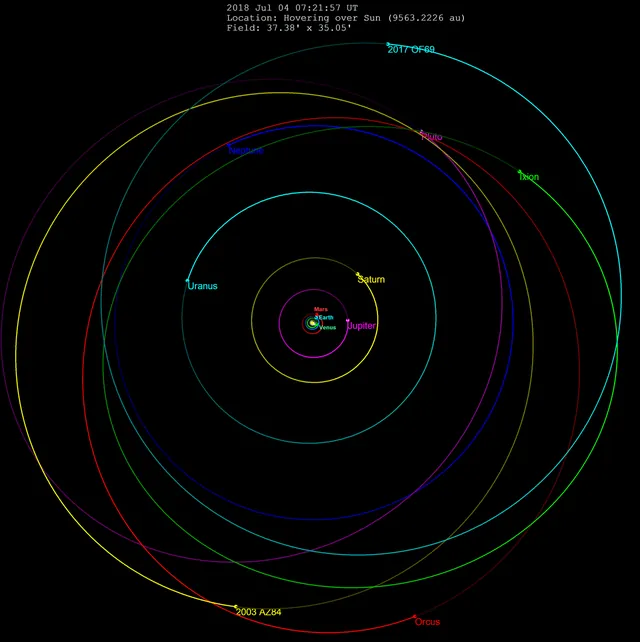
Orcus is a plutino: like Pluto, it is held in a resonance with Neptune, completing two orbits of the Sun for every three of Neptune’s. Its fairly elongated path carries it from 30.7 au to 48.1 au from the Sun every 247 years, and its eccentricity and its tilt of 20.6° to the plane of Earth’s orbit are both similar to Pluto’s.234
The two worlds move to the same rhythm but out of step. Orcus is at its farthest from the Sun when Pluto is at its nearest, and the far end of its orbit points in nearly the opposite direction to Pluto’s, which is why it is often called the anti-Pluto. According to JPL’s orbit, Orcus passed its farthest point around 2020 and will next be closest to the Sun around 2143.34
Discovery and naming
Michael Brown, Chad Trujillo and David Rabinowitz discovered Orcus on 17 February 2004 at Palomar Observatory. It was one of the largest trans-Neptunian objects found in wide-field surveys at Palomar between 2002 and 2007, alongside Quaoar, Eris, Makemake, Haumea, Sedna and Gonggong. Its provisional designation was 2004 DW, and it became minor planet number 90482.310
The name continues the Pluto parallel. Orcus was the Roman god of death, a counterpart of the Greek Pluto, who collected the dead and carried them to the underworld he ruled, and the anti-Pluto nickname weighed heavily in choosing it. Its moon was later named Vanth, a winged figure in Etruscan mythology who guides the dead to the underworld and is often shown beside Charun.348
What the surface is made of
Infrared spectra show a surface rich in water ice, mostly in its ordered crystalline form. A weak absorption near 2.2 micrometres has been linked to methane, ammonia or ammonium. Ammonia would be striking, because radiation should destroy it on short timescales, so its presence would require fresh material from impacts or, more likely, cryovolcanism, eruptions of icy material from inside.6
Using ESO’s Very Large Telescope with adaptive optics, a 2011 study set upper limits of about 2 per cent methane and 5 per cent ethane, and since methane alone cannot explain the 2.2-micrometre band it suggested a couple of per cent ammonia. Models of how Orcus and Vanth have evolved suggest the interior holds only about 20 to 30 per cent rock by mass, with as much organic material: a make-up much like that of comets.69
Vanth
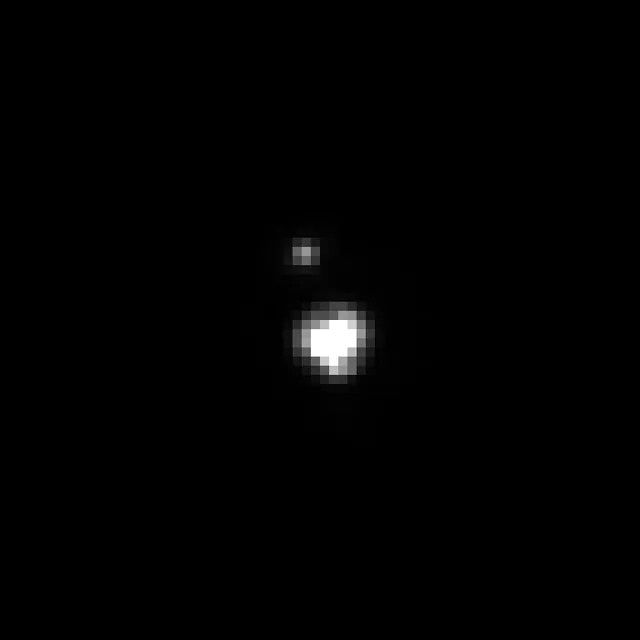
Michael Brown and T.-A. Suer found Vanth in Hubble images taken on 13 November 2005, about a quarter of an arcsecond from Orcus, and announced it in February 2007. It follows a nearly circular orbit, seen almost face-on from Earth, at about 8,980 km from Orcus, taking 9.539 days per circuit.57
Vanth is unusually large for the moon of a big Kuiper belt object. ALMA measurements give a diameter of 475 ± 75 km, and a stellar occultation on 7 March 2017 that Vanth, not Orcus, happened to cause limits it to 443 ± 10 km if it is round. Darker than Orcus, with an albedo of 0.08 and no water-ice band, it looks like an ordinary Kuiper belt object of its size rather than an icy fragment.125
How the pair formed is still open. A giant impact like the one thought to have made Pluto’s moon Charon, followed by tidal widening of the orbit, fits what is seen, but so does the capture of a passing body. Orcus also still spins much faster than Vanth orbits, so unlike Pluto and Charon the two have not settled into keeping the same faces towards each other.359
Observing Orcus
Orcus has been studied with telescopes on the ground and in space. Hubble found and tracked Vanth, Spitzer and Herschel measured the pair’s combined heat, and in October and November 2016 ALMA made the first observations to separate the two at thermal wavelengths. The Very Large Telescope used a lucky close pass of Orcus by a bright star to steer its adaptive optics and take separate spectra of Orcus and Vanth.156
Observers at five sites in North and South America tried to catch Orcus passing in front of a star on 7 March 2017. Two saw the star disappear, but speckle imaging with the 8.1-metre Gemini South telescope then showed that the target was a double star and that both events had been caused by Vanth. No rings or other material were found near Vanth or more than about 8,000 km from Orcus.2
- First resolved thermal images
- ALMA, 20161
Quick answers
- How big is Orcus?
- Orcus has a mean radius of about 455 km (diameter 910 km (+50/−40 km), from its heat emission).1
- How massive is Orcus?
- Orcus has a mass of 6.32 × 10²⁰ kg (Orcus and Vanth together; Vanth’s share is uncertain).5
- How dense is Orcus?
- Orcus has a mean density of about 1.4–2.0 g/cm³ (depends on Vanth’s unknown density).1
- How long is a day on Orcus?
- A day on Orcus lasts 13.19 hours (from its light curve; studies disagree).3
- How long is a year on Orcus?
- A year on Orcus lasts 247 Earth years (about 90,300 days).3
- How far is Orcus from the Sun?
- Orcus is 39.4 au from the Sun (about 5.9 billion km on average; between 30.7 and 48.1 au).3
- When was Orcus discovered?
- Orcus was discovered on 17 February 2004, by Michael Brown, Chad Trujillo and David Rabinowitz at Palomar Observatory.3
Sources
- Medium-sized satellites of large Kuiper belt objects (Brown and Butler) — The Astronomical Journal, 2018
- A stellar occultation by Vanth, a satellite of (90482) Orcus (Sickafoose et al.) — Icarus, 2019
- Small-Body Database Lookup: 90482 Orcus (2004 DW) — NASA/JPL Solar System Dynamics
- The dwarf planet Orcus (Matt Williams, Universe Today) — Phys.org, 2015
- The size, density, and formation of the Orcus–Vanth system in the Kuiper belt (Brown et al.) — The Astronomical Journal, 2010
- Integral-field spectroscopy of (90482) Orcus–Vanth (Carry et al.) — Astronomy & Astrophysics, 2011
- IAU Circular 8812: Satellites of 2003 AZ84, (50000), (55637) and (90482) — Central Bureau for Astronomical Telegrams, 2007
- Minor Planet Circulars, batch of 30 March 2010: (90482) Orcus I = Vanth — IAU Minor Planet Center, 2010
- Low rock mass fraction within trans-Neptunian objects inferred from the spin–orbit evolution of Orcus–Vanth and Salacia–Actaea (Arakawa et al.) — Journal of Geophysical Research: Planets, 2025
- Trans-Neptunian Space and the Post-Pluto Paradigm (Parker) — arXiv, 2021
Figures checked against these sources in November 2026. Where a quantity is not known, it is left out rather than estimated.

