asteroid
Apophis
Apophis is a stony near-Earth asteroid about 340 m across, discovered from Kitt Peak in Arizona on 19 June 2004. For a few days that December it scored higher on the Torino hazard scale than any asteroid before it, with a small but real chance of hitting Earth in 2029. Further tracking ruled that out, and since 2021 NASA has been confident that it poses no risk for at least 100 years.1234
On 13 April 2029 Apophis will sweep past Earth about 32,000 km above the surface, closer than many geosynchronous satellites, and should be visible to the naked eye from the Eastern Hemisphere, including Europe and Africa. An asteroid this large comes so close only once every few thousand years. NASA’s OSIRIS-APEX spacecraft is on its way to study the aftermath, and the European–Japanese Ramses mission is being built to fly alongside it.14567
Size and physical properties
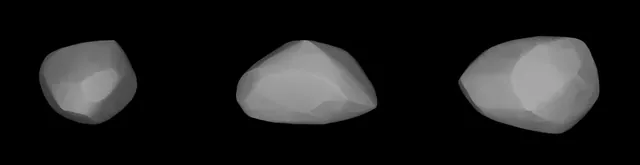
Radar observations in 2012–2013 gave Apophis a mean diameter of 340 m, give or take 40 m, with a long axis at least 450 m long. NASA compares its size to the height of the Eiffel Tower. ESA quotes a slightly larger width of 375 m. Radar hints that it is elongated and may have two lobes, like a peanut, but its exact shape is still unknown.1245
Its mass and density have not yet been measured; spacecraft at Apophis will map its gravity field to find out. The surface is fairly bright, reflecting about 35 per cent of the light that falls on it. There are no close-up pictures yet, but NASA expects it to resemble other stony asteroids such as Itokawa.129
Orbit and rotation
Apophis circles the Sun in about 324 days, on an orbit that carries it from 0.75 au, almost as close as Venus, out to 1.10 au, so it crosses Earth’s path twice each lap. With a year shorter than ours, it belongs to the Aten group. The 2029 encounter will stretch its orbit to a period of about 1.2 years, moving it into the Apollo group.123
Apophis does not spin neatly. It tumbles end over end roughly once every 31 hours, while rocking back and forth about its long axis over about 264 hours, a state called non-principal-axis rotation. Earth’s gravity in 2029 is expected to change both the speed and the direction of this spin.12
Discovery, alarm and all-clear
Roy Tucker, David Tholen and Fabrizio Bernardi found the asteroid on 19 June 2004 with the 2.3 m Bok telescope at Kitt Peak, but could follow it for only two nights. It was picked up again from Siding Spring in Australia in December 2004, and the link to the June sightings revealed that it would pass close to Earth on 13 April 2029, with a chance of impact.13
On 23 December 2004 the odds stood at about 1 in 300, the first object ever to reach level 2 on the Torino hazard scale. A day later they rose to about 1.6 per cent, level 4. On 27 December, older Spacewatch images from March 2004 lengthened the record enough to rule out a 2029 impact. Later observations removed a 2036 risk, and radar measurements in March 2021 eliminated the last, small chance of a hit in 2068.3410
Then known as 2004 MN4, it was numbered 99942 and in 2005 named Apophis, the Greek name for Apep, the ancient Egyptian god of evil and destruction. Tholen says the discoverers also knew the villain of that name in the television series Stargate SG-1, but that the asteroid was not named after him.12
Composition
Apophis is an S-type, or stony, asteroid made of silicate rock mixed with metallic nickel and iron. Infrared spectra taken with NASA’s Infrared Telescope Facility in 2013 match LL chondrites, a common kind of stony meteorite, with a likelihood above 99 per cent. Its most likely birthplace is the inner main asteroid belt, from which the gravity of the planets, chiefly Jupiter, gradually steered it into Earth’s neighbourhood over millions of years.168
The 2029 close approach
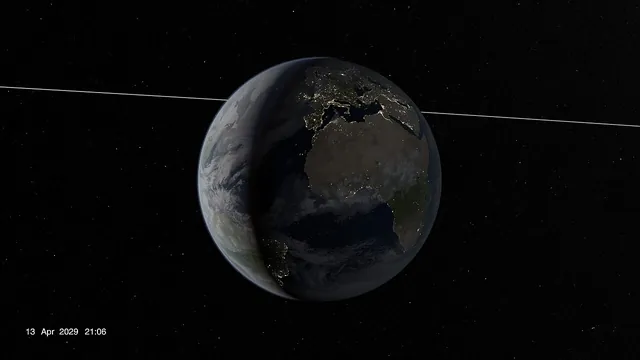
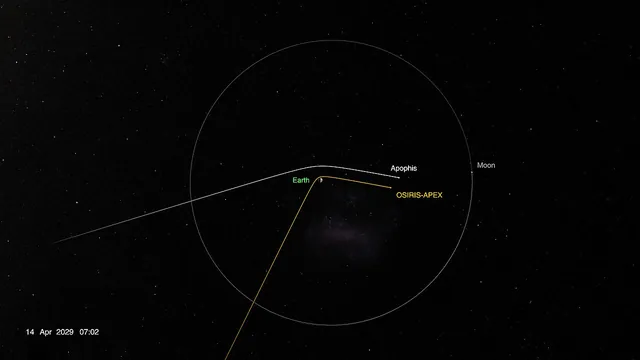
At about 21:45 UT on 13 April 2029, Apophis will pass about 38,000 km from Earth’s centre, or roughly 32,000 km above the surface, at about 7.4 km/s. That is inside the ring of geosynchronous satellites, about 36,000 km up. No other asteroid this large has been known in advance to come so close, and the event is likely without precedent in recorded history.124
Weather permitting, Apophis will be visible without a telescope or binoculars from the Eastern Hemisphere, including Europe and Africa. Earth’s tides will pull, twist and squeeze the asteroid, probably changing its spin and perhaps setting off small landslides on steep slopes. Watching how it responds will reveal what it is like inside.145
- Date and time
- 13 April 2029, about 21:45 UT2JPL’s solution gives 21:46 TDB
Exploration
Radar has done most of the close study so far. In March 2021, with Apophis 17 million km away, NASA’s 70 m Goldstone dish and the 100 m Green Bank Telescope imaged it at 38.75 m per pixel and pinned down its distance to about 150 m. Telescopes worldwide will watch the 2029 flyby, but for hours afterwards Apophis will be too close to the Sun in the sky for optical telescopes.49
NASA’s OSIRIS-REx, which delivered samples of asteroid Bennu to Earth in September 2023, was renamed OSIRIS-APEX and redirected to Apophis. It swung past Earth on 23 September 2025 and is due to reach Apophis in June 2029 for an 18-month survey, including a dip to within about 5 m of the surface to fire its thrusters and stir up dust and rocks.69
ESA and the Japanese space agency JAXA are building Ramses, the Rapid Apophis Mission for Space Safety, to meet the asteroid before the flyby and travel alongside it. The spacecraft was switched on for the first time in September 2026; it must launch on a Japanese H3 rocket in spring 2028, carrying two small CubeSats.579
- OSIRIS-APEX Earth flyby
- 23 September 202563,438 km from Earth
- OSIRIS-APEX arrival
- June 20296918-month campaign planned
- Ramses arrival
- February 20299planned, two months before the flyby
- Radar imaging, March 2021
- 38.75 m per pixel4at 17 million km
Quick answers
- How big is Apophis?
- Apophis has a mean radius of about 170 m (mean diameter 340 m; at least 450 m along its longest axis).12
- How long is a day on Apophis?
- A day on Apophis lasts 30.56 hours (it tumbles, with a slower wobble of about 264 hours).12
- How long is a year on Apophis?
- A year on Apophis lasts 0.89 Earth years (324 days; about 1.2 years after the 2029 flyby).12
- How far is Apophis from the Sun?
- Apophis is 0.92 au from the Sun (about 138 million km on average; 0.75 to 1.10 au).2
Sources
- Apophis Facts — NASA Science
- Small-Body Database Lookup: 99942 Apophis (2004 MN4) — NASA/JPL Solar System Dynamics, 2024
- Near-Earth Asteroid 2004 MN4 Reaches Highest Score To Date On Hazard Scale — NASA/JPL Center for Near-Earth Object Studies, 2004
- NASA Analysis: Earth Is Safe From Asteroid Apophis for 100-Plus Years — NASA Jet Propulsion Laboratory, 2021
- Ramses: ESA’s mission to rendezvous with asteroid Apophis — ESA
- OSIRIS-APEX — NASA Science
- First switch on for ESA-JAXA Ramses asteroid mission — ESA, 2026
- Surface Composition of (99942) Apophis — The Astronomical Journal, 2018
- Apophis Exploration — NASA Science
- Possibility of an Earth Impact in 2029 Ruled Out for Asteroid 2004 MN4 — NASA/JPL Center for Near-Earth Object Studies, 2004
Figures checked against these sources in November 2026. Where a quantity is not known, it is left out rather than estimated.

