planet
Venus
Venus is the second planet from the Sun and the one that comes closest to Earth. It is almost Earth’s twin in size, with 95 per cent of its radius and 82 per cent of its mass, yet its surface is the hottest of any planet: about 464 °C, beneath a carbon dioxide atmosphere that presses down with 92 times the pressure of the air at sea level on Earth.12
Unbroken clouds of sulphuric acid hide the ground, so the surface has been mapped by radar: plains of lava, thousands of volcanoes and remarkably few impact craters. Venus also turns backwards, and very slowly. One rotation takes 243 Earth days, longer than its 225-day year, and the Sun rises in the west. It has no moons and no rings.123
Size and physical properties
Venus is the planet most like Earth in bulk. Its radius is 6,051.8 km, only 319 km less than Earth’s mean radius, and it has 81.5 per cent of Earth’s mass and 86 per cent of its volume. Gravity at the surface is about nine-tenths of what we feel at home, and the mean density is within 5 per cent of Earth’s.1
It is also almost perfectly round: NASA’s fact sheet gives the same radius at the equator and the poles and a flattening of zero. The clouds reflect about 77 per cent of the sunlight that falls on them, which helps make Venus the third brightest object in our sky after the Sun and the Moon, reaching magnitude −4.8.12
- Equatorial radius
- 6,051.8 km1
- Polar radius
- 6,051.8 km1
- Mean radius
- 6,051.8 km1Earth: 6,371.0 km
- Flattening
- 0.0001
- Mass
- 4.8673 × 10²⁴ kg10.815 Earths
- Volume
- 9.2843 × 10¹¹ km³10.857 Earths
- Mean density
- 5,243 kg/m³1Earth: 5,513
- Gravity
- 8.87 m/s²1at the surface; 0.903 × Earth
- Escape velocity
- 10.36 km/s1
- Range of surface heights
- 13 km1lowest to highest point
- Geometric albedo
- 0.6891
- Bond albedo
- 0.771
Orbit and rotation
Venus circles the Sun at 0.72 of Earth’s distance on an almost circular path: its distance from the Sun changes by less than 1.5 million km over an orbit. Sunlight takes about six minutes to arrive. One orbit takes 224.7 Earth days, and Venus passes between Earth and the Sun about every 584 days, when it can come within 38.2 million km of us.12
The planet rotates backwards compared with Earth and most other planets, once in 243.03 Earth days by NASA’s fact sheet, so a single turn outlasts the year. Because the spin and the orbit run in opposite directions, the Sun crosses the sky faster than that: a solar day, from one sunrise to the next, lasts 116.75 Earth days, and the Sun rises in the west.12
The rotation is not perfectly steady. Radar observations made from Earth between 2006 and 2020 gave an average of 243.0226 days and showed the period varying by about 20 minutes, which implies that the heavy atmosphere is trading momentum with the solid planet. The axis is tilted only 2.64° from upright, too little to produce noticeable seasons.24
- Orbital period
- 224.701 days10.615 years
- Mean orbital speed
- 35.02 km/s1
- Orbital eccentricity
- 0.00681
- Orbital inclination
- 3.395°1to Earth’s orbit
- Rotation period
- 5,832.6 hours1243.025 days, backwards (retrograde)
- Average rotation period, 2006–2020
- 243.0226 ± 0.0013 days4from Earth-based radar
- Length of day
- 2,802.0 hours1116.75 Earth days, sunrise to sunrise
- Speed of rotation at the equator
- 1.81 m/s16.5 km/h; derived from the radius and rotation period
- Axial tilt
- 177.36°1the equator is inclined 2.64° to the orbit
- Brightest in our sky
- magnitude −4.81
Discovery and naming
Venus is the brightest object in the night sky after the Moon and has been known since prehistoric times, so it has no discoverer. Ancient observers took its morning and evening appearances for two separate bodies. It is named after the Roman goddess of love and beauty, and most of the features on its surface are named after women, real and mythical.12
Through a telescope Venus shows phases like the Moon’s, in a cycle lasting 584 days. Galileo was the first to observe them, and they showed him that Venus orbits the Sun, not Earth: key evidence for the Copernican system. Venus also crosses the face of the Sun as seen from Earth, but rarely. The last pair of transits fell on 8 June 2004 and 6 June 2012; the next are due on 11 December 2117 and 8 December 2125.256
Atmosphere and weather
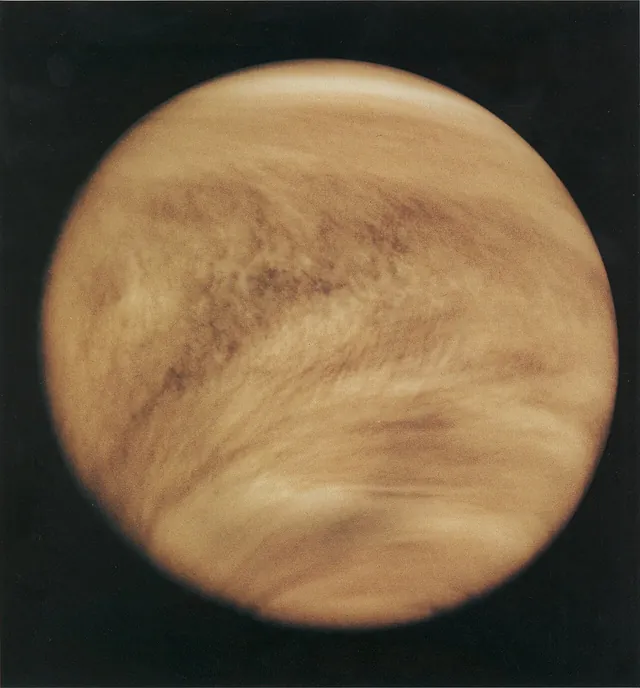
The atmosphere is 96.5 per cent carbon dioxide and 3.5 per cent nitrogen, and there is a great deal of it: about 4.8 × 10²⁰ kg, pressing on the surface at 92 bars. The carbon dioxide traps heat in a runaway greenhouse effect that holds the surface at an average of 464 °C, hotter than Mercury, with almost no difference between day and night.12
The clouds are made of sulphuric acid particles, not water. Those seen from space lie about 60 km above the ground, at a height where pressure and temperature are similar to those at Earth’s surface. They look mostly white, but in ultraviolet light dark streaks stand out. Something in them absorbs blue and ultraviolet light, and nobody has yet established what it is.27
At cloud level the whole atmosphere streams westwards around the planet in about four Earth days, some 60 times faster than the ground beneath it turns. This is called super-rotation. Winds reach about 100 metres per second at the cloud tops but only about one metre per second at the surface. In 2020 a team using data from Japan’s Akatsuki orbiter showed that thermal tides, set up by daytime heating, help to keep it going.1789
- Carbon dioxide
- 96.5%1near the surface, by volume
- Nitrogen
- 3.5%1
- Sulphur dioxide
- 150 parts per million1
- Argon
- 70 parts per million1
- Water vapour
- 20 parts per million1
- Surface pressure
- 92 bars1
- Average surface temperature
- 737 K (464 °C)1
- Density of the air at the surface
- about 65 kg/m³1
- Total mass of the atmosphere
- about 4.8 × 10²⁰ kg1
- Scale height
- 15.9 km1
- Wind speed at the surface
- 0.3–1.0 m/s1
- Wind speed at the cloud tops
- about 100 m/s7360 km/h
Surface and geology
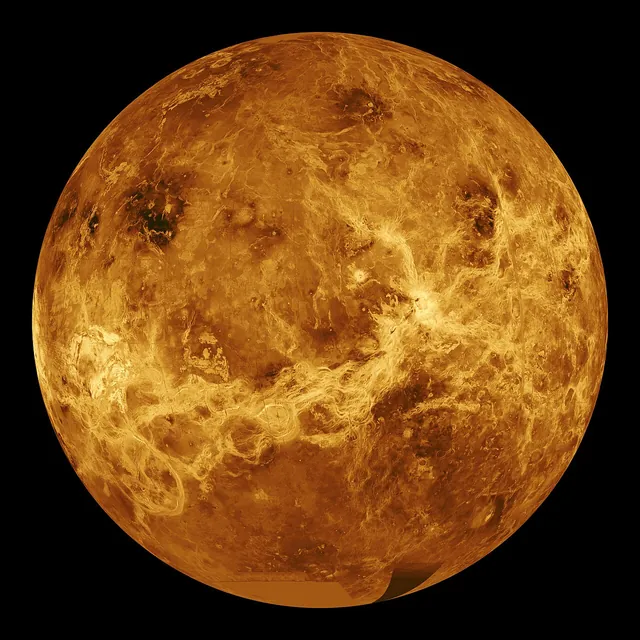
Radar is the only way to see the ground from orbit. NASA’s Magellan spacecraft mapped 98 per cent of the surface between 1990 and 1992 and found that at least 85 per cent of it is covered by volcanic flows. There are broad lava plains, thousands of volcanoes, long lava channels and highlands the size of continents. Magellan saw no sign of the drifting continents that reshape Earth.23
Impact craters are scarce: only about 900 are known, and apart from Earth no rocky planet has fewer. That makes the surface young. Its average age may be as little as 150 million years. Some models have the whole planet flooded with lava about half a billion years ago, while newer ones suggest it was renewed piece by piece. With no water, erosion is extremely slow.231011
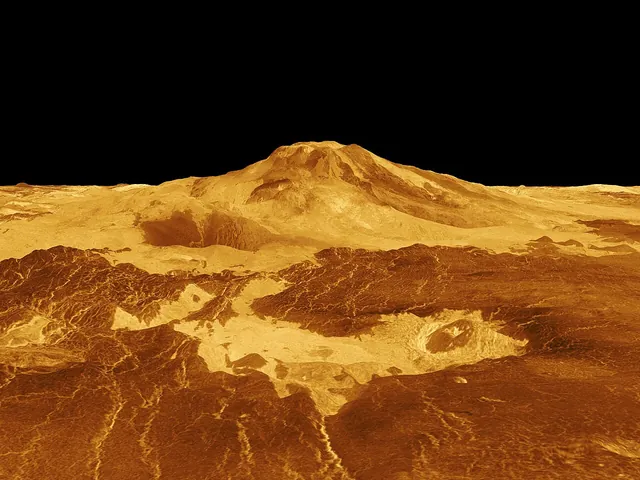
Signs that volcanoes still erupt have accumulated. Venus Express found lava flows judged less than 2.5 million years old, swings in sulphur dioxide above the clouds, and hot spots that flared along the Ganiki Chasma rift. In 2023, Magellan images taken eight months apart in 1991 were shown to record a vent on Maat Mons changing shape and growing. A 2024 study found new lava flows on Sif Mons and in Niobe Planitia.111213
What hides inside
Venus is thought to be built much like Earth: an iron core, a mantle of hot rock and a thin rocky crust. Its size and its mean density, 5,243 kg/m³ against Earth’s 5,513, point to a similar make-up. That picture rests largely on the comparison with Earth, because direct measurements of the interior of Venus are few.12
The best constraint so far, published in 2021, comes from tracking the planet’s spin by radar from Earth. It gave a moment of inertia factor of 0.337 ± 0.024, a measure of how strongly the mass is concentrated towards the centre. The uncertainty is wide, and the authors say the result yields only a rough estimate of the size of the core.4
Heat escaping from the interior is the likely driver of the volcanism, and plumes of hot mantle rock appear to rise beneath many of the ring-shaped coronae. Whether Venus ever had plate tectonics like Earth’s, and whether one of its first steps, the sinking of crust into the mantle, is happening today, are open questions that the planned radar orbiters are meant to answer.2111415
- Mean density
- 5,243 kg/m³1
Magnetic field
Venus does not generate a magnetic field of its own, even though it is thought to have an iron core similar in size to Earth’s. Mariner 2 detected no field as it flew past in 1962, though it passed at a great distance, and Pioneer Venus 1 later confirmed from orbit that the planet has little magnetic field, if any.21617
It does have an induced field. Sunlight ionises the top of the atmosphere, and the solar wind, which carries the Sun’s magnetic field with it, runs into this electrically charged layer. The result is a weak magnetic envelope drawn out behind the planet like the tail of a comet. The upper atmosphere is also leaking away: Venus Express measured twice as many hydrogen atoms as oxygen atoms escaping, a sign that water is being broken apart.28
Notable features
Maxwell Montes
The highest mountains on Venus, rising about 10.8 km above the planet’s mean surface, which is taller than Mount Everest. The range is 797 km across. It is named after the British physicist James C. Maxwell, an exception on a planet where most features are named after women.21718
Ishtar Terra and Aphrodite Terra
The two best-known highlands. Ishtar Terra, in the far north, is about the size of Australia and is listed as 5,610 km across. Aphrodite Terra, roughly the size of South America, stretches some 10,000 km along the equator. They are named after the Babylonian and Greek goddesses of love.218
Maat Mons
A volcano 395 km across whose peak stands 8 km above the mean surface, with lava flows running for hundreds of kilometres over the plains at its foot. A vent associated with it, at first less than 2.2 km² in area, changed shape and grew between February and October 1991.121819
Coronae
Oval features ringed by fractures, known in their hundreds and thought to mark places where plumes of hot rock rise from the mantle. A 2025 study of Magellan data found signs of such plumes beneath 52 of the 75 coronae it examined. The largest in the Gazetteer, Artemis Corona, is 2,600 km across.1418
Tesserae
Terrain creased by intricate patterns of ridges and grooves. Fortuna Tessera, one of the largest named examples, spans 2,801 km. NASA’s DAVINCI probe is to descend over Alpha Regio, a mountainous region 1,897 km across that may be among the oldest surfaces on Venus.21820
Mead crater
The largest impact crater known on Venus: 270 km across in the Gazetteer, 275 km in NASA’s original caption. It has more than one ring, and its flat floor was probably filled in by impact melt or volcanic lava. It is named after the American anthropologist Margaret Mead.1821
Exploration
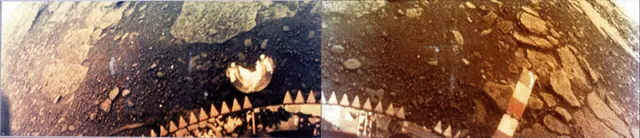
NASA’s Mariner 2 made the first successful visit to another planet, passing 34,854 km from Venus on 14 December 1962 and finding it far hotter than expected. The Soviet Venera landers then reached the ground. Venera 7 sent the first data from the surface of another planet on 15 December 1970, Venera 9 the first pictures on 22 October 1975, and Venera 13 the first colour images on 1 March 1982, surviving for 127 minutes.1622232425
Mariner 10 photographed the clouds in February 1974 on its way to Mercury. Pioneer Venus 1 orbited from December 1978 until October 1992 and mapped most of the surface by radar, while Pioneer Venus 2 sent four probes into the atmosphere on 9 December 1978. Magellan, launched on 4 May 1989, orbited from 10 August 1990 until 13 October 1994 and produced the radar maps still in use today.3172627
ESA’s Venus Express, launched on 9 November 2005, studied the atmosphere from April 2006 until its propellant ran out late in 2014. Japan’s Akatsuki, launched on 21 May 2010, entered orbit in December 2015; contact was lost in April 2024 and JAXA ended the mission on 18 September 2025. Three missions are planned: NASA’s VERITAS radar orbiter, NASA’s DAVINCI flyby craft and descent probe, and ESA’s EnVision orbiter.81528293031
- First flyby
- Mariner 2, 14 December 196216
- First data from the surface
- Venera 7, 15 December 197023
- First pictures from the surface
- Venera 9, 22 October 197524
- Global radar mapping
- Magellan, 1990–19943
- Most recent orbiter
- Akatsuki, ended 18 September 202529
- EnVision launch
- November 203131ESA; back-up dates in 2032 and 2033
Quick answers
- How big is Venus?
- Venus has a mean radius of 6,051.8 km (0.950 × Earth).1
- How massive is Venus?
- Venus has a mass of 4.8673 × 10²⁴ kg (0.815 × Earth).1
- How long is a day on Venus?
- A day on Venus lasts 243.03 Earth days (one backward rotation; sunrise to sunrise takes 116.75 Earth days).1
- How long is a year on Venus?
- A year on Venus lasts 224.7 Earth days.1
- How far is Venus from the Sun?
- Venus is 108.2 million km from the Sun (0.72 au on average).1
- How fast does Venus move through space?
- Venus moves along its orbit at 35.02 km/s (mean).1
- What is Venus’ axial tilt?
- Venus’ axis is tilted by 177.36° (spinning backwards, 2.64° from upright).1
- What is the temperature on Venus?
- The temperature on Venus is 464 °C (average at the surface).1
- How many moons does Venus have?
- Venus has no known moons.1
- What is Venus made of?
- Venus is made of rock and iron.2
Sources
- Venus Fact Sheet — NASA Space Science Data Coordinated Archive, 2024
- Venus: Facts — NASA Science
- Magellan — NASA Science
- Spin state and moment of inertia of Venus — Nature Astronomy, 2021
- Galileo’s Observations of the Moon, Jupiter, Venus and the Sun — NASA Science
- 2004 and 2012 Transits of Venus — NASA Goddard Space Flight Center
- Venus from Mariner 10 (PIA23791) — NASA/JPL Photojournal, 2020
- Venus Express goes gently into the night — European Space Agency
- How waves and turbulence maintain the super-rotation of Venus’ atmosphere — JAXA Institute of Space and Astronautical Science, 2020
- Venus Crater Database — Lunar and Planetary Institute
- Hot lava flows discovered on Venus — European Space Agency
- NASA’s Magellan Data Reveals Volcanic Activity on Venus — NASA Jet Propulsion Laboratory, 2023
- Ongoing Venus Volcanic Activity Discovered With NASA’s Magellan Data — NASA Jet Propulsion Laboratory, 2024
- NASA’s Magellan Mission Reveals Possible Tectonic Activity on Venus — NASA Jet Propulsion Laboratory, 2025
- VERITAS — NASA Science
- Mariner 2 — NASA Science
- Pioneer Venus 1 — NASA Science
- Gazetteer of Planetary Nomenclature: Venus — International Astronomical Union and US Geological Survey
- Venus - 3D Perspective View of Maat Mons (PIA00106) — NASA/JPL Photojournal
- DAVINCI — NASA Science
- Venus - Mead Crater (PIA00148) — NASA/JPL Photojournal
- Venus: Exploration — NASA Science
- Venera 7 — NASA Space Science Data Coordinated Archive
- Venera 9 Descent Craft — NASA Space Science Data Coordinated Archive
- Venera 13 Descent Craft — NASA Space Science Data Coordinated Archive
- Mariner 10 — NASA Science
- Pioneer Venus 2 — NASA Science
- Venus Express — European Space Agency
- Venus Climate Orbiter “AKATSUKI” Operation Completed — Japan Aerospace Exploration Agency, 2025
- DAVINCI Probe — NASA Space Science Data Coordinated Archive
- EnVision: Mission description — European Space Agency
- VERITAS — NASA Space Science Data Coordinated Archive
- The DAVINCI Mission — NASA Goddard Space Flight Center
Figures checked against these sources in November 2026. Where a quantity is not known, it is left out rather than estimated.

