planet
Saturn
Saturn is the sixth planet from the Sun and the second largest in the Solar System: a ball of hydrogen and helium nine times as wide as Earth and 95 times as massive. It is the least dense of the planets, lighter on average than water, and the most flattened, bulging visibly at the equator as it spins once in under eleven hours.123
What sets Saturn apart is its rings: a broad, bright disc of water-ice fragments more than 270,000 km across, yet typically only about ten metres thick. Around them orbit 293 known moons, more than any other planet has. They include Titan, the only moon with a dense atmosphere, and Enceladus, which sprays water from a buried ocean into space.45678
Size and physical properties
Saturn could hold almost 764 Earths, yet it has only 95 times Earth’s mass. Its mean density of 687 kg per cubic metre is the lowest of any planet and the only one below that of water, because Saturn is made almost entirely of hydrogen and helium and has a vast, distended outer layer.123
Low density and fast rotation together make it the most flattened planet. The equator lies 5,904 km farther from the centre than the poles, a difference of almost 10 per cent that is plain to see in photographs. Because there is no ground to measure from, sizes and gravity are quoted at the level in the atmosphere where the pressure equals one bar.1310
- Equatorial radius
- 60,268 km1at the 1-bar level
- Polar radius
- 54,364 km1
- Mean radius
- 58,232 km1
- Flattening
- 0.097961
- Mass
- 5.6832 × 10²⁶ kg195.16 Earths
- Volume
- 8.2713 × 10¹⁴ km³1764 Earths
- Mean density
- 687 kg/m³1Earth: 5,513; water: 1,000
- Gravity
- 11.19 m/s²1mean, at the 1-bar level
- Gravity felt at the equator
- 8.96 m/s²1reduced by the planet’s spin
- Gravity felt at the poles
- 12.14 m/s²1
- Escape velocity
- 35.5 km/s1
- Geometric albedo
- 0.4991
- Bond albedo
- 0.3421
Orbit and rotation
Saturn orbits at about nine and a half times Earth’s distance from the Sun. Out there sunlight takes 80 minutes to arrive and is only about 1 per cent as strong as at Earth. One circuit takes 29.45 Earth years.12
The day is hard to measure. Saturn has no solid surface, its cloud bands move at different speeds, and its magnetic field is so nearly aligned with the spin axis that it gives no clear rotating signal. Voyager radio data gave 10 hours 39 minutes, the 10.656 hours used in the tables here. Radio periods measured by Cassini wandered between about 10 hours 36 and 10 hours 48 minutes. In 2019, waves raised in the rings by vibrations inside the planet gave 10 hours 33 minutes 38 seconds.1911
The axis is tilted by 26.73 degrees, a little more than Earth’s, so Saturn has seasons, each lasting about seven Earth years. At each equinox the Sun lies edge-on to the rings: this happened on 11 August 2009 and again on 6 May 2025. Around the same time Earth passes through the plane of the rings, most recently on 23 March 2025, and the rings, seen edge-on, all but vanish in a small telescope.151213
- Orbital period
- 10,755.699 days129.447 years
- Mean orbital speed
- 9.67 km/s1
- Orbital eccentricity
- 0.05201
- Orbital inclination
- 2.486°1to Earth’s orbit
- Rotation period
- 10.656 hours1System III, from Voyager radio data
- Rotation period from ring waves
- 10 h 33 min 38 s9Cassini data, published 2019
- Speed of rotation at the equator
- 9.87 km/s135,500 km/h; derived from the equatorial radius and the 10.656-hour period
- Axial tilt
- 26.73°1
- Length of a season
- about 7 Earth years12
- Brightest in our sky
- magnitude −0.551at opposition, including the rings
Discovery and naming
Saturn is easy to see with the naked eye and has been known since ancient times, so it has no discoverer. It is the most distant planet found without a telescope. The oldest surviving written records of it are Assyrian, from about 700 BCE. It is named after the Roman god of agriculture and wealth, the father of Jupiter.1214
Galileo Galilei turned his telescope on Saturn in July 1610 and saw what looked like a triple planet, with a large companion on either side. Two years later the companions had vanished, because the rings were edge-on; then they returned, and he came to think of them as arms. Christiaan Huygens, who discovered Titan in 1655, announced in 1659 that Saturn is surrounded by a thin, flat ring that nowhere touches the planet.3614
Giovanni Domenico Cassini found four more moons, Iapetus in 1671, Rhea in 1672 and Tethys and Dione in 1684, and in 1675 the gap in the rings that bears his name. In the nineteenth century James Clerk Maxwell proved that the rings could not be a single sheet but must consist of countless small particles, each circling Saturn like a tiny moon, which the observations of James Keeler confirmed.3615
Atmosphere and weather
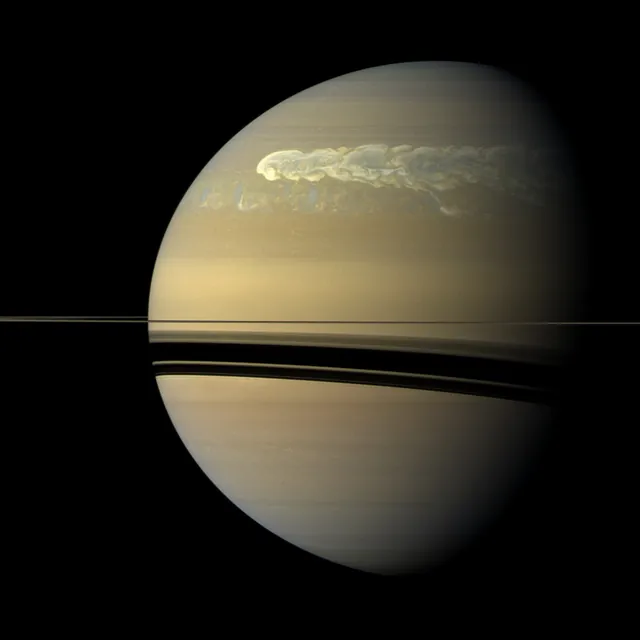
The atmosphere is about 96 per cent hydrogen and 3 per cent helium by volume, with traces of methane, ammonia and other gases. Saturn’s bands are fainter than Jupiter’s, in shades of yellow, brown and grey, but its winds are faster: 400 to 500 metres per second near the equator, about four times the speed of the strongest hurricane winds on Earth.12
Storms come in bursts. Thunderstorms such as the Dragon Storm of 2004 flare up in a southern band nicknamed storm alley, and Cassini picked up the radio crackle of their lightning. Roughly once every Saturn year, about 30 Earth years, a far larger outbreak called a Great White Spot erupts and spreads right round the planet. Why Saturn stores up energy for decades and then releases it all at once is not known.161718
Around the north pole a jet stream traces a six-sided pattern, the hexagon, first noticed in Voyager images from the early 1980s. For decades nothing similar was known in the south, but NASA reports that Hubble Space Telescope observations dating back to 2023, published in September 2026, show a giant ten-sided wave circling the south pole.2
What hides inside
Saturn has no true surface. Going down, the gas grows denser and hotter until the hydrogen becomes a liquid and then, under still greater pressure, a liquid metal. Material circulating in this fluid interior generates the magnetic field. Gravity measurements made during Cassini’s last orbits showed that the banded winds of the cloud tops reach at least 9,000 km down, about 15 per cent of the way to the centre and three times as deep as on Jupiter.21119
Saturn gives off more heat than it receives from the Sun, and more than a planet of its size should have left over from its formation. The favoured explanation is helium rain: deep inside, helium stops mixing with metallic hydrogen, forms droplets and sinks, releasing energy as it falls. This would also explain why the upper atmosphere is short of helium. Models predict that the helium has gathered into a helium-rich shell or core.320
The centre was long pictured as a compact ball of rock and metal; gravity data alone suggested a core of 15 to 18 Earth masses. Ripples raised in the rings by slow oscillations of the planet tell a different story. A 2021 analysis found a dilute, or “fuzzy”, core with no sharp edge: about 17 Earth masses of ice and rock mixed gradually into hydrogen and helium, spread across roughly 60 per cent of Saturn’s radius.2192122
Magnetic field and aurora
Saturn’s magnetic field is weaker than Jupiter’s but, by NASA’s reckoning, 578 times as powerful as Earth’s. Its oddity is its symmetry. Every other planetary magnetic field in the Solar System is tilted away from the planet’s spin axis; Saturn’s is tilted by less than 0.0095 degrees, as Cassini measured in its final orbits. Theories of how planets generate their fields say this should not be possible, and the alignment remains unexplained.224
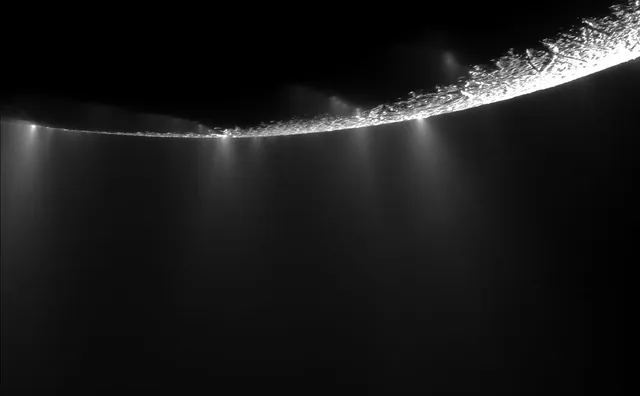
The field carves out a magnetosphere that encloses the rings and many of the moons; Titan spends about 95 per cent of its time inside it. Much of the electrically charged gas that fills it comes from Enceladus, whose plumes also feed the E ring. Aurorae form where charged particles spiral down into the atmosphere. Some, as on Jupiter, are powered by material from the moons and by the planet’s rapid spin rather than by the solar wind, but they are not fully understood.211
Notable features
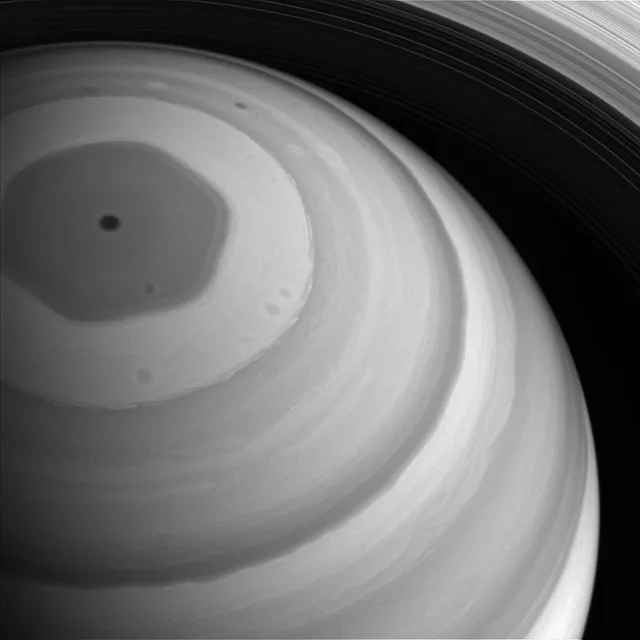
The north polar hexagon
A six-sided jet stream around the north pole, about 30,000 km across, with winds of roughly 320 km/h and a huge rotating storm at its centre. It was first noticed in Voyager images from the early 1980s and later studied closely by Cassini.2
The Great White Spot of 2010–2011
First seen on 5 December 2010 as a white spot about 1,300 km from north to south, it grew within three weeks to 10,000 km and by February 2011 had wrapped right round the planet. It was the largest, most intense storm that Voyager or Cassini recorded on Saturn, and its effects on the atmosphere lasted more than three years.171826
The Cassini Division
The gap about 4,700 km wide between the bright B and A rings, found by Cassini in 1675. It lies roughly 117,500 to 122,300 km from Saturn’s centre. It looks empty from Earth but is not: spacecraft showed it to be filled with thin, faint rings.241415
The F ring and its shepherd moons
A narrow ring 139,826 km from Saturn’s centre, just outside the A ring, discovered by Pioneer 11 in 1979. Two small moons flank it: Prometheus, orbiting at 139,353 km, and Pandora at 141,700 km. Prometheus confines the ring’s inner edge, while Pandora tends to disturb it.414272829
Ring spokes
Ghostly radial streaks that appear on the rings and turn with them, first seen by the Voyager spacecraft. They can be more than 16,000 km long yet form and fade within hours. They are thought to be tiny ice grains lifted by static electricity, and they appear in the years around each equinox.512
The Dragon Storm
A bright, tangled thunderstorm that flared up in mid-September 2004 in the southern band known as storm alley. Cassini linked it to bursts of radio static like those made by lightning on Earth. It appears to be a long-lived storm deep in the atmosphere that erupts from time to time.16
Rings and moons
The rings are almost entirely water ice, in pieces ranging from dust grains to boulders, with a few as big as mountains. Working outward from Saturn they are called D, C, B, A, F, G and E, lettered in order of discovery. The broad, bright main rings, C, B and A, span 74,658 to 136,780 km from the planet’s centre, yet are typically only about 10 metres thick. The faint E ring, fed by Enceladus, reaches out to 480,000 km.245
How old the rings are is disputed. Cassini’s final orbits weighed them at about 1.5 × 10¹⁹ kg, roughly 0.4 times the mass of Mimas. So little mass, and ice so clean, led the Cassini team to conclude that the rings formed only 10 to 100 million years ago. Other researchers argue that impacts and weathering can keep old rings looking clean, so they could be billions of years old. Meanwhile material is raining onto Saturn fast enough to empty the rings within 100 to 300 million years.19233031
Saturn has 293 known moons. Titan, with a radius of 2,575 km, is larger than the planet Mercury and has a dense, mostly nitrogen atmosphere above rivers, lakes and seas of liquid methane and ethane. Enceladus, about 500 km across, vents jets of water vapour and ice from a global ocean beneath its shell. Iapetus has one hemisphere as dark as coal and the other bright. Mimas bears Herschel, a crater 130 km across, a third of the moon’s own width.678273233
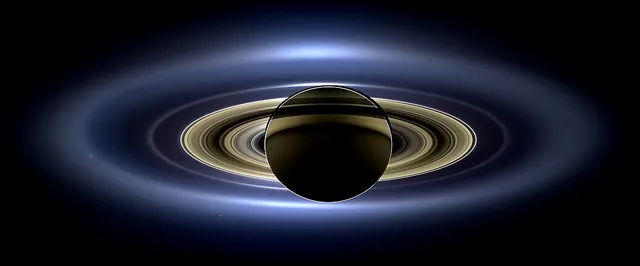
- D ring
- 66,900–74,510 km4distance from Saturn’s centre
- C ring
- 74,658–91,975 km4
- B ring
- 91,975–117,507 km4
- Cassini Division
- 117,507–122,340 km4between the B and A rings
- A ring
- 122,340–136,780 km4
- F ring
- 139,826 km4
- G ring
- 166,000–173,000 km4
- E ring
- 180,000–480,000 km4
- Mass of the rings
- 1.54 × 10¹⁹ kg230.41 ± 0.13 times the mass of Mimas
- Known moons
- 2936
Exploration
Four spacecraft have visited Saturn. Pioneer 11 was the first, passing about 21,000 km from the planet on 1 September 1979 and discovering the F ring. Voyager 1 followed on 12 November 1980 at a distance of 126,000 km, revealing thousands of ringlets and the thick atmosphere of Titan. Voyager 2 flew past at 101,000 km on 26 August 1981.14253435
Cassini–Huygens, a joint mission of NASA, the European Space Agency and the Italian space agency, was launched on 15 October 1997 and entered orbit around Saturn on 1 July 2004. The Huygens probe landed on Titan on 14 January 2005, the first landing on a world in the outer Solar System. Cassini went on to study the planet, its rings and its moons for 13 years, discovering the plumes of Enceladus in 2005.814183637
In April 2017 Cassini began its Grand Finale: 22 orbits that threaded the 2,000 km gap between the rings and the cloud tops. On 15 September 2017 it was steered into the atmosphere and burned up, so that it could never contaminate Enceladus or Titan. The next visitor will be Dragonfly, a NASA rotorcraft that will fly from site to site on Titan. NASA lists its launch as no earlier than July 2028 and its arrival as late 2034.243638
Quick answers
- How big is Saturn?
- Saturn has a mean radius of 58,232 km (9.14 × Earth).1
- How massive is Saturn?
- Saturn has a mass of 5.683 × 10²⁶ kg (95.16 × Earth).1
- How long is a day on Saturn?
- A day on Saturn lasts 10.656 hours (from Voyager radio data; ring studies suggest 10 h 34 min).19
- How long is a year on Saturn?
- A year on Saturn lasts 29.45 Earth years.1
- How far is Saturn from the Sun?
- Saturn is 1,432 million km from the Sun (9.57 au on average).1
- How fast does Saturn move through space?
- Saturn moves along its orbit at 9.67 km/s (mean).1
- What is Saturn’s axial tilt?
- Saturn’s axis is tilted by 26.73°.1
- What is the temperature on Saturn?
- The temperature on Saturn is −139 °C (where the pressure is 1 bar).1
- How many moons does Saturn have?
- Saturn has 293 known moons.6
- What is Saturn made of?
- Saturn is made of hydrogen and helium.1
Sources
- Saturn Fact Sheet — NASA Space Science Data Coordinated Archive, 2025
- Saturn: Facts — NASA Science, 2026
- Cassini-Huygens Saturn Arrival Press Kit — NASA, 2004
- Saturnian Rings Fact Sheet — NASA Space Science Data Coordinated Archive, 2022
- Cassini science: Rings — NASA Science
- Planetary Satellite Discovery Circumstances — NASA/JPL Solar System Dynamics
- Titan: Facts — NASA Science
- Enceladus — NASA Science
- Scientists Finally Know What Time It Is on Saturn — NASA Science, 2019
- Flattened Crescent — NASA Science
- Cassini science: Magnetosphere — NASA Science
- Hubble Captures the Start of a New Spoke Season at Saturn — NASA Science, 2023
- Hubble Views Saturn Ring-Plane Crossing — NASA Science, 1995
- Saturn: Exploration — NASA Science, 2026
- Solving the puzzles of Saturn and Titan — European Space Agency
- The Dragon Storm — NASA Science, 2005
- Catching Its Tail — NASA Science, 2011
- Saturn’s greatest storm — European Space Agency
- NASA’s Cassini Data Show Saturn’s Rings Relatively New — NASA Science, 2019
- Evidence for a Dichotomy in the Interior Structures of Jupiter and Saturn from Helium Phase Separation (Mankovich and Fortney) — Astrophysical Journal; arXiv preprint, 2020
- A diffuse core in Saturn revealed by ring seismology (Mankovich and Fuller) — Nature Astronomy; arXiv preprint, 2021
- Saturn Makes Waves in Its Own Rings — California Institute of Technology, 2021
- Measurement and implications of Saturn’s gravity field and ring mass (Iess et al.) — Science, 2019
- Groundbreaking Science Emerges from Ultra-Close Orbits of Saturn — NASA Science, 2018
- Pioneer 11 — NASA Science
- Spotting Saturn’s Northern Storm — NASA Science, 2011
- Saturnian Satellite Fact Sheet — NASA Space Science Data Coordinated Archive
- Prometheus — NASA Science
- Pandora — NASA Science
- Saturn’s rings age I.: Reconsideration of the exposure age (Ricerchi and Crida) — arXiv preprint, accepted by Icarus, 2026
- NASA Research Reveals Saturn is Losing Its Rings at Worst-Case-Scenario Rate — NASA Science, 2018
- Iapetus — NASA Science
- Mimas — NASA Science
- Voyager 1 — NASA Science
- Voyager 2 — NASA Science
- Cassini Grand Finale: Overview — NASA Science
- Cassini-Huygens — European Space Agency
- Dragonfly — NASA Science, 2026
Figures checked against these sources in November 2026. Where a quantity is not known, it is left out rather than estimated.

