planet
Neptune
Neptune is the eighth and most distant planet from the Sun, an ice giant almost four times as wide as Earth and seventeen times as massive. It is the only planet that cannot be seen with the naked eye, and it moves so slowly that one orbit takes about 165 Earth years: in 2011 it completed its first circuit since its discovery in 1846.12
Its atmosphere of hydrogen, helium and methane carries the strongest winds of any planet in the Solar System. Its true colour is a greenish blue, not the deep blue of the famous Voyager 2 pictures, which were processed to bring out the clouds. Around it lie five main rings and 16 known moons, among them Triton, a frozen world that orbits backwards.1234
Size and physical properties
Neptune is the fourth-largest planet. Almost 58 Earths would fit inside it, and it has just over 17 times Earth’s mass. It is the densest of the giant planets, with a mean density of 1,638 kg/m³ against 5,513 for Earth, because it is much richer than Jupiter and Saturn in elements heavier than hydrogen and helium.1256
Neptune has no solid surface, so its size and gravity are quoted at the level in the atmosphere where the pressure equals one bar. Gravity there is only about 15 per cent stronger than on Earth. The planet is slightly flattened by its spin: the equator is 423 km farther from the centre than the poles.12
- Equatorial radius
- 24,764 km1at the 1-bar level
- Polar radius
- 24,341 km1
- Mean radius
- 24,622 km1
- Flattening
- 0.017081
- Mass
- 1.02409 × 10²⁶ kg117.15 Earths
- Volume
- 6.254 × 10¹³ km³157.74 Earths
- Mean density
- 1,638 kg/m³1Earth: 5,513
- Gravity
- 11.27 m/s²1mean, at the 1-bar level
- Gravity felt at the equator
- 11.00 m/s²1reduced by the planet’s spin
- Escape velocity
- 23.5 km/s1
- Geometric albedo
- 0.4421
- Bond albedo
- 0.2901
Orbit and rotation
Neptune orbits about 30 times farther from the Sun than Earth, on a path that is very nearly circular. Sunlight takes about four hours to arrive and is roughly 900 times dimmer than on Earth, so that midday resembles a dim twilight. One circuit takes 164.79 Earth years; in 2011 the planet completed its first orbit since it was discovered.12
The axis is tilted by 28.32°, a little more than Earth’s, so Neptune has seasons, each lasting more than 40 years. A day lasts about 16 hours. The clouds drift with the winds and give no fixed marker, so the quoted rotation period of 16.11 hours is that of the magnetic field, as measured by Voyager 2.12
Pluto’s elongated orbit carries it closer to the Sun than Neptune for about 20 years in every 248, most recently from 1979 to 1999. The two can never collide, because Neptune completes three orbits for every two of Pluto’s, a repeating pattern that keeps them from ever coming close together.2
- Orbital period
- 60,189.018 days1164.79 years
- Mean orbital speed
- 5.45 km/s1
- Orbital eccentricity
- 0.00971
- Orbital inclination
- 1.770°1to Earth’s orbit
- Rotation period
- 16.11 hours1of the magnetic field, from Voyager 2
- Speed of rotation at the equator
- 2.68 km/s1about 9,660 km/h; derived from the equatorial radius and rotation period
- Axial tilt
- 28.32°1
Discovery and naming
Neptune was the first planet found by calculation rather than by sweeping the sky. Uranus was straying from its predicted path, and Urbain Le Verrier in Paris and John Couch Adams in Cambridge independently worked out where an unseen planet pulling on it should lie. Le Verrier sent his prediction to Johann Gottfried Galle at the Berlin Observatory, where the letter arrived on the morning of 23 September 1846.257
That night Galle, helped by the student Heinrich Louis d’Arrest, compared the stars seen through the observatory’s Fraunhofer telescope with a newly printed star chart. They found one that was not on the map, only about one degree from the predicted position. Seventeen days later, on 10 October 1846, William Lassell found Neptune’s largest moon, Triton.2578
Others had seen the planet without knowing what it was: Galileo recorded Neptune as a fixed star while observing with his small telescope in 1612 and 1613. Neptune is named after the Roman god of the sea, and its moons after lesser sea gods and nymphs of Greek mythology.2
- Found by
- Johann Gottfried Galle with Heinrich Louis d’Arrest8Berlin Observatory
Atmosphere and weather
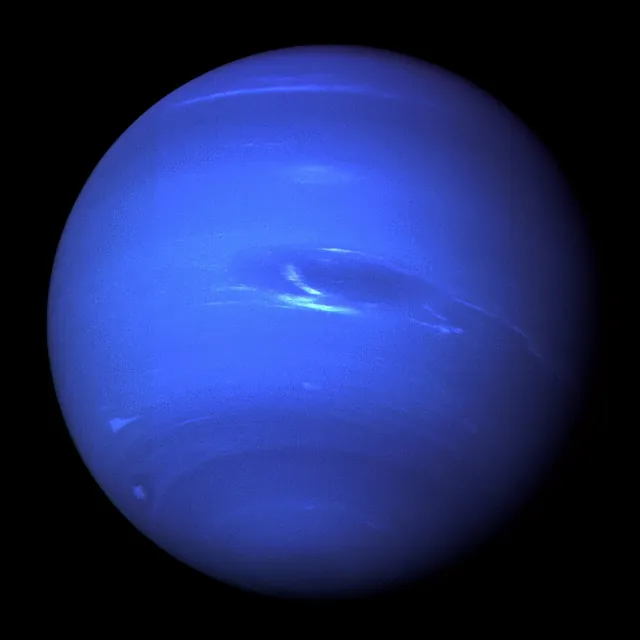
The atmosphere is about 80 per cent hydrogen and 19 per cent helium, with 1.5 per cent methane, which absorbs red light and gives the planet its colour. That colour is a greenish blue, only slightly bluer than Uranus. The deep blue of the classic Voyager 2 pictures came from processing that stretched the contrast to reveal the clouds, as a reanalysis of the original data published in 2024 showed.123610
Neptune is the windiest world in the Solar System. Winds drive clouds of frozen methane across the planet at more than 2,000 km/h, about three times as strong as Jupiter’s and nine times as strong as Earth’s. Where the pressure is one bar the temperature is 72 K, or −201 °C, and higher up it falls to 55 K.12
For a planet that receives so little sunlight, Neptune is surprisingly warm. Voyager 2’s infrared instrument showed that it gives out 2.61 times as much energy as it absorbs from the Sun, with an uncertainty of 0.28. Its effective temperature is 59.3 K, where sunlight alone would hold it at 46.6 K; the rest is heat escaping from the interior.11
- Hydrogen (H₂)
- 80.0% ± 3.2%1by volume
- Helium
- 19.0% ± 3.2%1
- Methane
- 1.5% ± 0.5%1
- Temperature at 1 bar
- 72 K (−201 °C)1
- Temperature at 0.1 bar
- 55 K (−218 °C)1
- Wind speed
- up to 580 m/s1about 2,090 km/h
- Scale height
- 19.1–20.3 km1
- Energy given out compared with sunlight absorbed
- 2.61 ± 0.2811from Voyager 2 infrared data
- Effective temperature
- 59.3 ± 0.8 K11
What hides inside
Neptune is called an ice giant because of what lies beneath the atmosphere. In the standard picture, 80 per cent or more of its mass is a hot, dense fluid of “icy” materials – water, methane and ammonia – above a small rocky core with about the mass of Earth. The atmosphere merges gradually into this fluid. An ocean of super-hot water may lie under the clouds, kept from boiling away by the enormous pressure.2
Much of this is inference. Only one spacecraft has ever flown past, and what is known of the planet can be matched by a wide range of interior models. Researchers still debate whether the materials are mixed or lie in distinct layers, and even whether Neptune holds more rock than ice, in which case “ice giant” would be the wrong name.91213
Magnetic field and aurora
Voyager 2 found that Neptune’s magnetic field is strangely lopsided. Its axis is tilted about 47° from the axis of rotation and is offset from the planet’s centre by almost half the planet’s radius, so the magnetosphere changes wildly during every rotation. The field is about 27 times as powerful as Earth’s.1214
Voyager 2 saw hints of aurorae, but none was confirmed until the James Webb Space Telescope observed Neptune in June 2023. Its spectrograph picked out the infrared glow of the ion H₃⁺, a signature of aurora, in results published in March 2025. Because the field is so tilted, the aurorae lie at mid-latitudes rather than near the poles. The upper atmosphere had also cooled to just over half its 1989 temperature.1415
Notable features
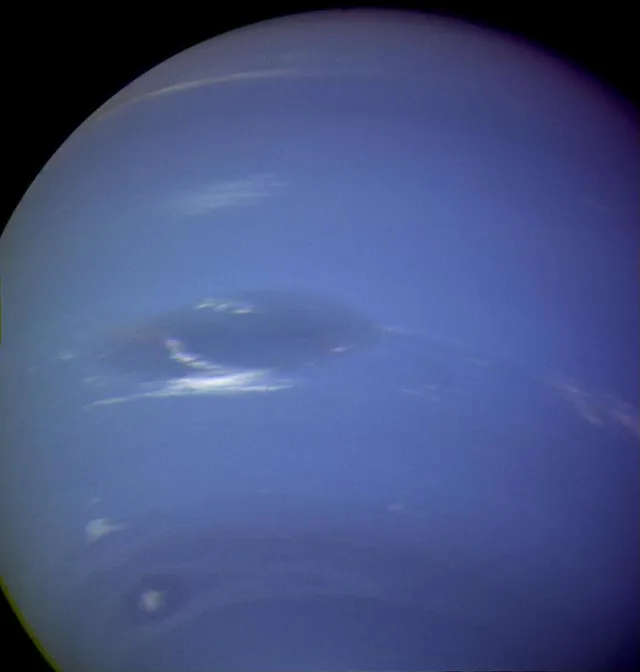
The Great Dark Spot
A dark oval storm that Voyager 2 found in 1989 at 22° south. It measured about 13,000 by 6,600 km, as long as Earth is wide, and was edged with bright clouds that changed shape within hours. When Hubble looked in 1994, it had vanished.1617
Dark Spot 2
Voyager 2’s second dark storm, also called the Lesser Dark Spot, lay farther south at 54° and had a bright core. It circled the planet in 16.1 hours against 18.3 for its larger neighbour, overtaking it every five days. It too had gone by 1994.16171819
Scooter
A small, fast-moving bright cloud south of the Great Dark Spot, nicknamed Scooter by the Voyager scientists. The three features moved eastward at different speeds, so they appeared close together only occasionally, as they do in the picture shown here.1820
Later dark spots
Dark storms come and go on Neptune, typically lasting a few years. Hubble has found four since 1993. One discovered in 2018 at 23° north was about 7,400 km across; it drifted towards the equator, where such storms are expected to break up, then unexpectedly turned back north in 2020.1621
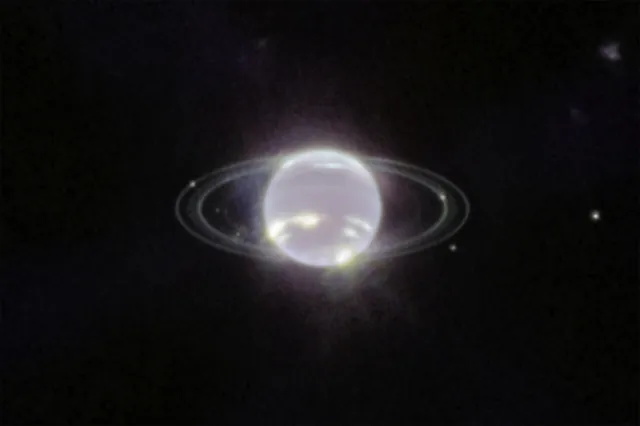
The ring arcs
Neptune’s outermost ring, Adams, lies 62,933 km from the planet’s centre and contains bright clumps called arcs, named Fraternité, Egalité, Liberté and Courage. Ring material ought to spread out evenly; the gravity of the small moon Galatea, orbiting just inside the ring, is thought to hold the arcs together.222
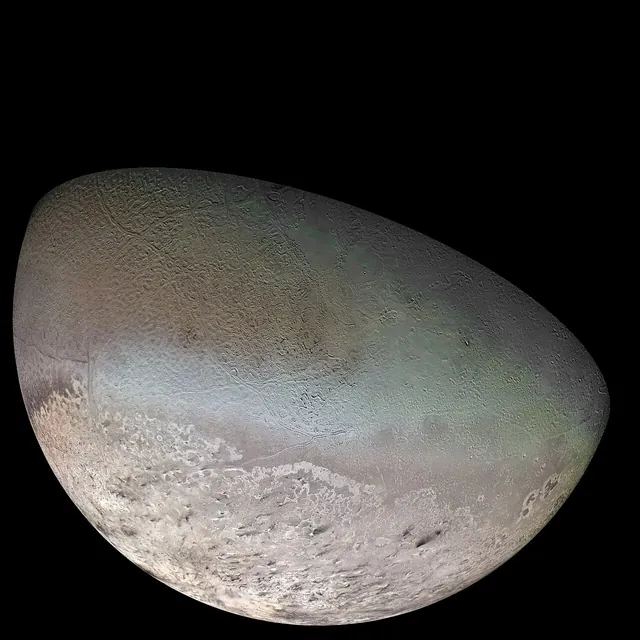
Triton’s geysers
Voyager 2 found geyser-like plumes on Triton throwing dark, icy material more than 8 km up, some of them active during the flyby, and dark streaks across the south polar cap where their dust had settled. At 38 K, or about −235 °C, Triton’s is the coldest surface known in the Solar System.223
Rings and moons
Neptune has five main rings. From the planet outwards they are Galle, Le Verrier, Lassell, Arago and Adams. Evidence for them was found in 1984 and Voyager 2 confirmed them in 1989. They are faint and dusty, and are thought to be relatively young and short-lived. In 2022 the James Webb Space Telescope gave the clearest view of them in more than 30 years, and the first in infrared light.26922
Sixteen moons are known. Triton, by far the largest, is the only large moon in the Solar System that orbits against its planet’s spin, which suggests it was once a Kuiper belt object captured by Neptune’s gravity. It keeps one face turned to Neptune, has a thin atmosphere of nitrogen, and is coated in nitrogen frost that reflects about 70 per cent of the sunlight striking it.242425
Proteus, dark, box-shaped and about 418 km across, is the largest of six inner moons found by Voyager 2. Tiny Hippocamp, about 34 km across and discovered in Hubble images in 2013, may be a fragment knocked off Proteus by a comet. Nereid, found by Gerard Kuiper in 1949, has one of the most eccentric orbits of any moon and takes 360 days to complete it. Two small outer moons are still unnamed.41925262728
Exploration
Voyager 2 is the only spacecraft to have visited Neptune. Launched on 20 August 1977, it reached the planet twelve years later and, at 03:56 UT on 25 August 1989, flew about 4,800 km above the cloud tops over the north pole, the closest of its four planetary flybys. It discovered six moons and four rings, clocked the winds, and photographed two-thirds of Triton.919
Everything since has been seen from afar. The Hubble Space Telescope has followed the planet’s dark storms and in 2013 revealed a 14th moon, Hippocamp. Images from the Keck Observatory in 2005 showed that some of the ring arcs had deteriorated. The James Webb Space Telescope took its first image of Neptune on 12 July 2022 and went on to detect the planet’s aurorae.914212729
No return mission has been approved. Trident, a spacecraft that would have made a single flyby of Triton, was one of four concepts NASA chose for further study in its Discovery programme in February 2020, but in June 2021 the agency selected two missions to Venus instead. Voyager 2 remains the first and only spacecraft to have studied Neptune up close.93031
- Closest approach to Neptune
- 25 August 1989, 03:56 UT19
Quick answers
- How big is Neptune?
- Neptune has a mean radius of 24,622 km (3.865 × Earth).1
- How massive is Neptune?
- Neptune has a mass of 1.024 × 10²⁶ kg (17.15 × Earth).1
- How long is a day on Neptune?
- A day on Neptune lasts 16.11 hours.1
- How long is a year on Neptune?
- A year on Neptune lasts 164.79 Earth years.1
- How far is Neptune from the Sun?
- Neptune is 4.515 billion km from the Sun (30.18 times Earth’s distance, on average).1
- How fast does Neptune move through space?
- Neptune moves along its orbit at 5.45 km/s (mean).1
- What is Neptune’s axial tilt?
- Neptune’s axis is tilted by 28.32°.1
- What is the temperature on Neptune?
- The temperature on Neptune is −201 °C (where the pressure is 1 bar).1
- How many moons does Neptune have?
- Neptune has 16 known moons.4
- What is Neptune made of?
- Neptune is made of icy fluids under hydrogen, helium and methane.2
Sources
- Neptune Fact Sheet — NASA Space Science Data Coordinated Archive, 2024
- Neptune: Facts — NASA Science, 2026
- New images reveal what Neptune and Uranus really look like — Royal Astronomical Society, 2024
- Planetary Satellite Discovery Circumstances — NASA/JPL Solar System Dynamics
- 175 Years Ago: Astronomers Discover Neptune, the Eighth Planet — NASA, 2021
- New Webb Image Captures Clearest View of Neptune’s Rings in Decades — NASA Science, 2022
- The history behind the AIP logo — Leibniz Institute for Astrophysics Potsdam
- 175th anniversary of the discovery of Neptune — Leibniz Institute for Astrophysics Potsdam, 2021
- Neptune: Exploration — NASA Science, 2026
- Modelling the seasonal cycle of Uranus’s colour and magnitude, and comparison with Neptune (Irwin et al.) — Monthly Notices of the Royal Astronomical Society, 2024
- The albedo, effective temperature, and energy balance of Neptune, as determined from Voyager data (Pearl and Conrath) — Journal of Geophysical Research: Space Physics, 1991
- Uranus and Neptune: Origin, Evolution and Internal Structure (Helled, Nettelmann and Guillot) — Space Science Reviews, 2020
- Neptune and Uranus: ice or rock giants? (Teanby et al.) — Philosophical Transactions of the Royal Society A, 2020
- NASA’s Webb Captures Neptune’s Auroras For First Time — NASA Science, 2025
- Discovery of H₃⁺ and infrared aurorae at Neptune with JWST (Melin et al.) — Nature Astronomy, 2025
- Hubble Tracks the Lifecycle of Giant Storms on Neptune — NASA Science, 2019
- Neptune Full Disk (Photojournal PIA00046) — NASA/JPL Photojournal, 1996
- Neptune – Great Dark Spot and Scooter (Photojournal PIA00048) — NASA/JPL Photojournal, 1996
- Voyager 2 — NASA Science, 2026
- Neptune – Great Dark Spot, Scooter, Dark Spot 2 (Photojournal PIA00049) — NASA/JPL Photojournal, 1996
- Dark Storm on Neptune Reverses Direction, Possibly Shedding a Fragment — NASA Science, 2020
- Neptunian Rings Fact Sheet — NASA Space Science Data Coordinated Archive, 2015
- Global Color Mosaic of Triton (Photojournal PIA00317) — NASA/JPL Photojournal, 1998
- Triton — NASA Science
- Neptunian Satellite Fact Sheet — NASA Space Science Data Coordinated Archive, 2024
- Proteus — NASA Science
- Hippocamp — NASA Science
- Nereid — NASA Science
- Neptune Close-Up (NIRCam Image), weic2214a — ESA/Webb, 2022
- NASA Selects Four Possible Missions to Study the Secrets of the Solar System — NASA, 2020
- NASA Selects 2 Missions to Study ‘Lost Habitable’ World of Venus — NASA, 2021
Figures checked against these sources in November 2026. Where a quantity is not known, it is left out rather than estimated.

