planet
Jupiter
Jupiter is the largest planet in the Solar System: a ball of hydrogen and helium eleven times as wide as Earth and nearly 318 times as massive, with more than twice the material of all the other bodies orbiting the Sun combined. It has no solid surface. What we see are the tops of its clouds, drawn into dark belts and bright zones by winds that blow in opposite directions.12
It also has the shortest day of any planet, turning once in just under ten hours while taking almost twelve Earth years to circle the Sun. Around it lie a faint system of rings, a magnetic field that reaches as far as Saturn’s orbit, and 115 known moons, four of them far larger than the rest.123
Size and physical properties
Jupiter could hold more than 1,300 Earths by volume, yet its mean density is only about a quarter of Earth’s, because it is made almost entirely of the two lightest elements. It is also visibly flattened: the equator is 4,638 km farther from the centre than the poles, a difference of about 6.5 per cent.1
Because there is no ground to measure from, sizes and gravity are quoted at the level in the atmosphere where the pressure equals one bar.1
- Equatorial radius
- 71,492 km1at the 1-bar level
- Polar radius
- 66,854 km1
- Mean radius
- 69,911 km1
- Flattening
- 0.064871
- Mass
- 1.89813 × 10²⁷ kg1317.83 Earths
- Volume
- 1.43128 × 10¹⁵ km³11,321 Earths
- Mean density
- 1,326 kg/m³1Earth: 5,513
- Gravity
- 25.92 m/s²1mean, at the 1-bar level
- Gravity felt at the equator
- 23.12 m/s²1reduced by the planet’s spin
- Escape velocity
- 59.5 km/s1
- Geometric albedo
- 0.5381
- Bond albedo
- 0.3431
Orbit and rotation
Jupiter is the fifth planet from the Sun, orbiting at a little over five times Earth’s distance. Sunlight takes about 43 minutes to reach it. One circuit takes 11.86 Earth years.12
Its axis is tilted by only about 3 degrees, so Jupiter spins nearly upright and has no seasons to speak of. It turns once in 9 hours 55.5 minutes, the shortest day of any planet in the Solar System.12
- Orbital period
- 4,332.589 days111.862 years
- Mean orbital speed
- 13.06 km/s1
- Orbital eccentricity
- 0.04871
- Orbital inclination
- 1.304°1to Earth’s orbit
- Rotation period
- 9.9250 hours1System III (1965.0)
- Length of day
- 9.9259 hours1
- Speed of rotation at the equator
- 12.6 km/s145,300 km/h; from the radius and rotation period
- Axial tilt
- 3.13°1
- Brightest in our sky
- magnitude −2.941
Discovery and naming
Jupiter is one of the brightest objects in the night sky and has been known since ancient times, so it has no discoverer. It is named after the king of the Roman gods. The first detailed observations were made by Galileo Galilei in 1610 with a small telescope he built himself; that year he found the four large moons that now bear his name.124
Atmosphere and weather
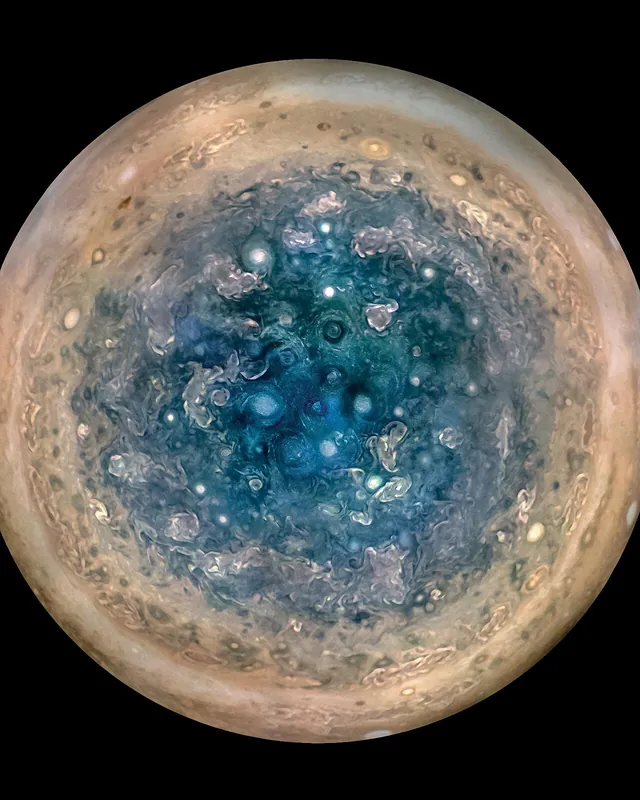
The atmosphere is about 90 per cent hydrogen and 10 per cent helium by volume, with traces of methane, ammonia and water. The stripes are clouds: the dark belts and bright zones are separated by jet streams blowing east and west in opposite directions, reaching about 150 metres per second near the equator.12
There are thought to be three cloud layers spanning about 71 km: ammonia ice on top, ammonium hydrosulphide crystals in the middle, and water ice and vapour below. Measurements by the Juno spacecraft show that the jet streams reach about 3,200 km down, far below the clouds.2
Juno also found giant cyclones packed around both poles: eight in an octagon around the north pole and five in a pentagon around the south, each surrounding a cyclone at the pole itself. They have stayed in place throughout the mission.2
What hides inside
Jupiter has the same main ingredients as the Sun, but never grew massive enough to ignite. Deeper into the atmosphere the pressure and temperature rise until the hydrogen gas is squeezed into a liquid, giving Jupiter the largest ocean in the Solar System, though one of hydrogen rather than water.2
Perhaps halfway to the centre, the pressure is thought to strip the electrons from the hydrogen atoms, turning the liquid into an electrical conductor like a metal. Currents in this spinning layer of metallic hydrogen are believed to generate the planet’s magnetic field.2
The core was long pictured as a small solid ball of rock, ice and metal. Juno’s measurements of the gravity and magnetic fields suggest otherwise: the core appears to be much larger than expected and partly dissolved, blending into the metallic hydrogen above it with no sharp edge. Researchers describe it as dilute, or “fuzzy”.2
Magnetic field and aurora
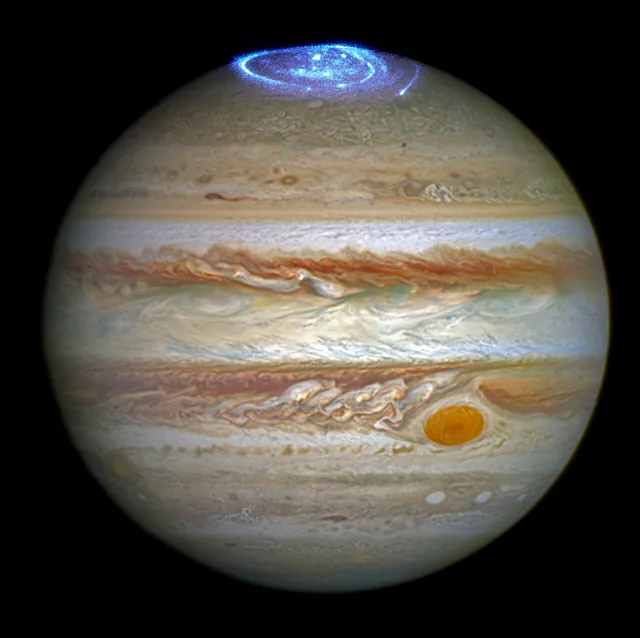
Jupiter’s magnetic field is 16 to 54 times as powerful as Earth’s. The bubble it carves out of the solar wind, the magnetosphere, extends 1 to 3 million km towards the Sun and trails more than a billion kilometres behind the planet, as far as the orbit of Saturn.2
Close to the planet the field traps charged particles and accelerates them to very high energies, creating intense radiation that bombards the innermost moons and can damage spacecraft. The field also produces some of the most spectacular aurorae in the Solar System at the planet’s poles.2
Notable features
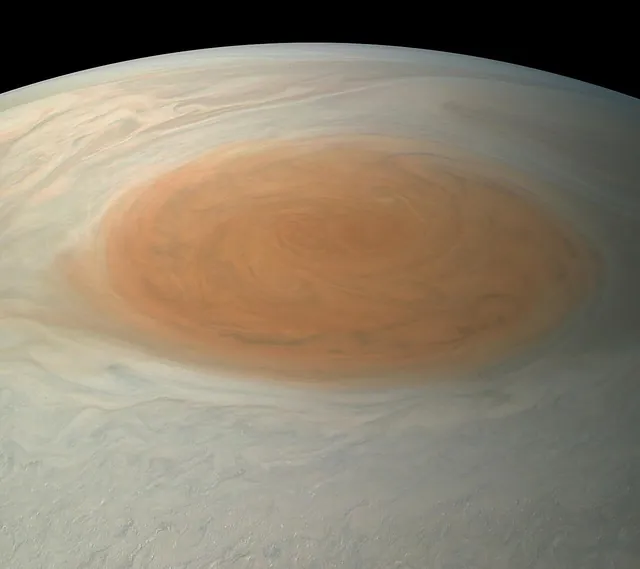
The Great Red Spot
A storm that has been watched for more than 300 years and is steadily shrinking. In the late 1800s its long axis was put at about 41,000 km; the Voyager spacecraft measured about 23,300 km in 1979, and Hubble about 16,500 km in 2014. Juno’s gravity measurements show it reaches some 500 km below the cloud tops.25
Belts and zones
The dark bands are called belts and the bright ones zones. Their colours may come from sulphur- and phosphorus-bearing gases rising from the warmer interior. With no solid surface to slow them, storms and spots among the bands can last for many years.2
Polar cyclones
Rings of cyclones surround each pole, eight in the north and five in the south. Like hurricanes on Earth they tend to drift towards the pole, but the cyclone already sitting there pushes them back, which holds the whole pattern in place.2
The rings
Jupiter’s rings were discovered by Voyager 1 in 1979. They are made of small, dark particles and are hard to see unless lit from behind. The main ring lies between 123,000 and 128,940 km from the planet’s centre, with a thick halo inside it and two fainter rings outside it named after the small moons Amalthea and Thebe. The rings are thought to be dust knocked off the small inner moons by meteoroid impacts.26
Moons
With 115 known moons, Jupiter resembles a miniature solar system. The four largest, found by Galileo in 1610, dwarf the rest. Io is the most volcanically active body in the Solar System. Europa probably hides an ocean of liquid water beneath its ice. Ganymede is the largest moon in the Solar System, bigger than the planet Mercury. Callisto orbits farthest out of the four.237
Exploration
Pioneer 10 was the first spacecraft to fly past Jupiter, passing 130,354 km from the planet on 4 December 1973. Voyager 1 followed in March 1979, discovering the rings and active volcanoes on Io, and Voyager 2 that July. Cassini in 2000 and New Horizons in 2007 studied the planet as they swung past on their way to Saturn and Pluto.4910
Galileo, launched in October 1989, orbited Jupiter from December 1995 until 21 September 2003, when it was deliberately flown into the planet to protect Europa and the ocean it may hold beneath its ice. It was the first spacecraft to send a probe into the atmosphere of an outer planet.411
Juno, launched on 5 August 2011, has orbited Jupiter since 4 July 2016, measuring its gravity and magnetic fields. Two more spacecraft are on their way to study the icy moons: ESA’s Juice, launched on 14 April 2023 and due in July 2031, and NASA’s Europa Clipper, launched on 14 October 2024 and due in 2030.4712
Quick answers
- How big is Jupiter?
- Jupiter has a mean radius of 69,911 km (10.97 × Earth).1
- How massive is Jupiter?
- Jupiter has a mass of 1.898 × 10²⁷ kg (317.83 × Earth).1
- How long is a day on Jupiter?
- A day on Jupiter lasts 9.93 hours.1
- How long is a year on Jupiter?
- A year on Jupiter lasts 11.86 Earth years.1
- How far is Jupiter from the Sun?
- Jupiter is 778.5 million km from the Sun (5.2 au on average).1
- How fast does Jupiter move through space?
- Jupiter moves along its orbit at 13.06 km/s (mean).1
- What is Jupiter’s axial tilt?
- Jupiter’s axis is tilted by 3.13°.1
- What is the temperature on Jupiter?
- The temperature on Jupiter is −108 °C (where the pressure is 1 bar).1
- How many moons does Jupiter have?
- Jupiter has 115 known moons.3
- What is Jupiter made of?
- Jupiter is made of hydrogen and helium.1
Sources
- Jupiter Fact Sheet — NASA Space Science Data Coordinated Archive, 2024
- Jupiter: Facts — NASA Science
- Planetary Satellite Discovery Circumstances — NASA/JPL Solar System Dynamics
- Jupiter: Exploration — NASA Science
- NASA’s Hubble Shows Jupiter’s Great Red Spot is Smaller than Ever Measured — NASA, 2014
- Jupiter Rings Fact Sheet — NASA Space Science Data Coordinated Archive
- Juno — NASA Science
- Jovian Satellite Fact Sheet — NASA Space Science Data Coordinated Archive
- Pioneer 10 — NASA Science
- New Horizons — NASA Science
- Galileo — NASA Science
- Juice factsheet — European Space Agency
Figures checked against these sources in November 2026. Where a quantity is not known, it is left out rather than estimated.

