dwarf planet
Pluto
Pluto is a dwarf planet in the Kuiper Belt, the icy region beyond Neptune. Clyde Tombaugh found it at Lowell Observatory in Arizona in 1930, and for decades it was counted as the ninth planet, until the International Astronomical Union reclassified it in 2006. About 2,377 km across, roughly two-thirds the width of Earth’s Moon, it takes 248 years to circle the Sun on a stretched and steeply tilted orbit.123
NASA’s New Horizons spacecraft flew past on 14 July 2015 and found a world far more active than anyone expected. A vast glacier of nitrogen ice, Sputnik Planitia, fills the western lobe of the bright, heart-shaped Tombaugh Regio, edged by mountains of water ice several kilometres high. Layers of blue haze float in a thin nitrogen atmosphere, and an ocean of liquid water may lie hidden beneath the icy crust.145678
Size and physical properties
New Horizons settled a question astronomers had argued over for decades: how big Pluto is. A few days before closest approach, mission scientists announced that it is about 2,370 km across, slightly larger than earlier estimates. Careful measurements of its outline in approach images later gave a mean radius of 1,188.3 km and showed no detectable flattening: Pluto is round to within 0.6 per cent.410
Pluto’s mass is 1.30 × 10²² kg, about one-sixth that of Earth’s Moon, and its mean density of 1.85 g/cm³ points to a mixture of rock and ice. Gravity at the surface is just 0.62 m/s², about 6 per cent of Earth’s, and the escape velocity is a modest 1.21 km/s.13910
Orbit and rotation
Pluto’s path round the Sun is unusual compared with the planets’: it is both elongated and tilted. Its average distance is 39.5 au, about 5.9 billion km, but it swings from 4.4 billion km at its closest to 7.3 billion km at its farthest, on an orbit inclined 17° to Earth’s. From 1979 to 1999 Pluto was near perihelion and actually closer to the Sun than Neptune. Sunlight takes about 5.5 hours to reach it.13
Pluto is locked in a 3:2 resonance with Neptune: it circles the Sun twice for every three Neptune orbits, in a stable, repeating pattern. So many smaller Kuiper Belt objects share this resonance that they have their own name, plutinos. Pluto’s axis is tipped so far that it spins almost on its side, and backwards, taking 6.4 Earth days to turn once.1313
Discovery and naming
Lowell Observatory in Flagstaff, Arizona, was searching for a planet beyond Neptune that Percival Lowell had predicted. Clyde Tombaugh, a young amateur from Kansas, joined the staff in 1929 and photographed the sky near the star Delta Geminorum on 21, 23 and 29 January 1930. Comparing plates on a blink comparator on 18 February, he noticed a faint point that had moved.214
After weeks of checking, the observatory announced the discovery on 13 March 1930, Percival Lowell’s birthday. The next day, at breakfast in Oxford, the schoolgirl Venetia Burney suggested naming it after the Roman god of the underworld; her grandfather passed the idea to Lowell Observatory, which chose it. In 2006 the International Astronomical Union made Pluto a dwarf planet, because other objects might cross its orbital path.12
Ice plains, glaciers and mountains
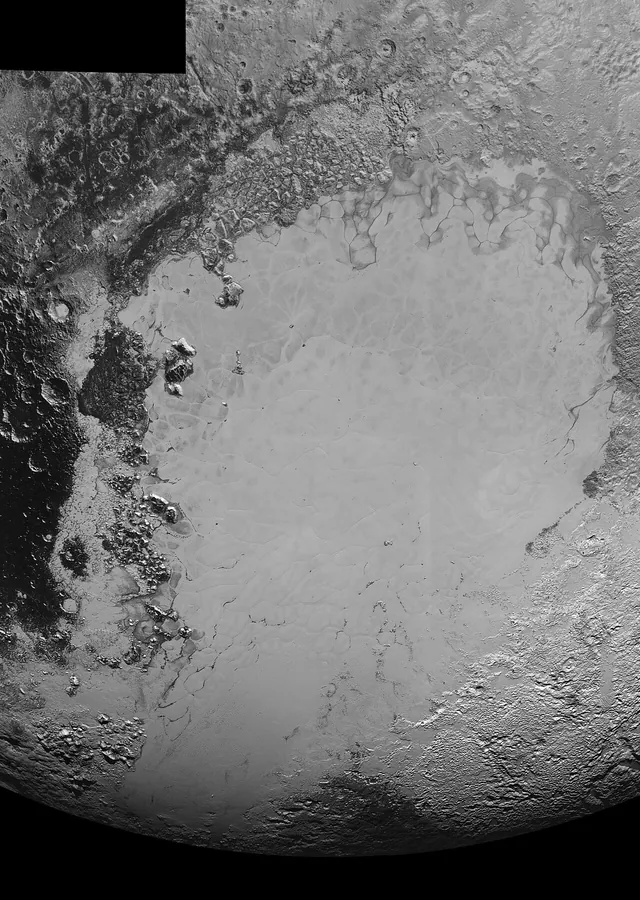
Pluto has mountains, valleys, plains, craters and glaciers. Its surface is dominated by ices of nitrogen, methane and carbon monoxide, which shift about over seasons and ages as they turn to gas, freeze out again and flow as glaciers. Beneath them, water ice forms a rigid bedrock that crops out in places. Colours vary sharply from region to region, from brilliant white ice to dark reddish ground.115
Its terrains differ hugely in age. Some cratered ground is up to about 4 billion years old, yet the nitrogen-ice plain of Sputnik Planitia has no impact craters at all, so its surface is no more than about 10 million years old. Elsewhere, a region with few craters seems to have been resurfaced late in Pluto’s history by giant icy domes several kilometres high.1617
In 2026 a fresh look at the flyby images suggested that liquid nitrogen has recently seeped up through cracks at the northern edge of Sputnik Planitia, darkening the ice. Rain is impossible on Pluto, so the liquid is thought to come from melting at the base of the glacier. It is the first evidence of recently flowing liquid on Pluto.18
Notable features
Tombaugh Regio
The bright “heart” seen as New Horizons approached is Tombaugh Regio, about 2,300 km across and named after Pluto’s discoverer. Its western lobe is the nitrogen-ice plain Sputnik Planitia; to the east lie deeply pitted, glaciated plains raised about 0.7 km.456
Sputnik Planitia
A depression about 1,200 by 2,000 km, its floor 2.5–3.5 km below the rim, holds the largest known glacier in the Solar System. The nitrogen ice slowly overturns in cells 10–40 km across, creeping a few centimetres a year and renewing the surface in about 500,000 years. It is named after Sputnik 1.45620
Tenzing Montes
These steep-sided blocks of water ice, spread over 283 km along the south-western edge of Sputnik Planitia, are the highest mountains known on Pluto. The tallest peak rises about 6.2 km from base to crest, with slopes of 40–50°. They are named after the Nepalese Sherpa mountaineer Tenzing Norgay.156
Hillary Montes
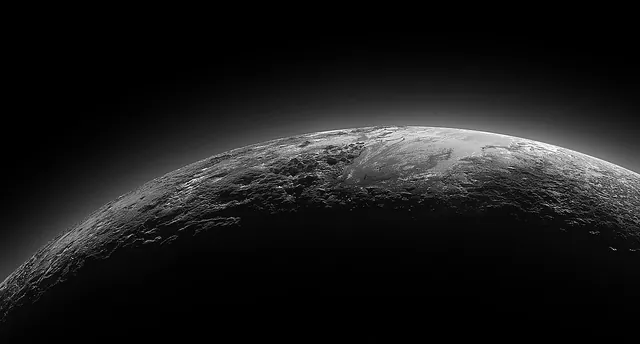
Farther north along the western shore of Sputnik Planitia, this 388 km range of icy blocks reaches about 3.5 km at its highest measured peak. It stands on the skyline of New Horizons’ famous backlit view of Pluto, and is named after the New Zealand mountaineer Edmund Hillary.5621
Wright Mons
South-west of Sputnik Planitia rises a broad mound about 160 km wide and 4 km high, with a summit depression 56 km across. New Horizons scientists think it and its neighbour Piccard Mons may be cryovolcanoes, built by ice erupting from below. The name honours the aviation pioneers Orville and Wilbur Wright.561722
What hides inside
Pluto probably has a rocky core surrounded by a mantle of water ice. Mountains several kilometres high and deep troughs show that its icy shell is fairly rigid. Whether Pluto has a magnetic field is not known, but its small size and slow rotation suggest that it has little or none.16
Sputnik Planitia offers a clue to what lies deeper. The basin sits very close to Pluto’s tidal axis, and the best explanation is that the whole dwarf planet rolled over until it settled there. That needs extra mass beneath the basin, which arises naturally if an ocean of liquid water lies under a rigid ice shell. Without an ocean, an implausibly thick layer of nitrogen, more than 40 km, would be required.48
Atmosphere and haze
Pluto has a thin atmosphere that is about 99 per cent nitrogen, with some methane and carbon monoxide. New Horizons found a surface pressure near 10 microbars, roughly a hundred-thousandth of Earth’s, and an upper atmosphere much colder and more compact than predicted, which slows the escape of gas to space. Methane is broken down there into hydrocarbons such as acetylene, ethylene and ethane.31923
These hydrocarbons gather into particles a fraction of a micrometre across that form a haze around the whole of Pluto. The particles scatter sunlight to give a bright blue glow, and as they settle they gather into many thin horizontal layers, some extending for hundreds of kilometres and reaching more than 200 km above the surface.71923
The atmosphere changes along Pluto’s orbit. It swells as surface ices turn to gas near the Sun, and much of it may freeze and fall as snow when Pluto is far away. Stellar occultations show that the pressure rose steadily from 1988 to 2016. A 2020 occultation gave about 12 microbars, a plateau, although other teams reported a slight fall in 2018 and 2019.12425

Moons
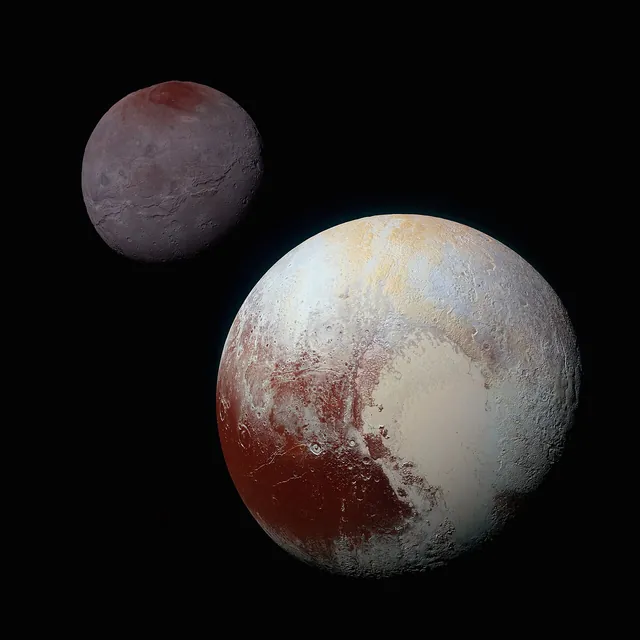
Pluto has five known moons. Charon, discovered in 1978, is about half Pluto’s size, the largest moon relative to its parent in the Solar System, and the two always keep the same faces turned to each other. Charon orbits about 19,600 km from Pluto every 6.39 days, exactly as long as Pluto takes to spin, so from Pluto it hangs motionless in the sky.11226
The four small moons were found with the Hubble Space Telescope: Nix and Hydra in 2005, Kerberos in 2011 and Styx in 2012. All are irregular in shape and less than 160 km wide, and unlike Charon they are not tidally locked. Their names come from the underworld of myth: the goddess of night, a nine-headed serpent, a three-headed dog and the river of the dead.11227
Exploration
Even the best views from Earth and the Hubble Space Telescope revealed little of Pluto’s surface. NASA approved New Horizons in 2001, and it lifted off on 19 January 2006, the fastest launch on record. A gravity assist from Jupiter in February 2007 cut three years from the journey, and the spacecraft spent much of its cruise in hibernation to extend its life.42729
At 11:49 UT on 14 July 2015 New Horizons passed about 12,500 km from Pluto, the first spacecraft to explore it, and observed Charon and all four small moons. Sending home the 6.25 gigabytes it gathered took until 25 October 2016. On 1 January 2019 it flew past the Kuiper Belt object Arrokoth, the most distant object ever explored up close.4
New Horizons is still working, the only mission so far to have explored Pluto. After a record 321-day hibernation it woke in good health on 23 June 2026, about 9.5 billion km from Earth, and is measuring charged particles, hydrogen gas and dust in the outer heliosphere and the Kuiper Belt.2930
- New Horizons launched
- 19 January 20064
- Closest approach to Pluto
- 14 July 2015411:49 UT, about 12,500 km from Pluto
- Flyby data fully received
- 25 October 20164about 6.25 gigabytes
- Current status
- Active in the Kuiper Belt29woke from a 321-day hibernation on 23 June 2026
Quick answers
- How big is Pluto?
- Pluto has a mean radius of 1,188.3 km (measured by New Horizons; about 2,377 km across the equator).1910
- How strong is gravity on Pluto?
- Gravity at the surface of Pluto is 0.62 m/s² (about 6% of Earth’s).139
- How long is a day on Pluto?
- A day on Pluto lasts 6.39 Earth days (about 153 hours; Pluto spins backwards (retrograde)).139
- What is the temperature on Pluto?
- The temperature on Pluto is about −232 °C (average; NSSDC gives a range of 24–38 K).13
Sources
- Pluto: Facts — NASA Science, 2025
- Discovery: The Story of Pluto — Lowell Observatory Archives
- Pluto Fact Sheet — NASA Space Science Data Coordinated Archive, 2024
- New Horizons — NASA Science, 2026
- Gazetteer of Planetary Nomenclature: Pluto features — International Astronomical Union and USGS Astrogeology Science Center
- Schenk et al., Basins, fractures and volcanoes: Global cartography and topography of Pluto from New Horizons — Icarus, 2018
- Pluto’s Haze in Bands of Blue, PIA20362 — NASA Photojournal, 2016
- Nimmo et al., Reorientation of Sputnik Planitia implies a subsurface ocean on Pluto — Nature, 2016
- Planetary Physical Parameters — NASA/JPL Solar System Dynamics, 2019
- Nimmo et al., Mean radius and shape of Pluto and Charon from New Horizons images — Icarus, 2017
- Small-Body Database Lookup: 134340 Pluto (1930 BM) — NASA/JPL Solar System Dynamics
- Planetary Satellite Discovery Circumstances — NASA/JPL Solar System Dynamics, 2023
- Kuiper Belt: Facts — NASA Science, 2025
- Gazetteer of Planetary Nomenclature: Pluto — International Astronomical Union and USGS Astrogeology Science Center
- Grundy et al., Surface compositions across Pluto and Charon — Science, 2016
- Moore et al., The geology of Pluto and Charon through the eyes of New Horizons — Science, 2016
- Singer et al., Large-scale cryovolcanic resurfacing on Pluto — Nature Communications, 2022
- NASA’s New Horizons Finds Evidence of Recent Liquid on Pluto’s Surface — NASA Science, 2026
- Stern et al., The Pluto system: Initial results from its exploration by New Horizons — Science, 2015
- McKinnon et al., Convection in a volatile nitrogen-ice-rich layer drives Pluto’s geological vigour — Nature, 2016
- Pluto’s Majestic Mountains, Frozen Plains and Foggy Hazes, PIA19948 — NASA Photojournal, 2015
- Ice Volcanoes on Pluto?, PIA20155 — NASA Photojournal
- Gladstone et al., The atmosphere of Pluto as observed by New Horizons — Science, 2016
- Meza et al., Lower atmosphere and pressure evolution on Pluto from ground-based stellar occultations, 1988–2016 — Astronomy & Astrophysics (arXiv preprint), 2019
- Sicardy et al., Pluto’s atmosphere in plateau phase since 2015 from a stellar occultation at Devasthal — Astrophysical Journal Letters (arXiv preprint), 2021
- Planetary Satellite Mean Elements — NASA/JPL Solar System Dynamics
- 45 Years Ago: Astronomers Discover Pluto’s Moon Charon — NASA History, 2023
- Planetary Satellite Physical Parameters — NASA/JPL Solar System Dynamics
- NASA’s New Horizons Spacecraft Wakes from Hibernation in Good Health — NASA Science, 2026
- Pluto — NASA Science
Figures checked against these sources in November 2026. Where a quantity is not known, it is left out rather than estimated.

