moon
Charon
Charon is the largest of Pluto’s five moons and, at about half Pluto’s width, the largest moon relative to its parent anywhere in the Solar System. James Christy of the US Naval Observatory discovered it in 1978. Pluto and Charon orbit a shared centre of mass lying in the space between them, and each always turns the same face to the other, so the pair are often called a double planet.123
NASA’s New Horizons spacecraft flew past in July 2015 and found a grey world of water ice with a startling dark red cap at its north pole, made from gas that escaped Pluto and froze on Charon’s frigid winter pole. A belt of canyons far longer and deeper than the Grand Canyon divides broken northern uplands from smoother southern plains, a sign that an ancient ocean inside Charon froze and cracked its crust.12456
Size and physical properties
New Horizons measured Charon’s mean radius at 606.0 km, about half Pluto’s, in line with earlier estimates from stellar occultations. Like Pluto, it shows no measurable flattening. Its mean density of about 1.70 g/cm³ is a little lower than Pluto’s, and in size, density and overall make-up Charon resembles the mid-sized moons of Saturn and Uranus, which are mixtures of ice and rock.6789
Surface gravity is only 0.29 m/s², and Charon has no detectable atmosphere. Compared with Pluto it is darker and far less colourful, it has no active nitrogen or methane ices on its surface, and all of its terrains are ancient. Its colours are mostly neutral grey, apart from the reddish polar regions.91213
Orbit and rotation
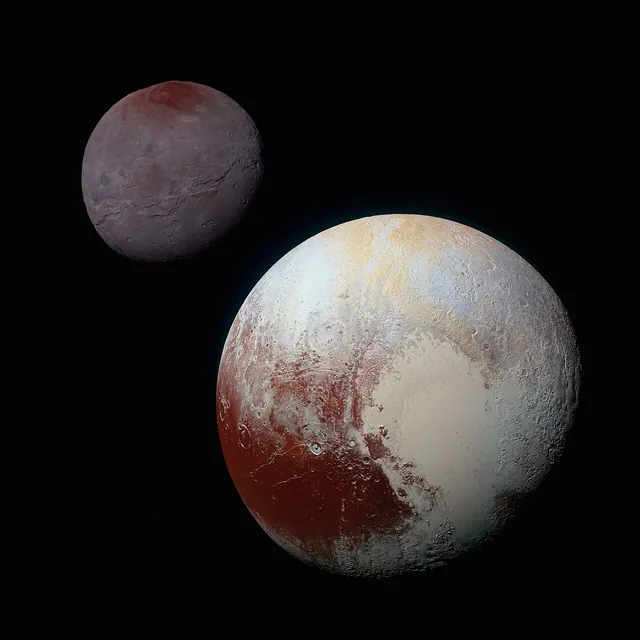
Charon circles Pluto at an average distance of about 19,600 km, twenty times closer than the Moon is to Earth, on a circular path in Pluto’s equatorial plane. One orbit takes 6.387 days, exactly as long as each body takes to spin. Because of this mutual tidal locking, Charon never rises or sets as seen from Pluto but hovers over the same spot.13910
Charon has about one-eighth of Pluto’s mass, so the two orbit a common centre of mass that lies between them rather than inside Pluto, and astronomers treat them as a double planet. The whole system is tipped on its side, like Uranus, which gives Charon long seasons and bitterly cold winter poles.1249
Discovery and naming
On 22 June 1978 James Christy, an astronomer at the US Naval Observatory, was studying photographs of Pluto taken with the observatory’s 61-inch telescope at its Flagstaff Station in Arizona, trying to refine Pluto’s orbit. Some showed a bulge. Working with Robert Harrington and older plates going back to 1965, he found that the bulge moved round Pluto on a regular cycle of 6.39 days.12
The discovery was announced on 7 July 1978. Christy named the moon after Charon, the ferryman who carried souls across a river of the underworld, a name that also echoed his wife Charlene’s nickname, Char. From 1985 Pluto and Charon passed in front of each other in a series of mutual eclipses that confirmed the moon, and in 1994 the Hubble Space Telescope first showed Charon as a separate object.12
Ice, canyons and plains
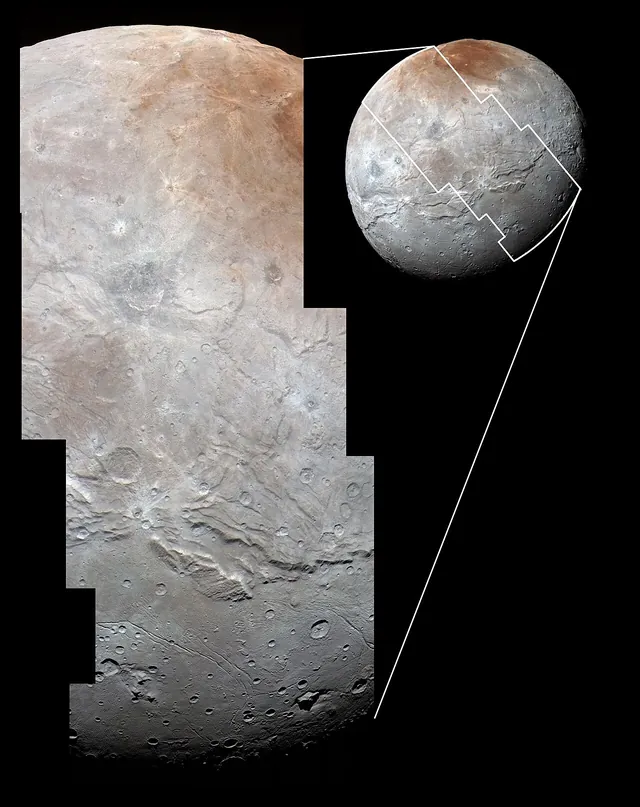
Charon’s surface is mostly dirty water ice. Its colours are much simpler than Pluto’s: neutral grey at low latitudes and reddish at the north pole. Small, fresh-looking craters show strong traces of ammonia in their ejecta. Temperatures range from about −238 °C to −218 °C, and no ices of nitrogen or methane are active on the surface.21213
The landscape is dramatic. Charon’s heights span 19 km from lowest to highest point, more than any other mid-sized icy moon except Saturn’s Iapetus. Much of the northern hemisphere, Oz Terra, is broken into huge blocks by troughs typically 3–6 km deep, reaching 13 km below the average surface near the pole. To the south lie the lower, smoother plains of Vulcan Planitia.6
Charon does not appear to be active today. Its crust was stretched apart and resurfaced, probably by icy volcanism, nearly 4 billion years ago. The largest crater, Dorothy, is about 240–260 km across and 6 km deep, and the mix of craters on Charon and Pluto has helped scientists test ideas about the sizes of objects in the Kuiper Belt.61415
- Range of heights
- 19 km6lowest to highest point on the side seen by New Horizons
- Highest points
- 5–6 km above the mean radius6
- Deepest troughs
- up to 13 km below the mean radius6
- Largest crater
- Dorothy, 240–260 km across6156 km deep; 240 km in the New Horizons topographic study, 261 km in the IAU gazetteer
- Age of the great resurfacing
- nearly 4 billion years14
Notable features
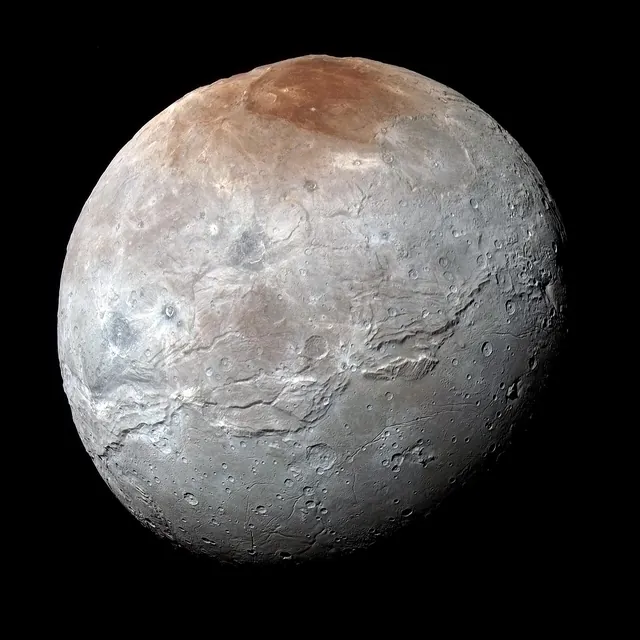
Neverland Regio (Mordor Macula)
Charon’s dark red north polar cap, about 465 km across, was nicknamed Mordor Macula by the New Horizons team and officially named Neverland Regio in February 2026. Models show it forms from gas escaping Pluto that freezes onto Charon’s cold winter pole and is turned into reddish compounds by light.4615
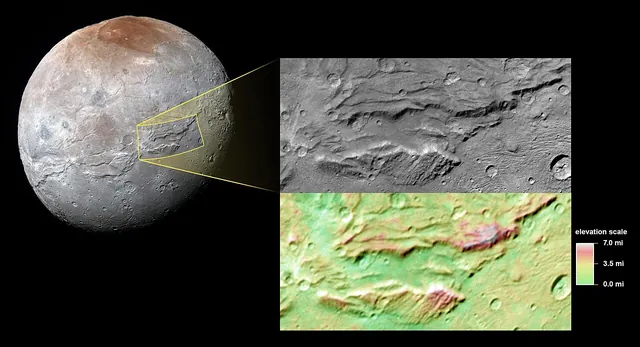
Serenity Chasma
This informally named canyon is part of a vast equatorial belt of chasms, running at least 1,800 km and reaching 7.5 km deep, one of the longest such systems in the Solar System. Its pull-apart faults and shape suggest that Charon’s water-ice layer was once partly liquid.56
Mandjet Chasma
An officially named trough 385 km long, Mandjet Chasma is one of the prominent chasms on the boundary between the broken uplands of Oz Terra and the plains of Vulcan Planitia. It is named after the Egyptian boat that carried the sun god Ra across the daytime sky.615
Vulcan Planitia
The informally named southern plains are rolling, locally fractured and pitted, and lie about 1 km below the northern terrain. A trough 2–3 km deep runs along their edge, and isolated mountains 2–4 km high stand in moats within them. They may have been flooded by icy lavas, or formed as crustal blocks foundered.614
Argo Chasma
A double-walled trough 355 km long in Charon’s northern hemisphere, named after the ship of Jason and the Argonauts. It encloses a smoother circular patch that may be an outlying part of the resurfaced plains of Vulcan Planitia.615
A lost ocean
Charon’s outer layer is mainly water ice. When the moon was young, heat from radioactive decay and from its formation may have melted that ice deep down into a subsurface ocean. As Charon cooled, the ocean froze and expanded, as water does when it freezes, pushing the surface outward until it stretched and split into the belt of canyons seen today.516
The southern plains may have formed when cold, icy fluids from inside erupted and flooded the surface. Tilted and sunken blocks around and within them suggest another possibility too: that much of Charon’s crust broke into large pieces, some of which sank into a softer layer beneath. Either way, the activity ended long ago.614
- Outer layer
- Mainly water ice5
Exploration
For years after its discovery Charon could not even be seen separately from Pluto, and even Hubble’s images revealed little of its surface. NASA’s New Horizons passed about 28,800 km from Charon on 14 July 2015, mapping the hemisphere it saw. It also photographed the dark southern hemisphere faintly lit by sunlight reflected from Pluto.2416
New Horizons is the only spacecraft to have visited, and its images were turned into detailed maps of Pluto and Charon released on the anniversary of the flyby in 2017, followed by global topographic maps in 2018. The spacecraft is still working deep in the Kuiper Belt and woke from its longest hibernation on 23 June 2026.6161718
- New Horizons flyby
- 14 July 201516
- Closest distance to Charon
- about 28,800 km16
- Surface mapped in stereo
- 40%6digital elevation models
Quick answers
- How big is Charon?
- Charon has a mean radius of 606.0 km (about 1,212 km across, half the width of Pluto).178
- How massive is Charon?
- Charon has a mass of 1.586 × 10²¹ kg (about one-eighth of Pluto’s).9
- How strong is gravity on Charon?
- Gravity at the surface of Charon is 0.29 m/s².9
- How far is Charon from Pluto?
- Charon is 19,600 km from Pluto (average distance between their centres).910
- How long is a day on Charon?
- A day on Charon lasts 6.387 days (synchronous: Charon keeps one face towards Pluto, and Pluto one face towards Charon).19
- What is the temperature on Charon?
- The temperature on Charon is −238 to −218 °C (−396 to −360 °F).2
Sources
- Charon — NASA Science, 2024
- 45 Years Ago: Astronomers Discover Pluto’s Moon Charon — NASA History, 2023
- Pluto: Facts — NASA Science, 2025
- Grundy et al., The formation of Charon’s red poles from seasonally cold-trapped volatiles — Nature, 2016
- Pluto’s ‘Hulk-like’ Moon Charon: A Possible Ancient Ocean?, PIA20467 — NASA Photojournal, 2016
- Schenk et al., Breaking up is hard to do: Global cartography and topography of Pluto’s mid-sized icy Moon Charon from New Horizons — Icarus, 2018
- Planetary Satellite Physical Parameters — NASA/JPL Solar System Dynamics
- Nimmo et al., Mean radius and shape of Pluto and Charon from New Horizons images — Icarus, 2017
- Pluto Fact Sheet (Charon) — NASA Space Science Data Coordinated Archive, 2024
- Planetary Satellite Mean Elements — NASA/JPL Solar System Dynamics
- Planetary Satellite Discovery Circumstances — NASA/JPL Solar System Dynamics, 2023
- Stern et al., The Pluto System After New Horizons — Annual Review of Astronomy and Astrophysics, 2018
- Grundy et al., Surface compositions across Pluto and Charon — Science, 2016
- Moore et al., The geology of Pluto and Charon through the eyes of New Horizons — Science, 2016
- Gazetteer of Planetary Nomenclature: Charon features — International Astronomical Union and USGS Astrogeology Science Center
- New Horizons — NASA Science, 2026
- Pluto — NASA Science
- NASA’s New Horizons Spacecraft Wakes from Hibernation in Good Health — NASA Science, 2026
Figures checked against these sources in November 2026. Where a quantity is not known, it is left out rather than estimated.

