planet
Uranus
Uranus is the seventh planet from the Sun and the third widest: an ice giant four times the width of Earth, wrapped in a cold, pale blue-green atmosphere of hydrogen, helium and methane. Its strangest trait is its posture. The planet is tipped almost 98 degrees, so it circles the Sun lying on its side, and it spins backwards compared with most of its neighbours.12
It was the first planet found with a telescope, by William Herschel in 1781, and only one spacecraft has ever been there: Voyager 2, which flew past in January 1986. Around Uranus lie 13 dark, narrow rings and 29 known moons, named after characters from Shakespeare and Alexander Pope. A year lasts 84 Earth years, so each season lasts about 21, and each pole in turn faces the Sun for decades.12345
Size and physical properties
Uranus is about four times as wide as Earth and could hold 63 Earths by volume, yet it has only 14.5 times Earth’s mass. Its mean density is less than a quarter of Earth’s, the second lowest of any planet after Saturn. It is slightly wider than its neighbour Neptune but less massive.12
Like the other giant planets, Uranus has no solid surface, so its size and gravity are quoted at the level in the atmosphere where the pressure equals one bar. There the pull of gravity is about nine tenths of what we feel on Earth.12
- Equatorial radius
- 25,559 km1at the 1-bar level
- Polar radius
- 24,973 km1
- Mean radius
- 25,362 km1
- Flattening
- 0.022931
- Mass
- 8.6811 × 10²⁵ kg114.54 Earths
- Volume
- 6.833 × 10¹³ km³163.08 Earths
- Mean density
- 1,270 kg/m³1Earth: 5,513
- Gravity
- 9.01 m/s²1mean, at the 1-bar level
- Gravity felt at the equator
- 8.69 m/s²1reduced by the planet’s spin
- Escape velocity
- 21.3 km/s1
- Geometric albedo
- 0.4881
- Bond albedo
- 0.3001
Orbit and rotation
Uranus orbits about 19 times as far from the Sun as Earth does, far enough that sunlight takes 2 hours 40 minutes to arrive. One circuit takes 84 Earth years. The planet’s equator is tilted 97.77 degrees to its orbit, possibly the result of a collision with an Earth-sized body long ago, although other explanations have been proposed.127
Because of the tilt, Uranus has the most extreme seasons in the Solar System. For nearly a quarter of each orbit the Sun shines almost directly over one pole, leaving the other hemisphere in a dark winter 21 years long; the poles themselves get about 42 years of continuous daylight, then 42 of night. The Sun crossed the equator in December 2007 and the north pole is now turning towards it.2357
Uranus spins in the opposite direction to most planets; only Venus does the same. Voyager 2’s radio measurements in 1986 gave a rotation period of 17.24 hours. In 2025 a team tracking the aurorae in more than a decade of Hubble images refined this to 17 hours 14 minutes 52 seconds, 28 seconds longer. That is the value used here.126
- Orbital period
- 30,685.4 days184.011 years
- Mean orbital speed
- 6.79 km/s1
- Orbital eccentricity
- 0.04691
- Orbital inclination
- 0.770°1to Earth’s orbit
- Rotation period
- 17 h 14 min 52 s6retrograde; from Hubble observations of the aurorae, 2025
- Speed of rotation at the equator
- 2.59 km/s16about 9,300 km/h; derived from the equatorial radius and the 2025 rotation period
- Axial tilt
- 97.77°1
- Brightest in our sky
- magnitude 5.381
Discovery and naming
Uranus was the first planet discovered with a telescope. Shortly before midnight on 13 March 1781, in the garden of his house at 19 New King Street in Bath, the musician and astronomer William Herschel noticed an object that showed a disc in his homemade 6.2-inch reflecting telescope. He first took it for a comet; its nearly circular orbit showed it to be a planet.289
Others had seen it without realising. By 1690 John Flamsteed, the first Astronomer Royal, had catalogued it as a star, 34 Tauri, and recorded it again in 1712 and 1715; one of his successors, James Bradley, observed it in 1748, 1750 and 1753. None of them saw it as anything but a faint point of light.8
Herschel named his find Georgium Sidus, “George’s Star”, after King George III. Astronomers outside Britain disliked the name, and in 1782 Johann Bode proposed Uranus, the Greek god of the sky, in keeping with the mythological names of the other planets. It is the only planet known by a Greek rather than a Roman name.2810
Atmosphere and weather
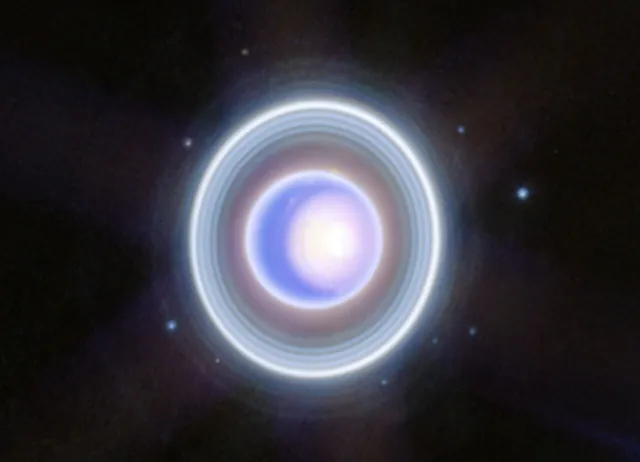
The atmosphere is mostly hydrogen and helium, with about 2 per cent methane and traces of water and ammonia. Methane absorbs the red part of sunlight, so the light reflected back from the cloud tops looks blue-green. It is also bitterly cold: temperatures fall as low as 49 K (−224 °C), which makes Uranus colder in places than Neptune, even though Neptune orbits much farther from the Sun.12
How blue is it? The familiar Voyager 2 pictures of Uranus were published in something close to true colour, unlike the same spacecraft’s deep-blue pictures of Neptune, which were contrast-stretched. A 2024 reanalysis found the two planets are a similar shade of greenish blue, with Uranus turning a little greener around its solstices. Webb’s pictures are infrared, so their colours are assigned.1112
Voyager 2 saw an almost featureless globe, but later observations show a changing world. Winds reach about 900 km/h, blowing against the planet’s rotation at the equator and with it nearer the poles. Hubble has watched a bright cap of haze over the north pole grow brighter year after year as northern summer approaches; NASA’s own pages put the solstice at 2028 or 2030.271213
What hides inside
Uranus is called an ice giant because of what lies beneath its atmosphere. Most of its mass, 80 per cent or more, is thought to be a hot, dense fluid of “icy” materials (water, methane and ammonia) lying above a small rocky core. “Ice” here names the ingredients, not their state: near the core the temperature reaches about 4,980 °C.2
For decades Uranus seemed to give off no more heat than it receives from the Sun, a conclusion that rested on one Voyager 2 measurement. Two studies published in 2025 found that it does emit a little heat of its own, about 12.5 to 15 per cent more than the sunlight it absorbs. That is still far less than Neptune, which emits more than twice what it receives.51415
Much of this picture is inferred rather than measured. There is no true surface to study, only gas that grows denser and hotter with depth, and only one spacecraft has ever passed by. Why Uranus releases so much less heat than the other giant planets has been hard to explain, and researchers look to a future flagship mission for answers.2514
Magnetic field and aurora
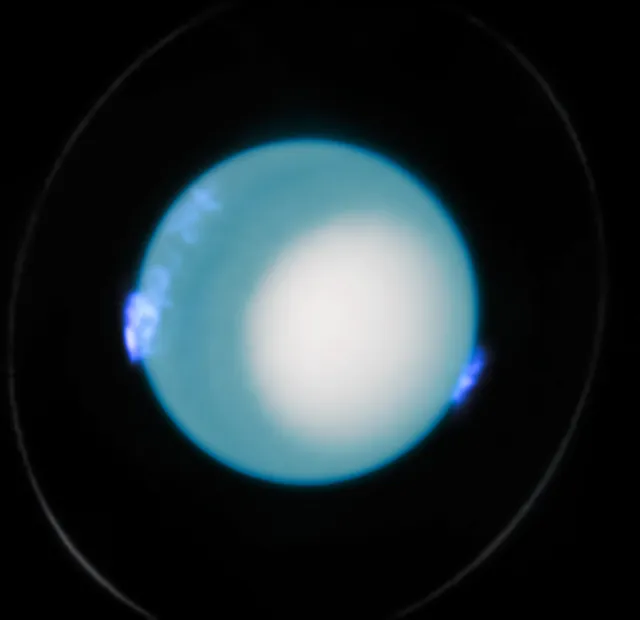
Voyager 2 found that Uranus has a magnetic field unlike any seen before. On most planets the magnetic axis lies close to the axis of rotation. On Uranus it is tilted nearly 60 degrees from it, and it does not pass through the middle of the planet but is offset by about a third of the planet’s radius.1216
The result is a lopsided magnetosphere. As the planet turns on its side, the field lines in the long tail trailing away from the Sun are twisted into a corkscrew. The aurorae do not circle the poles of rotation as they do on Earth, Jupiter and Saturn. Hubble first photographed them in 2011, and tracking their motion is what yielded the 2025 rotation period.2617
Notable features
The polar cap and hood
When Voyager 2 flew past, the south pole faced the Sun, and contrast-stretched false-colour images showed a dark polar hood ringed by lighter bands. Now the north pole is in sunlight and wears a bright cap of haze, which Hubble has watched grow brighter year after year and Webb imaged in infrared in 2023.71218
The dark spot of 2006
On 23 August 2006 Hubble’s Advanced Camera for Surveys took the first definitive images of a dark spot on Uranus: an elongated vortex about 1,700 by 3,000 km at 27 degrees north. Nothing like it appeared in Hubble pictures from 1994 to early 2006, so it had probably only just formed.19
The rings
The rings were discovered on 10 March 1977, when observers on the Kuiper Airborne Observatory and at Perth Observatory saw a star’s light dim before and after Uranus passed in front of it. Thirteen are known. Voyager 2 found two and Hubble two faint outer ones, announced in 2005; the inner rings are narrow and dark grey.2310
The Epsilon ring
The outermost and most substantial of the main rings lies 51,149 km from the planet’s centre, twice the planet’s radius. It is slightly eccentric and varies in width from 20 to 96 km, while most of the other main rings are only a few kilometres wide.20
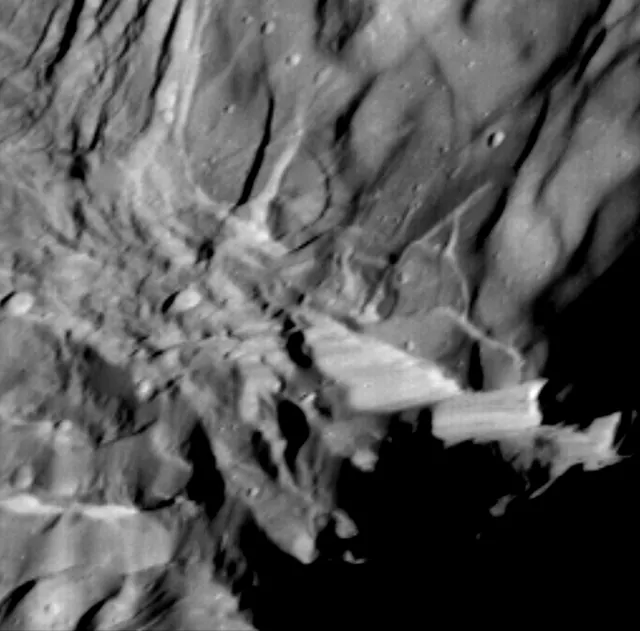
Verona Rupes
A fault cliff on Miranda, named after the city of Romeo and Juliet and mapped as a feature 116 km long. Its height is uncertain: NASA’s caption to the Voyager 2 image says it may be 5 km high, while a later NASA account puts it at an estimated 20 km, the tallest known cliff in the Solar System.212223
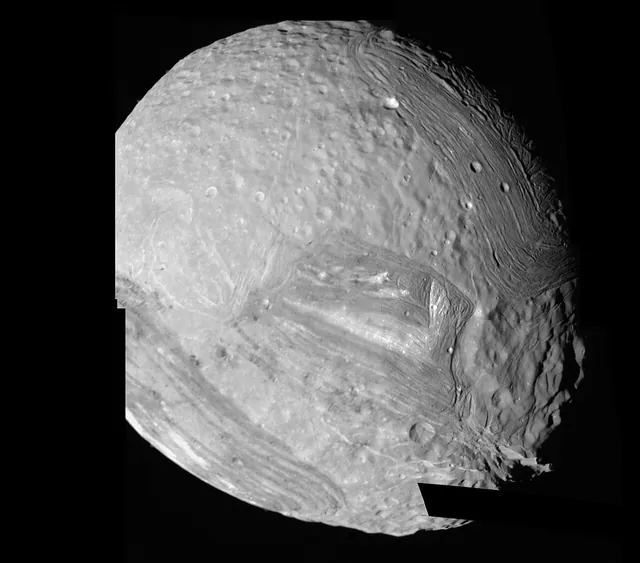
Miranda’s coronae
Three vast patches of ridges and grooves, sharply bounded and lightly cratered, found on no other known world: Arden (318 km across), Elsinore (323 km) and Inverness (234 km). Scientists disagree about their origin; the moon may have been shattered and reassembled, or slushy ice may have welled up from below.2124
Rings and moons
Uranus has 29 officially recognised moons. The five large ones are Titania and Oberon, found by William Herschel in 1787; Ariel and Umbriel, found by William Lassell in 1851; and Miranda, found by Gerard Kuiper in 1948. They are thought to be roughly half water ice and half rock. Their names come from the works of Shakespeare and Alexander Pope, not from classical myth.242425
Voyager 2 discovered ten small inner moons, and telescopes have added more ever since. The newest, S/2025 U1, was found in James Webb Space Telescope images taken on 2 February 2025. It is estimated to be only 10 km across and orbits about 56,000 km from the planet’s centre, between Ophelia and Bianca. The outer moons are probably captured asteroids.23426
The 13 rings fall into two groups. The inner system is mostly narrow and dark grey, ending at the Epsilon ring. Much farther out lie two broad, faint rings, the inner one reddish and the outer one blue. In order from the planet the rings are Zeta, 6, 5, 4, Alpha, Beta, Eta, Gamma, Delta, Lambda, Epsilon, Nu and Mu.220
Exploration
Only one spacecraft has visited Uranus. Voyager 2, launched on 20 August 1977, made its closest approach at 17:59 UT on 24 January 1986, about 81,500 km above the cloud tops, with only five and a half hours of close study. It found ten moons, two rings and the tilted magnetic field, and passed within 28,260 km of Miranda.316
Everything since has come from telescopes. Hubble found two outer rings and the moons Mab and Cupid, photographed the 2006 dark spot and the aurorae, and has recorded the seasons changing. In 2006 the Keck Observatory and Hubble showed that the outermost ring is blue. Webb imaged the rings and polar cap in infrared in 2023 and found a new moon in 2025.3712171926
A return is planned on paper only. The United States planetary science decadal survey for 2023–2032, published in April 2022, named a Uranus Orbiter and Probe as its highest-priority strategic mission. Engineers published an updated design in 2026, but it remains a concept: NASA’s Uranus pages speak of the possibility of a flagship mission and give no launch date.328
Quick answers
- How big is Uranus?
- Uranus has a mean radius of 25,362 km (3.98 × Earth).1
- How massive is Uranus?
- Uranus has a mass of 8.681 × 10²⁵ kg (14.54 × Earth).1
- How long is a day on Uranus?
- A day on Uranus lasts 17 h 14 min 52 s (spinning backwards; measured with Hubble, 2025).6
- How long is a year on Uranus?
- A year on Uranus lasts 84.01 Earth years.1
- How far is Uranus from the Sun?
- Uranus is 2,867 million km from the Sun (19.2 au on average).1
- How fast does Uranus move through space?
- Uranus moves along its orbit at 6.79 km/s (mean).1
- What is Uranus’ axial tilt?
- Uranus’ axis is tilted by 97.77°.1
- What is the temperature on Uranus?
- The temperature on Uranus is −197 °C (where the pressure is 1 bar).1
- How many moons does Uranus have?
- Uranus has 29 known moons.4
- What is Uranus made of?
- Uranus is made of icy fluids under hydrogen and helium.2
Sources
- Uranus Fact Sheet — NASA Space Science Data Coordinated Archive, 2024
- Uranus: Facts — NASA Science
- Uranus: Exploration — NASA Science
- Planetary Satellite Discovery Circumstances — NASA/JPL Solar System Dynamics
- NASA, Oxford Discover Warmer Uranus Than Once Thought — NASA Science, 2025
- Hubble Helps Determine Uranus’ Rotation Rate with Unprecedented Precision — NASA Science, 2025
- Hubble Monitors Changing Weather and Seasons at Jupiter and Uranus — NASA Science, 2023
- The Discovery of Uranus — Royal Museums Greenwich
- Herschel Museum of Astronomy — Bath Preservation Trust
- 240 Years Ago: Astronomer William Herschel Identifies Uranus as the Seventh Planet — NASA, 2021
- New images reveal what Neptune and Uranus really look like — Royal Astronomical Society, 2024
- NASA’s Webb Rings in Holidays with Ringed Planet Uranus — NASA Science, 2023
- 20-Year Hubble Study of Uranus Yields New Atmospheric Insights — NASA Science, 2025
- Internal Heat Flux and Energy Imbalance of Uranus (Wang et al., Geophysical Research Letters) — NASA Technical Reports Server, 2025
- UH Researchers Help Solve Uranus Heat Mystery — University of Houston, 2025
- Voyager 2 — NASA Science
- Hubble Spots Auroras on Uranus — NASA Science, 2017
- PIA00032: Uranus in True and False Color — NASA/JPL Photojournal
- Hubble Discovers Dark Cloud in the Atmosphere of Uranus — NASA Science, 2006
- Uranus Rings Fact Sheet — NASA Space Science Data Coordinated Archive, 2015
- Gazetteer of Planetary Nomenclature: Miranda — International Astronomical Union / US Geological Survey
- PIA00044: Miranda high resolution of large fault — NASA/JPL Photojournal
- Verona Rupes: Tallest Known Cliff in the Solar System — NASA Astronomy Picture of the Day, 2011
- Miranda — NASA Science
- Uranus Moons — NASA Science
- New Moon Discovered Orbiting Uranus Using NASA’s Webb Telescope — NASA Science, 2025
- Uranian Satellite Fact Sheet — NASA Space Science Data Coordinated Archive, 2023
- Uranus Orbiter and Probe: Mission Challenges and Concept Updates Since the Origins, Worlds, and Life Decadal Survey (The Planetary Science Journal) — NASA Technical Reports Server, 2026
Figures checked against these sources in November 2026. Where a quantity is not known, it is left out rather than estimated.

