moon
Oberon
Oberon is the outermost of Uranus’s five large moons and the second largest, a grey world of ice and rock about 1,523 km across. It circles the planet at 583,500 km every 13.46 days, always keeping the same face turned inwards. William Herschel discovered it on 11 January 1787, the same night as Titania, and it is named after the king of the fairies in Shakespeare’s A Midsummer Night’s Dream.1234
Voyager 2’s pictures from January 1986 show an ancient, heavily cratered surface like the highlands of Earth’s Moon, splashed with bright rays and with dark material lying on some crater floors, including the 206 km crater Hamlet. A mountain about 6 km high pokes above the edge of the disc. Oberon is roughly half ice and half rock, and models allow a thin ocean deep inside.125678
Size and physical properties
Oberon has a mean radius of 761.4 km, so it is about 1,523 km across: a little smaller than Titania and the second-largest moon of Uranus. JPL’s satellite ephemeris gives it a mass of about 3.1 × 10²¹ kg and a mean density of 1.66 g/cm³, consistent with a body that is roughly half water ice and half rock.129
Gravity at the surface is only about 0.35 m/s². Oberon reflects about 23 per cent of the sunlight that strikes it, a little less than Titania. Published figures for its mass disagree: NSSDC’s fact sheet lists 2.88 × 10²¹ kg and a density of 1.56 g/cm³, about 7 per cent below JPL’s values, which are used here.39
Orbit and rotation
Oberon orbits Uranus at an average distance of 583,500 km, almost 23 times the planet’s radius, taking 13.463234 days, or 13 days 11 hours 7 minutes, for each circuit. The orbit is nearly circular, with an eccentricity of 0.0014, and close to the plane of Uranus’s equator. Beyond Oberon lie only small irregular moons, on orbits millions of kilometres out.310
Oberon is tidally locked, turning once per orbit so that the same side always faces Uranus. Its leading hemisphere, the side that faces forward along its orbit, was found by Hubble in 2025 to be darker and redder than the trailing one, probably because Oberon sweeps up dust that drifts inwards from the irregular moons.312
- Rotation
- Synchronous3one turn per orbit
Discovery and naming
William Herschel discovered Oberon on 11 January 1787, observing from Slough in England, on the same night that he found Titania. He had discovered Uranus itself from Bath on 13 March 1781, and these two were the first of its moons to be seen; no others were found until 1851. Oberon is catalogued as Uranus IV.411
Herschel’s son John named it after the king of the fairies in Shakespeare’s A Midsummer Night’s Dream, husband of Titania. The theme carries on across its surface, where features are named after Shakespeare’s tragic heroes and places: craters such as Hamlet, Othello and Macbeth, and the canyon Mommur Chasma, named after Oberon’s forest home.141314
An ancient, cratered surface
Oberon is heavily cratered, much like Umbriel and unlike Ariel, Titania and Miranda. Voyager scientists compared its surface to the ancient cratered highlands of Earth’s Moon. Several large impact craters are surrounded by bright rays of ejected ice, similar to those on Jupiter’s moon Callisto, and Voyager’s pictures resolve features down to about 12 km across.156
Some crater floors are partly covered with very dark material. In NASA’s description of the best Voyager picture, a large crater near the centre has a bright central peak and a dark floor, perhaps icy, carbon-rich material erupted after the crater formed. NSSDC identifies the dark spot in a clear-filter Voyager frame as Hamlet, Oberon’s largest named crater.267
A large mountain about 6 km high peeks out on the moon’s lower left limb in Voyager’s best image. Telescope spectra from 2001 to 2005 found no carbon dioxide ice on Oberon, unlike its inner neighbours, but a 2026 study of James Webb Space Telescope spectra reports carbon dioxide mixed with carbon monoxide on Ariel, Umbriel, Titania and Oberon alike.161516
- Best Voyager resolution
- about 12 km6
A hidden ocean?
Oberon, like all of Uranus’s large moons, is roughly half ice and half rock. How these are arranged inside is unknown: Voyager 2 did not pass close enough to any of Uranus’s moons to detect the magnetic signals that revealed hidden oceans inside Jupiter’s moons Europa and Callisto, and no spacecraft has measured Oberon’s gravity in detail.118
A 2023 modelling study found that if Oberon has kept any liquid water to the present day, it is likely to be a residual ocean less than 50 km thick, perhaps extremely salty. Whether liquid survives depends on material properties and past orbital circumstances that are still unknown, so an ocean in Oberon remains a modelled possibility, not a discovery.8
Notable features
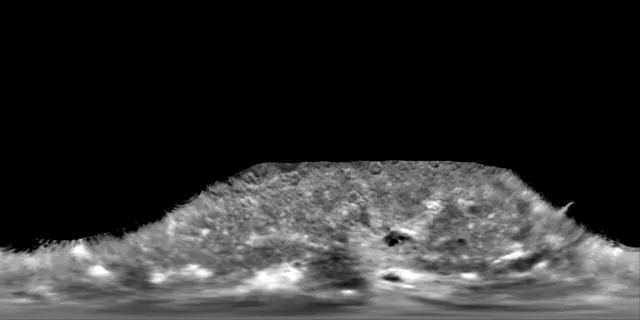
Hamlet
The largest named crater on Oberon, 206 km across and centred at 46.1° south. NSSDC identifies it as the dark spot seen in a Voyager 2 clear-filter image taken from about 663,000 km. It is named after the hero of Shakespeare’s tragedy Hamlet, and the name was approved in 1988.27
Macbeth
A crater 203 km across, almost as large as Hamlet, lying far to the south at 58.4° south. Like Oberon’s other craters it is named after one of Shakespeare’s heroes, here the title character of Macbeth; the name was approved in 1988.1319
Othello
An impact crater 114 km across near Oberon’s south pole, centred at 66° south. It is named after Othello, the title character of Shakespeare’s tragedy, and the name was approved by the International Astronomical Union in 1988.20
Mommur Chasma
A steep-sided canyon 537 km long, centred at 16.3° south: the largest named canyon on Oberon. Its name comes from Mommur, described in the gazetteer as a spirit place, the forest home of Oberon in A Midsummer Night’s Dream.141721
The limb mountain
An unnamed mountain about 6 km high, seen in silhouette on the lower left edge of the disc in Voyager 2’s best picture of Oberon, taken on 24 January 1986. NASA describes it as a striking topographic feature of Oberon.16
Exploration
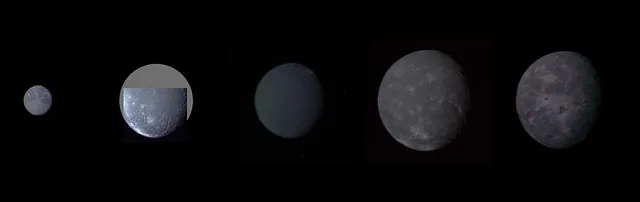
Only Voyager 2 has visited Oberon. It flew through the Uranus system on 24 January 1986 with just five and a half hours of close study. Its best picture of Oberon, taken shortly after 3:30 a.m. Pacific time from 660,000 km, shows features as small as 12 km, and only the southern hemisphere could be imaged.62223
Since then all new knowledge has come from telescopes. Earth-based spectra mapped its water ice, Hubble compared its two hemispheres in ultraviolet light, and the James Webb Space Telescope has measured carbon oxides on its surface. The 2022 United States planetary decadal survey named a Uranus Orbiter and Probe its top flagship priority, but it remains a concept with no launch date.1215162425
- Range of the best Oberon image
- 660,000 km6resolution about 12 km
Quick answers
- How massive is Oberon?
- Oberon has a mass of 3.08 × 10²¹ kg (from JPL’s GM; NSSDC lists 2.88 × 10²¹ kg).39
- How strong is gravity on Oberon?
- Gravity at the surface of Oberon is 0.354 m/s² (derived from JPL’s GM and mean radius).9
- How long is a day on Oberon?
- A day on Oberon lasts 13.463 days (synchronous: the same face always turned to Uranus).3
- How long does Oberon take to complete one orbit?
- Oberon completes one orbit in 13.463234 days (13 days 11 hours 7 minutes).310
- How far is Oberon from Uranus?
- Oberon is 583,500 km from Uranus (semi-major axis; 22.83 Uranus radii).310
- When was Oberon discovered?
- Oberon was discovered on 11 January 1787, by William Herschel, at Slough.411
- What is Oberon made of?
- Oberon is made of water ice and rock (roughly half of each).1
Sources
- Oberon — NASA Science, 2026
- Oberon – Voyager 2 (image 26836.23) — NASA Space Science Data Coordinated Archive, 2015
- Uranian Satellite Fact Sheet — NASA Space Science Data Coordinated Archive, 2023
- Planet and Satellite Names and Discoverers — IAU/USGS Gazetteer of Planetary Nomenclature
- Smith et al., Voyager 2 in the Uranian System: Imaging Science Results — Science, 1986
- Oberon at Voyager Closest Approach (PIA00034) — NASA Photojournal
- Hamlet (Oberon) — IAU/USGS Gazetteer of Planetary Nomenclature
- Castillo-Rogez et al., Compositions and Interior Structures of the Large Moons of Uranus and Implications for Future Spacecraft Observations — Journal of Geophysical Research: Planets, 2023
- Planetary Satellite Physical Parameters — NASA/JPL Solar System Dynamics
- Planetary Satellite Mean Elements — NASA/JPL Solar System Dynamics
- Planetary Satellite Discovery Circumstances — NASA/JPL Solar System Dynamics
- Moons of Uranus Surprise Scientists in NASA Hubble Study — Space Telescope Science Institute, 2025
- Categories for Naming Features on Planets and Satellites — IAU/USGS Gazetteer of Planetary Nomenclature
- Mommur Chasma (Oberon) — IAU/USGS Gazetteer of Planetary Nomenclature
- Grundy et al., Distributions of H₂O and CO₂ ices on Ariel, Umbriel, Titania, and Oberon from IRTF/SpeX observations — Icarus, 2006
- Cartwright et al., Tracing the source of carbon oxides on the large moons of Uranus — arXiv (preprint), 2026
- Nomenclature search results: Oberon — IAU/USGS Gazetteer of Planetary Nomenclature
- Cochrane et al., In Search of Subsurface Oceans within the Uranian Moons — Journal of Geophysical Research: Planets, 2021
- Macbeth (Oberon) — IAU/USGS Gazetteer of Planetary Nomenclature
- Othello (Oberon) — IAU/USGS Gazetteer of Planetary Nomenclature
- Descriptor Terms (Feature Types) — IAU/USGS Gazetteer of Planetary Nomenclature
- Voyager 2 — NASA Science
- Cartwright et al., The science case for spacecraft exploration of the Uranian satellites: Candidate ocean worlds in an ice giant system — arXiv, 2021
- Uranus Orbiter and Probe: Mission Challenges and Concept Updates Since the Origins, Worlds, and Life Decadal Survey — NASA Technical Reports Server, 2026
- Uranus Exploration — NASA Science
Figures checked against these sources in November 2026. Where a quantity is not known, it is left out rather than estimated.

