moon
Ariel
Ariel is the brightest of Uranus’s five large moons and the fourth largest, about 1,160 km across. William Lassell discovered it on 24 October 1851. Its surface appears to be the youngest of all the Uranian moons: few large craters survive, and the icy crust is slashed by enormous fault-bounded valleys whose floors have been partly filled with smoother, younger material.1234
Telescopes have found carbon dioxide ice on Ariel, concentrated on the hemisphere that trails behind in its orbit. In 2023 the James Webb Space Telescope also detected carbon monoxide ice and possible carbonate minerals, hinting that some of this carbon comes from inside the moon, perhaps even from a hidden ocean. Voyager 2, in January 1986, is the only spacecraft to have seen Ariel up close.5678
Size and physical properties
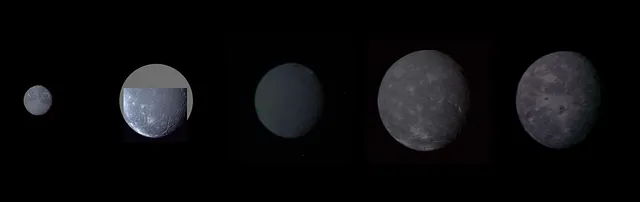
Ariel has a mean radius of 578.9 km, so it is about 1,160 km across, a little smaller than Umbriel and the fourth largest of Uranus’s moons after Titania, Oberon and Umbriel. NASA’s fact sheet gives it radii of 581.1, 577.9 and 577.7 km along its three axes, and a mass of about 1.29 × 10²¹ kg.29
Its mean density of 1.54 g/cm³ fits a mix of roughly equal amounts of water ice and rock. Ariel has the brightest surface of the five large Uranian moons, though all of them appear darkened by carbon-rich material. Its surface warms and cools quickly as sunlight comes and goes, and brightens sharply when lit from directly behind the observer: both signs of a porous, insulating surface layer.12
Orbit, rotation and seasons
Ariel orbits Uranus at an average of 190,900 km from the planet’s centre, about seven and a half times the planet’s radius, and takes 2.520379 days, or about 2 days 12 hours 29 minutes, to go round. Its orbit is a regular one: it travels in the same direction as Uranus spins, on a nearly circular path that lies almost exactly in the plane of the planet’s equator.1910
Like the other large Uranian moons it is tidally locked, always keeping the same face towards Uranus. Because the Uranian system is tipped over by about 98°, each pole spends about 21 years in constant sunlight, reaching an estimated 80–90 K, and then about 21 years in darkness at 20–30 K. Carbon dioxide ice warmed at the summer pole may drift to the dark winter hemisphere.169
- Length of each season
- about 21 years6
Discovery and naming
William Lassell, one of 19th-century England’s great amateur astronomers, discovered Ariel on 24 October 1851, observing from Liverpool. He paid for his telescopes with the fortune he had made in brewing. Lassell found Umbriel on the same night, bringing the number of known moons of Uranus to four, after William Herschel’s discovery of Titania and Oberon in 1787.1311
At Lassell’s request the name was chosen by John Herschel, son of the discoverer of Uranus. Ariel is a sylph in Alexander Pope’s poem The Rape of the Lock and a spirit who serves the magician Prospero in Shakespeare’s The Tempest; the IAU’s list cites Pope, while NASA mentions both. Ariel’s own craters and canyons are named after spirits from folklore around the world.1312
- Place
- Liverpool, England3
Canyons and young plains
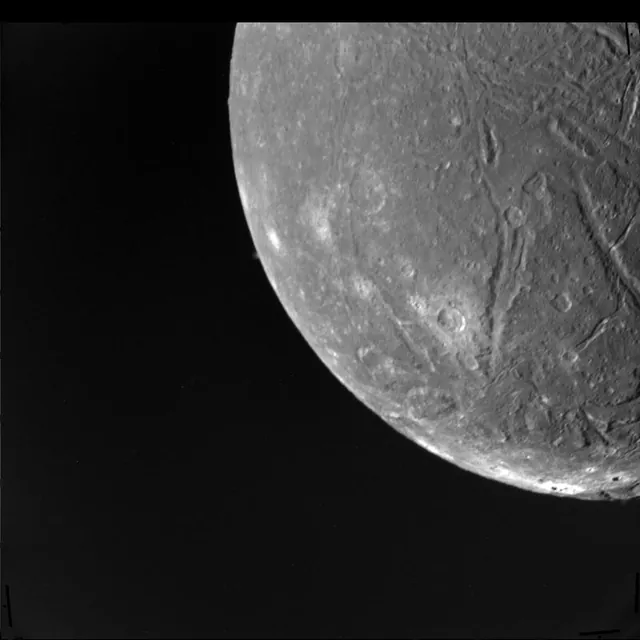
Ariel’s surface appears to be the youngest among the moons of Uranus. It has few large craters but many small ones: the large craters left by early, bigger impacts appear to have been wiped out, and some regions may be less than a billion years old. Much of the ground Voyager 2 saw is densely pitted with craters 5 to 10 km across.146
Valleys and fault scarps criss-cross this pitted terrain. Voyager scientists concluded that the valleys are graben, blocks of crust that dropped down as Ariel’s crust expanded and stretched. The largest valleys, and a smooth region near the centre of Voyager’s best view, are partly filled with younger deposits, cut in turn by narrow, winding scarps and valleys that may have formed by faulting or by the flow of fluids.1413
Some of these features may be cryovolcanic, made by icy material erupting from within. A 2025 study argued that the grooves running along the floors of the largest canyons are spreading centres, where material from the interior rose and formed new crust: with their floors removed, the canyon walls fit together like puzzle pieces. These grooves are among Ariel’s youngest known features.67
Ices of carbon
Ariel is thought to be roughly half water ice and half rock, and carbon dioxide ice has been found on its surface. Spectra taken with the IRTF telescope’s SpeX instrument from 2001 to 2005 mapped the carbon dioxide and showed it is most abundant on Ariel’s trailing hemisphere. Its signature weakens on moons farther from Uranus and is absent on Oberon.156
The James Webb Space Telescope observed Ariel on 6 and 7 September 2023. Its spectra confirmed strong carbon dioxide features, possibly in deposits thicker than about 10 mm, and revealed carbon monoxide ice and a band that may come from carbonate minerals. The team suggested that some of these carbon oxides come from Ariel’s interior, later spread around by radiation, sublimation and the seasons.67
What hides inside
Early in its history Ariel seems to have been heated enough to separate into layers, with denser rock sinking towards the centre and lighter ice rising. Models suggest that tides raised by Uranus were an important source of that heat, and that Ariel and its neighbours went through repeated cycles of heating, melting and freezing as their orbits fell into and out of resonance.17
Ariel is counted among the candidate ocean worlds and may still hold a thin remnant ocean beneath its ice. How big or how deep such an ocean might be can only be estimated, and whether it is connected to the canyons and the carbon ices on the surface is not known.67
Notable features
Kachina Chasmata
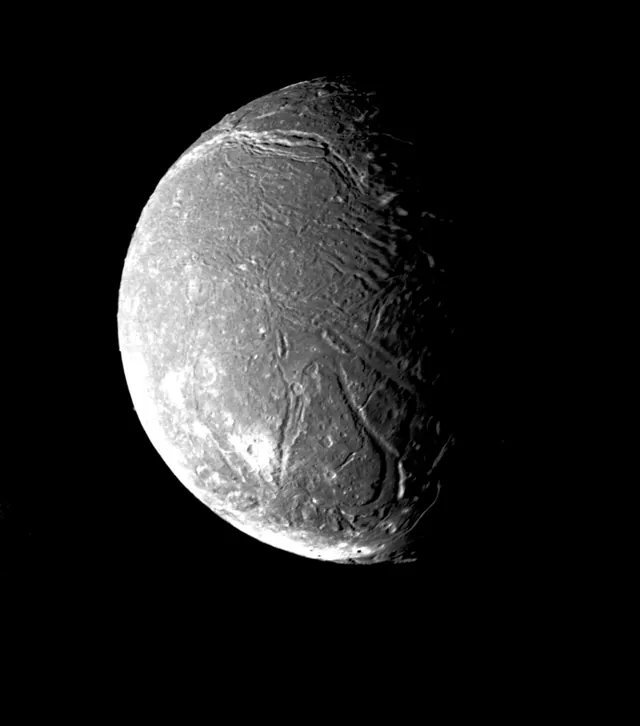
Ariel’s longest system of canyons, 622 km long and centred at 34° south. The name comes from the kachinas, good spirits of the Pueblo peoples of the United States who bring rain and other blessings.14
Kewpie Chasma
A canyon 467 km long at 28° south, the second longest named canyon on Ariel after Kachina Chasmata. It is named after a British race of quaint spirit babies. Ariel’s great canyons, or chasmata, are fault-bounded valleys cut through its older, pitted terrain.41215
Korrigan Chasma
A canyon 365 km long at 28° south, named after the korrigans, French wind spirits said to cure diseases. Like Ariel’s other large canyons it is a graben, a valley where a block of crust dropped between faults as the crust stretched.416
Yangoor
Ariel’s largest named crater, 78 km across, lying far to the south at 69° south. It is named after an Australian spirit that brings the day; like nearly all of Ariel’s craters, canyons and valleys, it takes its name from a spirit of folklore.1217
Domovoy
A crater 71 km across near the south pole, at 72° south, and the second largest named crater on Ariel. It takes its name from the domovoy, the Slavic spirit that protects the home.1218
Exploration
Voyager 2 is the only spacecraft to have visited. On 24 January 1986, the day of its closest approach to Uranus, it imaged Ariel from about 130,000 km, resolving details down to 2.4 km. Its best colour view, taken from 170,000 km through green, blue and violet filters, shows the southern hemisphere, and coverage of the moon remains incomplete.481920
Since then telescopes have taken over, from the ground-based IRTF to the James Webb Space Telescope. Scientists want an orbiter to map Ariel’s grooves and ices close up. The United States planetary science decadal survey named a Uranus Orbiter and Probe as its highest-priority strategic mission for 2023–2032, and an updated concept was published in 2026.56721
Quick answers
- How big is Ariel?
- Ariel has a mean radius of 578.9 km (about 1,160 km across).2
- How massive is Ariel?
- Ariel has a mass of 1.29 × 10²¹ kg.9
- How dense is Ariel?
- Ariel has a mean density of 1.54 g/cm³.2
- How long is a day on Ariel?
- A day on Ariel lasts 2.520379 days (synchronous: the same face always turned to Uranus).19
- How long does Ariel take to complete one orbit?
- Ariel completes one orbit in 2.520379 days (about 2 days 12 hours 29 minutes).910
- How far is Ariel from Uranus?
- Ariel is 190,900 km from Uranus (semi-major axis, from the planet’s centre).9
- What is the temperature on Ariel?
- The temperature on Ariel is about 80–90 K (−193 to −183 °C), estimated peak at the summer pole; 20–30 K at the winter pole.6
- What is Ariel made of?
- Ariel is made of water ice and silicate rock (thought to be in roughly equal amounts, with carbon dioxide ice on the surface).1
Sources
- Ariel — NASA Science
- Planetary Satellite Physical Parameters — NASA/JPL Solar System Dynamics
- Planet and Satellite Names and Discoverers — IAU/USGS Gazetteer of Planetary Nomenclature
- Ariel’s Densely Pitted Surface (PIA01534) — NASA Photojournal, 1999
- Grundy et al., Distributions of H2O and CO2 ices on Ariel, Umbriel, Titania, and Oberon from IRTF/SpeX observations — Icarus (preprint on arXiv), 2006
- Cartwright et al., JWST Reveals CO Ice, Concentrated CO2 Deposits, and Evidence for Carbonates Potentially Sourced from Ariel’s Interior — The Astrophysical Journal Letters, 2024
- New Study Suggests Trench-Like Features on Uranus’ Moon Ariel May Be Windows to Its Interior — Johns Hopkins University Applied Physics Laboratory, 2025
- Voyager 2 — NASA Science
- Uranian Satellite Fact Sheet — NASA Space Science Data Coordinated Archive, 2023
- Planetary Satellite Mean Elements — NASA/JPL Solar System Dynamics
- Planetary Satellite Discovery Circumstances — NASA/JPL Solar System Dynamics
- Nomenclature search results: Ariel — IAU/USGS Gazetteer of Planetary Nomenclature
- Ariel at Voyager Closest Approach (PIA00037) — NASA Photojournal, 2000
- Kachina Chasmata (Ariel) — IAU/USGS Gazetteer of Planetary Nomenclature
- Kewpie Chasma (Ariel) — IAU/USGS Gazetteer of Planetary Nomenclature
- Korrigan Chasma (Ariel) — IAU/USGS Gazetteer of Planetary Nomenclature
- Yangoor (Ariel) — IAU/USGS Gazetteer of Planetary Nomenclature
- Domovoy (Ariel) — IAU/USGS Gazetteer of Planetary Nomenclature
- Ariel – Highest Resolution Color Picture (PIA00041) — NASA Photojournal, 1996
- Uranus – Montage of Uranus’ Five Largest Satellites (PIA01361) — NASA Photojournal, 1999
- Uranus Orbiter and Probe: Mission Challenges and Concept Updates Since the Origins, Worlds, and Life Decadal Survey — The Planetary Science Journal (NASA Technical Reports Server record), 2026
Figures checked against these sources in November 2026. Where a quantity is not known, it is left out rather than estimated.

