moon
Umbriel
Umbriel is the darkest of Uranus’s large moons, an ancient ball of ice and rock about 1,170 km across. It orbits 266,000 km from the planet every 4.14 days, always showing Uranus the same face. William Lassell discovered it from Liverpool on 24 October 1851, the same night as Ariel, and it is named after a malevolent spirit in Alexander Pope’s poem The Rape of the Lock.1234
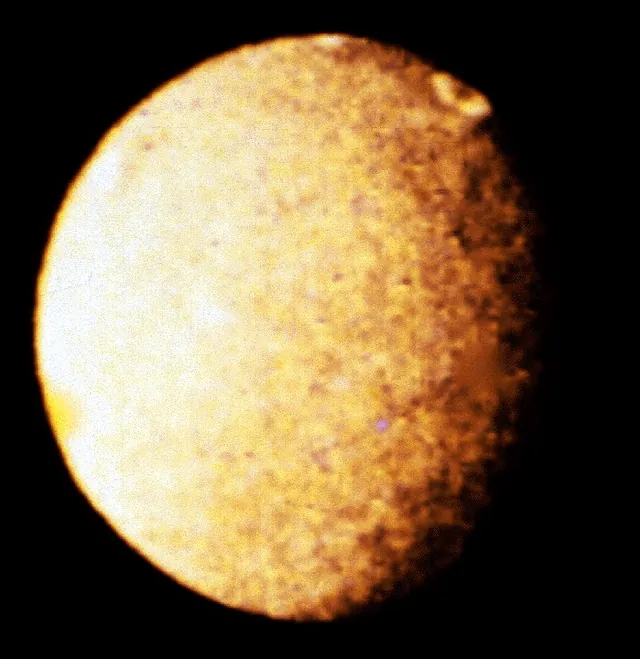
Voyager 2’s pictures from January 1986 show an evenly dark surface crowded with craters and little sign of geological activity. It reflects only 16 per cent of the light that strikes it. The striking exception is a bright ring about 140 km wide near the equator, at the crater Wunda. What darkened Umbriel, and what made the ring, are still unknown.1256
Size and physical properties
Voyager 2 images give Umbriel a mean radius of 584.7 km, about 1,170 km across. That makes it the third-largest moon of Uranus, only a few kilometres wider than Ariel. Its mean density of about 1.52 g/cm³ fits a body made of roughly half water ice and half rock, though the published values range from 1.46 to 1.54 g/cm³.237811
On 21 September 2020 Umbriel passed in front of a star, and observers across the United States and Canada recorded 19 positive chords. They gave a radius of 582.4 ± 0.8 km, a surface gravity of 0.251 m/s² and an escape velocity of 0.541 km/s. The fitted outline pointed to strong topography, with a limb parameter of 4.2 km, matching what Voyager had measured on the opposite, southern hemisphere.8
Orbit and rotation
Umbriel orbits Uranus at an average distance of 266,000 km, about 10.4 times the planet’s radius, between Ariel and Titania. Each circuit takes 4.144176 days, or 4 days 3 hours 28 minutes. Its orbit is nearly circular, with an eccentricity of 0.0039, and tilted by only about a tenth of a degree to the plane of Uranus’s equator.39
Umbriel is tidally locked, turning once per orbit so that the same side always faces Uranus. Scientists expected charged particles in Uranus’s magnetic field to darken its trailing hemisphere, but in 2025 Hubble found its leading and trailing sides very similar in brightness. The outer moons Titania and Oberon may shield it from incoming dust.312
- Rotation
- Synchronous3one turn per orbit
Discovery and naming
The astronomer William Lassell discovered Umbriel from Liverpool on 24 October 1851, the same night on which he found Ariel. They were the first new moons of Uranus to be found since William Herschel spotted Titania and Oberon in 1787. Umbriel is catalogued as Uranus II.410
John Herschel, William’s son, named it after Umbriel, a malevolent spirit in Alexander Pope’s 18th-century poem The Rape of the Lock; Ariel is named after a sylph from the same poem. Umbriel’s own craters keep the gloomy theme, named after dark spirits from world folklore, such as Wunda, an Australian dark spirit.14613
A dark, battered surface
Umbriel is heavily cratered, its surface resembling the ancient cratered highlands of Earth’s Moon, and it appears to have seen the least geological activity of Uranus’s large moons. It is almost completely covered with uniform dark material and lacks the many bright-rayed craters of its neighbours, so it shows little contrast. How this ancient surface was darkened remains a mystery.12514
The brightest area Voyager 2 saw is a ring about 140 km in diameter near the equator, at the 131 km crater Wunda. Its nature is not known, though it might be a frost deposit associated with the impact. On the shadow line Voyager also caught a crater about 110 km across with a bright central peak.256
Telescope spectra taken from 2001 to 2005 revealed carbon dioxide ice on Umbriel for the first time, concentrated on its trailing hemisphere. James Webb Space Telescope spectra published in 2026 show carbon dioxide and carbon monoxide gathered there too, which could point to production by charged-particle radiation, although the same study argues that the carbon oxides may be native to the moon.1516
No detectable atmosphere
The stellar occultation of 21 September 2020 also searched for gas around Umbriel. None was detected. For a thin atmosphere of carbon dioxide at 70 K, the observations set upper limits on the surface pressure of 13 nanobars at the 1σ level and 72 nanobars at the 3σ level.8
Notable features
Wunda
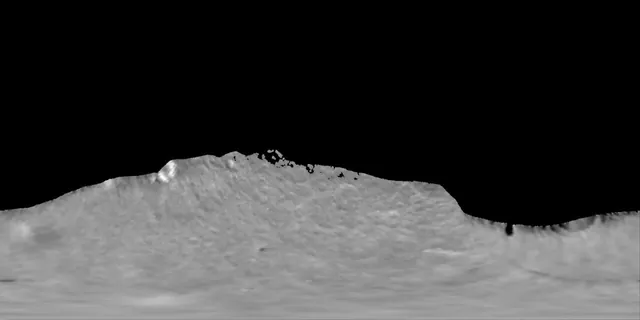
A crater 131 km across, centred at 7.9° south near the equator, whose bright ring is the most reflective area Voyager 2 found on Umbriel. Its name, approved in 1988, comes from an Australian dark spirit. What makes the ring so bright is unknown; frost is one suggestion.256
Wokolo
The largest named crater on Umbriel, 208 km across and centred at 30° south. The gazetteer records its name as that of a devil spirit of the Baramba of West Africa, and the name was approved by the International Astronomical Union in 1988.1718
Malingee
A crater 164 km across at 22.9° south, the second-largest named crater on Umbriel. It takes its name from an Aboriginal spirit who travels at night, in keeping with the moon’s theme of dark spirits, and was approved in 1988.131819
Vuver
A crater 98 km across, just south of the equator at 4.7° south. It is named after an evil spirit of the Volga Finns. Like the other named features on Umbriel, it lies in the southern hemisphere, the only part Voyager 2 could see, and was approved in 1988.182021
Skynd
A crater 72 km across lying almost on the equator, at 1.8° south. Its name comes from a troll who, the gazetteer says, stole the three wives of a man living in Englerup, from a collection of fairy lore. It was approved in 1988.22
Exploration
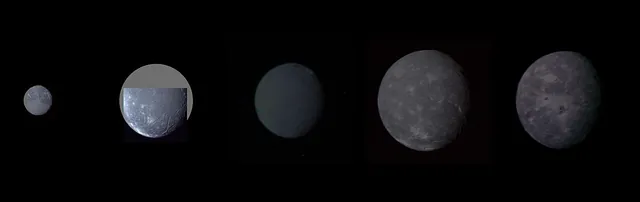
Only Voyager 2 has visited Umbriel. It flew through the Uranus system on 24 January 1986, with just five and a half hours of close study. Its most detailed image of Umbriel, a clear-filter view taken from 557,000 km, shows features about 10 km across, and only the southern hemisphere was in view.52123
Everything since has come from telescopes. Earth-based spectra found carbon dioxide ice, the 2020 occultation measured Umbriel’s size and its unseen northern limb, and Hubble and the James Webb Space Telescope have studied its surface. The 2022 United States planetary decadal survey named a Uranus Orbiter and Probe its top flagship priority, but it remains a concept with no launch date.81215162425
- Range of the most detailed Umbriel image
- 557,000 km5resolution about 10 km
Quick answers
- How big is Umbriel?
- Umbriel has a mean radius of 584.7 km (about 1,170 km across; a 2020 occultation gave 582.4 km).378
- How massive is Umbriel?
- Umbriel has a mass of 1.28 × 10²¹ kg (from JPL’s GM; NSSDC lists 1.22 × 10²¹ kg).37
- How dense is Umbriel?
- Umbriel has a mean density of 1.523 g/cm³ (NSSDC lists 1.46; the 2020 occultation study 1.54).378
- How strong is gravity on Umbriel?
- Gravity at the surface of Umbriel is 0.251 m/s² (from the 2020 occultation study).8
- How long is a day on Umbriel?
- A day on Umbriel lasts 4.144 days (synchronous: the same face always turned to Uranus).3
- How long does Umbriel take to complete one orbit?
- Umbriel completes one orbit in 4.144176 days (4 days 3 hours 28 minutes).39
- How far is Umbriel from Uranus?
- Umbriel is 266,000 km from Uranus (semi-major axis; 10.41 Uranus radii).39
Sources
- Umbriel — NASA Science, 2024
- Umbriel – Voyager 2 (image P-29502) — NASA Space Science Data Coordinated Archive
- Uranian Satellite Fact Sheet — NASA Space Science Data Coordinated Archive, 2023
- Planet and Satellite Names and Discoverers — IAU/USGS Gazetteer of Planetary Nomenclature
- Umbriel at Closest Approach (PIA00040) — NASA Photojournal
- Wunda (Umbriel) — IAU/USGS Gazetteer of Planetary Nomenclature
- Planetary Satellite Physical Parameters — NASA/JPL Solar System Dynamics
- Assafin et al., Kilometer-precise (UII) Umbriel physical properties from the multichord stellar occultation on 2020 September 21 — Monthly Notices of the Royal Astronomical Society, 2023
- Planetary Satellite Mean Elements — NASA/JPL Solar System Dynamics
- Planetary Satellite Discovery Circumstances — NASA/JPL Solar System Dynamics
- Oberon — NASA Science, 2026
- Moons of Uranus Surprise Scientists in NASA Hubble Study — Space Telescope Science Institute, 2025
- Categories for Naming Features on Planets and Satellites — IAU/USGS Gazetteer of Planetary Nomenclature
- Smith et al., Voyager 2 in the Uranian System: Imaging Science Results — Science, 1986
- Grundy et al., Distributions of H₂O and CO₂ ices on Ariel, Umbriel, Titania, and Oberon from IRTF/SpeX observations — Icarus, 2006
- Cartwright et al., Tracing the source of carbon oxides on the large moons of Uranus — arXiv (preprint), 2026
- Wokolo (Umbriel) — IAU/USGS Gazetteer of Planetary Nomenclature
- Nomenclature search results: Umbriel — IAU/USGS Gazetteer of Planetary Nomenclature
- Malingee (Umbriel) — IAU/USGS Gazetteer of Planetary Nomenclature
- Vuver (Umbriel) — IAU/USGS Gazetteer of Planetary Nomenclature
- Cartwright et al., The science case for spacecraft exploration of the Uranian satellites: Candidate ocean worlds in an ice giant system — arXiv, 2021
- Skynd (Umbriel) — IAU/USGS Gazetteer of Planetary Nomenclature
- Voyager 2 — NASA Science
- Uranus Orbiter and Probe: Mission Challenges and Concept Updates Since the Origins, Worlds, and Life Decadal Survey — NASA Technical Reports Server, 2026
- Uranus Exploration — NASA Science
Figures checked against these sources in November 2026. Where a quantity is not known, it is left out rather than estimated.

