moon
Miranda
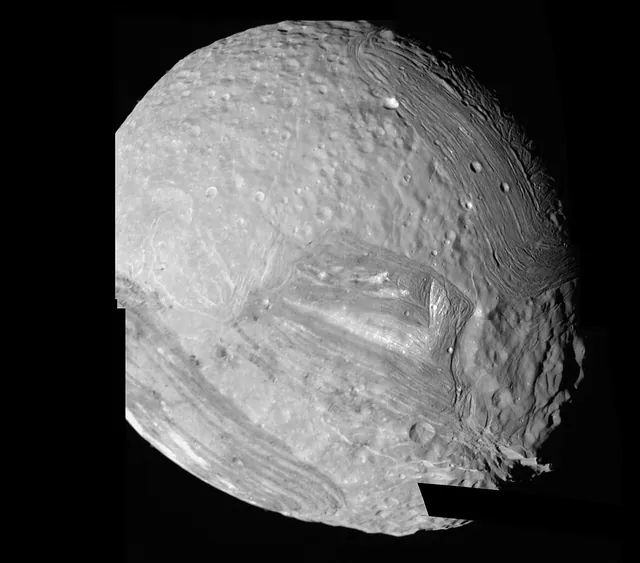
Miranda is the smallest and innermost of the five large moons of Uranus, only about 470 km across. When Voyager 2 swept past on 24 January 1986, its cameras revealed one of the strangest surfaces in the Solar System: old, cratered plains broken up by three huge grooved patches called coronae, and cut by canyons and cliffs that seem far too grand for so small a world.1234
How Miranda came to look like a patchwork quilt is still argued over. It may have been shattered and pieced back together, or warm, slushy ice may have welled up from inside. A 2024 study of its fractures suggests that between 100 and 500 million years ago a deep ocean lay beneath a thin icy shell. Voyager 2 is the only spacecraft to have visited, and it saw only the southern hemisphere.256
Size and physical properties
Miranda has a mean radius of 235.8 km, so it is about 470 km across: roughly one-seventh the size of Earth’s Moon, and the smallest of Uranus’s five large moons. It is not quite round. NASA’s fact sheet gives it radii of 240, 234.2 and 232.9 km along its three axes, and a mass of about 6.6 × 10¹⁹ kg.127
Its mean density of 1.18 g/cm³ is only a little more than that of water, fitting a body thought to be made of roughly equal amounts of water ice and rock. The surface is nearly as bright as Ariel’s but returns no more than about a third of the sunlight that falls on it. Miranda brightens sharply when fully lit from behind the observer, a sign of a porous surface.127
Orbit and rotation
Miranda circles Uranus at an average of 129,900 km from the planet’s centre, about five times the planet’s radius, and is the closest of the five large moons. It completes an orbit every 1.413479 days, about 33 hours and 55 minutes. The orbit is almost perfectly circular, but unlike those of the other four large moons it is noticeably tilted, by 4.34° to Uranus’s equator.278
Miranda is tidally locked, turning once per orbit so that one face always points at Uranus. Because the whole Uranian system is tipped over by about 98°, each pole of its moons spends about 21 years in sunlight and then 21 in darkness. Earlier in its history, orbital resonances with neighbouring moons may have made Miranda’s orbit more oval and its spin axis more tilted, heating it with tides.5710
- Rotation
- Synchronous7one turn per orbit
Discovery and naming
The astronomer Gerard P. Kuiper found Miranda on 16 February 1948, on photographs of the Uranian system taken at the McDonald Observatory near Fort Davis in western Texas. It was the fifth moon of Uranus to be found, after Titania and Oberon in 1787 and Ariel and Umbriel in 1851, and the last before Voyager 2 arrived in 1986.2911
Kuiper named it after the heroine of Shakespeare’s The Tempest, daughter of the magician Prospero. The moons of Uranus are named after characters from Shakespeare and Alexander Pope, and Miranda’s landscape follows suit: its craters carry the names of people in The Tempest, while its larger features are named after places in Shakespeare’s plays, from the forest of Arden to Hamlet’s Elsinore.291213
- Named after
- Miranda, heroine of The Tempest9named by Kuiper
A patchwork surface
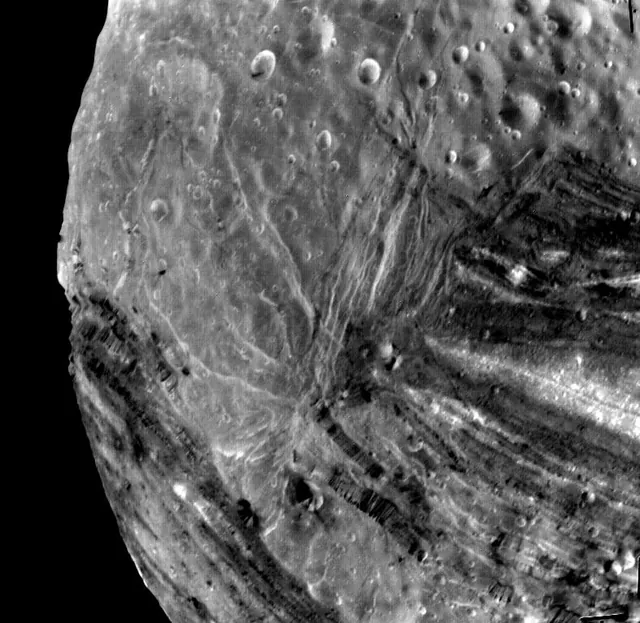
Voyager 2 found two strikingly different kinds of ground. One is old, heavily cratered, rolling terrain of fairly even brightness. The other is young and complex, with sets of bright and dark bands, scarps and ridges. The young terrain forms three coronae, unique in the Solar System: lightly cratered collections of ridges and valleys, set off from the older ground by sharp boundaries like mismatched patches.24
Faults slice across both. Voyager’s best mosaic shows folded ridges, probably squeezed together, and pulled-apart faults with cliffs 0.5 to 5 km high, taller than the walls of the Grand Canyon. NASA describes fault canyons as much as 12 times as deep as the Grand Canyon, and some grooves and troughs are a few kilometres deep, exposing materials of different brightness.21415
Why Miranda looks like this is unsettled. It may have been smashed apart and haphazardly reassembled, or slushy, partly melted ice may have risen to the surface and refrozen, perhaps after large impacts. Most studies of the coronae favour diapirism, the rise of buoyant, warmer ice from below; cryovolcanism and a giant impact have also been proposed. The youngest activity probably happened in bursts within the last 100 to 500 million years.25
What it is made of
Like Uranus’s other large moons, Miranda is thought to be roughly half water ice and half silicate rock, its surface darkened by carbon-rich material. Near-infrared spectra show an absorption at 2.2 microns that is best matched by ammonia ice or ammonia hydrates. Unlike its larger neighbours, Miranda shows no sign of carbon dioxide ice. Ammonia does not last long on Miranda’s surface, so its presence may mean activity was relatively recent.216
A buried ocean?
Nobody has measured Miranda’s interior. In 2024 a team mapped its craters, ridges and furrows from Voyager images and compared the pattern with the stresses that tides would raise in different interiors. The best match needed an icy crust no more than 30 km thick over an ocean at least 100 km deep, sometime in the last 100 to 500 million years.56
Such an ocean would have filled almost half of the moon. The researchers think tidal heating during past orbital resonances with neighbouring moons kept it liquid. Because the surface lacks the cracks that a freezing ocean would cause by expanding, they suggest Miranda may still be cooling and could hold a thin ocean today, though only new data can show whether any ocean exists.56
- Icy crust in the 2024 model
- 30 km thick or less5
Notable features
Arden Corona
A squarish corona 318 km across, centred at 29° south and named after the forest in As You Like It. It is made of concentric grooves interpreted as a series of normal faults, with dark and bright material in the grooves that may have been exposed or pushed up by the faulting.517
Elsinore Corona
The largest corona, 323 km across, on the opposite hemisphere from Arden and named after Hamlet’s castle. Like Arden it is made of concentric grooves, and its southern part consists of terrain that looks folded or as though it once flowed.518
Inverness Corona
The corona near the south pole, 234 km across and named after Macbeth’s castle. At its centre is a prominent bright, L-shaped region. Its side nearer Elsinore looks folded, its side nearer Arden pulled apart, so it may mark a change from stretching to squeezing of the crust.519
Verona Rupes
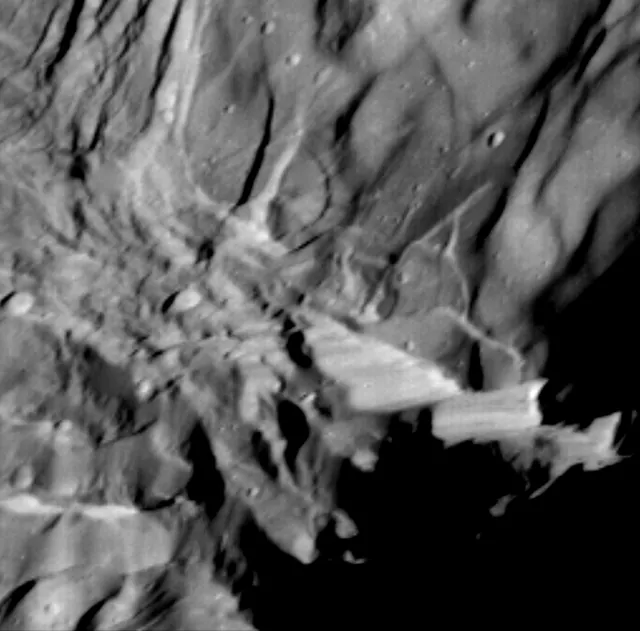
A fault cliff 116 km long, named after Romeo and Juliet’s city. Sources disagree on its height: a Voyager image caption says it may be 5 km high, while a NASA picture-of-the-day estimates 20 km. A dropped rock would take about 10 to 12 minutes to fall from the top.2202122
Alonso
The largest named crater on Miranda, 25 km across at 44° south, named after the King of Naples in The Tempest. Miranda’s named craters are all 25 km across or less and take their names from characters in that play, including Prospero (21 km), Ferdinand, Stephano and Trinculo.13
Exploration
Voyager 2, launched on 20 August 1977, is the only spacecraft to have visited. It made its closest approach to Uranus on 24 January 1986 and flew past Miranda at only 28,260 km, the closest it had come to any object in its travels so far. Its sharpest frames show details down to 560 metres, but only Miranda’s southern hemisphere was in view.3514
Since then Miranda has been studied only from afar, with telescopes measuring the ices on its surface. A return is a matter of planning: the United States planetary science decadal survey named a Uranus Orbiter and Probe as its highest-priority strategic mission for 2023–2032, and engineers published an updated concept for it in 2026.1623
Quick answers
- How big is Miranda?
- Miranda has a mean radius of 235.8 km (about 470 km across).1
- How massive is Miranda?
- Miranda has a mass of 6.6 × 10¹⁹ kg.7
- How dense is Miranda?
- Miranda has a mean density of 1.18 g/cm³.1
- How long is a day on Miranda?
- A day on Miranda lasts 1.413479 days (synchronous: the same face always turned to Uranus).7
- How long does Miranda take to complete one orbit?
- Miranda completes one orbit in 1.413479 days (about 33 hours 55 minutes).78
- How far is Miranda from Uranus?
- Miranda is 129,900 km from Uranus (semi-major axis, from the planet’s centre).7
- What is Miranda made of?
- Miranda is made of water ice and silicate rock (thought to be in roughly equal amounts).2
Sources
- Planetary Satellite Physical Parameters — NASA/JPL Solar System Dynamics
- Miranda — NASA Science
- Voyager 2 — NASA Science
- South Polar View of Miranda (PIA01490) — NASA Photojournal, 1998
- Strom et al., Constraining Ocean and Ice Shell Thickness on Miranda from Surface Geological Structures and Stress Modeling — The Planetary Science Journal, 2024
- Uranus’ Moon Miranda May Have an Ocean Beneath Its Surface, New Study Finds — Johns Hopkins University Applied Physics Laboratory, 2024
- Uranian Satellite Fact Sheet — NASA Space Science Data Coordinated Archive, 2023
- Planetary Satellite Mean Elements — NASA/JPL Solar System Dynamics
- Planet and Satellite Names and Discoverers — IAU/USGS Gazetteer of Planetary Nomenclature
- Cartwright et al., JWST Reveals CO Ice, Concentrated CO2 Deposits, and Evidence for Carbonates Potentially Sourced from Ariel’s Interior — The Astrophysical Journal Letters, 2024
- Planetary Satellite Discovery Circumstances — NASA/JPL Solar System Dynamics
- Uranus Moons — NASA Science, 2026
- Nomenclature search results: Miranda — IAU/USGS Gazetteer of Planetary Nomenclature
- Miranda – High Resolution Mosaic (PIA00043) — NASA Photojournal, 1996
- Miranda Fractures, Grooves and Craters (PIA00140) — NASA Photojournal, 1996
- DeColibus, Chanover and Cartwright, Are NH3 and CO2 ice present on Miranda? — arXiv (accepted by The Planetary Science Journal), 2023
- Arden Corona (Miranda) — IAU/USGS Gazetteer of Planetary Nomenclature
- Elsinore Corona (Miranda) — IAU/USGS Gazetteer of Planetary Nomenclature
- Inverness Corona (Miranda) — IAU/USGS Gazetteer of Planetary Nomenclature
- Verona Rupes (Miranda) — IAU/USGS Gazetteer of Planetary Nomenclature
- Miranda High Resolution of Large Fault (PIA00044) — NASA Photojournal, 1996
- Verona Rupes: Tallest Known Cliff in the Solar System — NASA Astronomy Picture of the Day, 2011
- Uranus Orbiter and Probe: Mission Challenges and Concept Updates Since the Origins, Worlds, and Life Decadal Survey — The Planetary Science Journal (NASA Technical Reports Server record), 2026
Figures checked against these sources in November 2026. Where a quantity is not known, it is left out rather than estimated.

