moon
Moon
The Moon is Earth’s only natural satellite, a rocky world 3,475 km across that circles us at an average distance of 384,400 km. It turns once for every orbit, so the same face is always towards us. Its bright highlands and dark lava plains, the maria, record more than four billion years of impacts and ancient volcanic eruptions, preserved because the Moon has almost no air and no weather.1234
It probably formed when a body about the size of Mars struck the young Earth, although scientists still debate the details. Its gravity raises our ocean tides, and it is slowly drifting away, by about 3.8 cm a year. Twelve Apollo astronauts walked on it between 1969 and 1972; in April 2026 the four-person crew of Artemis II flew around it, and NASA now plans its next crewed landing for 2028.15678
Size and physical properties
The Moon has a mean radius of 1,737.4 km, a little over a quarter of Earth’s. It is slightly flattened, 1,738.1 km across the equator against 1,736.0 km to the poles. Its mass is 7.346 × 10²² kg, about 1.2 per cent of Earth’s, so Earth outweighs it roughly 80 times. Earth is about 3.7 times wider.169
With a mean density of 3.344 g/cm³, well below Earth’s 5.51, the Moon is mostly rock with little iron. Gravity at the surface is 1.62 m/s², about one-sixth of Earth’s, which is why astronauts seemed to bounce across the ground. A spacecraft needs 2.38 km/s to escape. The surface is dark, with a geometric albedo of only 0.12.12
Orbit, rotation and tides
The Moon orbits Earth every 27.3217 days at an average distance of 384,400 km. Because Earth is meanwhile moving around the Sun, the cycle of phases, from one new moon to the next, takes longer: 29.53 days. The orbit is slightly oval, so the distance varies, roughly from 357,000 km at the closest perigees to 407,000 km at the farthest apogees. It is tilted 5.1° to the plane of Earth’s orbit.1211
The Moon is tidally locked: it spins once on its axis in exactly the time it takes to orbit, so one hemisphere always faces us. We still glimpse a little more than half, because the tilt and oval shape of the orbit let us see it from slightly different angles over a month. This apparent wobble is called libration. The far side is not dark; it simply faces away from Earth.21011
The Moon’s gravity is the main cause of Earth’s ocean tides, pulling the water into two bulges, one facing the Moon and one on the far side; the Sun adds a little less than half as much. Earth’s spin carries the bulges slightly ahead of the Moon, and their pull alters its orbital speed, so it creeps away from us by about 3.8 cm a year while Earth’s day gradually lengthens.15610
- Mean perigee
- 363,300 km1closest approaches range down to about 357,000 km
- Mean apogee
- 405,500 km1farthest points reach about 407,000 km
- Sidereal month (orbital period)
- 27.3217 days1
- Synodic month (new moon to new moon)
- 29.53 days1
- Rotation period
- 655.720 hours (27.32 days)1synchronous with the orbit
- Eccentricity
- 0.05491
- Inclination to the ecliptic
- 5.145°1
- Axial tilt to its orbit
- 6.68°1
- Mean orbital speed
- 1.022 km/s1
Origin and make-up
The leading idea is that the Moon was born in a giant collision about 4.5 billion years ago, when an object perhaps the size of Mars, sometimes called Theia, struck the young Earth and flung molten and vaporised debris into orbit. NASA notes that several versions of the theory still compete, including a series of impacts rather than one, and one simulation in which the Moon formed within hours.25
Apollo samples supplied the main evidence. Lunar rocks match Earth’s in their oxygen isotopes, are poor in elements that boil away easily, and show the Moon was once covered by a deep ocean of magma. The light mineral anorthosite floated to the top of that ocean to form the first crust. The Moon’s iron core is tiny, only about 1.6 to 1.8 per cent of its mass, against about 30 per cent for Earth’s.25
Maria, highlands and craters
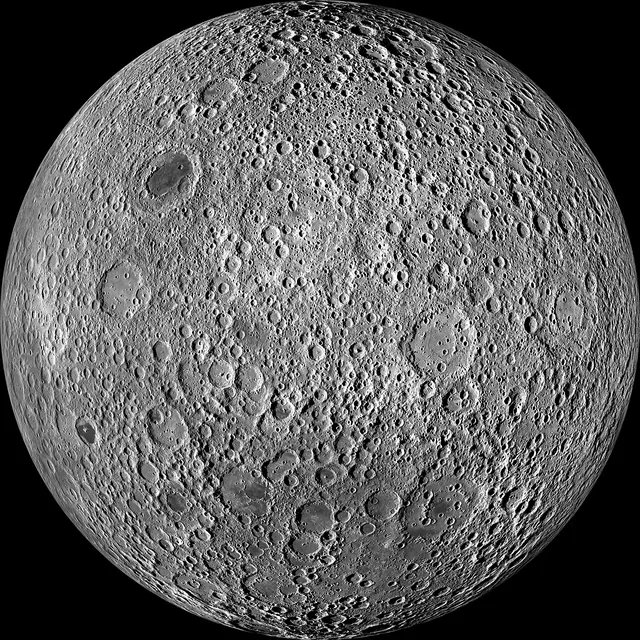
The Moon’s light areas are the highlands, ancient crust rich in calcium and aluminium. The dark maria, Latin for ‘seas’, are huge impact basins flooded with iron- and titanium-rich basalt lava between about 4.2 and 1.2 billion years ago. Volcanism was far more widespread on the near side than on the far side, which is heavily cratered and has a thicker crust. Why the two hemispheres differ so much is still unexplained.235
Without air to slow them, asteroids, meteoroids and comets have pounded the surface for billions of years. More than 40 impact basins wider than 300 km are known; the largest is the South Pole–Aitken basin. The impacts have ground the surface into regolith, a grey blanket of dust and broken rock only a few metres thick in parts of the young maria but up to about 20 m deep in the old highlands.234
The Moon is not entirely dry. Craters near the poles that never see sunlight are cold enough to trap ice: in 2018 data from NASA’s Moon Mineralogy Mapper on India’s Chandrayaan-1 confirmed water ice in such permanently shadowed regions. In 2020 the SOFIA airborne observatory found water molecules even on the sunlit surface, in Clavius crater, at about the equivalent of a 12-ounce (355 ml) bottle of water spread through a cubic metre of soil.213
What hides inside
Like Earth, the Moon has a crust, a mantle and a core, known from Apollo seismometers, laser ranging and orbiting spacecraft. Four seismometers left by the astronauts recorded moonquakes until 1977. Reanalysed with techniques from Earth seismology, those records point to a solid, iron-rich inner core about 240 km in radius inside a liquid iron shell about 90 km thick, wrapped in a partially molten layer.2314
Above lies the mantle, mostly solid and made of minerals such as olivine and pyroxene, then the crust. NASA gives the crust as about 40 km thick on the near side and 60 km on the far side. Gravity maps from the twin GRAIL spacecraft, flown in 2012, showed a porous crust, about 12 per cent empty space, with an average thickness of only 34 to 43 km, 10 to 20 km less than earlier estimates.231516
The Moon is still active in small ways. As its interior cools it shrinks, by about 50 m in diameter over the last several hundred million years, cracking the crust into cliffs called lobate scarps. Shallow moonquakes can reach magnitude 5.5 and last more than ten minutes, while much deeper ones are triggered by the tidal pull of Earth.617
- Inner core radius
- about 240 km2solid, iron-rich
- Liquid outer core
- about 90 km thick2
- Core size
- about 20% of the way to the surface3
- Average crust thickness (GRAIL)
- 34–43 km316NASA’s overview pages give about 40 km (near side) and 60 km (far side)
- Moment of inertia factor
- 0.3941a uniform sphere would give 0.4
- Largest shallow moonquakes
- up to magnitude 5.517
A whisper of an atmosphere
The Moon has only an exosphere, so thin that its atoms almost never collide with one another. It holds about a million billion times fewer molecules per cubic centimetre than Earth’s air, and its total mass is estimated at only about 25,000 kg. It is made almost entirely of helium, neon and argon, with traces of hydrogen, sodium and other elements, constantly topped up by impacts on the surface and by the solar wind.118
Apollo 12, 14 and 15 left gauges that confirmed how sparse the gas is, and Apollo 17 carried a spectrometer to measure its make-up. NASA’s LADEE orbiter studied it in 2013 and 2014. The exosphere gives no protection from radiation or meteoroids, and the exhaust of a single lander can briefly dominate it nearby.21819
Magnetism
Today the Moon has no global magnetic field, only scattered patches of magnetised crust; one of them shelters the bright swirl Reiner Gamma from the solar wind. Yet magnetised rocks brought back by Apollo show that the young Moon had a field that lasted more than a billion years and at times was as strong as Earth’s. It is recorded in samples as young as 3.1 billion years.22021
That field was probably generated by a dynamo of churning molten metal in the core. NASA researchers have proposed that heat released as the core crystallised powered it, but what drove and ended the lunar dynamo is still debated, and other sources, such as heat from impacts, have also been suggested.21
Notable features
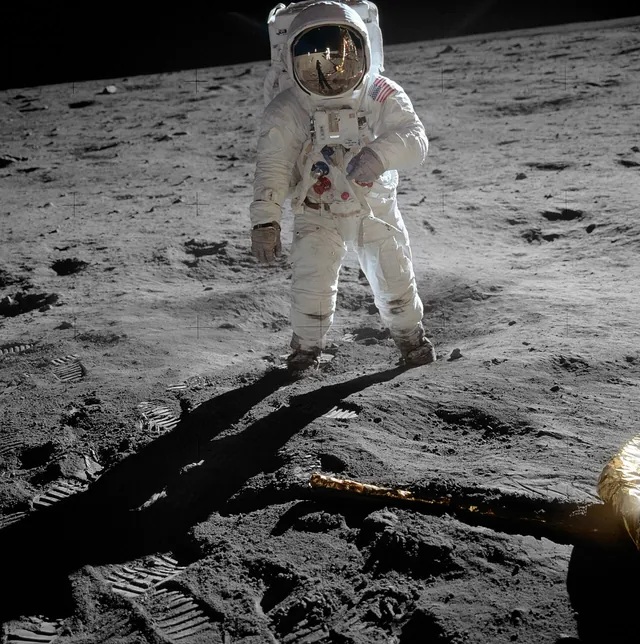
Mare Tranquillitatis
The ‘Sea of Tranquility’, a dark lava plain 876 km across on the eastern near side. On 20 July 1969 Apollo 11 landed near its south-western edge; the site, Statio Tranquillitatis, was named after the crew’s call sign ‘Tranquility Base’ and lies at 0.67° north, 23.47° east.22232425
Mare Imbrium
The ‘Sea of Showers’, a dark lava plain 1,146 km across in the north-west of the near side; among named maria only Mare Frigoris spans more. It fills the vast Imbrium impact basin, within which lies the bright young crater Copernicus. The name was adopted by the IAU in 1935.262728
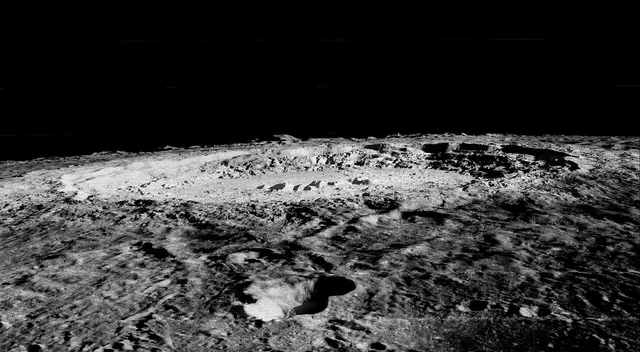
Copernicus
A crater 96 km across on the Imbrium plain, named after the Polish astronomer. Its bright rays lie over all the surrounding terrain, so it gave its name to the youngest age of lunar rocks. Apollo 12 collected material thought to be its ejecta, dated to about 800 million years.272829
Tycho
A crater 85 km across in the southern highlands, named after the Danish astronomer Tycho Brahe. At about 110 million years old it is young for the Moon. It is a complex crater, with terraced walls and a group of central peaks rising from its floor. The name was adopted by the IAU in 1935.2430
South Pole–Aitken basin
The largest and oldest recognised impact basin on the Moon, roughly 2,500 km across and more than 8 km deep, stretching across nearly a quarter of the Moon on the far side, from the crater Aitken down to the south pole. Its solidified sheet of impact melt is thought to be about 50 km thick.43132
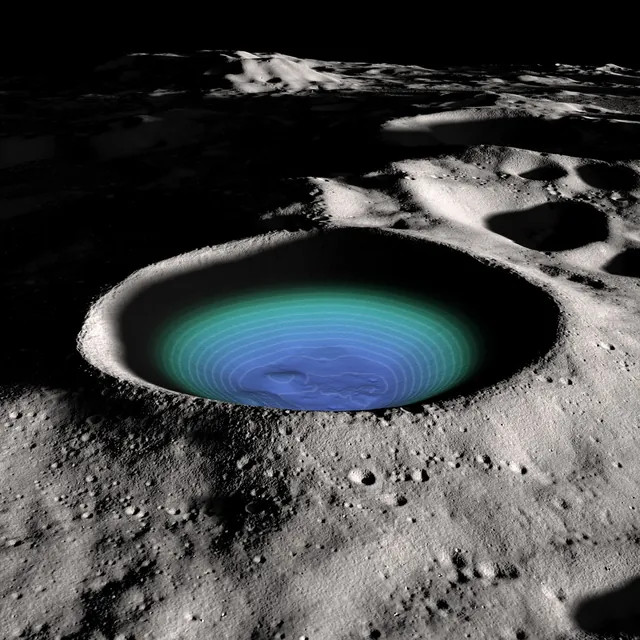
Shackleton
A crater 21 km across almost exactly at the south pole, named after the explorer Ernest Shackleton. Its floor lies in permanent shadow, among the cold traps where water ice can survive, and NASA plans to build its Moon Base in the surrounding south polar region.71333
Exploration
The Soviet Union reached the Moon first. Luna 2 struck its surface on 13 September 1959, the first spacecraft to do so, and a month later Luna 3 sent back the first pictures of the far side. NASA’s Ranger probes returned close-up images before crashing, from Ranger 7 in 1964, and Surveyor 1 made the first American soft landing in June 1966, paving the way for astronauts.224
Between 1969 and 1972 six Apollo missions landed, and twelve astronauts walked on the Moon, from Neil Armstrong and Buzz Aldrin to Gene Cernan and Harrison Schmitt. They brought home 382 kg of rock and soil and left seismometers and laser reflectors. More than 105 robotic spacecraft have now been launched to the Moon, among them NASA’s Lunar Reconnaissance Orbiter, mapping it since 2009 and still active.2357123435
China’s Chang’e 4 made the first landing on the far side in January 2019, Chang’e 5 returned samples in 2020 and Chang’e 6 brought back the first far-side samples in 2024. India’s Chandrayaan-3 landed near the south pole in August 2023. NASA’s Artemis II carried four astronauts around the Moon in April 2026. Artemis III, due in 2027, will test docking with landers in Earth orbit; Artemis IV is to land in 2028.8243637
- First impact
- Luna 2, 13 September 195924
- First far-side pictures
- Luna 3, October 195924
- First soft landing
- Luna 9, 3 February 196624
- Lunar Reconnaissance Orbiter
- launched 18 June 2009; still operating2435
- First far-side landing
- Chang’e 4, 3 January 201924
- First far-side sample return
- Chang’e 6, 202424
- Chandrayaan-3 landing
- 23 August 202324the first soft landing near the south pole
- Artemis II crewed flyby
- 1–10 April 2026836farthest humans have travelled: 252,756 miles (about 406,770 km) from Earth
- Next crewed landing
- Artemis IV, planned for 20288
Quick answers
- How big is the Moon?
- The Moon has a mean radius of 1,737.4 km (about 27 per cent of Earth’s).1
- How massive is the Moon?
- The Moon has a mass of 7.346 × 10²² kg (about 1.2 per cent of Earth’s).1
- How strong is gravity on the Moon?
- Gravity at the surface of the Moon is 1.62 m/s² (about one-sixth of Earth’s).12
- How long is a day on the Moon?
- A day on the Moon lasts 27.32 days (synchronous: one turn per orbit, so the same face always points at Earth).110
- How long does the Moon take to complete one orbit?
- The Moon completes one orbit in 27.3217 days (the cycle of phases, the synodic month, takes 29.53 days).1
- How far is the Moon from Earth?
- The Moon is 384,400 km from Earth (average; roughly 357,000 to 407,000 km).12
Sources
- Moon Fact Sheet — NASA Space Science Data Coordinated Archive, 2024
- Moon Facts — NASA Science, 2026
- Moon Composition & Structure — NASA Science, 2026
- Moon Craters — NASA Science, 2026
- Moon Formation — NASA Science, 2026
- Tides — NASA Science, 2026
- Moon Exploration — NASA Science, 2026
- Artemis — NASA, 2026
- Compare Earth and the Moon — NASA Science, 2026
- Tidal Locking — NASA Science, 2026
- Moon Phase and Libration, 2026 — NASA Scientific Visualization Studio, 2025
- The Apollo Program — NASA
- Water & Ices on the Moon — NASA Science, 2026
- Weber et al., Seismic Detection of the Layers of the Lunar Core — NASA Technical Reports Server, 2010
- GRAIL (Ebb and Flow) — NASA Science, 2024
- Taylor, Wieczorek, Neumann et al., Revised Thickness of the Lunar Crust from GRAIL Data: Implications for Lunar Bulk Composition — NASA Technical Reports Server (Lunar and Planetary Science Conference), 2013
- Moonquakes — NASA Science, 2026
- The Moon’s Atmosphere — NASA Science, 2026
- LADEE — NASA Science, 2024
- Solar Wind on the Moon — NASA Science, 2026
- NASA Scientists Find Dynamo at Lunar Core May Have Formed Magnetic Field — NASA
- Mare Tranquillitatis (Moon) — IAU/USGS Gazetteer of Planetary Nomenclature
- Statio Tranquillitatis (Moon) — IAU/USGS Gazetteer of Planetary Nomenclature
- Moon Missions — NASA Science, 2026
- Apollo 11 — NASA
- Mare Imbrium (Moon) — IAU/USGS Gazetteer of Planetary Nomenclature
- Limb of Copernicus Impact Crater (PIA00094) — NASA Photojournal, 1998
- Copernicus Crater and The Lunar Timescale — Lunar Reconnaissance Orbiter Camera, Arizona State University
- Copernicus (Moon) — IAU/USGS Gazetteer of Planetary Nomenclature
- Tycho (Moon) — IAU/USGS Gazetteer of Planetary Nomenclature
- The Moon’s Largest Impact Basin (PIA13496) — NASA Photojournal, 2010
- The Moon’s largest impact basin — Lunar Reconnaissance Orbiter Camera, Arizona State University, 2010
- Shackleton (Moon) — IAU/USGS Gazetteer of Planetary Nomenclature
- Who Has Walked on the Moon? — NASA Science, 2026
- Lunar Reconnaissance Orbiter — NASA Science, 2026
- Artemis II — NASA, 2026
- Artemis III — NASA, 2026
Figures checked against these sources in November 2026. Where a quantity is not known, it is left out rather than estimated.

