star
Sun
The Sun is the star at the centre of the Solar System: a glowing ball of hydrogen and helium 109 times as wide as Earth that holds 99.8 per cent of all the mass in the Solar System. Its gravity keeps every planet, asteroid and comet in orbit, and its light, which takes about eight minutes and 20 seconds to reach Earth, makes life here possible.123
It is an ordinary yellow dwarf, spectral type G2 V, about 4.6 billion years old and a little less than halfway through its life. In its core, at about 15 million °C, hydrogen fuses into helium. The Sun is anything but calm, though: on a cycle of roughly 11 years it swings between quiet spells and stormy peaks of sunspots, flares and eruptions that can reach Earth.124
Size and physical properties
The Sun is 1.39 million km across, 109 times the width of Earth, and its volume would hold about 1.3 million Earths. Its mass is 333,000 times Earth’s and makes up 99.8 per cent of everything in the Solar System. Being gas rather than rock, it is on average only about 1.4 times as dense as water, yet gravity at its visible surface is 28 times as strong as on Earth.12
Every second the Sun radiates 3.828 × 10²⁶ joules of energy, and to do so it converts about 4.26 million tonnes of matter into energy. It is almost perfectly round, flattened by only about 0.005 per cent. Astronomers class it as a G2 V star, a yellow dwarf on the main sequence, and the gradual fusion of hydrogen into helium in its core gives it the long lifetime that life on Earth has needed.126
The Sun formed about 4.6 billion years ago from a collapsing, spinning cloud of gas and dust, the solar nebula. Scientists expect it to shine much as it does now for another 5 billion years or so. Then it will swell into a red giant large enough to engulf Mercury and Venus, and possibly Earth, before ending its life as a white dwarf.2
- Mean radius
- 695,700 km1109.2 × Earth
- Mass
- 1.9884 × 10³⁰ kg1332,900 Earths
- Share of the Solar System’s mass
- 99.8%2
- Volume
- 1.412 × 10¹⁸ km³11,304,000 Earths
- Mean density
- 1,408 kg/m³1Earth: 5,514; water: 1,000
- Surface gravity
- 274.0 m/s²1at the equator; 28 × Earth
- Escape velocity
- 617.6 km/s1
- Flattening
- 0.000051
- Luminosity
- 3.828 × 10²⁶ W1
- Mass converted to energy
- 4.26 million tonnes per second1
- Absolute magnitude
- +4.831
- Spectral type
- G2 V1
- Age
- about 4.6 billion years2the same NASA page also gives 4.5 billion
- Expected remaining life as it is now
- about 5 billion years2
Rotation and motion
Because the Sun is a ball of electrically charged gas, or plasma, it does not turn as one piece. The equator goes round once in about 25 days and the regions near the poles in about 36. Astronomers adopt 25.38 days, the period at 16 degrees latitude. The spin axis is tilted by 7.25 degrees from the plane in which the planets orbit.12
The Sun does not stand still either. It moves at 19.4 km/s relative to the stars around it and carries the whole Solar System round the centre of the Milky Way once every 230 million years or so. Earth’s distance from it varies between 147.1 and 152.1 million km over the year, so sunlight takes a little over eight minutes to reach us.123
- Rotation at the equator
- about 25 days2
- Rotation at the poles
- about 36 days2
- Adopted rotation period
- 609.12 hours (25.38 days)1sidereal, at 16° latitude
- Speed relative to nearby stars
- 19.4 km/s1
- One orbit of the Milky Way
- about 230 million years2
- Apparent diameter
- 1,919 arcseconds1about half a degree; at 1 au
- Apparent magnitude
- −26.741
What hides inside
At the centre, where models put the temperature at about 15.7 million kelvin and the pressure at about 2.5 × 10¹¹ bar, hydrogen nuclei fuse into helium. In the simplest chain of reactions, four protons end up as one helium nucleus, releasing nearly 20 million times as much energy as burning the same weight of carbon. The outward push of this energy holds up the Sun’s enormous weight and stops it collapsing.126
Around the core lies the radiative zone, where energy creeps outward as radiation, absorbed and re-emitted countless times. NASA estimates that it takes about 170,000 years to get from the core to the top of the convection zone. Helioseismology, the study of sound waves ringing through the Sun, places the base of the convection zone at 71.3 per cent of the way from the centre to the surface.278
The convection zone fills the last 200,000 km or so below the surface. Here the temperature has fallen below 2 million °C, and great bubbles of hot plasma rise, cool and sink again, carrying heat to the surface, where their tops are seen as granules. Magnetic fields generated in the interior rise through this layer and break out into the atmosphere.27
- Central pressure
- 2.477 × 10¹¹ bar1
- Thickness of the core
- about 138,000 km2
- Base of the convection zone
- 0.713 of the Sun’s radius8from the centre; measured by helioseismology
- Depth of the convection zone
- about 200,000 km7
- Temperature in the convection zone
- below 2 million °C2
- Time for energy to reach the convection zone
- about 170,000 years2
What the Sun is made of
Measured by mass, the Sun’s visible surface is 73.8 per cent hydrogen and 24.9 per cent helium; everything else, which astronomers lump together as metals, adds up to just 1.3 per cent. Counted as atoms rather than by weight, hydrogen is even more dominant, at about 91 per cent, with helium at about 9 per cent and oxygen, carbon, neon and nitrogen the commonest of the rest.15
These figures come from the dark absorption lines in sunlight. A 2009 reanalysis with three-dimensional models of the solar atmosphere found less carbon, nitrogen, oxygen and neon than had been thought, lowering the share of heavier elements from about 2 per cent to 1.4 per cent. This clashes with models of the solar interior tested by helioseismology, a disagreement that has yet to be resolved.5
Atmosphere and the solar wind
The Sun has no solid surface. What we see is the photosphere, the “sphere of light”, a layer a few hundred kilometres thick from which most of the Sun’s radiation escapes into space, at about 5,500 °C. Above it lie the thin chromosphere, where the temperature climbs to tens of thousands of degrees, a narrow, irregular transition region, and the vast corona, the Sun’s upper atmosphere.127
The corona reaches temperatures of up to 2 million °C, hundreds of times hotter than the surface beneath it. Why is one of the biggest unsolved puzzles in solar physics, known as the coronal heating problem; it dates from 1942, when Bengt Edlén showed that mysterious lines in the corona’s light came from iron stripped of 13 electrons, which needs extreme heat. Both the corona and the chromosphere are normally drowned out by the photosphere and show themselves during a total eclipse.29
The corona is so hot that it streams away continuously as the solar wind, a flow of charged particles that blows in all directions and drags the Sun’s magnetic field out into a spiral. The Ulysses spacecraft found that wind from the regions near the poles travels at about 750 km/s and fills two-thirds of the space around the Sun, much faster than the 350 km/s wind from near the equator.210
- Effective temperature of the photosphere
- 5,772 K1
- Temperature range in the photosphere
- 6,600 K at the bottom to 4,400 K at the top1
- Thickness of the chromosphere
- about 2,500 km1
- Temperature of the corona
- up to 2 million °C2
- Fast solar wind
- about 750 km/s10from the polar regions
- Slow solar wind
- about 350 km/s10from the equatorial zone
Magnetic field and the solar cycle
The Sun’s activity rises and falls on a cycle averaging about 11 years, first noticed in the number of sunspots by Heinrich Schwabe in 1843. Around each peak, or solar maximum, the Sun’s magnetic poles swap places, so its magnetic field takes about 22 years, two sunspot cycles, to return to its starting arrangement. At maximum, sunspots, flares and coronal mass ejections are common; at minimum the Sun is often spotless.14911
Solar Cycle 25 began at the solar minimum of December 2019. In October 2024 NASA, NOAA and the international Solar Cycle Prediction Panel announced that the Sun had reached its maximum period, sooner and stronger than the panel had predicted in 2019. Sunspot records analysed by Belgium’s Solar-Terrestrial Centre of Excellence have since confirmed that the smoothed sunspot number peaked in October 2024 at 161, and that the cycle is now past its maximum.2412
Carried outward by the solar wind, the Sun’s magnetic field blows a vast bubble, the heliosphere, that encloses all the planets, so Earth lies inside the Sun’s extended atmosphere. Its outer edge, the heliopause, was crossed by Voyager 1 on 25 August 2012 and by Voyager 2 on 5 November 2018; beyond it lies interstellar space.21314
Notable features
Sunspots
Dark patches that are slightly cooler than the surrounding photosphere, where concentrated magnetic fields, around 3,000 gauss, break through the surface. They last from days to months and range from about 1,600 to 160,900 km across. Their numbers rise and fall with the solar cycle and are used to track it.124
Granulation
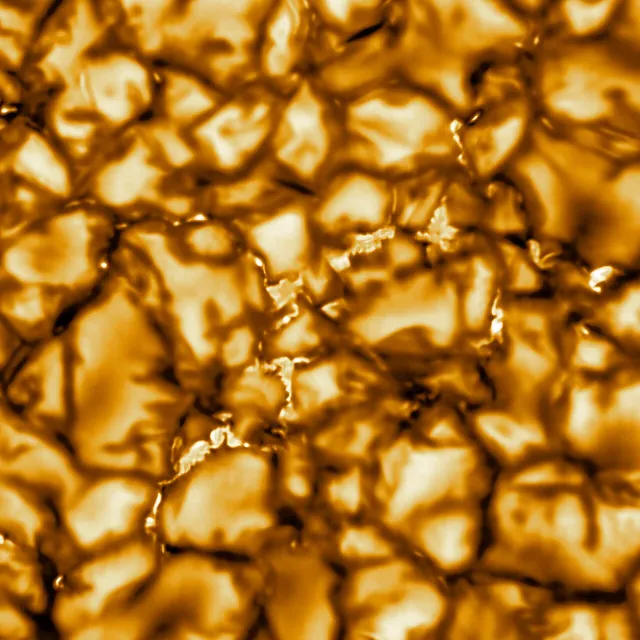
The whole surface is covered in a shifting pattern of cells, each roughly the size of Texas: the tops of convection currents, in which hot plasma rises in the bright centres, cools and sinks in the dark lanes between. The Inouye Solar Telescope’s first images in 2020 resolved features as small as 30 km within them.715
Solar flares
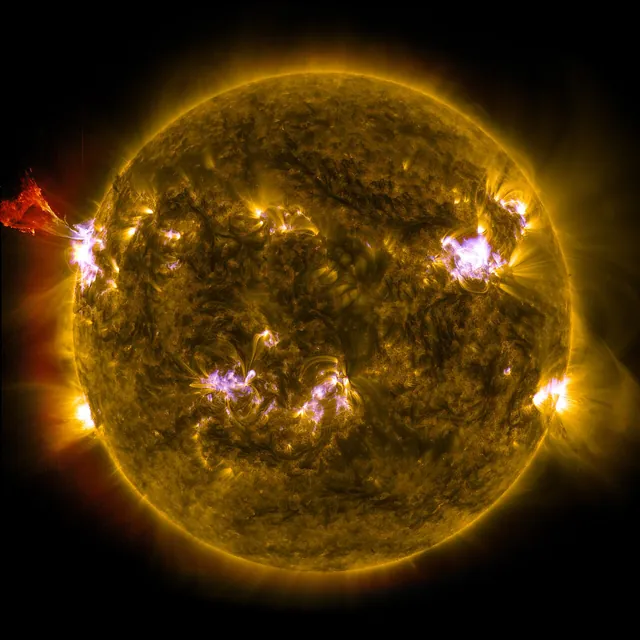
Sudden, intense bursts of light and particles triggered by the release of magnetic energy, the most powerful explosions in the Solar System, with energy comparable to billions of hydrogen bombs. The strongest are classed X. Between 3 and 9 May 2024 NASA’s Solar Dynamics Observatory recorded 82 notable flares, nine of them X-class.24
Coronal mass ejections
Immense clouds of magnetised plasma hurled into space at more than a million miles per hour (1.6 million km/h), often after a flare, which expand to millions of miles across. Aimed at Earth, they trigger geomagnetic storms and aurorae and can disrupt satellites and power grids. The first was seen from space on 14 December 1971, by the OSO-7 satellite.29
Prominences
Snakelike arches of cooler, denser plasma held above the surface by strong local magnetic fields of 10 to 100 gauss. Seen against the bright disc rather than at its edge, they appear as dark threads called filaments. When their magnetic structure becomes unstable they can erupt, flinging material out as a coronal mass ejection.12
The geomagnetic storm of May 2024
In early May 2024 a barrage of flares and coronal mass ejections, mainly from two active regions, caused the strongest geomagnetic storm at Earth in two decades. Its aurorae were possibly among the strongest seen in 500 years, and Belgium’s Solar-Terrestrial Centre of Excellence notes that a storm lasting so long is expected only once in about 41 years.412
How the Sun was understood
Around 1610 Galileo began recording dark spots on the Sun, and in 1613 he showed that they were features on the Sun itself, not planets passing in front of it. Heinrich Schwabe discovered the sunspot cycle in 1843. On 1 September 1859 Richard Carrington saw a brilliant flare; the next day the strongest geomagnetic storm on record lit up skies with aurorae as far south as Cuba and set telegraph paper on fire.29
Spectroscopy revealed what the Sun is made of. During the eclipse of 18 August 1868, Pierre Janssen saw a yellow line in the Sun’s spectrum that matched no known element, and Norman Lockyer reported the same discovery that October. Lockyer named the element helium, after the Greek word for the Sun; it was not isolated on Earth until 1895. In 1908 George Ellery Hale showed that sunspots are intensely magnetic.916
What powers the Sun stayed a riddle until Arthur Eddington’s work of 1926 described its core as a very hot gas of hydrogen and helium. In 1938 Hans Bethe showed that nuclear fusion of hydrogen into helium supplies the energy of the Sun and similar stars, work that won the 1967 Nobel Prize in Physics. In 1958 Eugene Parker predicted the solar wind, which Luna 1 detected the following year.6917
- Sunspots shown to lie on the Sun
- 16139by Galileo Galilei
- Sunspot cycle discovered
- 18439by Heinrich Schwabe
- Helium found in the Sun’s spectrum
- 18 August 186816by Pierre Janssen; independently by Norman Lockyer on 20 October 1868
- Sunspots found to be magnetic
- 19089by George Ellery Hale
- Corona shown to be millions of degrees
- 19429by Bengt Edlén
- Solar wind predicted
- 19589by Eugene Parker; detected by Luna 1 in 1959
Exploration
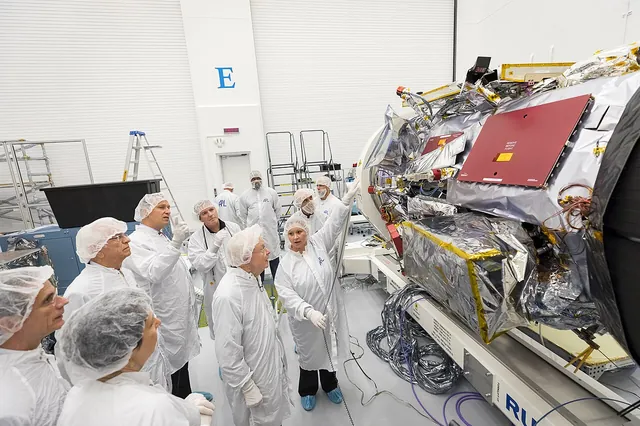
Ulysses, a joint ESA–NASA mission launched on 6 October 1990, was the first to fly over the Sun’s poles and mapped the solar wind in three dimensions until contact ended on 30 June 2009. SOHO, launched on 2 December 1995 and led by ESA, has watched the Sun from 1.5 million km away, near the L1 point, for three decades and has found more than 5,000 comets. NASA’s Solar Dynamics Observatory, launched on 11 February 2010, observes the Sun in ten extreme-ultraviolet wavelengths, taking a new image every 10 seconds.910181920
NASA’s Parker Solar Probe, launched on 12 August 2018, became the first spacecraft to fly through the corona in 2021. On 24 December 2024 it passed 3.8 million miles (6.1 million km) above the surface at 430,000 miles per hour, the fastest any human-made object has moved. It has matched that record on seven flybys since, most recently on 4 September 2026, and its mission has been extended into 2029.212223
ESA’s Solar Orbiter, built with NASA and launched in February 2020, comes within 42 million km of the Sun and has taken the first close-up images of its polar regions. India’s Aditya-L1 was launched on 2 September 2023 and placed in orbit around the Sun–Earth L1 point on 6 January 2024; it is still observing. On the ground, the 4-metre Daniel K. Inouye Solar Telescope on Haleakalā, Hawaii, the largest solar telescope in the world, released its first images in January 2020.152425262728
- Solar Dynamics Observatory
- launched 11 February 201020NASA; active
- Parker Solar Probe
- launched 12 August 20182123NASA; active, extended into 2029
- Parker Solar Probe’s closest approach
- 6.1 million km22233.8 million miles above the surface, first reached 24 December 2024
- Parker Solar Probe’s top speed
- about 700,000 km/h2122430,000 mph, the fastest human-made object
- Solar Orbiter
- launched February 20202425ESA with NASA; active
Quick answers
- How big is the Sun?
- The Sun has a mean radius of 695,700 km (109.2 × Earth).1
- How massive is the Sun?
- The Sun has a mass of 1.9884 × 10³⁰ kg (332,900 Earths; 99.8% of the Solar System’s mass).12
- How old is the Sun?
- The Sun is about 4.6 billion years old.2
- What is the temperature on the Sun?
- The temperature on the Sun is 5,772 K (about 5,500 °C), at the visible surface.12
- How far is the Sun from Earth?
- The Sun is 149.6 million km from Earth (average; light takes about 8 min 20 s).13
- How long is a day on the Sun?
- A day on the Sun lasts 25 days at the equator, 36 at the poles (the Sun is not solid, so it rotates at different rates).2
Sources
- Sun Fact Sheet — NASA Space Science Data Coordinated Archive, 2024
- Sun: Facts — NASA Science, 2026
- Voyager 1: What Is a Light-Day? — NASA Science, 2026
- NASA, NOAA: Sun Reaches Maximum Phase in 11-Year Solar Cycle — NASA Science, 2024
- The chemical composition of the Sun (Asplund, Grevesse, Sauval and Scott) — Annual Review of Astronomy and Astrophysics; arXiv preprint, 2009
- The Nobel Prize in Physics 1967: Award ceremony speech — Nobel Prize Outreach
- Layers of the Sun — NASA Science (The Sun Spot blog), 2023
- How Accurately Can We Calculate the Depth of the Solar Convective Zone? (Bahcall, Serenelli and Pinsonneault) — Astrophysical Journal; arXiv preprint, 2004
- Spots, Waves and Wind: A Solar Science Timeline — NASA
- Ulysses overview — European Space Agency
- Solar Cycle — NASA Solar Dynamics Observatory
- Solar Cycle 25 reached its maximum in October 2024 — Solar-Terrestrial Centre of Excellence, Royal Observatory of Belgium, 2026
- Voyager 1 — NASA Science, 2026
- NASA’s Voyager 2 Probe Enters Interstellar Space — NASA Jet Propulsion Laboratory, 2018
- NSF’s newest solar telescope produces first images — National Solar Observatory, 2020
- August 18 and October 20, 1868: Discovery of Helium — American Physical Society, APS News, 2014
- Hans Bethe: Facts — Nobel Prize Outreach
- Ulysses — NASA Science, 2026
- SOHO — NASA Science, 2026
- SDO: Solar Dynamics Observatory — NASA Science, 2026
- Parker Solar Probe — NASA Science, 2026
- NASA’s Parker Solar Probe Makes History With Closest Pass to Sun — NASA Science, 2024
- After Latest Swing Past Sun, NASA’s Parker Solar Probe Checks in — NASA Science, 2026
- Solar Orbiter — European Space Agency, 2026
- Solar Orbiter — NASA Science, 2025
- Aditya-L1 — Indian Space Research Organisation
- Aditya-L1 Mission: Announcement of Opportunity soliciting proposals for the fourth AO cycle observations — Indian Space Research Organisation, 2026
- Daniel K. Inouye Solar Telescope — National Solar Observatory
Figures checked against these sources in November 2026. Where a quantity is not known, it is left out rather than estimated.

