planet
Mercury
Mercury is the smallest planet in the Solar System and the closest to the Sun: a grey, cratered ball of rock and metal only a little larger than Earth’s Moon. It is also the fastest, racing along its orbit at about 47 km per second and completing a year in 88 Earth days. It has no moons and no rings.12
It turns so slowly that a single day, from one sunrise to the next, lasts 176 Earth days, twice as long as its year. With almost no air to hold the heat, the ground reaches about 430 °C by day and falls to about −180 °C at night. Yet craters near the poles whose floors never see the Sun hold deposits of water ice.23
Size and physical properties
Mercury is 4,879 km across, a little more than a third of Earth’s width, and has about 5.5 per cent of Earth’s mass. Gravity at its surface is 3.7 m/s², some 38 per cent of what we feel on Earth. The planet is almost perfectly round: its polar radius is only about 2 km shorter than its equatorial radius.124
For its size Mercury is remarkably heavy. Its mean density of 5,429 kg/m³ is second only to Earth’s among the planets, a sign of the very large metal core inside. The surface is dark, with a Bond albedo of 0.068, which means it reflects less than 7 per cent of the sunlight falling on it. Mercury has no moons and no rings.12
- Equatorial radius
- 2,440.5 km1
- Polar radius
- 2,438.3 km1
- Mean radius
- 2,439.7 km10.383 Earths
- Flattening
- 0.00091
- Mass
- 3.3010 × 10²³ kg10.0553 Earths
- Volume
- 6.083 × 10¹⁰ km³10.0562 Earths
- Mean density
- 5,429 kg/m³1Earth: 5,513
- Gravity
- 3.70 m/s²1mean, at the surface
- Escape velocity
- 4.3 km/s1
- Geometric albedo
- 0.1421
- Bond albedo
- 0.0681
Orbit and rotation
Mercury follows the least circular orbit of any planet, swinging from 46.0 million km from the Sun at its closest to 69.8 million km at its farthest. Sunlight takes about 3.2 minutes to reach it from its average distance. One circuit takes 87.97 Earth days, and the orbit is tilted by 7 degrees to Earth’s.124
The planet is caught in a 3:2 spin–orbit resonance: it turns three times on its axis for every two trips round the Sun. One rotation takes about 59 Earth days, but because Mercury travels so far along its orbit in that time, a full day from noon to noon lasts 176 Earth days, which is two Mercury years.245
When Mercury is nearest the Sun and moving fastest, its motion along the orbit briefly outpaces its spin. From some places the Sun would then be seen to rise, set again and rise a second time. The axis is tilted by only a few hundredths of a degree, so there are no seasons of the usual kind, and the floors of some polar craters stay in permanent darkness.124
- Orbital period
- 87.969 days1
- Mean orbital speed
- 47.36 km/s1
- Fastest orbital speed
- 58.97 km/s1at its closest to the Sun
- Slowest orbital speed
- 38.86 km/s1at its farthest from the Sun
- Orbital eccentricity
- 0.20561
- Orbital inclination
- 7.004°1to Earth’s orbit
- Rotation period
- 1,407.6 hours158.65 Earth days
- Length of day
- 4,222.6 hours1175.94 Earth days, sunrise to sunrise
- Speed of rotation at the equator
- 10.9 km/h13.03 m/s; derived from the equatorial radius and rotation period
- Axial tilt
- 0.034°1
- Brightest in our sky
- magnitude −2.431
Discovery and naming
Mercury has been known since prehistoric times, so it has no discoverer. The Romans named it after the swift messenger of their gods, a fitting name for the fastest planet. It is hard to observe from Earth because it stays so close to the Sun in the sky, and can be seen only around dawn or in twilight, when the Sun’s glare does not drown it out.1256
Its unusual rotation was explained by Giuseppe “Bepi” Colombo (1920–1984), a mathematician and engineer at the University of Padua in Italy. He was the first to work out that a resonance makes Mercury turn on its axis three times for every two orbits of the Sun. The European and Japanese mission now arriving at the planet is named after him.57
Atmosphere: a thin exosphere
Mercury has no atmosphere in the ordinary sense. What surrounds it is an exosphere bound to the surface and so thin that it is essentially a vacuum: the pressure on the ground is less than about 5 × 10⁻¹⁵ bar, and all the gas around the planet adds up to less than about 10 tonnes.12
Its atoms are blasted off the surface by the solar wind and by striking meteoroids. Sodium, magnesium, oxygen, hydrogen, potassium, calcium and helium have all been detected. MESSENGER found more magnesium and calcium above whichever part of the planet is at dawn, a sign that the morning side is struck hardest by fast-moving dust shed by comets.128
When Mariner 10 passed behind the planet in 1974, an occultation experiment found no sign of an atmosphere or ionosphere. With nothing to trap heat, the surface swings between about 430 °C in daylight and −180 °C at night, the greatest daily range of any planet. Venus, though farther from the Sun, is hotter, thanks to its dense atmosphere.2910
- Surface pressure
- less than about 5 × 10⁻¹⁵ bar1
- Total mass of gas
- less than about 10,000 kg1
- Average temperature
- 440 K (167 °C)1
- Temperature on the sunward side
- 590–725 K (317–452 °C)1
- Sodium
- 12,000–200,000 × 10⁶ per cm²1column abundance: the amount above each square centimetre of ground
- Magnesium
- 100,000 × 10⁶ per cm²1
- Oxygen
- less than 40,000 × 10⁶ per cm²1
- Hydrogen
- 5,000 × 10⁶ per cm²1
- Potassium
- 800–1,300 × 10⁶ per cm²1
- Calcium
- 300–1,000 × 10⁶ per cm²1
Surface and geology
Mercury’s surface resembles the Moon’s: a greyish-brown landscape crowded with impact craters, some surrounded by bright rays of crushed rock thrown out by the impact. In visible light its colours vary only subtly. Between the craters lie broad smooth plains, and MESSENGER found evidence of past volcanic activity. Craters are named after artists, musicians and authors who have died.2311
Long cliffs called lobate scarps cross the surface, many of them hundreds of kilometres long and hundreds to thousands of metres high. They mark thrust faults, formed as the interior cooled and the whole planet shrank. How much it shrank is disputed: one study of MESSENGER images found that the radius has decreased by as much as 7 km, while a later one argued for no more than 1 to 2 km.2121314
MESSENGER also discovered hollows: shallow, irregular pits with bright floors and halos, from 18 metres to more than 1.6 km across and found nowhere else so far. They look fresh, and may form where sulphur or other easily vaporised substances are lost from the rock, leaving it to crumble. Nobody yet knows for certain how they arise.1516
What hides inside
Mercury is built like a cannonball. Its metallic core is about 2,000 km in radius, more than 80 per cent of the radius of the whole planet, and holds roughly 70 per cent of its mass. The rocky mantle and crust above it are only about 400 km thick. The core is huge compared with those of the other rocky planets.21017
Part of the core is molten. In 2007, radar observations from Earth detected small shifts in Mercury’s spin, called librations, which proved that some of the core must be liquid metal. In 2019 a study of the planet’s spin and of the way its gravity tugged on MESSENGER found evidence of a solid inner core about 2,000 km wide, roughly half the width of the whole core and nearly the size of Earth’s inner core.17
Why Mercury has so much metal remains one of its chief mysteries. The size of the core is also not pinned down exactly: NASA’s fact page gives a radius of about 2,074 km, while a model based on MESSENGER’s gravity measurements puts the top of the liquid core 2,020 km from the centre, give or take 30 km.21017
- Radius of the core
- about 2,074 km2about 85% of the planet’s radius
- Top of the liquid core
- 2,020 ± 30 km from the centre10from models of MESSENGER’s gravity data
- Solid inner core
- about 2,000 km wide17
- Rocky outer shell
- about 400 km thick2mantle and crust together
- Core’s share of the planet’s mass
- about 70%10
- Moment of inertia factor
- 0.351Earth: 0.3308
Magnetic field
Mariner 10’s magnetometers revealed in 1974 that Mercury has a weak magnetic field. At the surface it is only about 1 per cent as strong as Earth’s, but it is a global field with two poles, pointing the same way as Earth’s, and is powered by the molten part of the core.291017
MESSENGER found that the field is not centred on the planet. It is displaced northwards by about 480 km, roughly a fifth of Mercury’s radius, an offset described by the mission’s scientists as unprecedented in the Solar System. The magnetic axis, by contrast, is almost exactly lined up with the axis of rotation.1310
The solar wind stretches the field into a long cavity, the magnetosphere, which is highly changeable. MESSENGER recorded frequent bursts of energetic electrons but no steady radiation belts. At times magnetic “tornadoes” funnel hot solar wind plasma straight down to the ground, where it knocks atoms off the surface and into the exosphere.210
Notable features
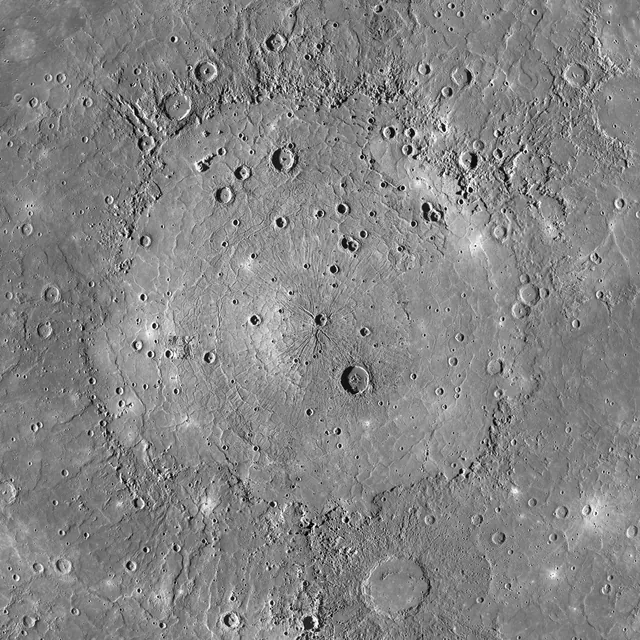
Caloris Planitia
The “hot plain”, named because the surface is hottest near this spot, fills Mercury’s youngest large impact basin, about 1,550 km across and the most striking feature in Mariner 10’s pictures. Volcanic plains later flooded it; the smooth plains inside cover 1.72 million km². Near its centre lie the troughs of Pantheon Fossae, about 311 km across.291819
Rachmaninoff
An impact basin 305 km across, centred at about 28° north. NASA lists it beside Caloris among the very large basins blasted out by asteroid impacts early in the Solar System’s history. Its name, approved in 2010, honours the Russian composer, pianist and conductor Sergei Rachmaninoff.219
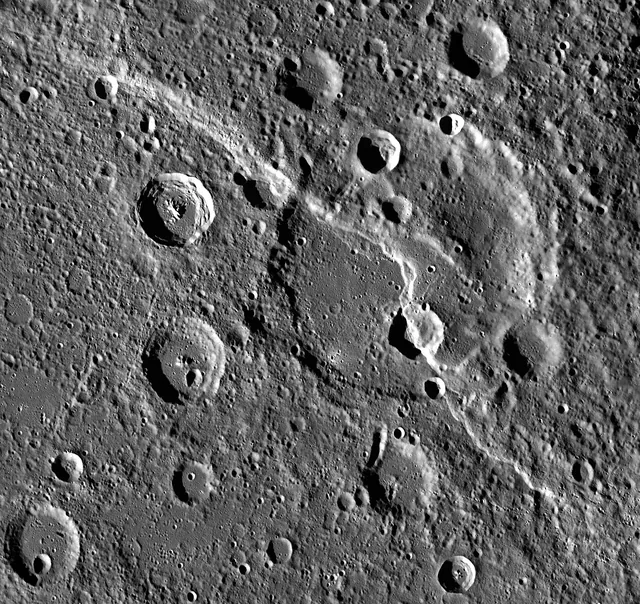
Carnegie Rupes
A lobate scarp 267 km long, at about 59° north, that cuts straight through the 133 km crater Duccio. Approached from the south-west it would be a wall nearly 2 km high. It is named after a research ship, launched in 1909, that was built almost without magnetic materials for magnetic surveys.1920
Enterprise Rupes
The largest lobate scarp on Mercury, in the southern hemisphere, with more than 3 km of relief. NASA describes it as about 1,000 km long; the IAU gazetteer lists the named feature at 822 km. Scarps like it mark thrust faults where the crust was pushed together as the planet contracted.1219
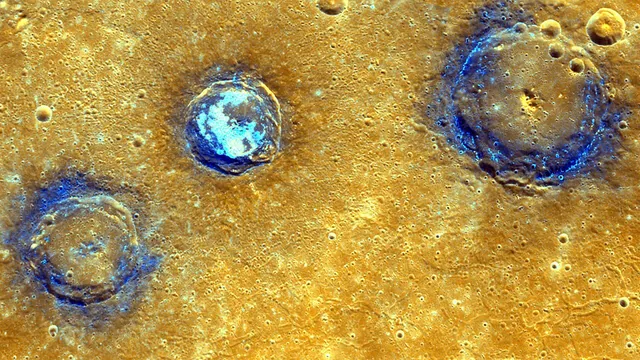
Hollows of the Caloris basin
Hollows cover the floor of the 52 km crater Sander and dot the rims of its neighbours Munch (61 km) and Poe (81 km), in the north-west of the Caloris basin. NASA puts the average age of hollows at about 100,000 years, far younger than the craters they sit in, so they may still be forming today.1521
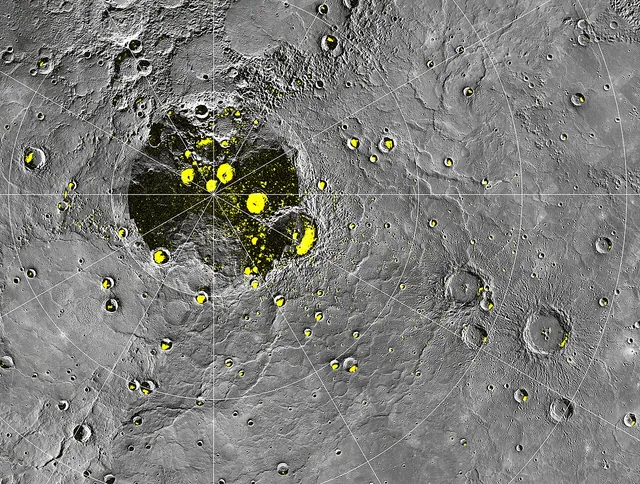
Polar ice deposits
In 1992 radar from Earth found patches at Mercury’s poles that reflect like water ice. MESSENGER showed that they lie on permanently shadowed crater floors, such as that of the 112 km crater Prokofiev, and its neutron measurements matched water ice. The ice appears nearly pure and may have been laid down within the last tens of millions of years.10192223
Exploration
Mariner 10, launched on 3 November 1973, was the first spacecraft sent to Mercury and the first to use the gravity of one planet, Venus, to reach another. It flew past three times: on 29 March 1974 at 703 km, on 21 September 1974 at about 48,069 km and on 16 March 1975 at only 327 km. Its 2,700 or so pictures covered nearly half the surface.9
MESSENGER, launched on 3 August 2004, flew past Mercury three times in 2008 and 2009 before becoming the first spacecraft to orbit it, on 18 March 2011. It circled the planet more than 4,000 times, mapped the entire surface, measured its composition and magnetic field, and verified that the polar deposits are mostly water ice. Out of propellant, it struck the surface on 30 April 2015.315
BepiColombo, a joint mission of ESA and the Japanese space agency JAXA, was launched on 20 October 2018 and made six flybys of Mercury between October 2021 and January 2025. Its transfer module was cast off on 3 September 2026. The two orbiters, ESA’s Mercury Planetary Orbiter and JAXA’s Mio, are scheduled to enter orbit together on 21 November 2026, to separate on 9–10 December and to begin their science phase in April 2027.5724
- Mariner 10 flybys
- 29 March 1974, 21 September 1974, 16 March 19759
- Closest Mariner 10 pass
- 327 km9third flyby
- BepiColombo launch
- 20 October 20185
- BepiColombo flybys of Mercury
- six, from 1 October 2021 to 8 January 20255
- BepiColombo orbit insertion
- 21 November 202624scheduled; as stated by ESA in October 2026
- Planned orbit of Mio
- 590 × 11,640 km above the surface25
- Planned orbit of the Mercury Planetary Orbiter
- 480 × 1,500 km above the surface25
Quick answers
- How big is Mercury?
- Mercury has a mean radius of 2,439.7 km (0.383 × Earth).1
- How massive is Mercury?
- Mercury has a mass of 3.301 × 10²³ kg (0.0553 × Earth).1
- How long is a day on Mercury?
- A day on Mercury lasts 176 Earth days (sunrise to sunrise; one turn on its axis takes 1,407.6 hours).12
- How long is a year on Mercury?
- A year on Mercury lasts 88 Earth days (87.969 days).1
- How far is Mercury from the Sun?
- Mercury is 57.9 million km from the Sun (0.387 au on average).1
- How fast does Mercury move through space?
- Mercury moves along its orbit at 47.36 km/s (mean).1
- What is Mercury’s axial tilt?
- Mercury’s axis is tilted by 0.034°.1
- What is the temperature on Mercury?
- The temperature on Mercury is −180 °C to 430 °C (at the surface, night to day).2
- How many moons does Mercury have?
- Mercury has no known moons.1
- What is Mercury made of?
- Mercury is made of rock around a large iron core.2
Sources
- Mercury Fact Sheet — NASA Space Science Data Coordinated Archive, 2024
- Mercury: Facts — NASA Science
- MESSENGER — NASA Science
- Meet Mercury — European Space Agency
- BepiColombo factsheet — European Space Agency
- Mercury: Exploration — NASA Science
- BepiColombo — NASA Science
- Small Collisions Make Big Impact on Mercury’s Thin Atmosphere — NASA, 2017
- Mariner 10 — NASA Science
- MESSENGER at Mercury: Scientific Highlights and End of Mission (L. R. Nittler, presentation to the NASA Advisory Council Science Committee) — NASA Science, 2015
- Mercury’s “True” Color is in the Eye of the Beholder (PIA11364) — NASA Photojournal, 2008
- Enterprise Rupes — NASA
- Mercury’s global contraction much greater than earlier estimates (P. K. Byrne and others) — Nature Geoscience, 2014
- A case for limited global contraction of Mercury (T. R. Watters) — Communications Earth & Environment, 2021
- Mercury’s Strange Hollows — NASA Science, 2023
- The Sleepy Hollows of Mercury — NASA Photojournal
- A Closer Look at Mercury’s Spin and Gravity Reveals the Planet’s Inner Solid Core — NASA, 2019
- The Mighty Caloris (PIA19213) — NASA Photojournal
- Gazetteer of Planetary Nomenclature: Mercury — International Astronomical Union and US Geological Survey
- Carnegie Cuts a Crater (PIA19279) — NASA Photojournal
- Orange Is the New Blue (PIA19421) — NASA Photojournal
- Water Ice on Mercury (PIA19411) — NASA Photojournal
- The Moon and Mercury May Have Thick Ice Deposits — NASA, 2019
- Latest updates: BepiColombo’s arrival at Mercury — European Space Agency, 2026
- Journey to Mercury — European Space Agency
Figures checked against these sources in November 2026. Where a quantity is not known, it is left out rather than estimated.

