moon
Callisto
Callisto is the outermost of Jupiter’s four large moons and, at about 4,820 km across, the third-largest moon in the Solar System, almost as big as the planet Mercury. Its dark, ancient surface is one of the most heavily cratered known: for about 4 billion years little seems to have disturbed it except a steady rain of impacts from space.1234
Yet this seemingly dead world may hide a salty ocean. Magnetic measurements by the Galileo spacecraft in the late 1990s pointed to an electrically conducting layer beneath the ice, although later research questions whether it is really there. Callisto also has a tenuous atmosphere of carbon dioxide, and ESA’s Juice spacecraft is due to fly past it 21 times in the early 2030s.1567
Size and physical properties
Callisto has a mean radius of 2,410.3 km, making it about 4,821 km across, just short of the planet Mercury’s 4,879 km. Among moons only Jupiter’s Ganymede and Saturn’s Titan are larger. Its mass, 1.08 × 10²³ kg, is about one and a half times that of our Moon but less than a third of Mercury’s.1238
With a mean density of 1.83 g/cm³, the lowest of the four Galilean moons, Callisto is a blend of rock and ice. Its surface gravity is 1.24 m/s², about an eighth of Earth’s. Its visual geometric albedo of 0.19 makes it the darkest of the four: it reflects less than half as much sunlight as Ganymede.23811
Orbit and rotation
Callisto orbits Jupiter at an average distance of 1,882,700 km, about 26 times the planet’s radius and 1.8 times as far out as Ganymede, taking 16.689 days for each circuit. The orbit is nearly circular, with an eccentricity of 0.007, so the distance ranges between about 1,870,000 and 1,896,000 km. Callisto is tidally locked, always showing Jupiter the same face.1239
Unlike Io, Europa and Ganymede, Callisto takes no part in the orbital resonance that links those three moons, in which Io makes four orbits and Europa two for every one of Ganymede’s. Callisto was seemingly too far from Jupiter early in the moons’ history for its orbit to be drawn inward into the pattern. With Jupiter, it circles the Sun about every 12 years.112
Discovery and naming
Galileo Galilei discovered Callisto on 7 January 1610 at Padua, the same night he first saw Ganymede. Within days he worked out that the little ‘stars’ beside Jupiter were moons going round it, and he announced them in March 1610 in Sidereus Nuncius, ‘The Starry Messenger’. They were the first objects found orbiting something other than Earth or the Sun.11013
Galileo named the four moons the Medicean planets and numbered them; Callisto, the outermost, is Jupiter IV. Its modern name was proposed by the German astronomer Simon Marius, who may have seen the moons at about the same time, on a suggestion from Johannes Kepler. In Greek myth Callisto was a daughter of Lycaon whom Zeus turned into a bear to protect her from Hera’s jealousy.11013
A battered, ancient surface
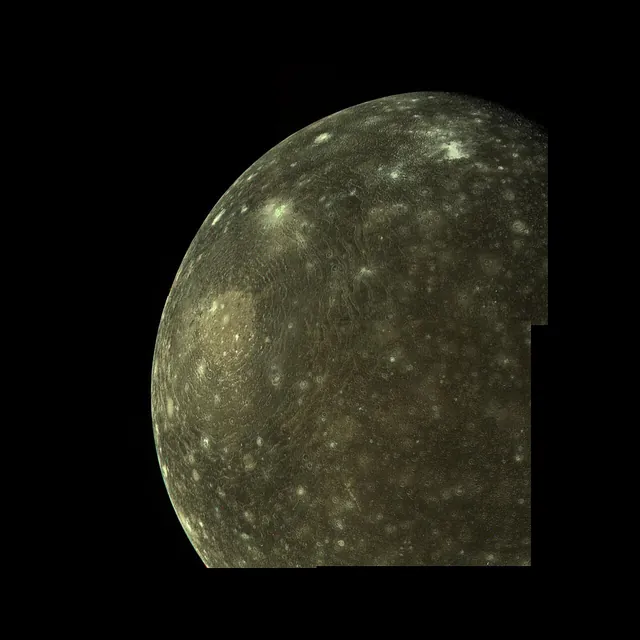
Callisto’s surface is ancient, about 4 billion years old, and pocked with craters of every size, from simple bowls to vast basins encircled by rings. Because so many craters survive, scientists conclude that the moon has seen little geological activity: there are no active volcanoes or shifting tectonic plates to erase them. Galileo’s images show it uniformly cratered but not uniform in colour or brightness.14
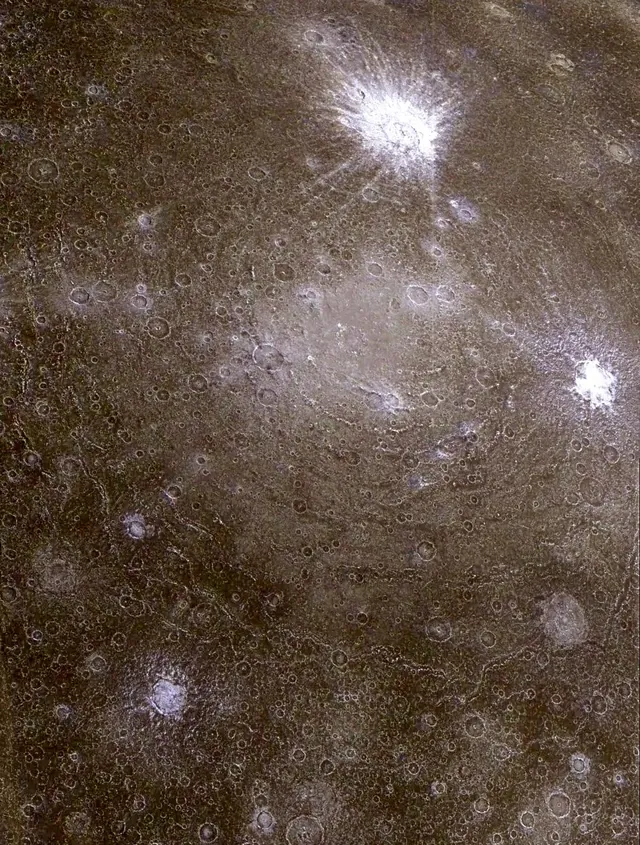
Brighter areas are thought to be mainly ice, while darker areas are highly eroded material poor in ice. Young impacts dig up clean ice that contrasts sharply with the darker, redder coating on older ground, and many crater peaks show as bright white dots, thought to be capped with water ice. ESA notes that the dark, densely cratered plains show signs of unusual erosion and degradation.14714
What hides inside
Callisto appears to be only partly layered. Radio tracking of Galileo during its first close flybys suggested a uniform mix of rock and ice, but more precise data from a third pass showed partial separation. One model has a rock–metal core less than a quarter of Callisto’s radius, a middle layer of mixed rock and ice, and an outer shell of clean ice less than 350 km thick; a mixture all the way to the centre also fits.1711
Callisto may also hide an ocean. Galileo’s magnetometer detected disturbances near the moon best explained by electric currents flowing in a salty liquid layer below the ice, driven by Jupiter’s changing magnetic field. NASA places such an ocean about 250 km beneath the surface, perhaps in contact with rock, but later research suggests it may lie deeper than thought, or may not exist at all.1517
A whiff of carbon dioxide
In 1997 Galileo’s near-infrared mapping spectrometer scanned just off Callisto’s edge and caught the glow of carbon dioxide up to 100 km above the surface, revealing an extremely thin atmosphere; the finding was announced in 1999. Its surface pressure is about 7.5 × 10⁻¹² bar, a few trillionths of Earth’s, at a temperature of about 150 K, close to that of the ground.16
Sunlight and particles swept along by Jupiter’s magnetic field should strip such a thin layer away in about four years, so either the atmosphere formed recently or some process is still supplying carbon dioxide. More recent research indicates that Callisto’s exosphere also contains oxygen and hydrogen. Galileo found similar thin, surface-bound exospheres around Europa and Ganymede.1617
Magnetic field
Unlike Ganymede, Callisto has no appreciable magnetic field of its own. Galileo did detect a field around it, but one that varies with the changing environment as Jupiter’s magnetosphere sweeps past, as expected for a field induced inside the moon. ESA notes that it could arise either from a large reservoir of liquid beneath the icy shell or from interactions in Callisto’s ionised upper atmosphere.257
Notable features
Valhalla
Callisto’s largest multi-ring impact structure, listed by the IAU as 3,000 km across. Voyager 1 images from March 1979 show a bright central area about 600 km wide, probably the original impact basin, with concentric bright rings reaching about 1,500 km from the centre. It is named after Odin’s hall in Norse myth.1518
Asgard
A second great ringed basin, 1,400 km across in the gazetteer, on the leading hemisphere near 32° north. Galileo images show a smooth, bright centre surrounded by rings up to 1,700 km in diameter, partly overprinted by the younger bright-rayed crater Burr. Its name is the Norse home of the gods.1416
Adlinda
A large ringed feature 840 km across in the southern hemisphere, centred at 48.5° south. Named in 1979, it takes its name from a place in the ocean depths where, in Arctic mythology, the souls of the dead are imprisoned.19
Heimdall
An impact crater 210 km across, centred at 63.5° south. Its name, approved in 2000, honours the Norse god of light who guards Bifröst, the great bridge of the gods.20
Exploration
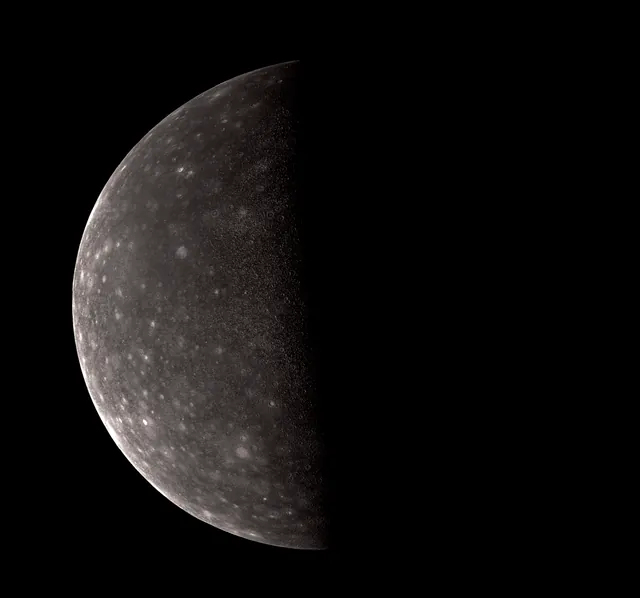
Pioneer 10 took the first close-up images of Callisto on 3 December 1973. Voyager 1 and Voyager 2 followed in March and July 1979; a Voyager 1 mosaic taken on 6 March from about 400,000 km showed details down to 10 km and revealed Callisto as a heavily cratered and hence geologically inactive world.13182122
Galileo, which orbited Jupiter from December 1995 until September 2003, made eight flybys of Callisto. It found the carbon dioxide atmosphere and the magnetic hints of an ocean, and in May 2001 took the only complete global colour image of the moon obtained by the mission. Cassini and New Horizons later studied Callisto as they passed Jupiter, and Juno has imaged it from orbit.4561723
ESA’s Juice spacecraft, launched on 14 April 2023 and due at Jupiter in July 2031, will study Callisto as a remnant of the early Jupiter system. ESA’s 2022 tour plan has it making 21 Callisto flybys between 2032 and 2034, starting in June 2032 and passing as close as 200 km, to chart its surface, its chemistry and any hidden ocean.72425
- Pioneer 10 closest approach to Jupiter
- 3 December 197313
- Closest planned approach
- 200 km7
Quick answers
- How massive is Callisto?
- Callisto has a mass of 1.0759 × 10²³ kg (about one and a half times our Moon’s).23
- How dense is Callisto?
- Callisto has a mean density of 1.8340 g/cm³.8
- How strong is gravity on Callisto?
- Gravity at the surface of Callisto is 1.24 m/s² (Earth: 9.8 m/s²).2
- How long is a day on Callisto?
- A day on Callisto lasts 400.5 hours (about 16.7 days), synchronous: the same face always turned to Jupiter.123
- How long does Callisto take to complete one orbit?
- Callisto completes one orbit in 16.689 days (about 16 days 16.5 hours).139
- What is the temperature on Callisto?
- The temperature on Callisto is −155 °C (about 118 K), mean.2
Sources
- Callisto Facts — NASA Science, 2025
- Solar System Small Worlds Fact Sheet — NASA Space Science Data Coordinated Archive, 2016
- Jovian Satellite Fact Sheet — NASA Space Science Data Coordinated Archive, 2023
- Global Callisto in Color (PIA03456) — NASA Photojournal, 2001
- Khurana et al., Induced magnetic fields as evidence for subsurface oceans in Europa and Callisto — Nature, 1998
- Carlson, A Tenuous Carbon Dioxide Atmosphere on Jupiter’s Moon Callisto — Science, 1999
- The moons of Jupiter: What will Juice discover? — European Space Agency, 2022
- Planetary Satellite Physical Parameters — NASA/JPL Solar System Dynamics
- Planetary Satellite Mean Elements — NASA/JPL Solar System Dynamics
- Planet and Satellite Names and Discoverers — IAU/USGS Gazetteer of Planetary Nomenclature
- Anderson et al., Distribution of Rock, Metals, and Ices in Callisto — Science, 1998
- Ganymede Facts — NASA Science, 2025
- Ganymede: Exploration — NASA Science, 2024
- Asgard Scarp Mosaic (PIA00562) — NASA Photojournal, 1997
- Valhalla (Callisto) — IAU/USGS Gazetteer of Planetary Nomenclature
- Asgard (Callisto) — IAU/USGS Gazetteer of Planetary Nomenclature
- Galileo — NASA Science, 2024
- Callisto Mosaic (PIA00080) — NASA Photojournal, 1996
- Adlinda (Callisto) — IAU/USGS Gazetteer of Planetary Nomenclature
- Heimdall (Callisto) — IAU/USGS Gazetteer of Planetary Nomenclature
- Voyager 1 — NASA Science, 2026
- Voyager 2 — NASA Science, 2026
- Callisto: Exploration — NASA Science, 2025
- Juice — European Space Agency, 2026
- Juice factsheet — European Space Agency, 2021
Figures checked against these sources in November 2026. Where a quantity is not known, it is left out rather than estimated.

