moon
Ganymede
Ganymede is Jupiter’s largest moon and the largest moon in the Solar System. At about 5,260 km across it is wider than the planet Mercury, yet it has less than half Mercury’s mass, because it is built of rock and water ice rather than rock and metal. It is also the only moon known to generate its own magnetic field, which lights up aurorae around its poles.123
Its icy surface is split between dark, ancient, heavily cratered regions and younger bright terrain scored with grooves and ridges. Beneath the ice there is strong evidence for a salty ocean that may hold more water than all of Earth’s surface, inferred in 2015 from the way Ganymede’s aurorae rock back and forth. ESA’s Juice spacecraft, launched in 2023, is due to become the first to orbit it.1456
Size and physical properties
Ganymede has a mean radius of 2,631.2 km, so it measures about 5,260 km across: larger than the planet Mercury, at 4,879 km, and the dwarf planet Pluto, and the biggest moon in the Solar System. Before the Voyager probes reached Jupiter in 1979, Saturn’s moon Titan was thought to be the largest; their measurements showed that Ganymede is bigger.12711
For its size Ganymede is light. Its mass of 1.48 × 10²³ kg is about twice that of our Moon but less than half of Mercury’s, and its mean density of 1.94 g/cm³ points to a mixture of roughly 60 per cent rock and 40 per cent ice. Gravity at the surface is 1.43 m/s², and its visual geometric albedo, a measure of how brightly it reflects sunlight, is 0.44.2378
Orbit and rotation
Ganymede circles Jupiter at an average distance of 1,070,400 km, third of the four large Galilean moons counting outward from the planet, and completes an orbit every 7.155 days. The orbit is almost perfectly circular, with an eccentricity of 0.001, so the distance varies only between about 1,068,000 and 1,072,000 km. The moon travels at about 10.9 km/s.1289
Ganymede is locked in step with two neighbours: each time it goes round Jupiter once, Europa goes round twice and Io four times. This orbital resonance keeps their orbits from becoming perfectly circular. Like the other Galilean moons, Ganymede is tidally locked, turning once per orbit so that the same side always faces Jupiter. With Jupiter, it circles the Sun about every 12 years.1
- Mean orbital speed
- 10.9 km/s2
Discovery and naming
Galileo Galilei first saw Ganymede on 7 January 1610 from Padua, looking at Jupiter through his homemade telescope. Within days he realised that the points of light beside the planet were moons orbiting it: the first objects found circling a body other than Earth or the Sun, and strong support for the Copernican view. He published the discovery in March 1610 in Sidereus Nuncius, ‘The Starry Messenger’.11011
Galileo called the four moons the Medicean planets, after his patrons the Medici family, and numbered them I to IV; Ganymede is Jupiter III. The German astronomer Simon Marius, who may have seen the moons at about the same time, proposed the names used today, which were suggested to him by Johannes Kepler. In Greek myth Ganymede was a young man carried to Olympus by Zeus, disguised as an eagle, to serve as cupbearer to the gods.11011
Dark and bright terrain
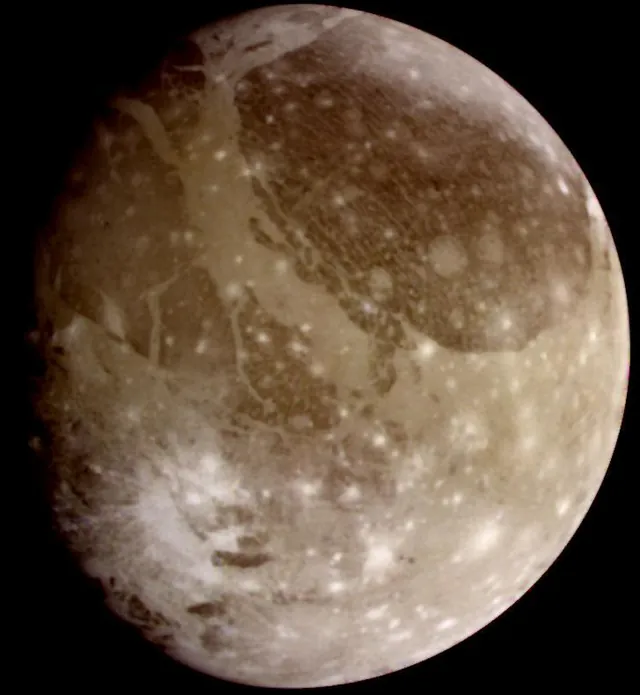
Ganymede’s surface is a patchwork of two kinds of terrain. About 40 per cent is dark, ancient and heavily cratered; the other 60 per cent is lighter and younger, cut by sets of grooves and ridges that run for thousands of kilometres and rise up to about 700 m. This pattern suggests that the icy crust was once pulled and broken by global tectonic forces.111
The brownish-grey colour comes from rocky material mixed with ice, and bright spots mark young impact craters and the fresh ice they threw out. Large craters tend to be flat, probably because the soft icy crust slowly settled. Spectra taken by Juno’s JIRAM instrument during its June 2021 flyby revealed mineral salts and organic compounds on the surface, results published in 2023.112
What hides inside
Ganymede is layered. Gravity measurements made by Galileo in 1996 showed that it has separated into a metallic core, a rocky mantle and a thick outer shell of ice. The core may be 400 to 1,300 km in radius, under an ice layer about 800 km deep. NASA describes the core as metallic iron, and it is this core that generates the moon’s magnetic field.134
Within the ice lies an ocean. Scientists estimate it at about 100 km thick, ten times deeper than Earth’s oceans, beneath roughly 150 km of mostly icy crust; ESA gives the ice shell as up to 130 km thick. Models suggest that layers of ice and liquid may be stacked like a club sandwich. Gravity data from Juno’s 2021 flyby hint that Ganymede may be less fully differentiated than earlier analyses implied.14614
A thin oxygen exosphere
Ganymede has only a whisper of an atmosphere. In 1998 astronomers reported ultraviolet airglow from oxygen seen with the Hubble Space Telescope, the signature of a tenuous layer of molecular oxygen holding between 1 × 10¹⁴ and 1 × 10¹⁵ molecules above each square centimetre of ground. The oxygen is thought to come from the icy surface, knocked loose by charged particles.11516
In 2021 a fresh analysis of Hubble data found water vapour as well. Over the warmest part of the surface, near the point where the Sun is overhead, water molecules sublimating from the ice outnumber oxygen, at about 10¹⁵ molecules per square centimetre; elsewhere the exosphere appears to be almost pure oxygen. With so little air to trap heat, daytime temperatures range from about 90 to 160 K.116
Magnetic field and aurorae
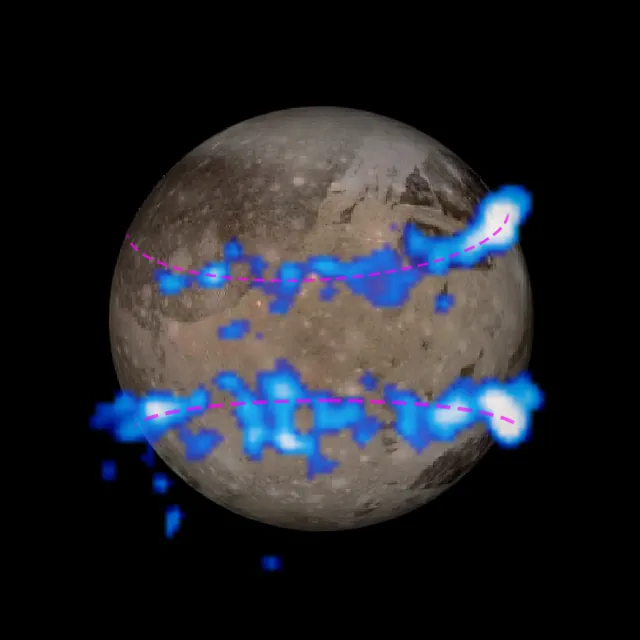
On its first two passes in 1996, at altitudes of 838 km and 264 km, the Galileo spacecraft discovered that Ganymede has its own magnetic field. The data fit a magnetic dipole tilted about 10° from the spin axis, with a strength of about 750 nanotesla at the equator: strong enough to carve out a small magnetosphere inside Jupiter’s much larger one. No other moon is known to have one.117
The field guides charged particles into belts of aurorae around both poles, which Hubble can see in ultraviolet light. Because Jupiter’s field changes as the planet rotates, the aurorae rock back and forth. In 2015 a team led by Joachim Saur reported that they rock by only about 2°, not the 6° expected without an ocean: a salty, electrically conducting layer must be damping the motion.418
Notable features
Galileo Regio
The largest of Ganymede’s dark regions: an old, heavily cratered expanse centred 45° north of the equator, listed in the IAU gazetteer as 4,439 km across. It was named in 1979 after Galileo Galilei. Dark regions like this cover about 40 per cent of the moon and are its oldest surface.11213
Uruk Sulcus
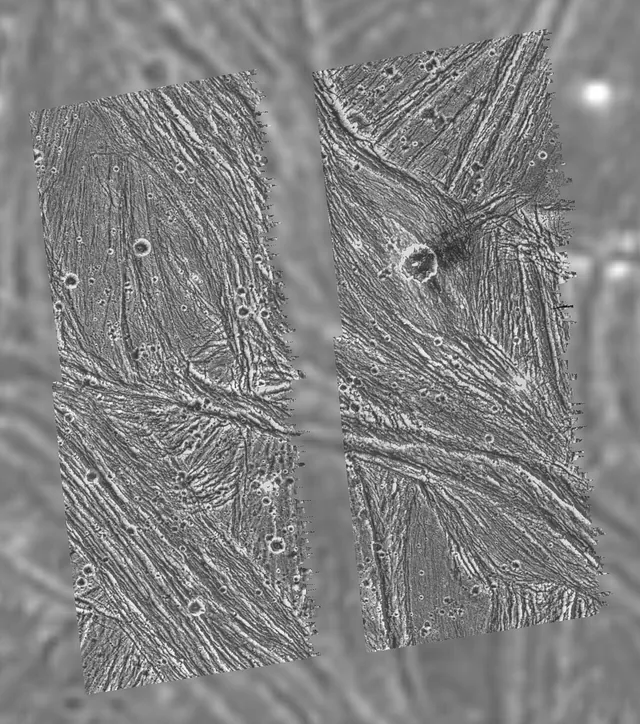
A broad lane of bright grooved terrain near the equator, 2,200 km long in the gazetteer and named after the Babylonian city ruled by Gilgamesh. Galileo images from 27 June 1996, showing details as small as 74 m, revealed it as a fabric of parallel ridges and troughs, the hallmark of Ganymede’s bright terrain.1920
Tros
An impact crater 94 km across, centred about 11° north of the equator and named in 1979 after Tros, the father of Ganymede in Greek myth. On Ganymede young craters stand out as bright spots splashed with fresh ice, while large old craters have flattened as the soft icy crust settled.11221
Enki Catena
A chain of 13 craters 160 km long, named in 1997. It was probably made by a comet that Jupiter’s gravity pulled into pieces, the fragments striking Ganymede in rapid succession. The chain straddles a boundary between bright and dark terrain, and its ejecta shows up brightly only on the bright side.2223
Exploration
Pioneer 10 took the first close-up pictures of Ganymede on 3 December 1973, and Pioneer 11 passed within 692,200 km of it a year later. Voyager 1 and Voyager 2 flew through the Jupiter system in 1979 and revealed its two distinct kinds of terrain. Galileo, the first spacecraft to orbit Jupiter, arrived in December 1995 and made eight flybys of Ganymede before its mission ended in September 2003.11242526
Other spacecraft caught Ganymede in passing: Cassini in December 2000 and New Horizons on 27 February 2007. On 7 June 2021 NASA’s Juno flew just 1,038 km above the surface, closer than any spacecraft in more than two decades, and photographed craters, distinct dark and bright terrain and long structures possibly linked to tectonic faults.11
ESA’s Jupiter Icy Moons Explorer, Juice, launched on 14 April 2023 and is due at Jupiter in July 2031, after a final Earth flyby in January 2029. Ganymede is its primary target. After 35 flybys of Ganymede, Callisto and Europa it will enter orbit around Ganymede, the first spacecraft to orbit a moon other than our own; ESA’s 2022 plan put this in late 2034, ending with an impact on the surface in 2035.5627
- Pioneer 10 closest approach to Jupiter
- 3 December 197311
Quick answers
- How massive is Ganymede?
- Ganymede has a mass of 1.4819 × 10²³ kg (about twice our Moon’s, under half of Mercury’s).28
- How dense is Ganymede?
- Ganymede has a mean density of 1.9416 g/cm³.7
- How strong is gravity on Ganymede?
- Gravity at the surface of Ganymede is 1.43 m/s² (Earth: 9.8 m/s²).2
- How long is a day on Ganymede?
- A day on Ganymede lasts 171.7 hours (about 7.15 days), synchronous: the same face always turned to Jupiter.128
- How long does Ganymede take to complete one orbit?
- Ganymede completes one orbit in 7.155 days (about 7 days 3.7 hours).189
- What is the temperature on Ganymede?
- The temperature on Ganymede is 90 to 160 K (−183 to −113 °C), daytime range.1
Sources
- Ganymede Facts — NASA Science, 2025
- Solar System Small Worlds Fact Sheet — NASA Space Science Data Coordinated Archive, 2016
- Anderson et al., Gravitational constraints on the internal structure of Ganymede — Nature, 1996
- NASA’s Hubble Observations Suggest Underground Ocean on Jupiter’s Largest Moon — NASA Science, 2015
- Juice — European Space Agency, 2026
- Spotlight on Ganymede, Juice’s primary target — European Space Agency, 2023
- Planetary Satellite Physical Parameters — NASA/JPL Solar System Dynamics
- Jovian Satellite Fact Sheet — NASA Space Science Data Coordinated Archive, 2023
- Planetary Satellite Mean Elements — NASA/JPL Solar System Dynamics
- Planet and Satellite Names and Discoverers — IAU/USGS Gazetteer of Planetary Nomenclature
- Ganymede: Exploration — NASA Science, 2024
- Ganymede Color Global (PIA00716) — NASA Photojournal, 1998
- Galileo Regio (Ganymede) — IAU/USGS Gazetteer of Planetary Nomenclature
- Gomez Casajus et al., Gravity Field of Ganymede After the Juno Extended Mission — Geophysical Research Letters, 2022
- Hall et al., The Far-Ultraviolet Oxygen Airglow of Europa and Ganymede — The Astrophysical Journal, 1998
- Roth et al., A sublimated water atmosphere on Ganymede detected from Hubble Space Telescope observations — Nature Astronomy, 2021
- Kivelson et al., Discovery of Ganymede’s magnetic field by the Galileo spacecraft — Nature, 1996
- Saur et al., The search for a subsurface ocean in Ganymede with Hubble Space Telescope observations of its auroral ovals — Journal of Geophysical Research: Space Physics, 2015
- Uruk Sulcus (Ganymede) — IAU/USGS Gazetteer of Planetary Nomenclature
- Uruk Sulcus Mosaic – Galileo over Voyager Data (PIA00493) — NASA Photojournal, 1997
- Tros (Ganymede) — IAU/USGS Gazetteer of Planetary Nomenclature
- Enki Catena (Ganymede) — IAU/USGS Gazetteer of Planetary Nomenclature
- Anatomy of a Torn Comet (PIA01610) — NASA Photojournal, 1998
- Galileo — NASA Science, 2024
- Voyager 1 — NASA Science, 2026
- Voyager 2 — NASA Science, 2026
- The moons of Jupiter: What will Juice discover? — European Space Agency, 2022
Figures checked against these sources in November 2026. Where a quantity is not known, it is left out rather than estimated.

