moon
Io
Io is the innermost of Jupiter’s four large moons and the most volcanically active world in the Solar System. Slightly larger than our Moon, it is dotted with an estimated 400 volcanoes, some throwing plumes of sulphur-rich gas hundreds of kilometres into space and others filling lakes with molten silicate lava. Its yellow, orange and white surface is painted by sulphur and frozen sulphur dioxide.1234
The heat comes from tides. Io’s orbit is kept slightly oval by regular tugs from Europa and Ganymede, so Jupiter’s gravity squeezes and relaxes the moon, raising its solid surface by as much as 100 metres. Voyager 1 caught the first eruption in 1979, and in December 2023 and February 2024 NASA’s Juno passed within about 1,500 km of the surface.2356
Size and physical properties
Io has a mean radius of 1,821.49 km, making it about 3,643 km across: a little larger than our Moon and roughly a quarter of Earth’s diameter. It is the third-largest of Jupiter’s moons and the fifth in distance from the planet. Its mass is 8.932 × 10²² kg, and gravity at the surface is 1.80 m/s², slightly more than on the Moon.12789
With a mean density of 3.53 g/cm³, Io is the densest of Jupiter’s large moons, a rocky world with essentially no water. The Galilean moons grow less dense with distance from Jupiter, and ancient volcanic activity probably evaporated whatever water Io once held. Its bright surface reflects 62 per cent of the light that falls on it.2579
Orbit, rotation and tides
Io circles Jupiter at an average distance of 421,800 km, under six times the planet’s radius, taking 1.769 days, or about 42.5 hours, for each orbit. It is tidally locked, always turning the same face to Jupiter. Its orbit is nearly circular, with an eccentricity of 0.004, so its distance from the planet varies only between about 420,000 and 424,000 km.28910
That small eccentricity is forced. Io, Europa and Ganymede are locked in a resonance: for every orbit of Ganymede, Europa completes two and Io four. The repeated alignments give each moon a regular tug that stops its orbit becoming circular. As Io’s distance from Jupiter changes, the planet’s tides make its surface bulge in and out by as much as 100 metres.25
Flexing on this scale generates enormous heat by friction inside the moon. In a paper published on 2 March 1979, the planetary scientists S. J. Peale, P. Cassen and R. T. Reynolds argued that tidal heating had probably melted much of Io and that the effects might show in Voyager 1’s pictures. The spacecraft flew past three days later.3612
Discovery and naming
Galileo Galilei turned his telescope on Jupiter on 7 January 1610 and saw what he took for three fixed stars beside it. He had apparently seen Io that night but could not separate it from Europa until the next, 8 January, the date credited as Io’s discovery. Within a week he had found a fourth companion, and by 15 January he understood that all four were circling Jupiter.21113
Galileo announced the moons in Sidereus Nuncius in March 1610 and named them the Medicean stars, after his patrons. The German astronomer Simon Marius, who probably found them independently, proposed the mythological names in Mundus Iovialis in 1614, crediting the idea to Johannes Kepler. In myth Io was a mortal woman whom Jupiter turned into a cow. The names came into general use only in the 19th century.21113
Volcanoes and lava
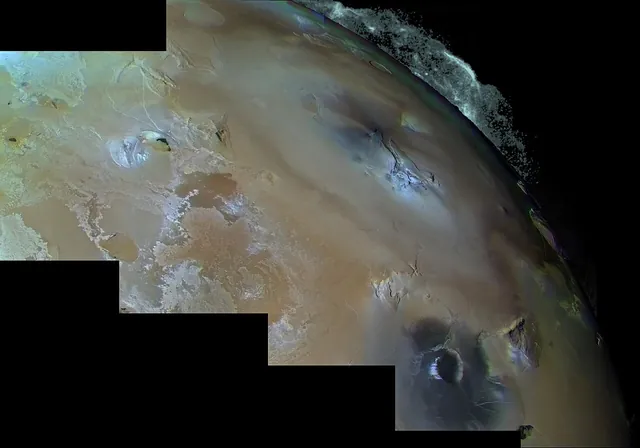
Io’s volcanoes lay down new deposits faster than comets and asteroids can mark it with large craters. Galileo-era surveys counted 541 volcanic centres, and NASA now estimates about 400 volcanoes. Galileo’s infrared measurements showed that at least 12 vents were erupting lava probably hotter than any basalt erupting on Earth today; at Pillan Patera it exceeded 1,700 K and may have reached 2,000 K.13141516
Such temperatures point to magnesium-rich silicate lava, of a kind that has not erupted on Earth for billions of years; the hottest eruptions here today reach about 1,500 K. Sulphur and its compounds colour much of the surface, and sulphur dioxide frost forms the white patches. Lava from Pillan in 1997 ran 70 km and covered about 400 km² in roughly two weeks.2151617
Plumes of gas and dust rise above many vents. Pele’s reached about 300 km when Voyager 1 saw it and about 390 km at the turn of 2001, dropping a red ring of fallout 1,400 km across. Io also has mountains that are not volcanoes: 115 were catalogued, averaging 6.3 km high, probably crustal blocks thrust up as buried volcanic layers sink.41418
What hides inside
Data from the Galileo spacecraft suggest that an iron core lies at Io’s centre, inside a body of rock. The tidal energy released within the moon is so enormous that it was thought it might keep much of the interior molten, perhaps as a global ocean of magma lying not far beneath the crust.2320
Juno’s close flybys tested that idea. Tracking the spacecraft’s radio signal, together with Galileo data, showed how much Jupiter deforms Io, giving a tidal Love number k₂ of 0.125 ± 0.047. A moon with a shallow global magma ocean would deform far more. The team concluded that Io’s interior is mostly solid, with each volcano probably fed by its own chamber of magma.320
Juno’s microwave radiometer has since measured heat rising through the crust: temperatures rise by more than 40 °F (about 22 °C) just a few feet below the surface. The background heat flow of 1 to 3 watts per square metre means that, across the whole moon, Io releases energy up to 30 times faster than Earth’s average.19
A thin, collapsing atmosphere
Io has a very thin atmosphere made mainly of sulphur dioxide, supplied by its volcanoes. Every Io day the moon spends about two hours in Jupiter’s shadow. Observations with the Gemini North telescope in November 2013 showed that as the surface cools from about −148 °C to about −168 °C in eclipse, most of the gas freezes out as frost, and the atmosphere collapses.221
When Io returns to sunlight the frost warms and turns back into gas, rebuilding the atmosphere. So although volcanoes are the ultimate source of the sulphur dioxide, sunlight controls the atmospheric pressure from day to day by setting the temperature of the ice on the surface.21
Plasma torus and flux tube
Io orbits inside Jupiter’s powerful magnetic field. As Jupiter rotates, its field sweeps past the moon and strips away about a tonne of material every second. The gas is ionised and spreads around Io’s orbit as a doughnut-shaped cloud of intense radiation, the Io plasma torus, and ions escaping from it inflate Jupiter’s magnetosphere to over twice the size expected.2
Moving through the field turns Io into an electric generator, developing 400,000 volts across itself and a current of 3 million amperes. The current flows along Jupiter’s magnetic field lines to the planet, where it creates lightning in the upper atmosphere, while ions from the torus feed Jupiter’s auroras. Whether Io has a magnetic field of its own is uncertain.28
- Voltage across Io
- 400,000 V2
Notable features
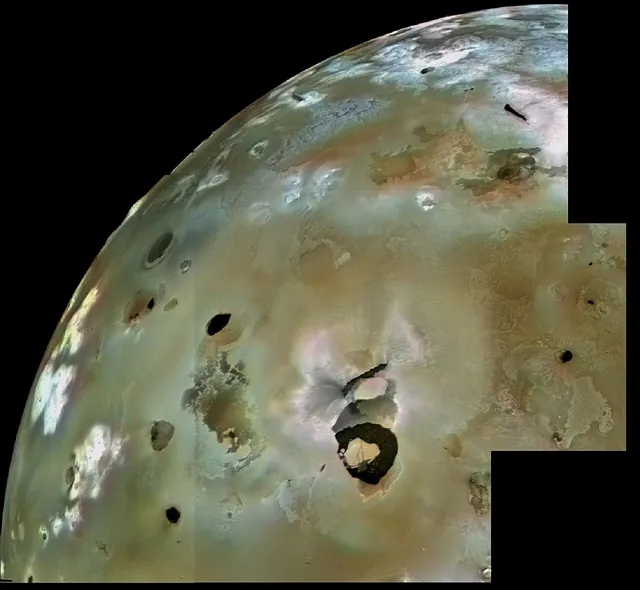
Loki Patera
Io’s largest volcanic depression, a lava lake listed by the gazetteer as 227 km across; NASA gives about 200 km. Loki alone gave off about 15 per cent of Io’s volcanic heat in Galileo’s 2000 measurements. Juno found islands in the lake and a surface as smooth as volcanic glass.22232425
Pele
An eruptive centre near 19° south whose plume reached about 300 km when Voyager 1 saw it, and about 390 km in images from Galileo and Cassini at the turn of 2001. Its fallout forms a red ring about 1,400 km across. Despite its huge plume, Pele gives off little heat, because its activity is confined to a small crater.4182426
Tvashtar Paterae
A group of volcanic depressions near 63° north, about 305 km across, named after the Indian smith god. Galileo saw a curtain of hot lava there in 1999 and 2000, and at the turn of 2001 it threw up a plume about 385 km high. New Horizons caught another plume, about 330 km high, in 2007.42728
Prometheus
An eruptive centre near the equator, 439 km across in the gazetteer, with a plume about 100 km tall. Galileo found no central vent; the plume may rise where fresh lava overruns plains rich in sulphur dioxide, and it shifted about 80 km between the Voyager and Galileo visits, along with the lava field.2930
Boösaule Montes
Io’s highest known mountain, measured in a 2001 global survey at 17.5 km, give or take 3 km, against an average of 6.3 km for Io’s peaks. The massif spans about 540 km just south of the equator. It is named after the cave where, in myth, Io gave birth to Epaphus.1431
Pillan Patera
A caldera about 69 km across that erupted violently in 1997, sending out a lava flow 70 km long. Galileo measured its lava at over 1,700 K and perhaps 2,000 K, hotter than any eruption on Earth today. The name honours the Araucanian god of thunder, fire and volcanoes.15161732
Exploration
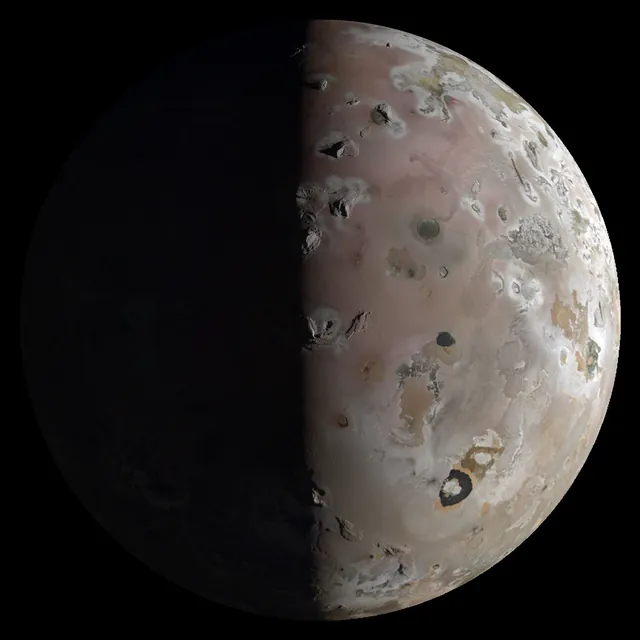
Pioneer 10 and 11 made the first close measurements in 1973 and 1974. In March 1979 Linda Morabito, a Voyager 1 navigation engineer, spotted a plume rising off Io’s limb in an image taken the day before: the first active volcano seen beyond Earth. Nine eruptions were eventually found in the Voyager images. Voyager 2 followed in July 1979.6253334
Galileo orbited Jupiter from December 1995 to September 2003, flying close to Io seven times and passing about 900 km above it on its arrival day. Most of what is known about Io comes from it. New Horizons, passing Jupiter on 28 February 2007 on its way to Pluto, photographed eruptions including Tvashtar’s giant plume.1283536
Juno, in orbit since 2016, swooped within about 1,500 km of Io on 30 December 2023 and 3 February 2024, the closest approaches in over 20 years. It took the first close-up images of the northern latitudes, mapped Loki Patera and a peak nicknamed Steeple Mountain, showed that Io lacks a shallow magma ocean, and measured heat flowing up through the crust.1920212337
- New Horizons Jupiter flyby
- 28 February 200736
Quick answers
- How strong is gravity on Io?
- Gravity at the surface of Io is 1.80 m/s² (Earth: 9.8 m/s²).8
- How long is a day on Io?
- A day on Io lasts 1.769 days (synchronous: one turn per orbit, about 42.5 hours).89
- How long does Io take to complete one orbit?
- Io completes one orbit in 1.769138 days.9
- What is the temperature on Io?
- The temperature on Io is about −155 °C (mean; the hottest lava tops 1,700 K).8
Sources
- Io — NASA Science, 2025
- Io: Facts — NASA Science, 2025
- NASA’s Juno Mission Uncovers Heart of Jovian Moon’s Volcanic Rage — NASA Jet Propulsion Laboratory, 2024
- Galileo and Cassini Image Two Giant Plumes on Io — NASA Photojournal, 2001
- Europa: Facts — NASA Science, 2025
- L. A. Morabito, Discovery of Volcanic Activity on Io: A Historical Review — arXiv, 2012
- Planetary Satellite Physical Parameters — NASA/JPL Solar System Dynamics
- Solar System Small Worlds Fact Sheet — NASA Space Science Data Coordinated Archive, 2016
- Jovian Satellite Fact Sheet — NASA Space Science Data Coordinated Archive, 2023
- Planetary Satellite Mean Elements — NASA/JPL Solar System Dynamics
- Planet and Satellite Names and Discoverers — IAU/USGS Gazetteer of Planetary Nomenclature
- Peale, Cassen and Reynolds, Melting of Io by Tidal Dissipation — Science, 1979
- Satellites of Jupiter — The Galileo Project, Rice University
- Schenk, Hargitai, Wilson et al., The mountains of Io: Global and geological perspectives from Voyager and Galileo — Journal of Geophysical Research: Planets, 2001
- McEwen et al., High-Temperature Silicate Volcanism on Jupiter’s Moon Io — Science, 1998
- Io in Eclipse Reveals High-Temperature Hot Spots — NASA Photojournal, 1998
- 1997 Lava Flows Near Pillan Patera, Io — NASA Photojournal, 1999
- Eruption of Pele (PIA00323) — NASA Photojournal
- NASA’s Juno Takes Temperature of Jupiter’s Fiery Moon Io — NASA Jet Propulsion Laboratory, 2026
- Park et al., Io’s tidal response precludes a shallow magma ocean — Nature, 2024
- SwRI space scientists observe Io’s atmospheric collapse during eclipse — Southwest Research Institute, 2016
- Loki Patera (Io) — IAU/USGS Gazetteer of Planetary Nomenclature
- NASA’s Juno Gives Aerial Views of Mountain, Lava Lake on Io — NASA, 2024
- Io’s Nighttime Heat — NASA Photojournal, 2000
- Io: Exploration — NASA Science, 2025
- Pele (Io) — IAU/USGS Gazetteer of Planetary Nomenclature
- Tvashtar Paterae (Io) — IAU/USGS Gazetteer of Planetary Nomenclature
- Tvashtar Composite — NASA Photojournal, 2007
- Prometheus (Io) — IAU/USGS Gazetteer of Planetary Nomenclature
- Galileo Takes a Close-up Look at Prometheus (PIA02568) — NASA Photojournal, 2000
- Boösaule Montes (Io) — IAU/USGS Gazetteer of Planetary Nomenclature
- Pillan Patera (Io) — IAU/USGS Gazetteer of Planetary Nomenclature
- Morabito, Synnott, Kupferman and Collins, Discovery of Currently Active Extraterrestrial Volcanism — Science, 1979
- Voyager: The Grand Tour of Big Science (NASA SP-4219, chapter 11) — NASA History Office
- Galileo — NASA Science, 2024
- New Horizons — NASA Science, 2026
- NASA’s Juno to Get Close Look at Jupiter’s Volcanic Moon Io on Dec. 30 — NASA Jet Propulsion Laboratory, 2023
Figures checked against these sources in November 2026. Where a quantity is not known, it is left out rather than estimated.

