moon
Europa
Europa is the smallest of Jupiter’s four large moons, a little smaller than our Moon but far brighter: its ice reflects 5.5 times as much sunlight. Its surface is water ice, crisscrossed by long reddish-brown cracks and ridges and broken in places into jumbled blocks. So few craters mark it that the surface is thought to be no more than 40 to 90 million years old.12
Beneath the ice there is strong evidence for a global ocean of salty water, perhaps holding twice as much water as all of Earth’s oceans. Whether that hidden ocean could support life is an open scientific question. NASA’s Europa Clipper, launched on 14 October 2024, is due to reach Jupiter in April 2030 and make 49 close flybys to find out whether Europa is habitable.134
Size and physical properties
Europa has a mean radius of 1,560.80 km, so it is about 3,100 km across, roughly 90 per cent the size of our Moon. It is the smallest of the four Galilean moons and the sixth-largest moon in the Solar System. Its mass is 4.80 × 10²² kg, and gravity at the surface is 1.31 m/s², a little weaker than on the Moon.1256910
Its mean density of 3.01 g/cm³ fits a body of rock and metal beneath a layer of water and ice. Its icy surface reflects 68 per cent of the light that falls on it, about 5.5 times as much sunlight as our Moon does, so if Europa replaced the Moon in our sky it would look about the same size but far brighter.156
Orbit, rotation and tides
Europa orbits Jupiter at an average distance of 671,100 km, about 9.4 times the planet’s radius, once every 3.551 days. It is tidally locked, so the same hemisphere always faces Jupiter. Because Jupiter’s equator is tilted by only about 3° to its path around the Sun, Europa has no seasons like Earth’s.167
Europa is locked in a resonance with Io and Ganymede: for each orbit of Ganymede, Europa completes two and Io four. The regular tugs keep Europa’s orbit slightly oval, so its distance from Jupiter varies and the planet’s tides stretch and relax the moon. That flexing probably cracks the surface and may heat the ocean floor, perhaps driving volcanic or hydrothermal activity there.1
Discovery and naming
Galileo Galilei first turned his telescope on Jupiter on 7 January 1610, seeing what he took for small stars beside it. That night Europa and Io appeared as a single point of light, and he separated them on 8 January, the date credited as Europa’s discovery. Within a week he had found all four moons, and by 15 January he understood that they orbit Jupiter.81112
Galileo called the moons the Medicean stars, after his patrons, and numbered them; Europa was Jupiter II. Simon Marius, who probably saw them independently at about the same time, proposed the names in use today in Mundus Iovialis in 1614, crediting Johannes Kepler with the idea. In myth Europa was a princess of Tyre carried off to Crete by Jupiter in the form of a white bull.811
A young, cracked surface of ice
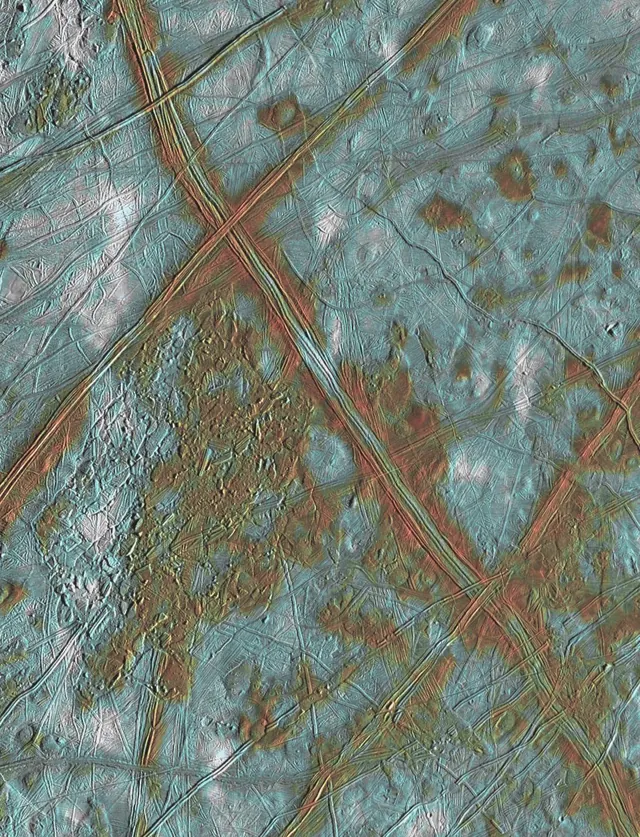
Telescope spectra taken at Kitt Peak in 1972 showed that Europa’s surface is mostly water ice. Voyager’s pictures in 1979 revealed a smooth, bright world criss-crossed by bands and ridges, with remarkably few large craters, tall cliffs or mountains. Some dark bands had edges that matched like jigsaw pieces, as though the crust had split and filled with darker icy material.1
Galileo showed that the long, straight fractures, called lineae, are often only 1 to 2 km wide but can run for thousands of kilometres. Some have built up into ridges hundreds of metres tall, including double ridges; others have pulled apart into broad bands. Along them, and in blotches elsewhere, lies a reddish-brown material that probably contains salts and sulphur compounds altered by radiation.113
Galileo also found chaos terrain, broken, blocky landscapes coated in reddish material where crustal plates seem to have rafted into new positions, and pits and domes suggesting that the ice shell slowly churns. One proposal, from 2011, is that chaos forms where the surface collapses over lens-shaped lakes within the ice. Counts of the few craters give the surface an age of only 40 to 90 million years.114
The hidden ocean
Galileo’s magnetometer gave the strongest evidence for an ocean. Jupiter’s magnetic field was disturbed around Europa in a way that implied a field induced inside the moon by a deep, electrically conducting layer. A pass on 3 January 2000, with Jupiter’s field in an orientation not sampled before, showed the changes expected of an induced field rather than a permanent one, strengthening the case for a planet-scale ocean.115
Europa is thought to have an iron core, a rocky mantle and an ocean of salty water 60 to 150 km deep under an ice shell probably 15 to 25 km thick. Although Europa is only a quarter of Earth’s diameter, its ocean may hold twice as much water as all of Earth’s. The ocean is strongly indicated but still awaits confirmation by a future mission.13
Life as we know it needs liquid water, certain chemical elements and a source of energy. Europa probably has the water and elements; energy could come from chemical reactions rather than sunlight, perhaps fuelled by radiation at the surface or activity on the seafloor. No life has been found there; Europa Clipper’s goal is to determine whether there are places below the surface that could support it.13
Thin oxygen and possible plumes
Europa has only a tenuous atmosphere, mainly of oxygen. Charged particles from Jupiter strike the ice and split water molecules into hydrogen and oxygen. Measuring the resulting ions during its 2022 flyby, Juno’s JADE instrument found that Europa produces about 12 kg of oxygen a second, around 1,000 tonnes a day, far less than most earlier estimates. Some of it may reach the ocean below.1916
Hubble has seen hints that Europa vents water vapour. Observations in 2012 showed signs of vapour above the south pole reaching more than 160 km, and in ten later transits of Jupiter possible plumes appeared in silhouette three times. In 2019 a team using the Keck Observatory reported the first direct detection of water vapour above the surface. No plume has yet been confirmed.11718
Radiation
Europa orbits in the middle of Jupiter’s radiation belts, and its surface is blasted by charged particles swept round by the planet’s magnetic field. The radiation would kill any life on the surface, but by splitting the ice it may also create chemical fuel that could reach the ocean. The harsh environment also limits spacecraft: ESA’s Juice will make only two Europa flybys for this reason.1919
Notable features
Conamara Chaos
A region of chaos terrain about 144 km across, centred at 9.7° north, where plates of crust have broken apart and rafted into new positions before refreezing. Named after a rugged part of western Ireland, it was imaged in colour by Galileo in 1996 and 1997.1420
Pwyll
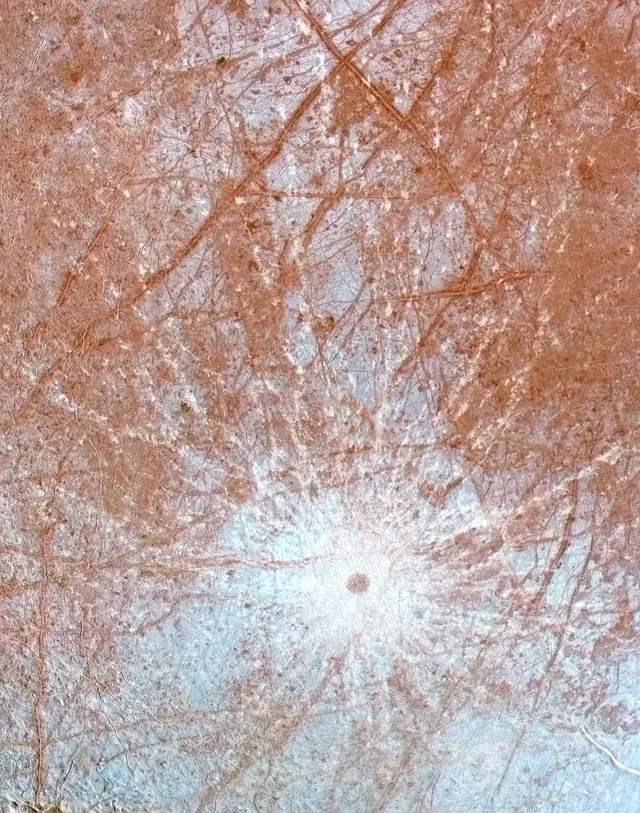
One of Europa’s youngest features: an impact crater listed by the gazetteer as 45 km across, surrounded by a dark spot of material blasted from beneath the surface and bright rays that stretch for more than 1,000 km. NASA’s 1996 caption gives the crater itself as 26 km wide.2122
Thera Macula
A dark, irregular patch about 95 km across at 46.7° south, south-east of the long fracture Agenor Linea. It is named after the island where Cadmus stopped while searching for his sister Europa.2324
Thrace Macula
A larger dark patch beside Thera Macula, about 180 km across at 45.9° south, named after the region of northern Greece where Cadmus also stopped in his search for Europa. Galileo imaged both maculae on 20 February 1997.2425
Annwn Regio
A region near the equator imaged by Juno at closest approach on 29 September 2022. The pictures show tall shadow-casting blocks, ridges and troughs, and an oblong pit near the day–night line that might be a degraded impact crater.10
Exploration
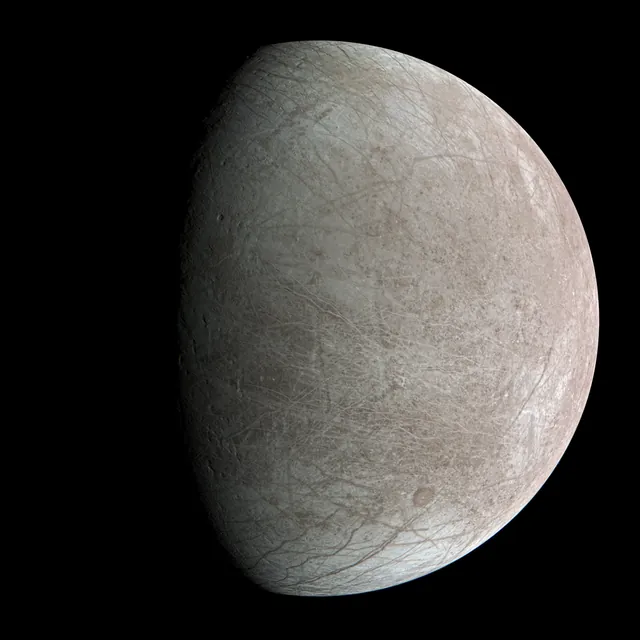
Pioneer 10 and 11 passed Jupiter in the early 1970s, but Voyager 1 and 2 took the first detailed pictures in 1979, Voyager 2 making its closest approach on 9 July. Galileo orbited Jupiter from 1995 to 2003, making 11 close encounters with Europa, as close as 351 km on 3 January 2000. It was deliberately plunged into Jupiter in 2003 so that it could never contaminate Europa.1102627
Juno flew within about 352 km of Europa on 29 September 2022, the first close look in over two decades. Its images revealed pits 20 to 50 km wide, a double ridge with possible plume stains and a chaos feature nicknamed the Platypus, and supported the idea that Europa’s ice shell has shifted relative to its interior.1013
Europa Clipper launched on 14 October 2024, flew past Mars on 1 March 2025 and swings past Earth on 3 December 2026. It is due to enter orbit around Jupiter in April 2030 and make 49 close flybys of Europa with nine instruments. ESA’s Juice, due at Jupiter in July 2031, will fly past Europa twice in July 2032, coming within 400 km.342829
- Europa Clipper launch
- 14 October 2024326
- Europa Clipper arrival
- April 203034
- Europa Clipper planned flybys
- 493
Quick answers
- How massive is Europa?
- Europa has a mass of 4.800 × 10²² kg (about two-thirds of our Moon’s).6
- How dense is Europa?
- Europa has a mean density of 3.0130 g/cm³.5
- How strong is gravity on Europa?
- Gravity at the surface of Europa is 1.31 m/s² (Earth: 9.8 m/s²).2
- How long is a day on Europa?
- A day on Europa lasts 3.551 days (synchronous: one turn per orbit, about 85.2 hours).26
- How long does Europa take to complete one orbit?
- Europa completes one orbit in 3.551181 days.6
- How far is Europa from Jupiter?
- Europa is 671,100 km from Jupiter (semi-major axis, 9.40 Jupiter radii).67
- What is the temperature on Europa?
- The temperature on Europa is about −170 °C (mean).2
- When was Europa discovered?
- Europa was discovered on 8 January 1610, by Galileo Galilei.8
- What is Europa made of?
- Europa is made of ice shell over a salty ocean, rock and an iron core.1
Sources
- Europa: Facts — NASA Science, 2025
- Solar System Small Worlds Fact Sheet — NASA Space Science Data Coordinated Archive, 2016
- Europa Clipper — NASA Science, 2026
- Europa Clipper Mission Timeline — NASA Science, 2026
- Planetary Satellite Physical Parameters — NASA/JPL Solar System Dynamics
- Jovian Satellite Fact Sheet — NASA Space Science Data Coordinated Archive, 2023
- Planetary Satellite Mean Elements — NASA/JPL Solar System Dynamics
- Planet and Satellite Names and Discoverers — IAU/USGS Gazetteer of Planetary Nomenclature
- NASA’s Juno Mission Measures Oxygen Production at Europa — NASA, 2024
- NASA’s Juno Shares First Image From Flyby of Jupiter’s Moon Europa — NASA, 2022
- Satellites of Jupiter — The Galileo Project, Rice University
- Io: Facts — NASA Science, 2025
- NASA’s Juno Provides High-Definition Views of Europa’s Icy Shell — NASA, 2024
- Europa Ice Rafts in Local and Color Context (PIA01296) — NASA Photojournal, 1997
- Kivelson et al., Galileo Magnetometer Measurements: A Stronger Case for a Subsurface Ocean at Europa — Science, 2000
- Szalay et al., Oxygen production from dissociation of Europa’s water-ice surface — Nature Astronomy, 2024
- NASA’s Hubble Spots Possible Water Plumes Erupting on Jupiter’s Moon Europa — NASA, 2016
- Roth et al., Transient Water Vapor at Europa’s South Pole — Science, 2014
- Juice: Frequently Asked Questions — European Space Agency
- Conamara Chaos (Europa) — IAU/USGS Gazetteer of Planetary Nomenclature
- Pwyll (Europa) — IAU/USGS Gazetteer of Planetary Nomenclature
- Pwyll Crater on Europa (PIA01211) — NASA Photojournal, 1996
- Thera Macula (Europa) — IAU/USGS Gazetteer of Planetary Nomenclature
- Thera and Thrace Macula on Europa (PIA00875) — NASA Photojournal, 1997
- Thrace Macula (Europa) — IAU/USGS Gazetteer of Planetary Nomenclature
- Europa — NASA Science, 2026
- Galileo — NASA Science, 2024
- Juice — European Space Agency
- The moons of Jupiter: What will Juice discover? — European Space Agency
Figures checked against these sources in November 2026. Where a quantity is not known, it is left out rather than estimated.

