moon
Titan
Titan is Saturn’s largest moon and the second-largest moon in the Solar System, bigger than the planet Mercury. It is the only moon known to have a dense atmosphere: a deep blanket of nitrogen and methane, topped by an orange haze that hides the ground from ordinary cameras. At the surface the air presses about one and a half times as hard as Earth’s, and the temperature sits near −179 °C.123
Beneath the haze lies the only world besides Earth with stable liquid on its surface. Methane and ethane fall as rain, cut river channels and gather in lakes and seas near the poles, while dunes of dark organic sand stretch around the equator. The Huygens probe landed here in January 2005, and NASA’s Dragonfly rotorcraft is due to follow, launching no earlier than July 2028.1456
Size and physical properties
Titan has a mean radius of 2,574.76 km, making it about 5,150 km across. That is nearly half as wide again as Earth’s Moon and larger than the planet Mercury. Among moons only Jupiter’s Ganymede is bigger, and by just 2 per cent. Titan’s mass, though, is modest: roughly one forty-fifth of Earth’s.1278
Its mean density is 1.88 g/cm³, less than twice that of water, which fits a world built of both rock and water ice. Gravity at the surface is 1.35 m/s², a little weaker than on our Moon, and a spacecraft needs about 2.6 km/s to escape. Its visual geometric albedo, a measure of how brightly it reflects sunlight, is 0.22.12789
Orbit and rotation
Titan circles Saturn at an average distance of about 1.22 million km, roughly 20 times the planet’s radius, completing one orbit every 15.945 days, or 15 days and 22 hours. The orbit is slightly oval, with an eccentricity of 0.029, so the distance swings between about 1,186,000 and 1,258,000 km. It lies close to the plane of Saturn’s equator.18910
Like our Moon, Titan is tidally locked: it turns once per orbit and always shows the same face to its planet. Its spin axis is tilted by only about 0.3°. Because Titan shares Saturn’s tilt towards the Sun, its seasons run on Saturn’s schedule, each lasting more than seven Earth years within a year of about 29.1912
Discovery and naming
The Dutch scientist Christiaan Huygens found Titan on 25 March 1655, observing from The Hague. He and his brother Constantijn had been making their own telescopes, with lenses ground and polished by a new method, and he turned one of them on Saturn intending to study its rings. Beside the planet he saw a large moon, which he called simply Luna Saturni, ‘Saturn’s moon’.11113
The modern name came much later. In 1847 John Herschel, publishing his observations from the Cape of Good Hope, proposed calling Saturn’s seven known moons after the Titans and Titanesses, the mythical brothers and sisters of Saturn. For the bright satellite found by Huygens he chose Titan itself, explaining that the name was indicated by its superior size.11415
- Place
- The Hague11
Atmosphere and weather
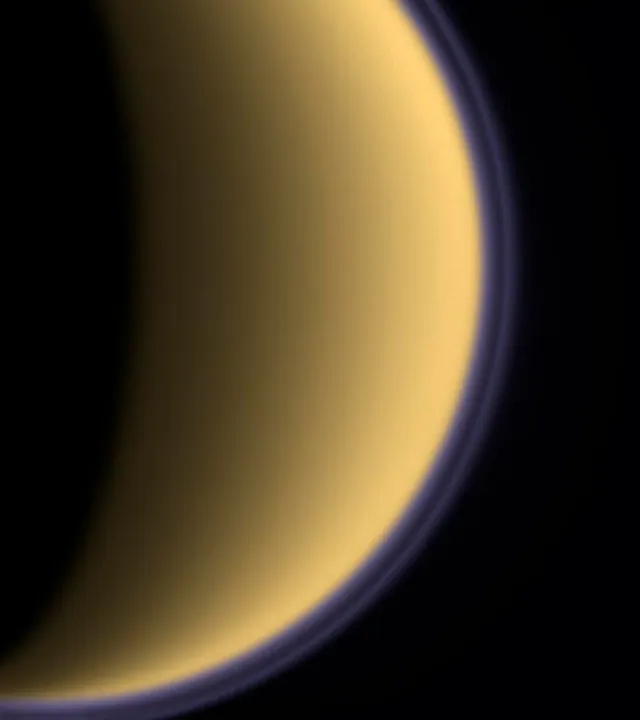
Titan’s air is about 95 per cent nitrogen and 5 per cent methane, with traces of other carbon-rich gases. The Huygens probe measured the methane directly as it fell: 1.48 per cent in the lower stratosphere, rising to 5.65 per cent near the ground. At the surface it recorded a pressure of 1,467 hPa and a temperature of 93.65 K, about −179 °C.1316
High above, sunlight and energetic particles from Saturn’s magnetic field split methane and nitrogen apart. The fragments recombine into complex organic molecules that build up a thick orange smog, hiding the surface in visible light; a thin, detached haze layer floats above the main one. Because Titan’s gravity is weak, the atmosphere is puffed up, reaching about 600 km into space.117
Methane plays the part that water plays on Earth. It condenses into clouds, falls as rain, runs across the land into lakes and seas, and evaporates again. Sunlight steadily destroys methane, so something must be replacing it. Eruptions from ice volcanoes are one suspect, but where the methane comes from is still a mystery.1
Seas, dunes and ice
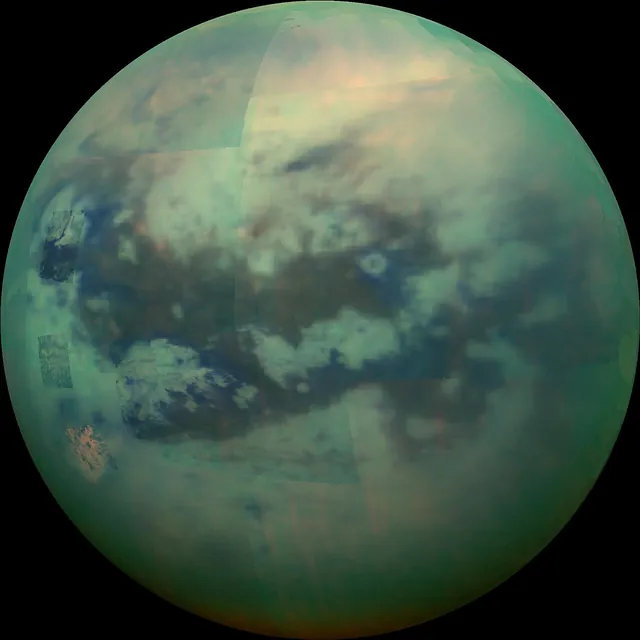
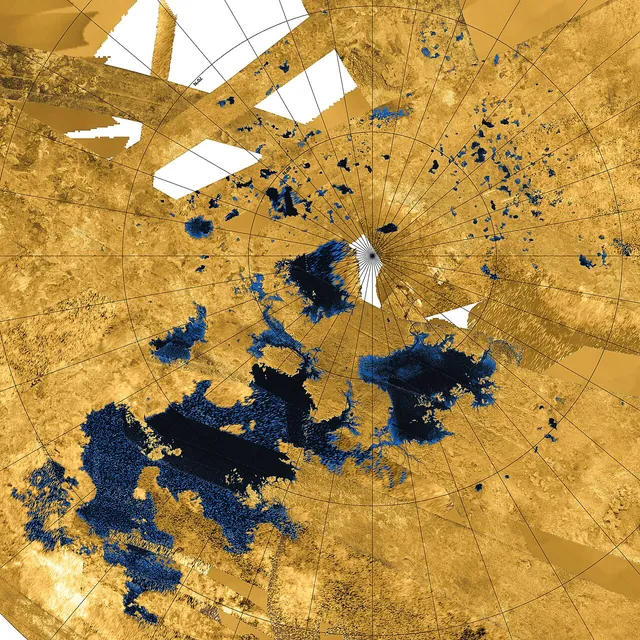
At about −179 °C water ice plays the role of rock, and it is liquid methane and ethane that shape the land, carving river channels and filling lakes and seas. Nearly all of this liquid lies in the far north, inside a region about 900 by 1,800 km; only 3 per cent is found elsewhere. Huygens came down on a frozen surface littered with rounded pebbles.1418
Around the equator stretch vast fields of tall, straight dunes, much like those of the Namib Desert but made of dark hydrocarbon grains that settle out of the atmosphere. Impact craters are scarce, a sign that the surface is young and that rain, wind and movements of the crust keep wiping them away. The largest confirmed crater, Menrva, is 392 km across.11920
Titan may also have volcanoes that erupt chilled water instead of molten rock. Cassini’s best candidate is the region around Sotra Patera, a pit about 1,700 m deep lying beside the 1,450 m peak Doom Mons, with finger-like flows spreading nearby. Whether such cryovolcanoes are truly at work on Titan has not been settled.121
What hides inside
Titan’s interior is known only from indirect clues. One model based on Cassini–Huygens data has a core of water-bearing rock about 4,000 km across, wrapped in a shell of dense high-pressure ice, then a layer of salty liquid water, and finally an outer crust of ordinary water ice coated with organic material that has settled from the sky.1
The case for that hidden ocean came from gravity. Tracking Cassini during six flybys between 2006 and 2011 showed that Saturn raises solid tides about 10 m high on Titan, where a moon made entirely of rock would bulge by only about 1 m. Such flexibility pointed to a global layer of liquid water beneath the ice.2324
A 2025 reanalysis of the tracking data challenges this. It found that Titan turns far more tidal energy into heat than a moon with an ocean should, and concluded that there is no global ocean. Instead an ice shell about 170 km thick would overlie slushy high-pressure ice holding pockets of meltwater, around a rocky core about 2,000 km in radius. Dragonfly’s seismic measurements should test the idea.1225
Magnetic field
Cassini’s magnetometer never detected a magnetic field coming from Titan itself. The moon spends about 95 per cent of its time inside Saturn’s magnetosphere, cloaked in the planet’s field. When a solar outburst in December 2013 left it exposed, the solar wind draped itself around Titan much as it does around Venus and Mars, which have no global field.26
Notable features
Kraken Mare
Titan’s largest sea, a sprawling body of liquid methane and ethane near the north pole, centred at 68° north. The IAU gazetteer gives it a span of 1,170 km. The name, approved in 2008, comes from the Kraken, a sea monster of Norwegian legend.422
Ligeia Mare
The second-largest sea, a nearly heart-shaped body 500 km across close to the north pole, named after one of the sirens of Greek myth. Cassini’s radar picked up echoes from its floor, showing it to be about 170 m deep and filled with very pure, clear liquid.42728
Ontario Lacus
The largest present-day lake in the southern hemisphere, at 72° south: about 235 km long and 80 km wide, and probably at least 10 m deep in the middle. Named after Lake Ontario, it lies inside the basin of a far larger ancient sea.293031
Xanadu
A bright region about the size of Australia, listed as 3,400 km across and centred 15° south of the equator. Hubble first spotted it in 1994 as a bright patch in infrared light. In 2006 Cassini’s radar revealed hills, mountains and winding river channels, probably cut by flowing methane or ethane.3233
Selk crater and Ahmakiq Undae
Selk is an impact crater 80 km across, close to the equator at 7° north. The large dune field to its south, about 810 km across, was named Ahmakiq Undae in 2026 and is where Dragonfly will land. Deposits made by the Selk impact are among the mission’s main targets.343536
Doom Mons and Sotra Patera
Cassini’s best candidate for an ice volcano. Doom Mons, named after the volcano in Tolkien’s fiction, stands about 1,450 m high; the gazetteer lists it as 63 km across. Beside it lies Sotra Patera, a pit about 1,700 m deep and 30 km wide.2137
Exploration
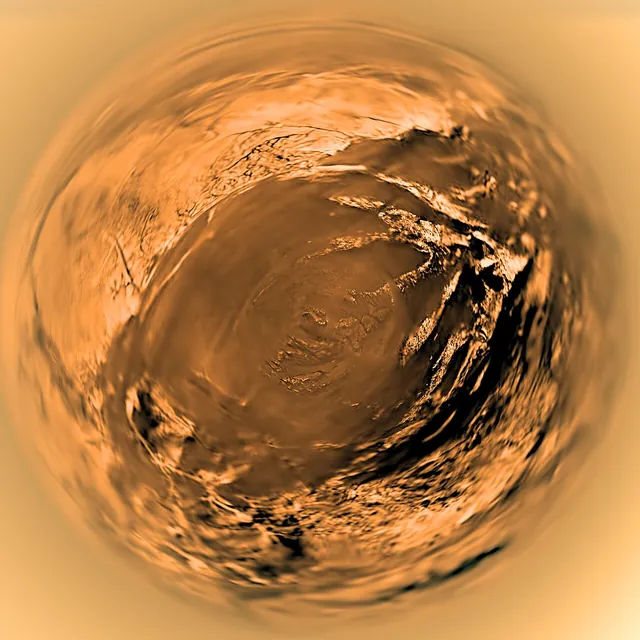
Pioneer 11 was the first spacecraft to study Titan, passing through the Saturn system on 1 September 1979. Voyager 1 followed in November 1980 and Voyager 2 in 1981. Their pictures showed only a featureless orange world, but the Voyagers revealed that the atmosphere is mainly nitrogen, and Voyager 1 measured Titan’s radius, surface temperature and air pressure.3839
Cassini entered orbit around Saturn in 2004 and made 127 close flybys of Titan over 13 years, mapping it with radar and infrared instruments. It carried ESA’s Huygens probe, released on 25 December 2004. On 14 January 2005 Huygens descended through the atmosphere for 2 hours 27 minutes and touched down: the first landing in the outer Solar System.53840
Next comes NASA’s Dragonfly, a rotorcraft selected in 2019. It is scheduled to launch no earlier than July 2028 and arrive in late 2034. During a planned 3.3-year mission it will fly between sites among the equatorial dunes and at Selk crater, making one flight every one or two Titan days (each about 16 Earth days) and analysing surface material for the chemistry that came before life.636
Quick answers
- How dense is Titan?
- Titan has a mean density of 1.8814 g/cm³.7
- How strong is gravity on Titan?
- Gravity at the surface of Titan is 1.35 m/s² (Earth: 9.8 m/s²).8
- How long does Titan take to complete one orbit?
- Titan completes one orbit in 15.945 days (15 days 22 hours).1910
- What is the temperature on Titan?
- The temperature on Titan is 93.65 K (about −179 °C), measured by Huygens where it landed.13
Sources
- Titan: Facts — NASA Science, 2026
- Facts about Titan — European Space Agency, 2003
- Fulchignoni et al., In situ measurements of the physical characteristics of Titan’s environment — Nature, 2005
- Titan’s North (PIA17655) — NASA Photojournal, 2013
- Huygens Probe — NASA Science, 2024
- Dragonfly — NASA Science, 2026
- Planetary Satellite Physical Parameters — NASA/JPL Solar System Dynamics
- Solar System Small Worlds Fact Sheet — NASA Space Science Data Coordinated Archive, 2016
- Saturnian Satellite Fact Sheet — NASA Space Science Data Coordinated Archive, 2025
- Planetary Satellite Mean Elements — NASA/JPL Solar System Dynamics
- Planet and Satellite Names and Discoverers — IAU/USGS Gazetteer of Planetary Nomenclature
- Petricca et al., Titan’s strong tidal dissipation precludes a subsurface ocean — Nature, 2025
- Christiaan Huygens: Discoverer of Titan — European Space Agency, 2012
- J. F. W. Herschel, Results of Astronomical Observations Made During the Years 1834, 5, 6, 7, 8, at the Cape of Good Hope — Smith, Elder and Co. (digitised by the Internet Archive), 1847
- Enceladus — NASA Science, 2024
- Niemann et al., Composition of Titan’s lower atmosphere and simple surface volatiles as measured by the Cassini-Huygens probe gas chromatograph mass spectrometer experiment — Journal of Geophysical Research: Planets, 2010
- Purple Haze (PIA06090) — NASA Photojournal, 2004
- Titan’s surface — European Space Agency
- Peering Through Titan’s Haze (PIA20016) — NASA Photojournal, 2015
- Menrva (Titan) — IAU/USGS Gazetteer of Planetary Nomenclature
- Flyover of Sotra Facula, Titan (PIA13695) — NASA Photojournal, 2010
- Kraken Mare (Titan) — IAU/USGS Gazetteer of Planetary Nomenclature
- Iess et al., The Tides of Titan — Science, 2012
- Cassini Finds Likely Subsurface Ocean on Saturn Moon — NASA Jet Propulsion Laboratory, 2012
- NASA Study Suggests Saturn’s Moon Titan May Not Have Global Ocean — NASA Jet Propulsion Laboratory, 2025
- Cassini Catches Titan Naked in the Solar Wind — NASA, 2015
- Ligeia Mare (Titan) — IAU/USGS Gazetteer of Planetary Nomenclature
- NASA’s Cassini Spacecraft Reveals Clues About Saturn Moon (release 13-370) — NASA, 2013
- Ontario Lacus (Titan) — IAU/USGS Gazetteer of Planetary Nomenclature
- Outline of an Ancient Sea on Titan — NASA Photojournal, 2012
- Land of Lakes? — NASA Photojournal, 2005
- Xanadu (Titan) — IAU/USGS Gazetteer of Planetary Nomenclature
- Cassini Reveals Titan’s Xanadu Region to Be an Earth-Like Land — NASA Jet Propulsion Laboratory, 2006
- Selk (Titan) — IAU/USGS Gazetteer of Planetary Nomenclature
- Ahmakiq Undae (Titan) — IAU/USGS Gazetteer of Planetary Nomenclature, 2026
- NASA’s Dragonfly Gets Wired Up While Titan Landing Area Is Named — NASA Science, 2026
- Doom Mons (Titan) — IAU/USGS Gazetteer of Planetary Nomenclature
- Titan Exploration — NASA Science, 2025
- Voyager 1 — NASA Science, 2026
- Huygens lands on Titan! — ESA Science & Technology, 2005
Figures checked against these sources in November 2026. Where a quantity is not known, it is left out rather than estimated.

