moon
Enceladus
Enceladus is a small, icy moon of Saturn, only about 500 km across, yet it has the whitest, most reflective surface in the Solar System. Fresh snow keeps it bright. In 2005 NASA’s Cassini spacecraft discovered jets of water vapour and ice grains spraying from long, warm fractures near its south pole, nicknamed the “tiger stripes”, and much of that material falls back onto the surface.12
The jets are fed by a global ocean of salty liquid water hidden beneath the ice. By flying through the spray, Cassini tasted that ocean: salts, silica grains that point to hot water reacting with rock on the sea floor, molecular hydrogen and phosphates. The icy particles that escape spread around Saturn to form its faint E ring. Whether such an ocean could support life is an open scientific question.134567
Size and physical properties
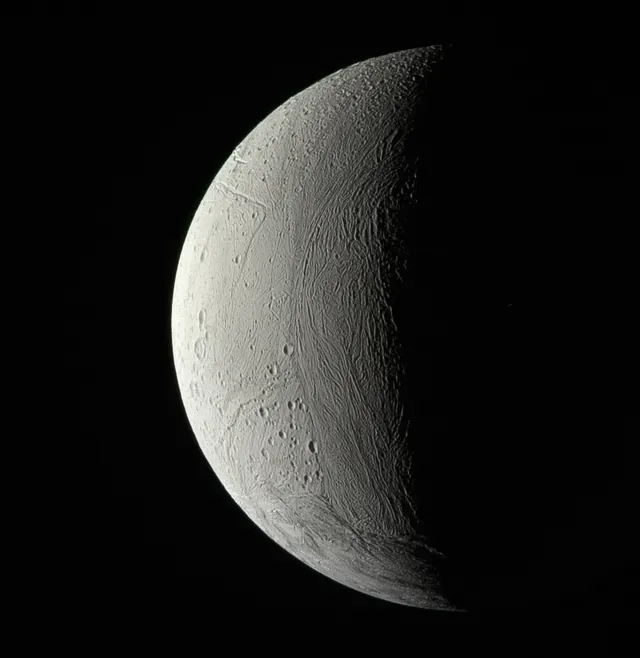
Enceladus has a mean radius of 252.1 km, making it about as wide as the US state of Arizona. It is not quite a sphere: its three axes measure about 257, 251 and 248 km. Its mass is 1.08 × 10²⁰ kg and its mean density 1.61 g/cm³, a mixture that points to rock as well as ice.1489
No body in the Solar System reflects sunlight better. Its visual geometric albedo is listed as 1.0, and NASA calls it the most reflective object we know. Because it sends so much sunlight straight back into space, the surface stays extremely cold, at about −201 °C. Ice grains from its own jets settle back like snow and keep it bright white.1911
Orbit and rotation
Enceladus circles Saturn at an average distance of about 238,000 km, between the orbits of Mimas and Tethys, completing one lap every 1.37 days, or about 32.9 hours. It travels through the densest part of the E ring, the faint ring its own jets supply. Like our Moon it is tidally locked, always keeping the same face turned towards its planet.19
Enceladus is held in an orbital resonance with the larger moon Dione: it goes round Saturn twice for every single orbit Dione makes. Dione’s regular tugs keep Enceladus’s path slightly oval, so its distance from Saturn keeps changing. Saturn’s gravity therefore squeezes and relaxes the moon on every orbit, generating heat inside it.19
Discovery and naming
The British astronomer William Herschel discovered Enceladus on 28 August 1789, observing from Slough in England. For nearly two centuries it remained little more than a point of light. Pictures from the Voyager spacecraft in the 1980s finally showed a small world, remarkably smooth in places and bright white all over.110
The name was suggested by William Herschel’s son, John Herschel, in an 1847 book of his observations from the Cape of Good Hope, in which he named the seven Saturnian moons then known. Enceladus was one of the Giants of Greek myth; in the legend he was crushed by Athene in the war against the Olympian gods, and the earth piled on top of him became Sicily.110
Tiger stripes and plumes
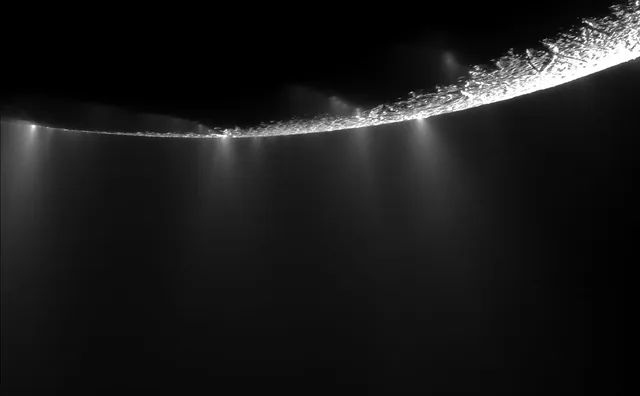
Some regions of Enceladus carry craters up to about 35 km wide, but others have almost none, a sign that much of the surface has been renewed in the geologically recent past. The south polar region is almost entirely free of craters. It is ringed by folded ridges and troughs near 55° south and littered with ice boulders the size of houses.12
Four long, parallel fractures cross this region: the “tiger stripes”, each about 135 km long. Cassini found them to be about 300 m deep, with V-shaped walls, and warmer than their surroundings. Jets of vapour and ice burst from them, from the hottest spots along the fractures, at about 400 metres per second. In 2014 scientists counted 101 distinct geysers.1213
Heat pours out of the south polar terrain. Measurements by Cassini’s infrared spectrometer put the power at about 15.8 gigawatts, far more than models of the interior had predicted. The jets also change with the moon’s orbit: they are weakest when Enceladus is closest to Saturn and strongest when it is farthest away, as tides open and close the cracks.13
What the plumes contain
The plume gas is nearly 98 per cent water vapour. The rest includes about 1 per cent molecular hydrogen, plus carbon dioxide, methane and ammonia. Cassini found organic material about 20 times denser than expected. In 2009 its dust analyser found that some ice grains in the E ring are rich in sodium salts, about 0.5 to 2 per cent by mass, which can only form from liquid water.41314
Flying close to the jets, Cassini found that salt-rich grains carry more than 99 per cent of the solid mass leaving the moon, pointing to a salty reservoir as the source. Tiny silica particles, 2 to 8 nanometres in radius, suggested water hotter than 90 °C reacting with rock. Hydrogen measured in October 2015 added independent evidence for such hydrothermal activity.561415
In 2023 a team reported sodium phosphates in ice grains, implying phosphorus concentrations at least 100 times higher than in Earth’s oceans. Liquid water, chemical energy and the key elements make Enceladus a prime place to ask whether life could exist beyond Earth. The hydrogen chemistry could serve as an energy source for life, if life happened to exist there; whether it does remains unknown.71316
The hidden ocean
Gravity measurements made by tracking Cassini first revealed a sea beneath the south pole. Published in 2014, they suggested a large, probably regional body of water about 10 km deep, under an ice shell 30 to 40 km thick. The sodium-rich grains had already shown that the plumes came from liquid water in contact with rock.41317
In 2015 a study of more than seven years of Cassini images settled the question. Enceladus wobbles slightly as it orbits, a forced libration of 0.120 ± 0.014°. That is too large for an icy crust frozen solid to the core, so the shell must float on a global ocean of liquid water. How this ocean avoids freezing is not yet fully understood.318
The ice shell is thought to average about 20 to 25 km thick, thinning to perhaps 1 to 5 km at the south pole. The silica grains suggest that hot, mineral-rich water rises from vents on the sea floor, somewhat like the hydrothermal vents in Earth’s deep oceans, and is carried quickly up to the plume sources.15
Feeding Saturn’s E ring
The particles thrown out by the jets build a vast halo of fine ice dust around Enceladus. Most of it falls back onto the moon like snow, but a fraction escapes and spreads along its orbit, forming Saturn’s broad, faint E ring. Cassini confirmed in 2005 that the south polar activity is the main source of the ring’s material.1213
The influence reaches further. Observations by ESA’s Herschel Space Observatory revealed a huge doughnut-shaped cloud of water vapour from Enceladus encircling Saturn, which appears to supply water to the planet’s upper atmosphere. Enceladus is the only moon known to change the chemical make-up of its parent planet in this way.13
Notable features
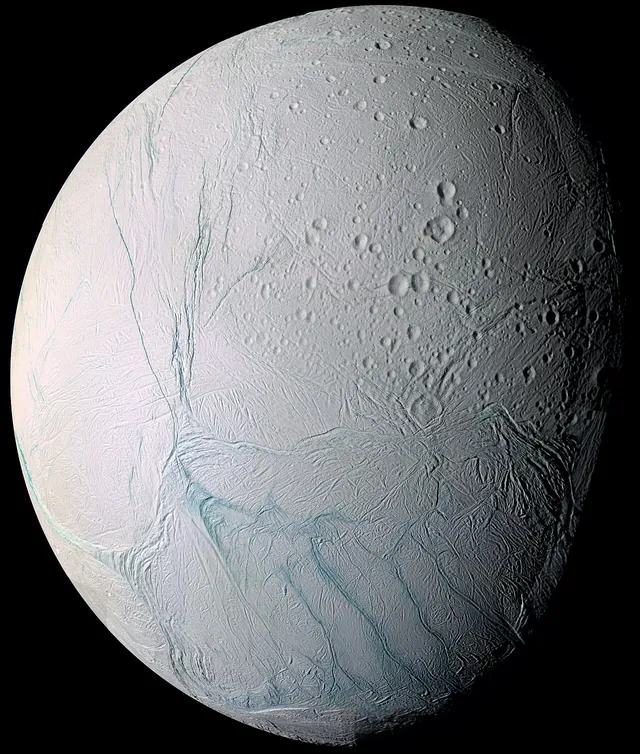
Baghdad Sulcus
The longest of the four tiger stripes, listed in the IAU gazetteer as 176 km long and passing close to the south pole at about 87° south. Like the other stripes it is named after a city in Richard Burton’s translation of the Arabian Nights. The names were approved in 2006.19
Damascus Sulcus
A tiger stripe 125 km long, centred near 81° south, named after the home city of the merchant Ayyub in one of the Arabian Nights tales. Cassini’s images traced the jets to the four tiger stripes, and in almost every case to the hottest spots along them.1320
Cairo and Alexandria Sulci
The other two tiger stripes complete the set of four. The gazetteer lists Cairo Sulcus as 165 km long, centred near 82° south, and Alexandria Sulcus as 111 km long, near 76° south. Both are named after cities that appear in tales from the Arabian Nights.2122
Samarkand Sulci
A wide system of grooves and ridges in the northern hemisphere, listed as 360 km across and centred at 30° north. These sulci show that tectonic forces have reshaped parts of Enceladus far from the active south pole. The name, approved in 1982, comes from the Arabian Nights.123
Ali Baba
One of the larger craters in the old cratered plains of the north, 34 km across and centred near 57° north. NASA notes that craters on Enceladus reach about 35 km in diameter. It is named after the hero of the tale of the forty thieves, and was named in 1982.124
Exploration
The Voyager spacecraft photographed Enceladus in the 1980s, showing a small, smooth, bright white moon. Cassini, which arrived at Saturn in 2004, made its first close pass on 17 February 2005. Its magnetometer noticed that Saturn’s magnetic field was disturbed above the south pole, as if gas were escaping. Closer flybys that year revealed the warm tiger stripes and their plume.11113
The discovery changed Cassini’s mission. Only three close flybys of Enceladus had been planned for its four-year primary mission; 20 more were added, seven of them straight through the plumes. On 9 October 2008 Cassini passed about 25 km above the surface, and on 28 October 2015 it made its deepest dive through the plume. The mission ended on 15 September 2017.11114
No spacecraft has yet landed on Enceladus. ESA is studying its fourth large-class mission, L4, which would sample the plumes from orbit and set a lander on the surface to search for the ingredients of life. Its launch is listed for 2042. In 2024 ESA’s expert committee named Enceladus the most compelling target, ahead of Titan and Europa.1625
Quick answers
- How big is Enceladus?
- Enceladus has a mean radius of 252.1 km (about 504 km across).8
- How massive is Enceladus?
- Enceladus has a mass of 1.08 × 10²⁰ kg.9
- How long is a day on Enceladus?
- A day on Enceladus lasts 1.37 days (synchronous: the same face always turned to Saturn).19
- How long does Enceladus take to complete one orbit?
- Enceladus completes one orbit in 1.370 days (about 32.9 hours).19
- What is the temperature on Enceladus?
- The temperature on Enceladus is about −201 °C.1
Sources
- Enceladus — NASA Science, 2024
- Porco et al., Cassini Observes the Active South Pole of Enceladus — Science, 2006
- Thomas et al., Enceladus’s measured physical libration requires a global subsurface ocean — Icarus, 2016
- Postberg et al., Sodium salts in E-ring ice grains from an ocean below the surface of Enceladus — Nature, 2009
- Hsu et al., Ongoing hydrothermal activities within Enceladus — Nature, 2015
- Waite et al., Cassini finds molecular hydrogen in the Enceladus plume: Evidence for hydrothermal processes — Science, 2017
- Postberg et al., Detection of phosphates originating from Enceladus’s ocean — Nature, 2023
- Planetary Satellite Physical Parameters — NASA/JPL Solar System Dynamics
- Saturnian Satellite Fact Sheet — NASA Space Science Data Coordinated Archive, 2025
- Planet and Satellite Names and Discoverers — IAU/USGS Gazetteer of Planetary Nomenclature
- An Ice World…With an Ocean? — NASA Science, 2017
- Planetary Satellite Mean Elements — NASA/JPL Solar System Dynamics
- Cassini at Enceladus: A Decade-Plus of Discovery — NASA Science, 2015
- NASA Missions Provide New Insights into ‘Ocean Worlds’ in Our Solar System — NASA Jet Propulsion Laboratory, 2017
- Postberg et al., A salt-water reservoir as the source of a compositionally stratified plume on Enceladus — Nature, 2011
- Saturn’s moon Enceladus top target for ESA — European Space Agency, 2024
- Iess et al., The Gravity Field and Interior Structure of Enceladus — Science, 2014
- Cassini Finds Global Ocean in Saturn’s Moon Enceladus — NASA Jet Propulsion Laboratory, 2015
- Baghdad Sulcus (Enceladus) — IAU/USGS Gazetteer of Planetary Nomenclature
- Damascus Sulcus (Enceladus) — IAU/USGS Gazetteer of Planetary Nomenclature
- Cairo Sulcus (Enceladus) — IAU/USGS Gazetteer of Planetary Nomenclature
- Alexandria Sulcus (Enceladus) — IAU/USGS Gazetteer of Planetary Nomenclature
- Samarkand Sulci (Enceladus) — IAU/USGS Gazetteer of Planetary Nomenclature
- Ali Baba (Enceladus) — IAU/USGS Gazetteer of Planetary Nomenclature
- L4 to Enceladus — ESA Science Programme
Figures checked against these sources in November 2026. Where a quantity is not known, it is left out rather than estimated.

