moon
Tethys
Tethys is one of Saturn’s larger moons, an icy world about 1,062 km across. Its density is so low, barely below that of liquid water, that it must be made almost entirely of water ice with only a little rock. It is cold, airless and scarred by craters, and its bright surface is constantly dusted with fine ice from the plumes of its neighbour Enceladus.12
Two giant features dominate Tethys: the impact crater Odysseus, about 400 to 445 km wide, and Ithaca Chasma, a vast valley running roughly from pole to pole. Tethys also shares its orbit with two tiny moons, Telesto and Calypso, which travel 60° ahead of and behind it. Cassini spotted mysterious red arcs on its surface in 2015.1345
Size and physical properties
Tethys has a mean radius of 531.1 km, so it is about 1,062 km across, and NASA ranks it as Saturn’s fifth-largest moon. It is not quite a sphere, measuring about 1,077 by 1,057 by 1,053 km. Its mass is 6.18 × 10²⁰ kg, and it is similar in many ways to its sister moons Dione and Rhea.126
Its mean density of 0.984 g/cm³ is just below that of liquid water, which means Tethys is made almost entirely of water ice with only a small amount of rock. At an average of about −187 °C the ice is as hard as rock. Its surface is highly reflective, partly because it is constantly bombarded by ice grains from Saturn’s E ring, which are produced by the geysers of Enceladus.12
Orbit and rotation
Tethys orbits Saturn at an average distance of about 295,000 km, completing a circuit every 1.888 days, or about 45.3 hours. Its orbit is almost perfectly circular and lies close to the plane of Saturn’s equator. Like nearly all of Saturn’s major moons it is tidally locked, so the same side always faces the planet.168
Tethys does not travel alone. Two small moons share its orbit, held at its Lagrangian points: Telesto 60° ahead of it at L4 and Calypso 60° behind at L5. The three circle Saturn as a unit. That such moons survive implies these points have stayed stable against outside disturbances for millions of years.16
Discovery and naming
The astronomer Giovanni Domenico Cassini discovered Tethys on 21 March 1684, observing from Paris. He called it and his three other Saturnian discoveries, Iapetus, Dione and Rhea, the Sidera Lodoicea, the Stars of Louis, after King Louis XIV. Other astronomers simply numbered the moons by distance, making Tethys Saturn III.17
The name used today was suggested by John Herschel, who proposed naming Saturn’s moons after the Titans and Titanesses, the brothers and sisters of Kronos, the Greek counterpart of Saturn. In myth Tethys was a Titaness, wife of Oceanus and mother of the great rivers and of the Oceanids. Features on Tethys generally take their names from Homer’s Odyssey.17
- Place
- Paris7
Surface
Tethys is heavily scarred, though less cratered than its sister moons Dione and Rhea, perhaps because tidal warming kept it partly molten for longer. The northern hemisphere is lighter and battered by ages of impacts; nearer the equator the terrain is darker with fewer craters, suggesting past resurfacing. A slightly darker band runs around the equator on the leading side.1
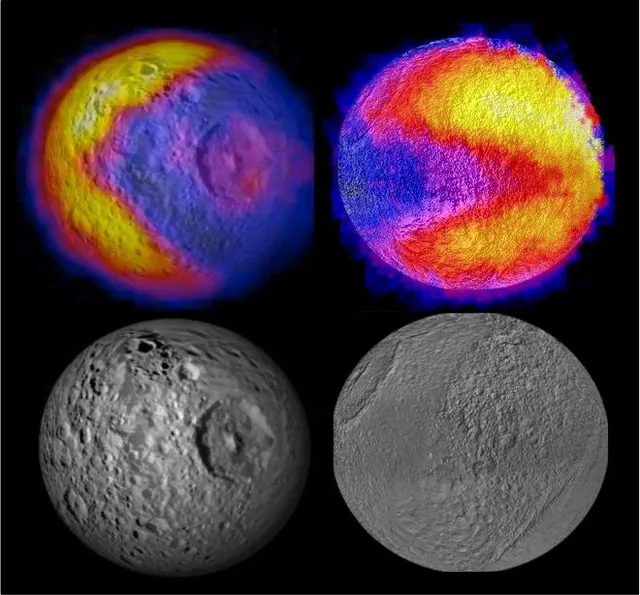
In September 2011 Cassini’s infrared spectrometer found a warm pattern shaped like the Pac-Man video-game character on Tethys, like one seen on Mimas the year before. High-energy electrons from Saturn’s magnetosphere are thought to pack the surface ice on the leading side, changing how it warms and cools. Unlike on Mimas, the region also shows as a dark lens in ordinary images.9
Enhanced-colour images taken in April 2015 revealed narrow, curved red streaks across the northern hemisphere, only a few kilometres wide but several hundred long. Their origin is a mystery: they might be exposed ice with chemical impurities, material vented from inside, or traces of fractures too small to see. In natural colour the surface looks fairly uniform.5
Interior
With a density below that of liquid water, Tethys must be built almost entirely of water ice, with only a small fraction of rock. Its giant crater gives a clue to its past: an impact the size of Odysseus could have shattered a solid body, and the crater’s collapsed rim and peak suggest the interior was still partly molten and the crust elastic when it formed.12
Telesto and Calypso
Telesto and Calypso are tiny, irregular moons that share Tethys’s orbit. Telesto, with radii of about 16, 12 and 10 km, rides 60° ahead of Tethys; Calypso, with radii of about 15, 12 and 7 km, follows 60° behind. Both were discovered in 1980: Calypso on 13 March by D. Pascu and colleagues at Flagstaff, and Telesto on 8 April by B. A. Smith and colleagues at Tucson.167
Notable features
Odysseus
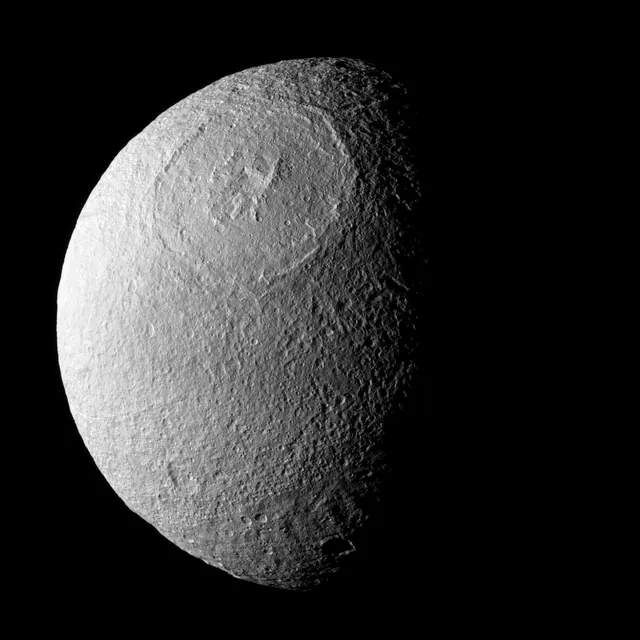
The giant impact crater that dominates Tethys’s western hemisphere, named after the hero of Homer’s Odyssey. NASA gives its diameter as 400 km, nearly two-fifths of the moon’s width; the IAU gazetteer lists 445 km. Its rim and central peak have largely collapsed, leaving a shallow basin.13
Ithaca Chasma
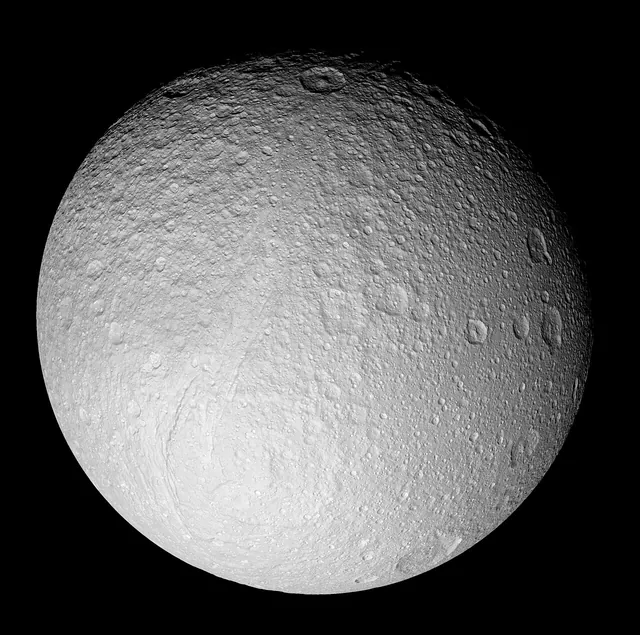
A vast valley named after Odysseus’s island kingdom, running roughly from the north pole towards the south. NASA describes it as about 100 km wide, 3 to 5 km deep and 2,000 km long; the gazetteer lists a length of 1,219 km. It may have formed as internal water froze and expanded, or in the Odysseus impact.14
Penelope
A large crater 207.5 km across, just south of the equator near 11° south. It is named after the faithful wife of Odysseus in Homer’s Odyssey, and its name was approved in 1982, along with those of Odysseus, Ithaca Chasma and Telemachus.341011
Telemachus
A prominent crater with a central peak, 92 km across, in the northern hemisphere at 54° north, named after the son of Odysseus. Nearby lie the faint remains of the ancient crater Teiresias, so worn down by later impacts that only a circle of hummocks marks its rim.111
Melanthius
A large crater 250 km across in the southern hemisphere, centred near 58° south. It is named after the disloyal goatherd of the Odyssey who insulted Odysseus and was slain. Its name was approved in 1982, the same year as Odysseus and Ithaca Chasma.3412
Exploration
Through telescopes Tethys appeared only as a tiny dot until Voyager 1 and Voyager 2 flew past in 1980 and 1981. Their images showed a major impact crater and a great chasm. NASA’s Cassini orbiter later added a wealth of detail, including a variety of colours at small scales suggesting materials not seen elsewhere.1
Cassini’s closest flyby of Tethys came on 24 September 2005, when it passed about 1,500 km above the surface and imaged the high southern latitudes that the Voyagers had never seen. Later observations revealed the Pac-Man thermal pattern in 2011 and, as northern summer lit up the north, the red arcs in 2015.5913
- Voyager flybys
- 1980 and 19811
Quick answers
- How big is Tethys?
- Tethys has a mean radius of 531.1 km (about 1,062 km across).2
- How massive is Tethys?
- Tethys has a mass of 6.18 × 10²⁰ kg.6
- How long is a day on Tethys?
- A day on Tethys lasts 1.888 days (synchronous: the same face always turned to Saturn).16
- How long does Tethys take to complete one orbit?
- Tethys completes one orbit in 1.888 days (about 45.3 hours).16
- What is the temperature on Tethys?
- The temperature on Tethys is about −187 °C (average).1
- What is Tethys made of?
- Tethys is made of almost entirely water ice, with a little rock.1
Sources
- Tethys — NASA Science, 2024
- Planetary Satellite Physical Parameters — NASA/JPL Solar System Dynamics
- Odysseus (Tethys) — IAU/USGS Gazetteer of Planetary Nomenclature
- Ithaca Chasma (Tethys) — IAU/USGS Gazetteer of Planetary Nomenclature
- Red Arcs on Tethys (PIA19637) — NASA Photojournal, 2015
- Saturnian Satellite Fact Sheet — NASA Space Science Data Coordinated Archive, 2025
- Planet and Satellite Names and Discoverers — IAU/USGS Gazetteer of Planetary Nomenclature
- Planetary Satellite Mean Elements — NASA/JPL Solar System Dynamics
- A Pair of ‘Pac-Men’ (PIA16198) — NASA Photojournal, 2012
- Penelope (Tethys) — IAU/USGS Gazetteer of Planetary Nomenclature
- Telemachus (Tethys) — IAU/USGS Gazetteer of Planetary Nomenclature
- Melanthius (Tethys) — IAU/USGS Gazetteer of Planetary Nomenclature
- Tethys in Full View (PIA07738) — NASA Photojournal, 2005
Figures checked against these sources in November 2026. Where a quantity is not known, it is left out rather than estimated.

