moon
Rhea
Rhea is Saturn’s second-largest moon, about 1,530 km across, yet less than a third the width of Titan. It is a cold, airless ball of ice mixed with rock, more heavily cratered than its sister moons Dione and Tethys, its surface scarred by ancient basins such as 360 km Tirawa and brightened in places by fresh, young craters like Inktomi. It always keeps the same face towards its planet.1234
In 2010 the Cassini spacecraft found that Rhea is wrapped in an extremely thin exosphere of oxygen and carbon dioxide, the first time a spacecraft had directly captured oxygen molecules in the atmosphere of a world other than Earth. Two years earlier Cassini’s particle instruments had hinted that Rhea might even have rings, but a dedicated camera search later found none.1567
Size and physical properties
Rhea has a mean radius of 763.5 km, making it about 1,530 km across. That makes it Saturn’s second-largest moon, though its radius is less than a third of Titan’s. Rhea is very nearly a sphere, with axes of 765, 763 and 762 km, and its mass is 2.31 × 10²¹ kg. Gravity at the surface works out at about 0.26 m/s².129
Its density, 1.24 times that of water, suggests Rhea is about three-quarters ice and one-quarter rock. Like its sister moons Dione and Tethys it reflects a lot of sunlight, a sign that its surface is largely water ice, which at these temperatures behaves like rock. Sunlit ground warms to about −174 °C, while shaded areas fall to about −220 °C.129
Orbit and rotation
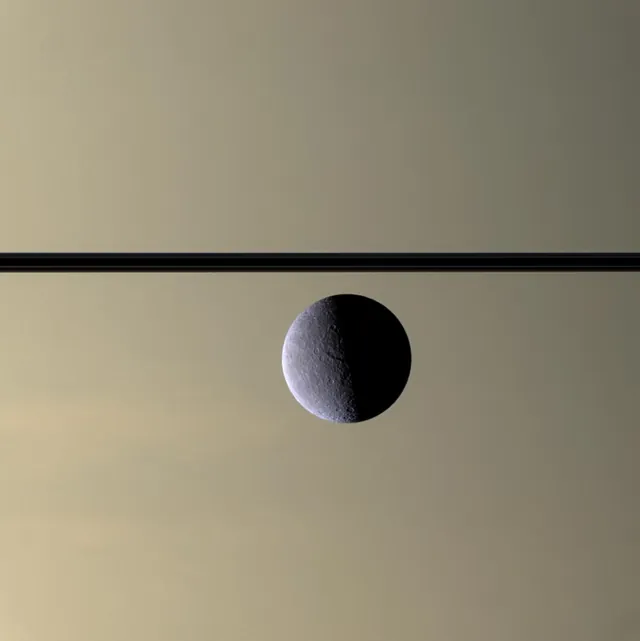
Rhea orbits Saturn at an average distance of 527,040 km, about 8.7 times the planet’s radius, taking 4.5175 days, or 4 days 12 hours 25 minutes, to go round once. Its orbit is almost perfectly circular, with an eccentricity of 0.0010, and is tilted only about 0.35° to Saturn’s equator. Rhea is tidally locked, so the same side always faces Saturn.1910
Lying farther out than Dione and Tethys, Rhea is not flexed enough by Saturn’s tides to be warmed from within. That may be why it has fewer smooth plains than its sister moons, whose plains probably formed where liquid water once reached the surface and froze over old craters. Rhea’s weaker internal heating, or simply more bombardment, left it more heavily cratered.1
Discovery and naming
Giovanni Domenico Cassini discovered Rhea from Paris on 23 December 1672, a year after he had found Iapetus. He grouped the four Saturnian moons he discovered as the Sidera Lodoicea, the ‘Stars of Louis’, after King Louis XIV. Astronomers also called Rhea Saturn V, the fifth moon outward from the planet, and to observers it remained a tiny dot until the Voyager encounters.11112
John Herschel later gave Saturn’s moons the names of Titans and Titanesses. Rhea was a Titaness, the wife of Kronos (the Romans’ Saturn) and the mother of Zeus, called the mother of the gods because several of the Olympians were her children. Features on Rhea are named after people and places from creation myths around the world.111
- Place
- Paris11
An ancient, battered surface
Voyager images showed two kinds of terrain: bright, heavily cratered ground with craters wider than 40 km, and areas in parts of the polar and equatorial regions where craters are all smaller than that. The difference may record a major resurfacing event, but a very old one, since there are few young rayed craters. The plains are thought to be about 4 billion years old.1
Voyager also spotted puzzling bright ‘wispy’ lines tens to hundreds of kilometres long. In 2006 Cassini images showed them to be subsidence fractures forming canyons, with walls several hundred metres high kept bright as darker material falls off and exposes fresh ice. Such cliffs, also found on Dione and Tethys, suggest that Rhea was once tectonically active.1
What lies inside
Rhea’s density suggests a mix of about three parts ice to one part rock, but how that material is arranged is harder to tell. During a close encounter Cassini measured the moon’s moment of inertia, a measure of how difficult it is to change its spin. The value was higher than expected if Rhea had a rocky core, so it is thought to be a fairly even mixture of ice and rock: a frozen dirty snowball.1
A thin breath of oxygen and carbon dioxide
In 2010 Cassini’s Ion and Neutral Mass Spectrometer detected a very tenuous exosphere of oxygen and carbon dioxide around Rhea. It was the first time a spacecraft had directly captured molecules of an oxygen atmosphere at a world other than Earth. The result was published online in Science by Teolis and colleagues on 25 November 2010.15
The oxygen seems to come from Saturn’s magnetic field sweeping over Rhea: energetic particles trapped in it strike the water-ice surface and break molecules apart, releasing oxygen. Where the carbon dioxide comes from is less certain. At the surface the oxygen is about five trillion times less dense than Earth’s air, yet still around 100 times denser than the exospheres of the Moon or Mercury.15
- Oxygen density at the surface
- about 5 trillion times less than Earth’s1
The rings that weren’t
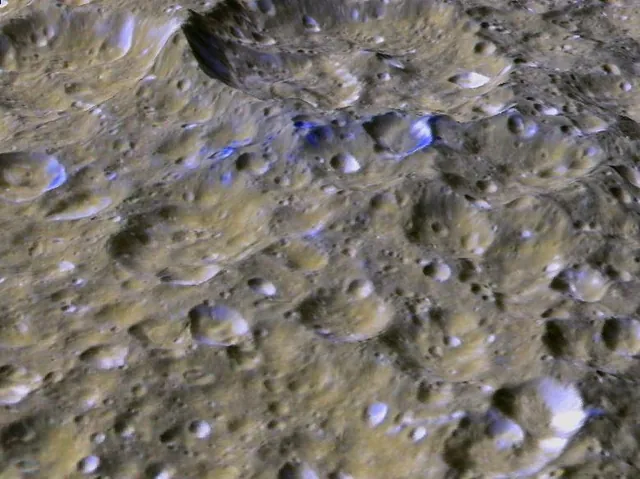
In 2008 Jones and colleagues reported that Cassini found energetic electrons depleted around Rhea. Since the moon has no substantial gas envelope, they argued that solid material must be absorbing the particles: grains and boulders up to several decimetres across, orbiting Rhea as an equatorial debris disc, perhaps with denser rings or arcs inside it. NASA described it as the first time rings had been found around a moon.16
A chain of bluish patches about 10 km wide along Rhea’s equator was suggested as fresh ice exposed where ring material struck the surface, and became a target of the March 2010 flyby. But an intensive search with Cassini’s narrow-angle camera, published in 2010 by Tiscareno and colleagues, found nothing orbiting Rhea, contradicting the earlier inference of narrow rings within a broad disc.71516
So the rings of Rhea remain unconfirmed. The original evidence came only indirectly, from instruments that sample particles and fields around the spacecraft, while the cameras designed to see ring material directly saw none. NASA’s own overview of Rhea still describes the 2008 evidence, so readers will meet both versions of the story; the imaging result is the later one.167
Notable features
Tirawa
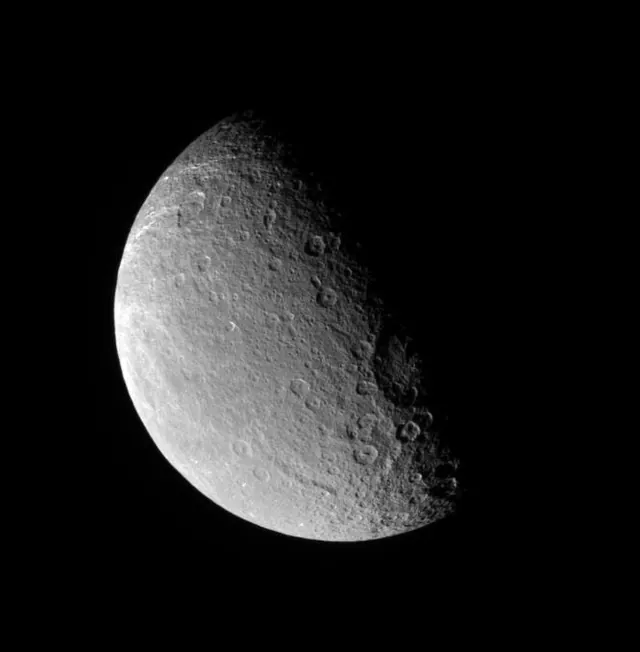
A giant impact basin about 360 km across and 5 km deep in places, centred at 34° north. Its floor and rim are themselves covered in impact craters, showing that it is very ancient. It is named after the great spirit of the Pawnee, who created the first people.3817
Inktomi
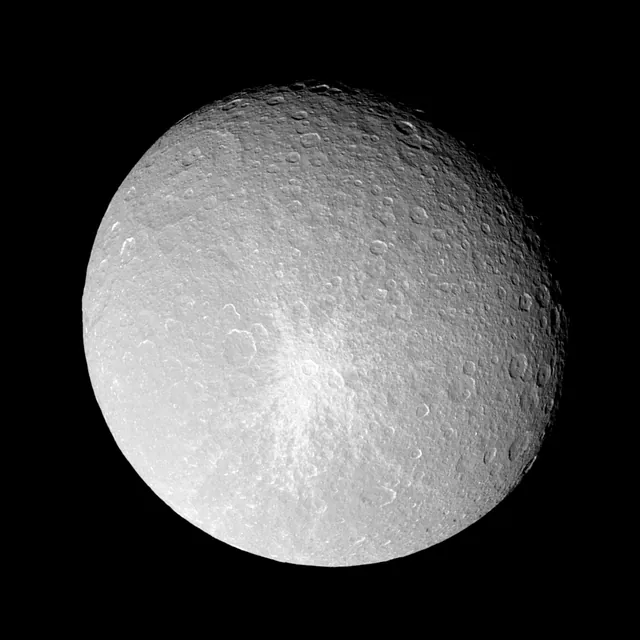
A crater 47.2 km across at 14° south whose bright rays splash across the leading hemisphere. Freshly dug-up ice is bright and darkens with time in space, so Inktomi is believed to be Rhea’s youngest feature. It is named after a Dakota spirit, ‘the Spider’.41819
Mamaldi
Rhea’s largest named crater, a basin listed as 480 km across, centred at 14° north and lying to the south-west of Tirawa. Its name, approved in 2010, honours after a goddess of the Nanai people of the Amur River region who created the Asian continent and Sakhalin Island.813
Galunlati Chasmata
The largest named canyon system on Rhea, listed as 740 km across at 38° north. Bright cliffs like these were the ‘wispy’ streaks of the Voyager images. The name comes from the vault above the sky in Cherokee myth, where all living things dwelt before Earth was made.114
Exploration
Voyager 1 and 2 made the first close-up images of Rhea when they flew through the Saturn system in 1980 and 1981. Cassini made a close flyby of Rhea on 26 November 2005, photographing one whole face in fine detail from distances between about 79,000 and 59,000 km.1816
On 2 March 2010, after more than four years without a targeted flyby, Cassini swooped to within 100.9 km of Rhea at 8.6 km/s to ‘sniff’ what comes off the moon. Its plasma spectrometer studied how Rhea interacts with Saturn’s magnetosphere, while radar and infrared and visible mapping instruments examined the surface’s texture, composition and geological history.16
Quick answers
- How massive is Rhea?
- Rhea has a mass of 2.31 × 10²¹ kg.9
- How dense is Rhea?
- Rhea has a mean density of 1.237 g/cm³ (about three-quarters ice, one-quarter rock).12
- How strong is gravity on Rhea?
- Gravity at the surface of Rhea is 0.264 m/s² (derived from JPL’s GM and mean radius).2
- How long is a day on Rhea?
- A day on Rhea lasts 4.518 days (synchronous: the same face always turned to Saturn).19
- How long does Rhea take to complete one orbit?
- Rhea completes one orbit in 4.5175 days (4 days 12 hours 25 minutes).910
- What is the temperature on Rhea?
- The temperature on Rhea is −174 °C to −220 °C (sunlit areas to shade).1
- When was Rhea discovered?
- Rhea was discovered on 23 December 1672, by Giovanni Domenico Cassini, in Paris.111
- What is Rhea made of?
- Rhea is made of water ice and rock (probably mixed through, without a separate rocky core).1
Sources
- Rhea — NASA Science, 2024
- Planetary Satellite Physical Parameters — NASA/JPL Solar System Dynamics
- Tirawa at Twilight (PIA07575) — NASA Photojournal, 2005
- Little Bright Spot (PIA18300) — NASA Photojournal, 2015
- Teolis et al., Cassini Finds an Oxygen–Carbon Dioxide Atmosphere at Saturn’s Icy Moon Rhea — Science, 2010
- Jones et al., The Dust Halo of Saturn’s Largest Icy Moon, Rhea — Science, 2008
- Tiscareno et al., Cassini imaging search rules out rings around Rhea — Geophysical Research Letters, 2010
- Rhea: Full Moon (PIA07763) — NASA Photojournal, 2005
- Saturnian Satellite Fact Sheet — NASA Space Science Data Coordinated Archive, 2025
- Planetary Satellite Mean Elements — NASA/JPL Solar System Dynamics
- Planet and Satellite Names and Discoverers — IAU/USGS Gazetteer of Planetary Nomenclature
- Planetary Satellite Discovery Circumstances — NASA/JPL Solar System Dynamics
- Mamaldi (Rhea) — IAU/USGS Gazetteer of Planetary Nomenclature
- Galunlati Chasmata (Rhea) — IAU/USGS Gazetteer of Planetary Nomenclature
- Rhea’s Blue Streaks (Looking South) (PIA12854) — NASA Photojournal, 2010
- Rhea Flyby (R-2) – March 2, 2010 — NASA Science, 2010
- Tirawa (Rhea) — IAU/USGS Gazetteer of Planetary Nomenclature
- Inktomi (Rhea) — IAU/USGS Gazetteer of Planetary Nomenclature
- Revisiting the Splat (PIA08148) — NASA Photojournal, 2006
Figures checked against these sources in November 2026. Where a quantity is not known, it is left out rather than estimated.

