moon
Dione
Dione is an icy moon of Saturn about 1,120 km across, circling the planet every 2.7 days at roughly the same distance as our Moon lies from Earth. Its density suggests that about a third of it is rock, with the rest water ice so cold that it behaves like rock. Two tiny moons, Helene and Polydeuces, share its orbit, one travelling 60° ahead of it and one 60° behind.123
Voyager’s pictures showed bright, wispy streaks across one side of Dione. When Cassini flew close in December 2004 the wisps turned out to be gleaming ice cliffs and canyon walls, cracked open by forces from within. Cassini also caught a whiff of oxygen around the moon, and its gravity measurements point to a global ocean of liquid water hidden about 100 km below the surface.1456
Size and physical properties
Dione has a mean radius of 561.4 km, so it is about 1,120 km across. It is very nearly round, with axes measuring 563, 561 and 560 km. Its mass is 1.10 × 10²¹ kg, and the pull of gravity at its surface works out at about 0.23 m/s², so a dropped stone would fall very slowly.23
The moon’s mean density is 1.48 times that of liquid water. That points to a mix in which about a third of Dione is a dense core, probably of silicate rock, and the rest is ice. Its icy surface reflects sunlight well, with a visual geometric albedo of 0.7, and at an average of −186 °C the ice is as hard as rock.123
Orbit, rotation and companions
Dione circles Saturn at an average distance of 377,400 km, about 6.3 times the planet’s radius and close to the distance between Earth and the Moon. One orbit takes 2.737 days. The path is almost perfectly circular, with an eccentricity of just 0.0022, and lies in the plane of Saturn’s equator. Like our Moon, Dione is tidally locked, keeping one face towards its planet.137
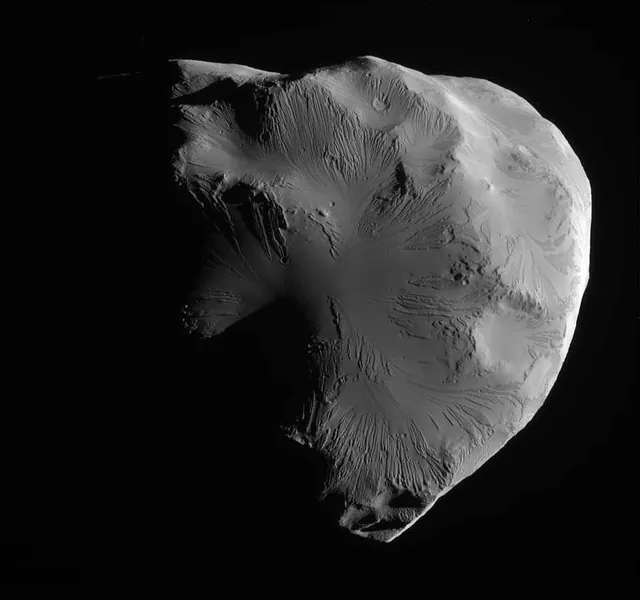
Dione is in resonance with its inner neighbour Enceladus, which completes exactly two orbits for every one of Dione’s. It also shepherds two tiny co-orbital moons. Helene travels 60° ahead of Dione and Polydeuces 60° behind, at the stable Lagrangian points L4 and L5. Helene was found from the Pic du Midi observatory in 1980; Polydeuces was spotted in Cassini images in 2004.189
- Resonance
- 2:1 with Enceladus1
Discovery and naming
Giovanni Domenico Cassini discovered Dione from Paris on 21 March 1684, the same date on which he found Tethys. He had already found Iapetus in 1671 and Rhea in 1672. Cassini called the four the Sidera Lodoicea, the ‘Stars of Louis’, in honour of King Louis XIV, while other astronomers simply numbered the moons outward from Saturn, making Dione Saturn IV.189
The names used today were applied later by John Herschel, who named Saturn’s moons after the Titans and Titanesses, brothers and sisters of Saturn. In Greek myth Dione was a sister of Cronos and, by some accounts, the mother of Aphrodite by Zeus. Features on Dione are named after people and places in Virgil’s Aeneid.18
- Place
- Paris8
Craters, cliffs and canyons
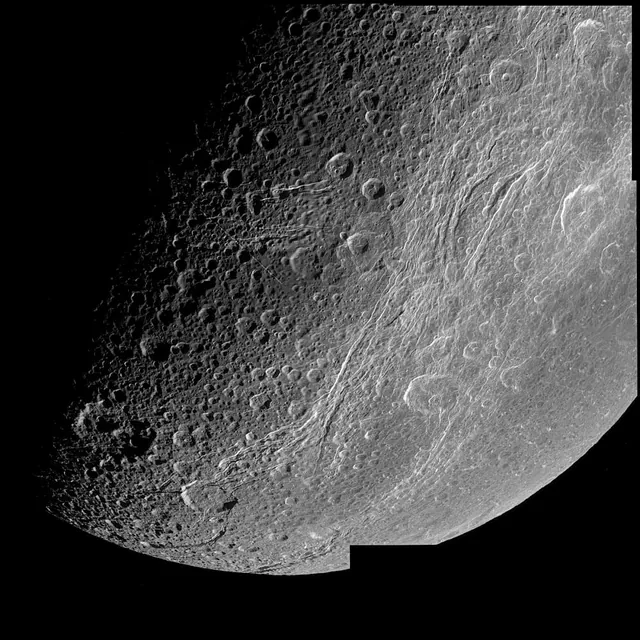
Dione’s surface mixes heavily cratered terrain, moderately and lightly cratered plains, and fractured zones. Oddly, the heaviest cratering is on the trailing hemisphere, though a moon’s leading side should collect more impacts. One idea is that a later impact spun Dione round; bodies big enough to leave 35 km craters could have done it. Why it seems to have turned exactly 180° is a mystery.1
In Voyager images the fractured areas appeared as bright, thin, wispy lines tens to hundreds of kilometres long. Cassini’s first close look, on 14 December 2004, surprised its imaging team: the wisps are not thick ice deposits but bright ice cliffs created by tectonic fractures. Some canyon walls are several hundred metres high and stay bright because darker material falls away, exposing clean water ice.14
The cliffs show that Dione was once tectonically active, and they may be a mature version of the ‘tiger stripes’ on Enceladus. Dione is also constantly dusted by Saturn’s E ring, a band of very fine ice powder, as fine as smoke, that ultimately comes from the geysers of Enceladus.1
A hidden ocean?
Dione’s gravity and shape, measured during Cassini’s close flybys, hold clues to what lies inside. In 2016 Mikael Beuthe, Attilio Rivoldini and Antony Trinh modelled the moon’s ice shell as floating in balance on a liquid layer. They found that the data are best explained by an ice shell about 99 km thick resting on a global ocean about 65 km deep.612
The authors called this the first clear evidence for a present-day ocean within Dione. The uncertainties are large, roughly ±23 km for the shell and ±30 km for the ocean, and the result depends on the model rather than on a direct detection. Beneath the water, Dione’s density suggests a rocky core making up about a third of the moon.16
A whisper of oxygen
Dione has an extremely thin exosphere containing oxygen. On 7 April 2010 Cassini flew through the moon’s plasma wake, and its plasma spectrometer picked up molecular oxygen ions, the first direct detection of a gas envelope around Dione. The oxygen is knocked off the icy surface by charged particles from Saturn’s magnetosphere, a process called sputtering, and is then swept away again.513
The ions were sparse, between 0.01 and 0.09 per cubic centimetre. The lead scientist, Robert Tokar, compared the concentration of oxygen to that in Earth’s atmosphere at a height of about 300 miles (480 km). That is far too little to sustain life, but it is a clear example of a process by which icy worlds bombarded by charged particles can produce a lot of oxygen.513
Notable features
Padua Chasmata
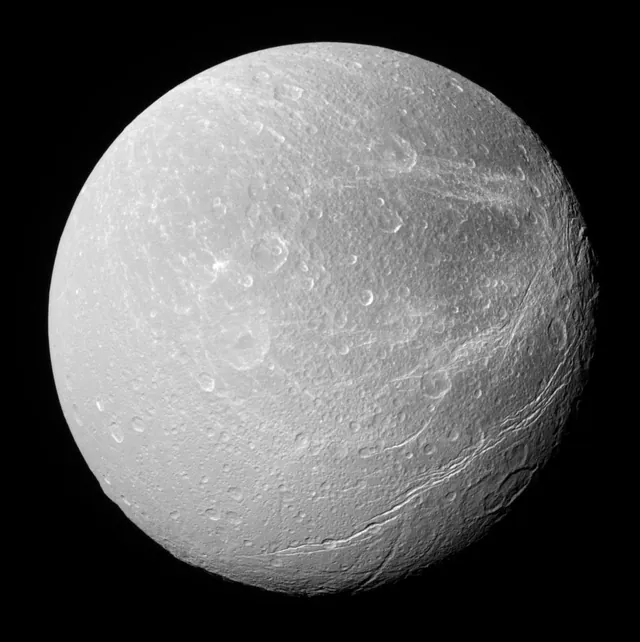
A system of canyons that the IAU gazetteer lists as 1,025 km across, centred 17.7° north of the equator. Its name, approved by the IAU in 2008, comes from Padua, the city in northern Italy founded, according to the gazetteer, by Antenor.114
Palatine Chasmata
Dione’s largest named canyon system, listed as 1,100 km across and sprawling over the southern hemisphere around 48° south, reaching almost 70° south. Its name, approved in 1982, comes from the Palatine, one of the seven hills of Rome.11
Evander
A large impact basin 350 km across in Dione’s far south, centred at 57° south. It is named after Evander, the mythical king of Arcadia and an ally of Aeneas, who founded Pallanteum on the future site of Rome.15
Andromache
At 439 km across, the largest crater on Dione named in the IAU gazetteer, lying close to the equator at 5.9° north. The name, approved in August 2026, honours Hector’s wife, whom Aeneas meets at Hector’s cenotaph in Buthrotum.10
Exploration
Before spacecraft, Dione was just a point of light. Voyager images revealed its cratered plains and mysterious bright wisps. Cassini, which orbited Saturn from 2004, made the first close study, passing Dione on 14 December 2004 and returning the pictures that showed the wisps to be ice cliffs.1416
Cassini made five targeted flybys of Dione. The closest, in December 2011, brought it within 100 km of the surface. The fifth and last, on 17 August 2015, passed 474 km from the surface and gathered gravity data to improve knowledge of the moon’s internal structure, allowing comparisons with Saturn’s other moons.1216
Quick answers
- How big is Dione?
- Dione has a mean radius of 561.4 km (about 1,120 km across).2
- How massive is Dione?
- Dione has a mass of 1.10 × 10²¹ kg.3
- How strong is gravity on Dione?
- Gravity at the surface of Dione is 0.232 m/s² (derived from JPL’s GM and mean radius).2
- How long is a day on Dione?
- A day on Dione lasts 2.737 days (synchronous: the same face always turned to Saturn).13
- How long does Dione take to complete one orbit?
- Dione completes one orbit in 2.736915 days (2 days 17 hours 41 minutes).37
- What is the temperature on Dione?
- The temperature on Dione is about −186 °C (average, 87 K).1
- When was Dione discovered?
- Dione was discovered on 21 March 1684, by Giovanni Domenico Cassini, in Paris.18
- What is Dione made of?
- Dione is made of water ice and rock (about a third rock, probably in a core).1
Sources
- Dione — NASA Science, 2024
- Planetary Satellite Physical Parameters — NASA/JPL Solar System Dynamics
- Saturnian Satellite Fact Sheet — NASA Space Science Data Coordinated Archive, 2025
- Highest Resolution View of Dione (PIA06163) — NASA Photojournal, 2004
- Tokar et al., Detection of exospheric O₂⁺ at Saturn’s moon Dione — Geophysical Research Letters, 2012
- Beuthe, Rivoldini and Trinh, Enceladus’s and Dione’s floating ice shells supported by minimum stress isostasy — Geophysical Research Letters, 2016
- Planetary Satellite Mean Elements — NASA/JPL Solar System Dynamics
- Planet and Satellite Names and Discoverers — IAU/USGS Gazetteer of Planetary Nomenclature
- Planetary Satellite Discovery Circumstances — NASA/JPL Solar System Dynamics
- Andromache (Dione) — IAU/USGS Gazetteer of Planetary Nomenclature, 2026
- Palatine Chasmata (Dione) — IAU/USGS Gazetteer of Planetary Nomenclature
- Dione Flyby (D-5) – Aug. 17, 2015 — NASA Science, 2015
- Oxygen detected in atmosphere of Saturn’s moon Dione — Los Alamos National Laboratory (via EurekAlert!), 2012
- Padua Chasmata (Dione) — IAU/USGS Gazetteer of Planetary Nomenclature
- Evander (Dione) — IAU/USGS Gazetteer of Planetary Nomenclature
- Cassini to Make Last Close Flyby of Saturn Moon Dione — NASA Jet Propulsion Laboratory, 2015
Figures checked against these sources in November 2026. Where a quantity is not known, it is left out rather than estimated.

