moon
Iapetus
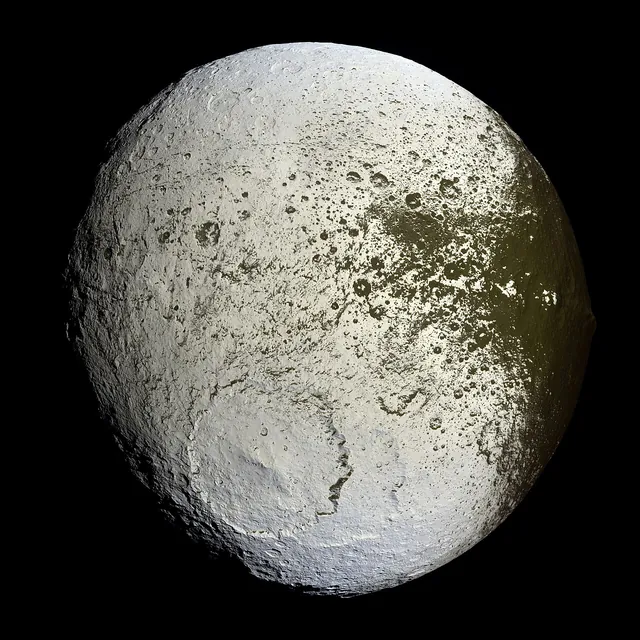
Iapetus is Saturn’s third-largest moon, about 1,470 km across, and the strangest-looking of them all. Its leading hemisphere, the side that faces forward in its orbit, is as dark as coal, while the trailing side is nearly as bright as snow. Giovanni Domenico Cassini noticed this soon after discovering the moon in 1671: he could see Iapetus on only one side of Saturn.1234
Cassini the spacecraft helped explain the puzzle. Dust drifting in from a vast ring around Saturn, fed by the distant moon Phoebe, darkens the leading side, and the warmer dark ground then loses its ice, which refreezes on the colder bright areas. Iapetus also wears a unique ridge of mountains along its equator, reaching up to 20 km high, and follows a distant orbit tilted well away from the rings.15678
Size and physical properties
Iapetus has a mean radius of 734.3 km, making it about 1,470 km across and the third-largest of Saturn’s moons. It is not quite round: it measures 746 km from the centre at the equator but only 712 km to the poles, a squashed shape that NASA has likened to a walnut. Its mass is 1.81 × 10²¹ kg.12811
With a density of just 1.09 g/cm³, Iapetus is only a little denser than water, which suggests it is about three-quarters ice and one-quarter rock. Its reflectivity is extraordinary. The dark terrain reflects only 3 to 5 per cent of the sunlight that falls on it, while the bright terrain reflects 50 to 60 per cent: about ten times as much.1212
A distant, tilted orbit
Iapetus is by far the most distant of Saturn’s large moons, orbiting at an average of 3,560,850 km, about 59 times the planet’s radius and nearly three times as far out as Titan, which orbits at about 1.22 million km. One trip round Saturn takes 79.33 days. Despite the distance, Saturn has tidally locked Iapetus, so it turns once per orbit and always shows the planet the same face.189
Unlike the inner moons, Iapetus does not orbit in the plane of Saturn’s equator and rings. NASA’s fact sheet gives an inclination of 14.72°; JPL describes the orbit as tilted 7.6° to its local Laplace plane, the plane about which it precesses, which itself lies 14.8° from Saturn’s equator. The slow 79-day rotation gives each patch of ground a very long day.389
Discovery: the moon that vanished
Giovanni Domenico Cassini discovered Iapetus from Paris on 25 October 1671, the first of the four Saturnian moons he would find. He soon noticed something odd: he could see the new moon only when it lay on the western side of Saturn. He correctly concluded that one side of Iapetus is much darker than the other, and that the moon keeps the same face to Saturn.1310
For three centuries Iapetus remained a dot whose brightness rose and fell around its orbit. The Voyager 1 and 2 flybys of 1980 and 1981 confirmed Cassini’s explanation with images of its contrasting hemispheres. The name, given later by John Herschel, comes from the Titan Iapetus, father of Atlas and Prometheus; features on the moon are named from the French epic The Song of Roland.110
- Place
- Paris10
Yin and yang
The dark terrain, Cassini Regio, covers about 40 per cent of Iapetus, spread over the leading hemisphere and wrapping onto the trailing side near the equator. The bright regions, Roncevaux Terra in the north and Saragossa Terra in the south, cover the poles and most of the trailing side. The dark material is thought to contain nitrogen-bearing organic compounds, hydrated minerals and other carbon-rich minerals.3414
In 2009 Tilmann Denk, John Spencer and colleagues explained the pattern as thermal migration of ice. Reddish dust swept up from space darkens the leading side slightly. Darker ground absorbs more sunlight, and on Iapetus, with its 79-day rotation, the dark areas reach 129 K, warm enough for ice to evaporate. The vapour refreezes on the colder poles and trailing side, which grow brighter still.3512
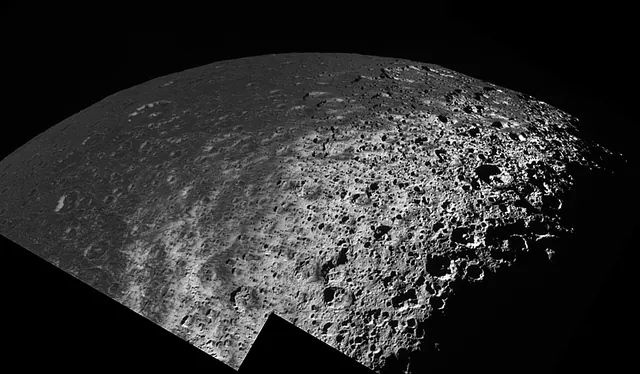
This runaway loop leaves dark leftovers behind and piles ice up elsewhere, sharpening the contrast over billions of years. It works on Iapetus because the moon spins so slowly, is small enough for ice to travel across it, and has a source of dust to start the process. Close-up images show the same effect locally, with ice gathering on cold, pole-facing slopes.3515
- Dark terrain (Cassini Regio)
- about 40% of the surface4
Dust from Phoebe’s giant ring
Observations made in 2009, before NASA’s Spitzer Space Telescope ran out of coolant, revealed the likely source of that dust: an enormous, faint ring around Saturn, announced in October 2009. The discovery paper traced it from at least 128 to 207 Saturn radii and found it about 40 Saturn radii thick; NASA’s announcement put the bulk of it between about 6 and 18 million km out, tilted 27° to the main rings.617
The distant moon Phoebe orbits within this ring and probably supplies it, as impacts chip dust off its surface. The ring’s particles circle Saturn backwards, in the same direction as Phoebe, while Iapetus moves the opposite way. Grains smaller than a centimetre slowly spiral inwards, and many end up striking the dark leading face of Iapetus, like insects on a windscreen.617
Notable features
Equatorial ridge and Toledo Montes
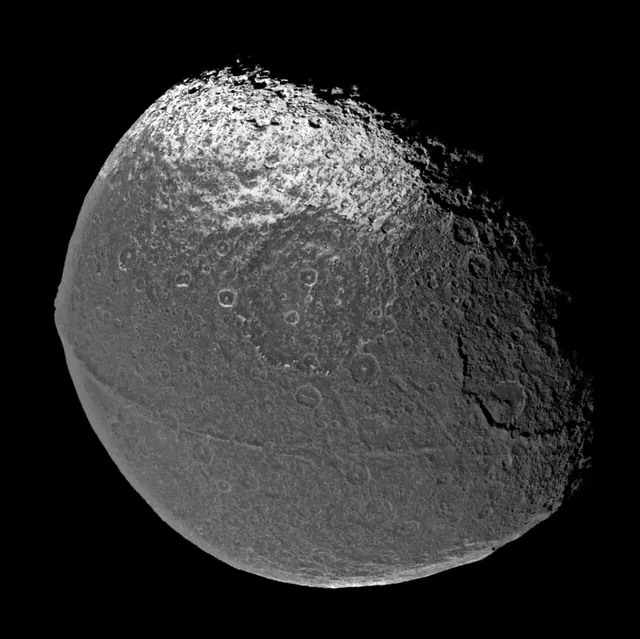
A ridge discovered in Cassini images on 25 December 2004 runs almost exactly along the equator; early measurements gave it up to 20 km of relief. Toledo Montes, one named stretch, is listed as 1,100 km long. The ridge may date from faster spin, or be debris from a collapsed ring.14718
Cassini Regio
The dark region covering most of the leading hemisphere, named after Giovanni Domenico Cassini, who discovered Iapetus in 1671 and first deduced that it has a dark side. The name was approved in 1982. Its heavily cratered ground is ancient, under a coating of dark material.71619
Turgis
The largest well-preserved impact basin on Iapetus, about 580 km across, at 17° north on the eastern edge of Cassini Regio. It is named after a Saracen baron in The Song of Roland, killed by Oliver in the first battle.420
Engelier
A huge basin 504 km across at 41° south on the bright trailing side. When it formed it destroyed about half of an older basin, the 445 km Gerin. Engelier is named after one of the Twelve Peers in The Song of Roland, the Gascon of Bordeaux.421
Saragossa Terra
The bright southern terrain, listed in the gazetteer as 2,300 km across and covering the southern hemisphere. With Roncevaux Terra in the north it makes up the snow-bright half of Iapetus. It is named after the town held by Marsilion and eventually taken by the French.422
Exploration
Voyager 1 and 2 gave the first close views in 1980 and 1981, confirming the two-tone surface and spotting mountains on the side facing away from Saturn, still informally called the Voyager Mountains. Cassini first studied Iapetus closely on New Year’s Eve 2004, revealing the equatorial ridge and the ancient, heavily cratered surface of Cassini Regio.1716
Cassini’s only close flyby came on 10 September 2007, when it passed about 1,640 km from the surface, 100 times closer than in 2004. It took the first high-resolution pictures of the bright trailing hemisphere and gathered temperature measurements that underpin the thermal-migration explanation. Before the encounter NASA called it the last time the spacecraft would aim its instruments at this moon.3111423
- Voyager flybys
- 1980 and 19811
Quick answers
- How massive is Iapetus?
- Iapetus has a mass of 1.81 × 10²¹ kg.8
- How dense is Iapetus?
- Iapetus has a mean density of 1.089 g/cm³ (barely denser than water).2
- How strong is gravity on Iapetus?
- Gravity at the surface of Iapetus is 0.224 m/s² (derived from JPL’s GM and mean radius).2
- How long is a day on Iapetus?
- A day on Iapetus lasts 79.33 days (synchronous: the same face always turned to Saturn).18
- How long does Iapetus take to complete one orbit?
- Iapetus completes one orbit in 79.330 days (79 days 7 hours 55 minutes).89
- How far is Iapetus from Saturn?
- Iapetus is 3,560,850 km from Saturn (semi-major axis, about 59 Saturn radii).18
- What is the temperature on Iapetus?
- The temperature on Iapetus is up to 129 K (about −144 °C), warmest dark terrain, measured by Cassini.3
- When was Iapetus discovered?
- Iapetus was discovered on 25 October 1671, by Giovanni Domenico Cassini, in Paris.110
- What is Iapetus made of?
- Iapetus is made of mostly water ice, some rock (perhaps three-quarters ice).1
Sources
- Iapetus — NASA Science, 2024
- Planetary Satellite Physical Parameters — NASA/JPL Solar System Dynamics
- Cassini closes in on the centuries-old mystery of Saturn’s moon Iapetus — Southwest Research Institute, 2009
- Global View of Iapetus’ Dichotomy (PIA11690) — NASA Photojournal, 2009
- Spencer and Denk, Formation of Iapetus’ Extreme Albedo Dichotomy by Exogenically Triggered Thermal Ice Migration — Science, 2010
- Verbiscer, Skrutskie and Hamilton, Saturn’s largest ring — Nature, 2009
- Porco et al., Cassini Imaging Science: Initial Results on Phoebe and Iapetus — Science, 2005
- Saturnian Satellite Fact Sheet — NASA Space Science Data Coordinated Archive, 2025
- Planetary Satellite Mean Elements — NASA/JPL Solar System Dynamics
- Planet and Satellite Names and Discoverers — IAU/USGS Gazetteer of Planetary Nomenclature
- Cassini Prepares to Fly By Walnut-shaped Moon (news release 2007-096) — NASA Science, 2007
- Formation of Iapetus’ Extreme Albedo Dichotomy by Exogenically Triggered Thermal Ice Migration (abstract) — ESA Science & Technology, 2010
- Planetary Satellite Discovery Circumstances — NASA/JPL Solar System Dynamics
- The Other Side of Iapetus (PIA08384) — NASA Photojournal, 2007
- Iapetus: A View from the Top (PIA06170) — NASA Photojournal, 2005
- Encountering Iapetus (PIA06166) — NASA Photojournal, 2005
- NASA Space Telescope Discovers Largest Ring Around Saturn (ssc2009-19) — NASA Jet Propulsion Laboratory / Spitzer Science Center, 2009
- Toledo Montes (Iapetus) — IAU/USGS Gazetteer of Planetary Nomenclature
- Cassini Regio (Iapetus) — IAU/USGS Gazetteer of Planetary Nomenclature
- Turgis (Iapetus) — IAU/USGS Gazetteer of Planetary Nomenclature
- Engelier (Iapetus) — IAU/USGS Gazetteer of Planetary Nomenclature
- Saragossa Terra (Iapetus) — IAU/USGS Gazetteer of Planetary Nomenclature
- Cassini Flies By Walnut-Shaped Moon Iapetus — NASA Science, 2007
Figures checked against these sources in November 2026. Where a quantity is not known, it is left out rather than estimated.

