moon
Phoebe
Phoebe is a dark, battered moon about 213 km across that circles Saturn backwards, in the opposite direction to the planet’s other large moons. It orbits nearly 13 million km out, almost four times farther than Iapetus, and takes about a year and a half to go round. It is the largest of Saturn’s distant ‘irregular’ moons, holding more than 98 per cent of their combined mass.12345
Its backward, tilted orbit and dark surface suggest that Phoebe did not form with Saturn but was captured, probably from the population of icy bodies in the outer Solar System to which the Kuiper belt objects belong. Cassini flew close by in June 2004, and in 2009 the Spitzer Space Telescope found that dust knocked off Phoebe forms an enormous, faint ring, by far the largest around Saturn.56789
Size and make-up
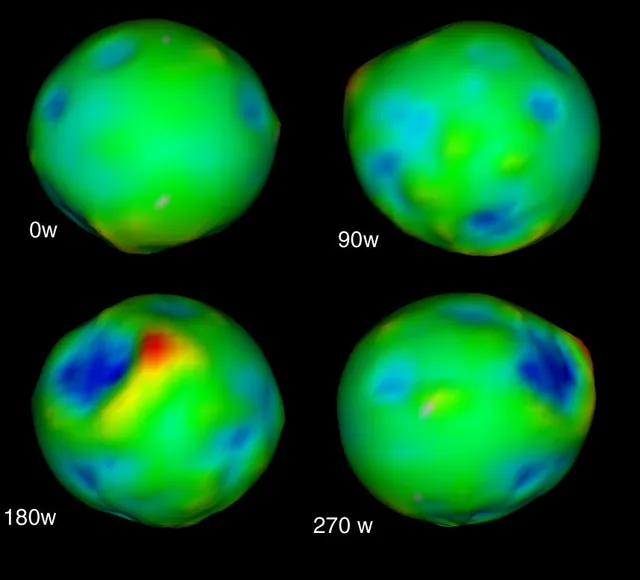
Despite its rugged surface, Phoebe is nearly round. Cassini’s shape model gives axes of 219 × 217 × 204 km, the shortest being the spin axis, and a mean radius of 106.5 km, about one-sixteenth the radius of Earth’s Moon. Its mass is about 8.3 × 10¹⁸ kg, and its surface heights range over about 16 km, much of that within one large crater.1234514
Phoebe’s density, 1.64 g/cm³, is high for a moon of Saturn and points to a mix of ice and rock. Torrence Johnson and Jonathan Lunine found that this rock-to-ice ratio is close to those of Pluto and Triton but very different from Saturn’s regular moons, supporting the idea that Phoebe formed in the wider solar nebula and was captured later.25612
A backward orbit far from Saturn
Phoebe orbits at an average of about 12.9 million km, roughly 215 times Saturn’s radius, in a moderately stretched orbit with an eccentricity of 0.164. It goes round in the retrograde direction, opposite to most moons and most objects in the Solar System, with its orbit tilted about 175° to Saturn’s equator. One circuit takes about 548 to 550 days, or roughly 18 months.1310
Phoebe is not tidally locked. It spins once every 9 hours 16 minutes and 25 seconds, a period found by matching Cassini’s shape model to light curves and stellar occultations observed from Earth. Unlike its orbit, the spin is prograde, and because its north pole points close to Saturn’s, Phoebe has seasons much like the planet’s.134
The first moon found by photography
Phoebe first appeared on a photographic plate taken on 16 August 1898 at Arequipa, Peru. William H. Pickering found it, working with DeLisle Stewart, and his older brother Edward Pickering, director of Harvard College Observatory, announced the discovery on 17 March 1899. It was the first moon ever discovered photographically and the first irregular moon found anywhere in the Solar System.41115
Pickering suggested the name about a month after the discovery. In Greek myth Phoebe was a Titaness and a sister of Saturn, which follows John Herschel’s scheme of naming Saturn’s moons after his siblings. NASA notes that Phoebe is also another name for the Moon goddess the Greeks called Artemis. Craters on Phoebe are named after the Argonauts.141116
A dark, icy surface
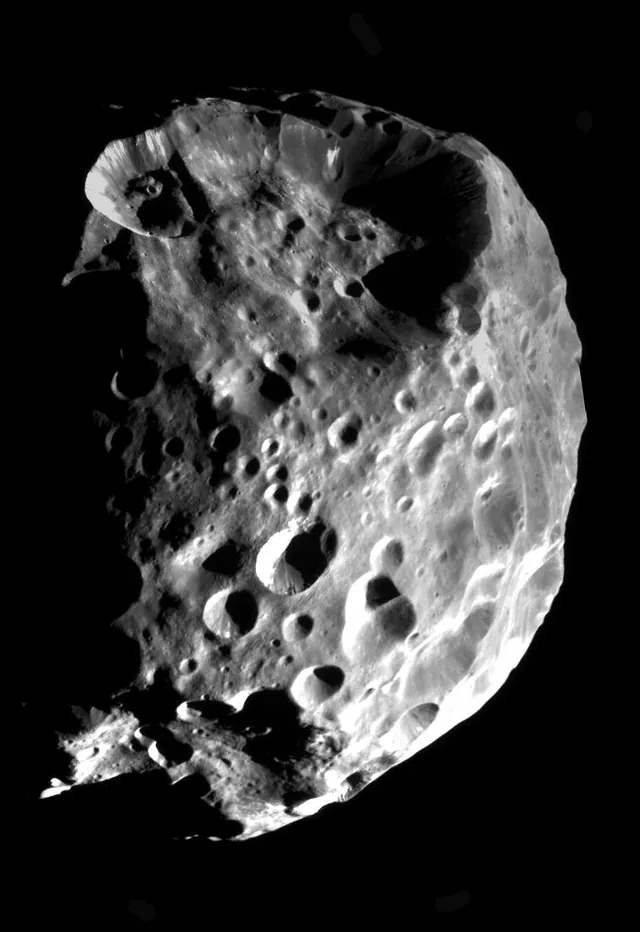
Phoebe is very dark, reflecting only about 6 per cent of the sunlight that reaches it. Cassini showed an ancient, heavily cratered surface with distinct layers of different materials. Small, bright young craters and streaks where dark material has slid down crater walls reveal brighter material, probably ice, beneath a thin dark coating.11213
Cassini’s infrared mapping spectrometer found iron-bearing minerals, bound water, trapped carbon dioxide, probable clay-like minerals, organic compounds, nitriles and cyanide compounds, making Phoebe one of the most compositionally varied objects then observed. The team concluded that its surface probably holds primitive outer Solar System material, like that of a comet.7
Saturn’s largest ring
In 2009 the Spitzer Space Telescope, observing in infrared before its coolant ran out, revealed a vast, faint ring of dust around Saturn with Phoebe orbiting inside it. The discovery paper traced it from at least 128 to 207 Saturn radii and found it about 40 Saturn radii thick, matching the range of Phoebe’s up-and-down motion. Impacts on Phoebe probably keep the ring supplied.89
Infrared images published in 2015 showed the whole ring stretching from 100 to 270 Saturn radii. Its dust is only about 80 K and so sparse that someone standing in it would not notice. The ring circles backwards with Phoebe, and grains smaller than a centimetre slowly spiral inwards, many striking the dark leading face of Iapetus.8917
Notable features
Jason
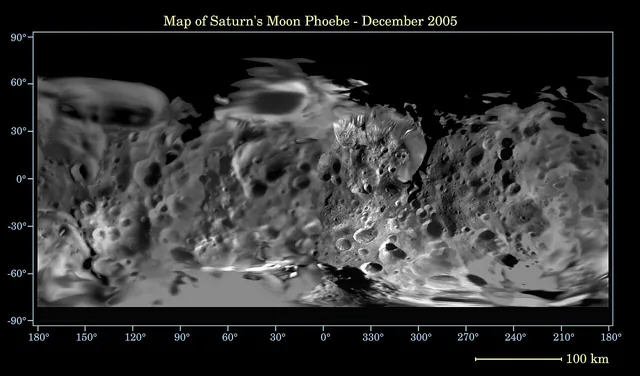
The largest named crater on Phoebe, 101 km across, at 16° north. Its name, approved in 2006, honours the leading Argonaut, son of the Thessalian king Aeson, who delivered the Golden Fleece; Phoebe’s craters are named after his crew.1618
Leto Regio
A region about 95 km across centred near 60° north and 20° west. Its name, approved by the International Astronomical Union in 2000, comes from Leto, the daughter of the Titaness Phoebe in Greek mythology. It covers part of the moon’s high northern latitudes.1920
Eurytus
A crater 89 km across at about 40° south, named in 2006 after an Argonaut, a son of Mercury and Antianira. With Jason it is one of the largest of the craters that cover Phoebe’s ancient surface.1221
Idmon
A crater 61 km across near Phoebe’s south pole, at 67° south. It is named after the Argonaut Idmon, a prophet described as a son of Apollo and the nymph Cyrene, or of Abas. The name was approved in 2006.22
Exploration
Phoebe was the first target Cassini met on arriving at Saturn, and the spacecraft’s path and arrival time were chosen to make the encounter possible. On 11 June 2004, 19 days before it entered orbit around Saturn, Cassini passed just 2,068 km above Phoebe. It was the only close flyby of any of Saturn’s outer moons in the whole mission.156
The flyby made Phoebe unusually well studied for an irregular moon of its size. Cassini’s cameras mapped its craters and shape, its infrared spectrometer charted the surface chemistry, and the imaging results showed a density pointing to a mixture of ice and rock. Cassini later watched Phoebe from afar, including from 12.7 million km in January 2015.1471220
- Resolution of the departure mosaic
- about 65 m per pixel5
Quick answers
- How massive is Phoebe?
- Phoebe has a mass of 8.3 × 10¹⁸ kg.3
- How strong is gravity on Phoebe?
- Gravity at the surface of Phoebe is 0.049 m/s² (derived from JPL’s GM and mean radius).2
- How long is a day on Phoebe?
- A day on Phoebe lasts 9 h 16 min 25 s (spins forwards although it orbits backwards).14
- How long does Phoebe take to complete one orbit?
- Phoebe completes one orbit in about 548–550 days (retrograde).310
- How far is Phoebe from Saturn?
- Phoebe is 12,944,000 km from Saturn (semi-major axis, about 215 Saturn radii).3
Sources
- Phoebe — NASA Science, 2024
- Planetary Satellite Physical Parameters — NASA/JPL Solar System Dynamics
- Saturnian Satellite Fact Sheet — NASA Space Science Data Coordinated Archive, 2025
- Phoebe — Tilmann Denk (Cassini imaging team member)
- Arrival and Departure at Phoebe (PIA18411) — NASA Photojournal, 2014
- Johnson and Lunine, Saturn’s moon Phoebe as a captured body from the outer Solar System — Nature, 2005
- Clark et al., Compositional maps of Saturn’s moon Phoebe from imaging spectroscopy — Nature, 2005
- NASA Space Telescope Discovers Largest Ring Around Saturn (ssc2009-19) — NASA Jet Propulsion Laboratory / Spitzer Science Center, 2009
- Verbiscer, Skrutskie and Hamilton, Saturn’s largest ring — Nature, 2009
- Planetary Satellite Mean Elements — NASA/JPL Solar System Dynamics
- Planet and Satellite Names and Discoverers — IAU/USGS Gazetteer of Planetary Nomenclature
- Porco et al., Cassini Imaging Science: Initial Results on Phoebe and Iapetus — Science, 2005
- The Face of Phoebe (PIA06064) — NASA Photojournal, 2004
- The True Shape of Phoebe (PIA06070) — NASA Photojournal, 2004
- Planetary Satellite Discovery Circumstances — NASA/JPL Solar System Dynamics
- Phoebe nomenclature search results — IAU/USGS Gazetteer of Planetary Nomenclature
- Hamilton et al., Small particles dominate Saturn’s Phoebe ring to surprisingly large distances — Nature, 2015
- Jason (Phoebe) — IAU/USGS Gazetteer of Planetary Nomenclature
- Leto Regio (Phoebe) — IAU/USGS Gazetteer of Planetary Nomenclature
- Map of Phoebe – December 2005 (PIA07775) — NASA Photojournal, 2005
- Eurytus (Phoebe) — IAU/USGS Gazetteer of Planetary Nomenclature
- Idmon (Phoebe) — IAU/USGS Gazetteer of Planetary Nomenclature
Figures checked against these sources in November 2026. Where a quantity is not known, it is left out rather than estimated.

