moon
Triton
Triton is Neptune’s largest moon by far, about 2,700 km across, and the only large moon in the Solar System that circles its planet backwards, against the direction of the planet’s spin. That odd, steeply tilted orbit is the main reason astronomers think Triton did not form beside Neptune at all, but began as an icy body of the Kuiper belt, like Pluto, and was later captured by Neptune’s gravity.123
Voyager 2 flew past in August 1989 and found one of the coldest surfaces ever measured, about 38 K (−235 °C), coated in frozen nitrogen. Even so, Triton is active: dark plumes rose about 8 km above its south polar cap, and its thin nitrogen atmosphere thickens and thins with seasons lasting more than 40 years. No spacecraft has returned since.124567
Size and physical properties
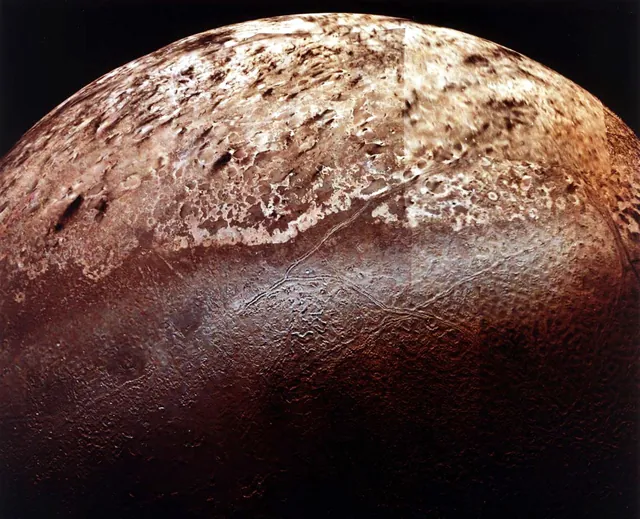
Triton has a mean radius of 1,352.6 km, so it is about 2,700 km across: roughly three-quarters the width of Earth’s Moon and the seventh-largest moon in the Solar System. It holds about 2.14 × 10²² kg, some 40 per cent more than Pluto, and it is by far the largest of Neptune’s moons.12389
Its mean density of about 2.07 g/cm³, around twice that of water, is higher than almost any other moon of the outer planets; only Europa and Io are denser. That points to more rock inside Triton than in the icy moons of Saturn and Uranus. Gravity at the surface is 0.78 m/s², and the bright nitrogen frost reflects about 70 per cent of the sunlight that falls on it.18910
A backwards orbit
Triton circles Neptune every 5.877 days at an average distance of 354,760 km, about 14 times the planet’s radius, in an orbit that is almost perfectly round. But it travels the wrong way: retrograde, against Neptune’s rotation, on a path tilted 157° to the planet’s equator, or 23° from its plane when the backwards motion is set aside. No other large moon does this.17911
Such an orbit is hard to make in place, so Triton is thought to be a Kuiper belt object captured by Neptune. One model has it captured during a close encounter between Neptune and a binary pair of icy bodies, perhaps like Pluto and Charon. Tides now drain Triton’s orbital energy and draw it slowly inward; one study calculated that it reaches Neptune’s Roche limit, inside which tides tear a moon apart, in about 3.6 billion years.12313
Triton is tidally locked, keeping one face towards Neptune. Because its orbit is so steeply tilted, each pole in turn is tipped towards the Sun during Neptune’s 165-year journey round it, giving seasons that last a little over 40 years. The southern summer solstice passed in 2000; the strongest southern summers come only once every few hundred years.1214
Discovery and naming
The English astronomer William Lassell discovered Triton on 10 October 1846, just 17 days after Neptune itself had been found. Lassell was one of the great amateur astronomers of the 19th century, paying for his telescopes with the fortune he had made in the brewery business.11215
Triton is named after the son of Poseidon, the Greek god who corresponds to the Roman Neptune. The name was slow to catch on: until Neptune’s second moon, Nereid, was found in 1949, Triton was usually known simply as ‘the satellite of Neptune’.1
A young, frozen surface
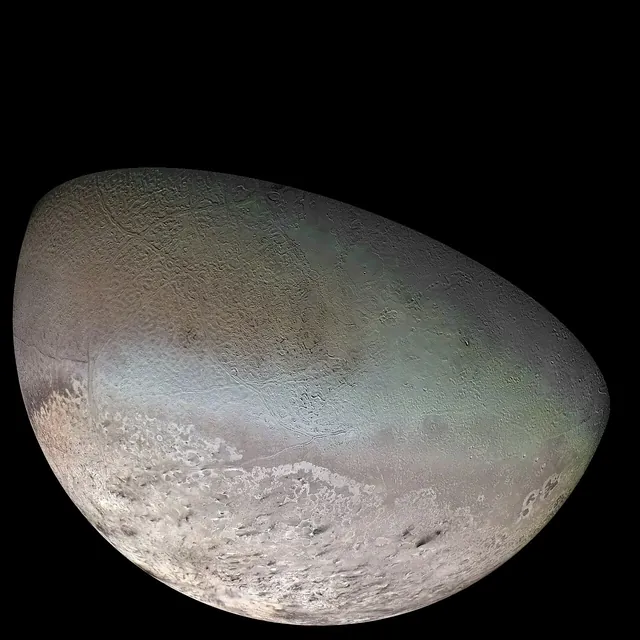
At 38 K, about −235 °C, most of Triton’s nitrogen lies frozen as frost, making it the only moon known whose surface is mainly nitrogen ice. Ices of methane, carbon monoxide, carbon dioxide and water are mixed in. The vast pinkish south polar cap probably contains methane ice that sunlight has turned into pink or red compounds; a bluish band near the equator may be fresh nitrogen frost.124
Impact craters are scarce. Crater counts suggest most of the surface is less than about 10 million years old, among the youngest in the Solar System. Instead there are smooth plains, pits and frozen flows of icy lava, broad walled plains, long ridges, and the strange dimpled ‘cantaloupe terrain’, unlike anything found elsewhere.1471617
The cantaloupe terrain is named for its texture, which resembles melon skin. Its origin is not settled; one explanation is that Triton’s icy crust overturned, sending up countless rising blobs of ice called diapirs. The mounds it left are a few hundred metres high and a few kilometres across.41718
A thin, changing atmosphere
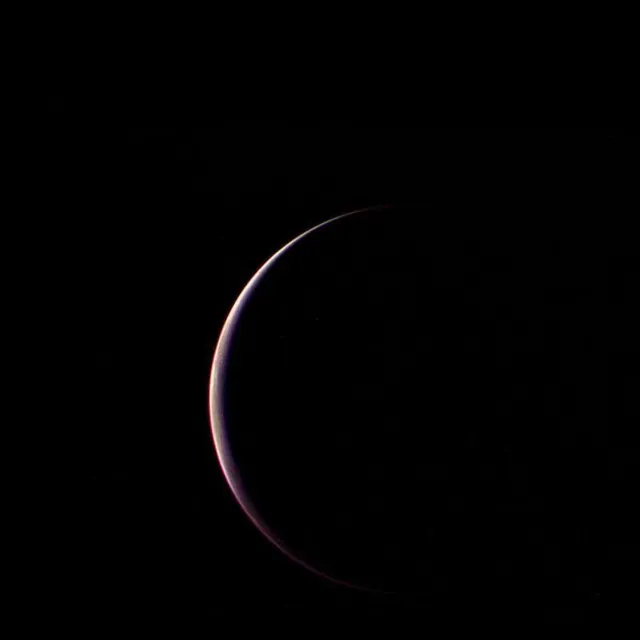
Triton’s atmosphere is mostly nitrogen, with small amounts of methane and carbon monoxide. Voyager 2 measured a surface pressure of about 14 microbars, some 70,000 times less than on Earth. The air extends about 800 km above the ground, and thin clouds of nitrogen ice may form a few kilometres up. Its ionosphere is about ten times more active than that of any other moon.1267
The atmosphere is fed by surface ice turning to gas, so it swells as summer warms the ice. A stellar occultation watched by the Hubble Space Telescope in November 1997 showed the pressure rising, implying the atmosphere had at least doubled since 1989. In 2010 infrared spectra from ESO’s Very Large Telescope put the pressure at 40–65 microbars, perhaps four times Voyager’s value.214
What hides inside
Voyager 2’s data show that Triton is differentiated: a crust of frozen nitrogen over an icy mantle, which is thought to cover a core of rock and metal. Its surface bears signs of early melting. If Triton was captured onto a stretched-out orbit, tides would have heated it strongly, perhaps keeping it molten for up to a billion years after capture.1619
Whether liquid water survives today is unknown. Models suggest that tides raised by Triton’s tilted orbit, or heat from radioactive rock, could keep an ocean beneath the ice if antifreeze such as ammonia is present. No measurement has yet tested this: detecting an ocean would need a magnetometer flown close to Triton.71620
- Structure
- Nitrogen crust, icy mantle, rock-and-metal core1
Notable features
Hili and Mahilani
Plumes on Triton named by the IAU in 1991, at about 57° and 51° south. Voyager 2 caught at least four active eruptions in all; the two best observed were columns of dark material rising about 8 km, where dark clouds drifted downwind for more than 100 km.521
South polar streaks
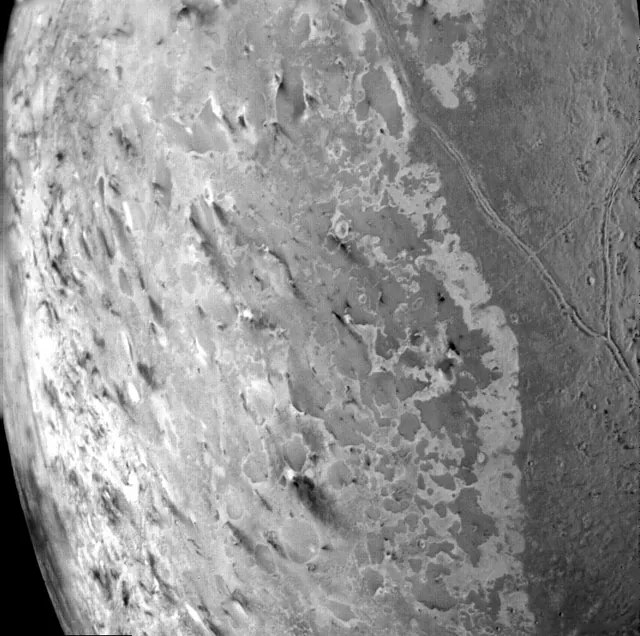
About 50 dark streaks lie across the south polar terrain, each starting at a dark spot several kilometres across that may be a vent. Some exceed 160 km. One idea is that sunlight warms nitrogen ice just below the surface until gas bursts out, carrying dust that winds spread northeast, though some researchers question whether sunlight alone drives them.51622
South polar cap
A vast, bright, pinkish cap over the south polar region seen by Voyager 2, believed to contain methane ice that sunlight has turned into pink or red compounds. North of its ragged edge the ground is darker and redder. No matching northern cap was detected, though Voyager saw little of the far north.41623
Cantaloupe terrain
Widespread, rugged, dimpled ground on Triton’s Neptune-facing side, named for its unusual texture, which resembles melon skin. In Voyager 2’s false-colour maps it appears to predate the units beside it, and it may have formed when rising blobs of ice pushed up through the crust.16171824
Xuuch, Yara and Unga
Three of Triton’s few named impact craters, approved by the IAU in December 2024, all close to the equator. Xuuch is 14 km across, Yara 11 km and Unga 9 km. Their scarcity is one sign of how recently the surface has been renewed.1621
Exploration
Voyager 2, launched on 20 August 1977, is the only spacecraft to have visited Triton. On 25 August 1989 it passed Neptune and then Triton, photographing mostly the southern, Neptune-facing hemisphere, measuring the temperature and atmosphere and catching the plumes in action. Sources differ on coverage: NASA’s mission page says two-thirds of the moon, while the Trident team put the area seen at 40 per cent.1671624
Since then Triton has been watched from afar. Stellar occultations in the 1990s, including one observed by Hubble in 1997, tracked the atmosphere’s growth, and in 2010 ESO’s Very Large Telescope made the first ground-based detection of methane in its atmosphere and found carbon monoxide, confirming that the atmosphere changes with the seasons.214
No return mission has been approved. Trident, a proposed NASA Discovery mission that would have flown once past Triton in 2038 after a launch in 2025 or 2026, was chosen for further study in February 2020, but in June 2021 NASA selected two Venus missions instead.72025
Quick answers
- How dense is Triton?
- Triton has a mean density of 2.065 g/cm³.8
- How strong is gravity on Triton?
- Gravity at the surface of Triton is 0.78 m/s² (Earth: 9.8 m/s²).10
- How long does Triton take to complete one orbit?
- Triton completes one orbit in 5.877 days (retrograde: against Neptune’s spin).911
- How long is a day on Triton?
- A day on Triton lasts 5.877 days (synchronous: the same face always turned to Neptune).19
- What is the temperature on Triton?
- The temperature on Triton is 38 K (about −235 °C), measured by Voyager 2 in 1989.14
- What is Triton made of?
- Triton is made of rock and metal core, icy mantle, frozen nitrogen crust.1
Sources
- Triton — NASA Science, 2024
- Summer on Triton (eso1015) — European Southern Observatory, 2010
- Agnor and Hamilton, Neptune’s capture of its moon Triton in a binary-planet gravitational encounter — Nature, 2006
- Global Color Mosaic of Triton (PIA00317) — NASA Photojournal, 1998
- Soderblom et al., Triton’s Geyser-Like Plumes: Discovery and Basic Characterization — Science, 1990
- Voyager Fact Sheet — NASA Science, 2026
- Proposed NASA Mission Would Visit Neptune’s Curious Moon Triton — NASA Jet Propulsion Laboratory, 2020
- Planetary Satellite Physical Parameters — NASA/JPL Solar System Dynamics
- Neptunian Satellite Fact Sheet — NASA Space Science Data Coordinated Archive, 2024
- Solar System Small Worlds Fact Sheet — NASA Space Science Data Coordinated Archive, 2016
- Planetary Satellite Mean Elements — NASA/JPL Solar System Dynamics
- Planetary Satellite Discovery Circumstances — NASA/JPL Solar System Dynamics
- Chyba, Jankowski and Nicholson, Tidal evolution in the Neptune-Triton system — Astronomy and Astrophysics (abstract via NASA Technical Reports Server), 1989
- MIT researcher finds evidence of global warming on Neptune’s largest moon — MIT News, 1998
- Neptune Moons — NASA Science, 2026
- Howett et al., Trident: A Mission to Explore Triton, a Candidate Ocean World — Europlanet Science Congress 2020 abstracts, 2020
- Triton’s ‘Cantaloupe’ Terrain (PIA12186) — NASA Photojournal, 2009
- Triton – False Color of ‘Cantaloupe’ Terrain (PIA00060) — NASA Photojournal, 1996
- Smith et al., Voyager 2 at Neptune: Imaging Science Results — Science, 1989
- NASA Selects Four Possible Missions to Study the Secrets of the Solar System (release 20-016) — NASA, 2020
- Triton nomenclature search results — IAU/USGS Gazetteer of Planetary Nomenclature
- Triton South Polar Terrain (PIA00059) — NASA Photojournal, 1996
- Triton – Voyager 2 (P-34764) — NASA Space Science Data Coordinated Archive
- Voyager 2 — NASA Science, 2026
- NASA Selects 2 Missions to Study ‘Lost Habitable’ World of Venus (release 21-073) — NASA, 2021
- Voyager’s Parting Shot of Triton (PIA02247) — NASA Science, 2000
Figures checked against these sources in November 2026. Where a quantity is not known, it is left out rather than estimated.

