moon
Proteus
Proteus is Neptune’s second-largest moon, a dark, boxy body about 420 km across that circles the planet in just 27 hours. It is irregular in shape, but only just: NASA notes that with a little more mass, its own gravity would have pulled it into a sphere. Despite its size it went unseen from Earth until Voyager 2 found it in 1989.1234
Proteus reflects only about 6 per cent of the sunlight that falls on it, making it one of the darkest objects in the Solar System. Its battered, cratered surface records a violent history: scientists think it re-formed from debris after Triton’s capture, and that the tiny moon Hippocamp is a fragment chipped off it by a comet.1256
A moon on the edge of round
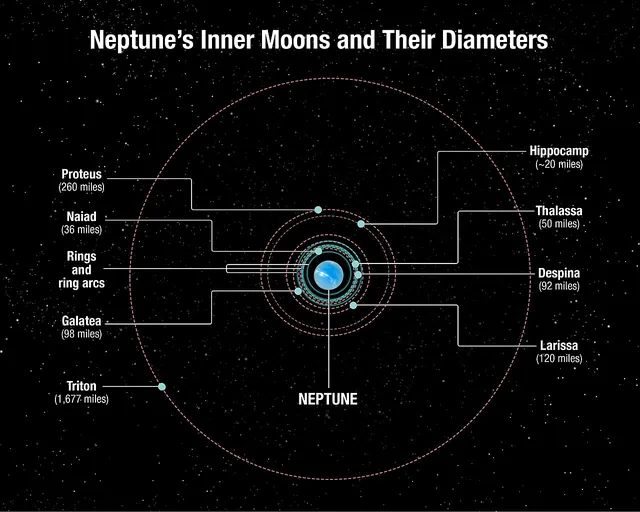
Proteus is the largest of Neptune’s inner moons and second only to Triton overall. NASA’s fact sheet gives its three radii as 220, 208 and 202 km, so it measures roughly 440 by 404 km, and JPL lists a mean radius of 208 km. A shape model drawn from the edges and shadow lines in Voyager images gives axes of 424 × 390 × 396 km and a volume of about 3.4 × 10⁷ km³.1789
NASA describes Proteus as having an odd, box-like shape and says that with just a little more mass it would be able to transform into a sphere. Its mass is uncertain: NASA’s fact sheet lists about 5 × 10¹⁹ kg, while JPL’s estimate of its gravitational pull carries an uncertainty almost as large as the value itself, so its density is not well known.279
Orbit
Proteus orbits 117,647 km from Neptune’s centre, less than five times the planet’s radius, and completes a circuit in 1.122 days, about 27 hours. Its orbit is almost perfectly circular and lies close to Neptune’s equator, and Proteus travels in the same direction that Neptune rotates, unlike the giant moon Triton, whose orbit is retrograde.2711
Tides raised on Neptune have slowly pushed Proteus outwards over time. Mark Showalter and colleagues, studying Hubble images, concluded that long ago Proteus orbited where the tiny moon Hippocamp is today. The two orbits are now only about 12,000 km apart.136
- Orbital period
- 1.122315 days7
Found by Voyager 2
Proteus was discovered in June 1989 in images taken by Voyager 2 as it approached Neptune, and was credited to the Voyager science team. It was first designated S/1989 N 1. NASA calls the late discovery unusual, since the smaller moon Nereid had been found from Earth decades earlier; Proteus was probably overlooked because it is so dark and Neptune so far from Earth.2410
Proteus is named after the shape-changing Greek sea god, a son of Oceanus and Tethys. The International Astronomical Union requires Neptune’s moons to carry names from Greek and Roman mythology of the undersea world. Its formal designation in the IAU’s list of moons is Neptune VIII.124
- Date
- June 19894
A dark, battered surface
Voyager 2’s best images show a dark, spectrally grey surface, heavily cratered and with hints of groove-like lines. A detailed relief map from the same images found extensive evidence of linear fractures despite the poor image quality. NASA notes that Proteus shows no sign of geological modification.258
Voyager 2 also revealed one very large impact crater, almost large enough to have shattered the moon. The only feature on Proteus with an official name is the crater Pharos, approved in 1994 and named after the island where the sea god Proteus reigned. The gazetteer gives no size for it.1312
- Named features
- 1 (the crater Pharos)12
Proteus and Hippocamp
Neptune’s inner moons are probably younger than the planet. When Neptune captured Triton, the newcomer is thought to have torn apart the original moons, and their debris re-formed into a second generation, Proteus among them. Further comet impacts kept breaking these moons up, and the 2026 study of Nereid with the James Webb Space Telescope also treats Proteus as re-accreted debris.1613
In 2013 Showalter’s team found a seventh inner moon, Hippocamp, with Hubble. Only about 34 km across and about one-thousandth the mass of Proteus, it orbits just inside it, at about 105,300 km from Neptune. The team’s 2019 study concluded that Hippocamp is probably an ancient fragment knocked off Proteus by a comet: a third-generation moon.1367
Exploration
Voyager 2 is the first and only spacecraft to have visited Neptune and Proteus. During its flyby of the Neptune system it photographed the moon on 25 August 1989 from about 146,000 km, at a resolution of about 2.7 km per line pair; the images were taken with short exposures to avoid smearing, which leaves them grainy.514
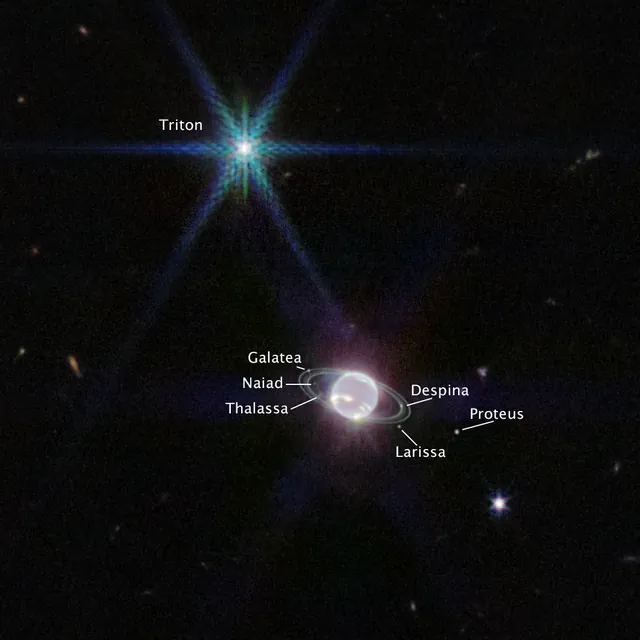
Since then Proteus has been followed from Earth orbit. Hubble images supported the 2019 study of its orbit and of Hippocamp, and in September 2022 the James Webb Space Telescope captured Proteus as a faint dot beside Neptune and its rings, one of seven of Neptune’s moons in the image.3615
Quick answers
Sources
- Hubble helps uncover origin of Neptune’s smallest moon Hippocamp (heic1904) — ESA/Hubble, 2019
- Proteus — NASA Science, 2024
- Tiny Neptune Moon Spotted by Hubble May Have Broken from Larger Moon — NASA Science, 2019
- Planet and Satellite Names and Discoverers — IAU/USGS Gazetteer of Planetary Nomenclature
- 1989N1 Surface Detail (PIA00062) — NASA Photojournal, 1996
- Showalter et al., The seventh inner moon of Neptune — Nature, 2019
- Neptunian Satellite Fact Sheet — NASA Space Science Data Coordinated Archive, 2024
- Stooke, The surfaces of Larissa and Proteus — Earth, Moon, and Planets, 1994
- Planetary Satellite Physical Parameters — NASA/JPL Solar System Dynamics
- Planetary Satellite Discovery Circumstances — NASA/JPL Solar System Dynamics
- Planetary Satellite Mean Elements — NASA/JPL Solar System Dynamics
- Pharos (Proteus) — IAU/USGS Gazetteer of Planetary Nomenclature
- Belyakov et al., Nereid as a Regular Satellite of Neptune — Science Advances, 2026
- Neptune: Exploration — NASA Science, 2026
- New Webb Image Captures Clearest View of Neptune’s Rings in Decades (weic2214) — ESA/Webb, 2022
Figures checked against these sources in November 2026. Where a quantity is not known, it is left out rather than estimated.

