moon
Mimas
Mimas is the smallest and innermost of Saturn’s major moons, a battered ball of ice about 396 km across. One enormous impact crater, Herschel, spans about a third of its face, giving it the look of a famous fictional space station. The blow that dug it probably came close to shattering the moon. The rest of its surface is crowded with craters, among the most heavily cratered in the Solar System.12
That frozen face may hide a surprise. In 2024 a team studying Cassini’s record of how Mimas moves around Saturn concluded that a global ocean probably lies 20 to 30 km beneath the ice, and that it formed within the last 25 million years, too recently to have marked the surface. Other scientists call the case strong but not yet confirmed. Mimas also helps shape the edge of the Cassini Division in Saturn’s rings.345
Size and physical properties
Mimas has a mean radius of 198.2 km, about 396 km across. It is just too small to have pulled itself into a perfect sphere, so it is slightly egg-shaped, measuring about 208 by 197 by 191 km. Its mass is 3.79 × 10¹⁹ kg, and it is the smallest of Saturn’s major moons.167
Its mean density, 1.15 g/cm³, is only a little above that of water, suggesting that Mimas consists almost entirely of water ice, the only substance ever detected on Mimas. It reflects sunlight well, with a visual geometric albedo of 0.6, though less brightly than its neighbour Enceladus.167
Orbit and rotation
Mimas orbits closer to Saturn than any other major moon, at an average distance of about 185,500 km, and races round the planet in 0.942 days, about 22 hours 36 minutes. Its orbit is noticeably oval, with an eccentricity of 0.02, and tilted by about 1.5° to Saturn’s equator. Like our Moon it is tidally locked, keeping one face towards its planet.1711
That orbit poses a puzzle. Mimas is closer to Saturn than Enceladus and its path is more elongated, so tides should heat it more. Yet Enceladus erupts while Mimas looks frozen. Scientists call this the “Mimas test”: any theory that explains the partly thawed interior of Enceladus must also explain the apparently frozen Mimas.1
Discovery and naming
William Herschel discovered Mimas in 1789 with his great 40-foot reflecting telescope, observing from Slough in England. Sources differ on the date: NASA gives 17 September 1789, while the IAU’s gazetteer lists 18 July 1789. To astronomers on the ground it stayed a mere dot until the Voyager spacecraft photographed it in 1980.110
The name came from Herschel’s son John, who named the first seven moons of Saturn in the 19th century. In myth Mimas was a Giant killed by Mars, or in other tellings by Hephaestus, in the war between the Titans and the gods of Olympus. Because it is the innermost of the classical moons, Mimas is also called Saturn I.110
A cratered face and a strange glow
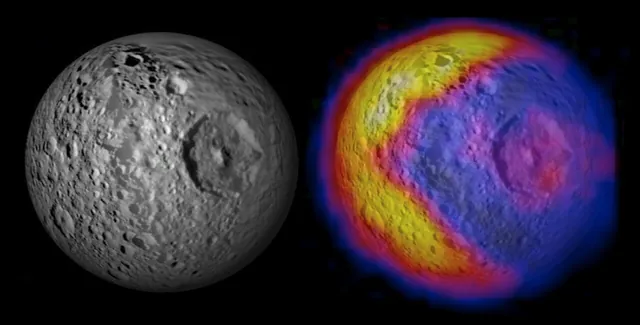
Mimas has one of the most heavily cratered surfaces in the Solar System, with craters packed edge to edge and reaching more than 40 km across. Around the south pole, though, the craters are generally no more than 20 km wide, hinting that some melting or resurfacing happened there later than elsewhere. Fractures called chasmata on the far side may be cracks from the Herschel impact.1
In February 2010 Cassini’s infrared spectrometer mapped daytime temperatures and found a startling pattern. One side of the moon was split into a warm region near 92 K and a cold region near 77 K, separated by a sharp V-shaped boundary. Seen whole, the warm area looked like the Pac-Man video-game character opening its mouth towards a dot.89
Scientists think high-energy electrons from Saturn’s magnetosphere strike the low latitudes of the side of Mimas that faces forward in its orbit, packing its fluffy surface into hard ice. The packed ice warms up and cools down more slowly than the rest. A similar pattern was found on Tethys in 2011.9
A young hidden ocean?
Mimas rocks slightly back and forth as it orbits, a motion called libration. Measurements from Cassini images, published in 2014, found one part of this wobble to be twice as large as expected. The team concluded that Mimas has either an oddly shaped, non-hydrostatic interior, perhaps an elongated core, or an ocean beneath a thick shell of ice.412
In 2024 Valéry Lainey and colleagues added a second clue: the slow drift of the point in Mimas’s orbit closest to Saturn, measured from Cassini data. No rigid interior could explain both the drift and the wobble, they found, but a global ocean 20 to 30 km beneath the surface could. Their models suggest it is less than 25 million years old and still evolving.34
If the ocean is that young, the ice above it reached its present thickness only in the last 2 to 3 million years, too short a time for cracks or eruptions to appear at the surface. Independent planetary scientists called the result very strong and the ocean highly likely or plausible, but not confirmed, and worth dedicated exploration.34
Mimas and Saturn’s rings
Mimas has a strong influence on Saturn’s rings. A ring particle orbiting at the inner edge of the Cassini Division, the broad gap just outside the B ring, goes round Saturn almost exactly twice for each orbit of Mimas. These repeated, well-timed tugs, a 2:1 resonance, were proposed in 1978 as the explanation for the division’s size and position.513
Cassini observations confirmed that the outer edge of the B ring, which forms the inner edge of the Cassini Division, lies at the Mimas 2:1 resonance and carries a two-lobed distortion caused by it. A 2010 study suggested that most of the smaller gaps inside the division come from the B ring’s disturbed edge, acting together with Mimas.5
Notable features
Herschel
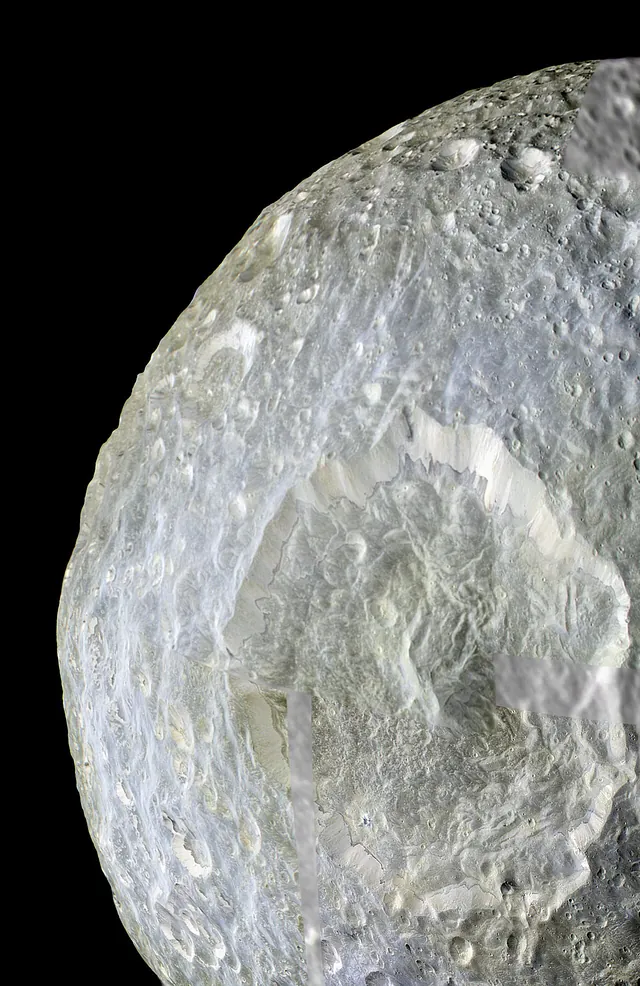
The giant crater named after the moon’s discoverer, about a third as wide as Mimas itself. NASA gives its width as 130 km, the IAU gazetteer as 139 km. Its walls rise about 5 km and its central peak about 6 km. The impact probably came close to breaking the moon apart.114
Arthur
A crater 64 km across in the southern hemisphere, near 35° south. It is named after King Arthur, leader of the Round Table, and its name was approved in 1982. Like most of the moon’s surface, the ground around it is densely packed with smaller craters.115
Ossa Chasma
A canyon 95 km long, centred near 24° south. NASA notes that shock waves from the Herschel impact may have caused the fractures on the far side of Mimas. It is named after Mount Ossa in Greek myth, on which Mount Pelion was piled during the war of the Titans and the gods.116
Exploration
Until the Voyager spacecraft photographed it in 1980, Mimas was little more than a dot of light. NASA’s Cassini orbiter later made several close approaches. The closest came on 13 February 2010, at about 9,500 km, producing the sharpest views of Herschel and the temperature map that revealed the Pac-Man pattern.128
Cassini’s long record of images is still yielding discoveries: both the 2014 libration study and the 2024 ocean study came from re-analysing its data. Lainey’s team combined tens of thousands of Cassini images of Mimas and 18 other Saturnian moons, supplemented with observations from the Hubble Space Telescope.3412
- Voyager images
- 19801
Quick answers
- How massive is Mimas?
- Mimas has a mass of 3.79 × 10¹⁹ kg.7
- How long is a day on Mimas?
- A day on Mimas lasts 0.942 days (synchronous: the same face always turned to Saturn).17
- How long does Mimas take to complete one orbit?
- Mimas completes one orbit in 0.942 days (NASA gives 22 hours 36 minutes).17
- What is the temperature on Mimas?
- The temperature on Mimas is about 77–95 K (−196 to −178 °C), daytime, measured by Cassini.89
- What is Mimas made of?
- Mimas is made of almost entirely water ice.1
Sources
- Mimas — NASA Science, 2025
- Flying by the Death Star Moon (PIA12570) — NASA Photojournal, 2010
- Lainey et al., A recently formed ocean inside Saturn’s moon Mimas — Nature, 2024
- That’s No Moon; It’s an Ocean World — Eos (American Geophysical Union), 2024
- Hedman et al., The Architecture of the Cassini Division — Astronomical Journal, 2010
- Planetary Satellite Physical Parameters — NASA/JPL Solar System Dynamics
- Saturnian Satellite Fact Sheet — NASA Space Science Data Coordinated Archive, 2025
- Bizarre Temperatures on Mimas (PIA12867) — NASA Photojournal, 2010
- A Pair of ‘Pac-Men’ (PIA16198) — NASA Photojournal, 2012
- Planet and Satellite Names and Discoverers — IAU/USGS Gazetteer of Planetary Nomenclature
- Planetary Satellite Mean Elements — NASA/JPL Solar System Dynamics
- Tajeddine et al., Constraints on Mimas’ interior from Cassini ISS libration measurements — Science, 2014
- Goldreich and Tremaine, The formation of the Cassini division in Saturn’s rings — Icarus (record in the NASA Technical Reports Server), 1978
- Herschel (Mimas) — IAU/USGS Gazetteer of Planetary Nomenclature
- Arthur (Mimas) — IAU/USGS Gazetteer of Planetary Nomenclature
- Ossa Chasma (Mimas) — IAU/USGS Gazetteer of Planetary Nomenclature
Figures checked against these sources in November 2026. Where a quantity is not known, it is left out rather than estimated.

