dwarf planet
Eris
Eris is a dwarf planet in the far outer Solar System, almost exactly the size of Pluto but about 27 per cent more massive. Its discovery, announced on 29 July 2005, helped trigger the debate that led the International Astronomical Union in 2006 to clarify what counts as a planet, making Pluto, Eris and Ceres dwarf planets. It is named after the Greek goddess of discord and strife.12345
Eris follows a steeply tilted, stretched orbit that takes about 560 years and carries it from 38 to almost 98 times Earth’s distance from the Sun. It is now close to its farthest point, more than 95 au away. Its surface is one of the brightest known, reflecting about 96 per cent of the light that falls on it, and is coated in methane ice. A small moon, Dysnomia, circles it every 15.8 days.16789
Size and physical properties
On 6 November 2010 Eris passed in front of a faint star, and the timing of the star’s disappearance, recorded from several sites, showed a spherical body with a radius of 1,163 ± 6 km. That makes Eris almost a twin of Pluto in size. Its visible geometric albedo of 0.96 is extraordinarily high: the surface reflects nearly all the sunlight it receives, perhaps because a former atmosphere has frozen onto it as fresh frost.1
Eris’s mass comes from the orbit of its moon. Keck and Hubble observations in 2005 and 2006 gave 1.67 × 10²² kg, 1.27 times the mass of Pluto. Combined with the occultation radius, that implies a mean density of 2.52 g/cm³. A 2021 study using new Hubble images, which also allowed for Dysnomia’s volume, revised the density of the pair to 2.43 g/cm³.129
Orbit and rotation
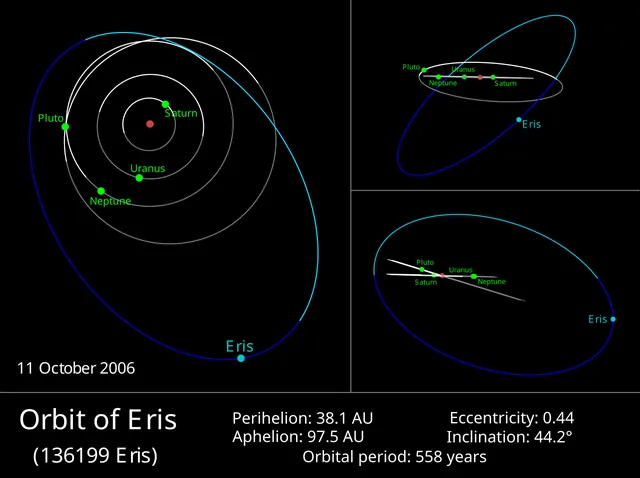
Eris travels around the Sun on an orbit tilted about 44° to the plane of the planets and far more elongated than theirs, with an eccentricity of 0.44. Its average distance is 67.9 au, about 10.2 billion km, but it ranges from 38.2 au at perihelion to 97.7 au at aphelion, and one circuit takes about 560 years. NASA describes it as the largest known member of the scattered disc, beyond the main Kuiper Belt.46813
When it was discovered Eris was at aphelion, and it remains near that turning point. In November 2026 it was 95.5 au from the Sun, so far that sunlight takes about 13 hours to arrive, and creeping slowly inwards; it will not reach perihelion until about 2257. In 2022 and 2023 two teams showed that Eris spins once every 15.8 days, in step with Dysnomia’s orbit, so it always turns the same face to its moon.16781011
Discovery and naming
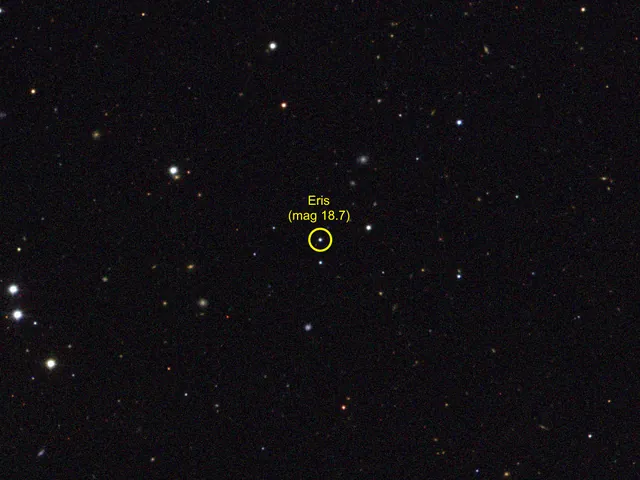
Mike Brown of Caltech, Chad Trujillo of Gemini Observatory and David Rabinowitz of Yale University found Eris in images taken on 21 October 2003 with the 1.2-metre Samuel Oschin Schmidt telescope at Palomar Observatory, during a survey of the outer Solar System. The object was not picked out of the data until January 2005. Older images then traced its path back to 1989, giving an orbit with very small uncertainties.3468
The team, who had nicknamed it Xena, announced the find on 29 July 2005, sooner than planned because information about their objects had leaked out. Because it seemed bigger than Pluto it was hailed as a tenth planet. The debate that followed led the International Astronomical Union to define planets in August 2006, and in September 2006 the object was named Eris, after the Greek goddess of discord, its moon Dysnomia after her daughter.345814
Surface
Infrared spectra taken at Gemini Observatory soon after discovery showed that Eris, like Pluto, is covered mainly in frozen methane, although in visible light it is almost neutral grey rather than Pluto’s strong red. Later, the James Webb Space Telescope’s NIRSpec spectrometer confirmed a methane-rich surface whose ice lets sunlight travel long paths through it, and found evidence of nitrogen ice but no carbon monoxide ice. Surface temperatures are estimated at about −243 to −217 °C.4812
Webb could also pick out methane containing heavy hydrogen. The ratio of deuterium to hydrogen in Eris’s methane, (2.5 ± 0.5) × 10⁻⁴, is much lower than in the apparently primordial methane of comet 67P/Churyumov–Gerasimenko but similar to that of water in many comets. The researchers suggest that the methane’s hydrogen came from water, through processes in hot environments deep inside Eris, in the past or even today.12
Atmosphere
No atmosphere has been detected. The 2010 occultation ruled out any nitrogen, argon or methane atmosphere with a surface pressure greater than about 1 nanobar, some 10,000 times thinner than Pluto’s. The bright surface may be an atmosphere that has collapsed into frost in the cold far from the Sun, and the astronomers who measured it expect such an atmosphere to return from time to time as Eris approaches perihelion.14
- Upper limit on surface pressure
- about 1 nanobar1for nitrogen, argon or methane
Dysnomia, the moon of Eris
Eris has one known moon, Dysnomia, found on 10 September 2005 with the laser guide star adaptive optics system of the Keck Observatory on Mauna Kea. It is only about 2 per cent as bright as Eris. Named after the daughter of Eris, a spirit of lawlessness, it follows a nearly circular, prograde orbit about 37,350 km from Eris, completing a circuit every 15.786 days.245915
Timing that orbit is what revealed the mass of Eris. Thermal measurements with the Atacama Large Millimeter/submillimeter Array, published in 2018, gave Dysnomia a diameter of 700 ± 115 km and a very dark surface, with an albedo of about 0.04, unlike its brilliant parent. Its orbit is tilted about 78° to Eris’s path around the Sun; the next season of eclipses between the two will come in 2239.2916
Exploration
No spacecraft has visited Eris: the only one to explore the Kuiper Belt, New Horizons, flew past Pluto and Arrokoth. Everything known about Eris comes from telescopes. Palomar found it, Gemini took its first spectra, Keck and Hubble tracked its moon to weigh it, a network of telescopes timed the 2010 occultation, the Atacama array measured Dysnomia and the James Webb Space Telescope analysed its ices.128121617
Measuring the rotation took years of patient photometry, because Eris’s brightness varies by only about 3 per cent. Earlier estimates ranged from a few hours to about 16 days. Data from ground-based telescopes and the TESS and Gaia space telescopes, and independently from the Palomar 60-inch telescope, Hubble’s Wide Field Camera 3 and the Dark Energy Survey, settled on a period matching Dysnomia’s orbit.1011
Quick answers
- How big is Eris?
- Eris has a mean radius of 1,163 km (±6 km, from a stellar occultation in 2010).1
- How massive is Eris?
- Eris has a mass of 1.67 × 10²² kg (1.27 times the mass of Pluto).2
- How dense is Eris?
- Eris has a mean density of about 2.4–2.5 g/cm³ (2.52 g/cm³ (2011); 2.43 g/cm³ for Eris and Dysnomia together (2021)).19
- How long is a day on Eris?
- A day on Eris lasts about 15.8 days (synchronous: Eris keeps the same face turned to Dysnomia).1011
- How long is a year on Eris?
- A year on Eris lasts about 560 Earth years (204,517 days).6
- How far is Eris from the Sun?
- Eris is 67.9 au on average from the Sun (about 10.2 billion km; 38.2 to 97.7 au).6
- What is the temperature on Eris?
- The temperature on Eris is about −243 to −217 °C.4
Sources
- Sicardy et al., A Pluto-like radius and a high albedo for the dwarf planet Eris from an occultation — Nature, 2011
- Brown and Schaller, The mass of dwarf planet Eris — Science, 2007
- MPEC 2005-O41: 2003 UB313 — Minor Planet Center, 2005
- Eris — NASA Science, 2026
- Planet and Satellite Names and Discoverers — International Astronomical Union and USGS Astrogeology Science Center (Gazetteer of Planetary Nomenclature)
- Small-Body Database Lookup: 136199 Eris (2003 UB313) — NASA/JPL Solar System Dynamics, 2026
- Horizons System: ephemeris of 136199 Eris for 1–2 November 2026 — NASA/JPL Solar System Dynamics, 2026
- Brown, Trujillo and Rabinowitz, Discovery of a planetary-sized object in the scattered Kuiper belt — Astrophysical Journal Letters, 2005
- Holler et al., The Eris/Dysnomia system I: The orbit of Dysnomia — Icarus, 2021
- Szakáts et al., Tidally locked rotation of the dwarf planet (136199) Eris discovered from long-term ground based and space photometry — Astronomy & Astrophysics, 2023
- Bernstein et al., Synchronous rotation in the (136199) Eris–Dysnomia system — arXiv, 2023
- Grundy et al., Measurement of D/H and 13C/12C ratios in methane ice on Eris and Makemake: Evidence for internal activity — Icarus, 2024
- Kuiper Belt: Facts — NASA Science
- 10th Planet Controversy — Universe Today (from AstronomiaOnline), 2005
- Brown et al., Satellites of the largest Kuiper belt objects — Astrophysical Journal Letters, 2006
- Brown and Butler, Medium-sized satellites of large Kuiper belt objects — Astronomical Journal, 2018
- Kuiper Belt — NASA Science
Figures checked against these sources in November 2026. Where a quantity is not known, it is left out rather than estimated.

