dwarf planet
Ceres
Ceres is the largest object in the asteroid belt between Mars and Jupiter, and the only dwarf planet in the inner Solar System. About 940 km across, it was the first member of the belt to be found, spotted by Giuseppe Piazzi from Palermo on 1 January 1801. It has been called a planet, then an asteroid and, since 2006, a dwarf planet.123
NASA’s Dawn spacecraft studied Ceres from orbit between 2015 and 2018 and found a dark, cratered world dotted with bright salt deposits. Its crust is a mixture of ice, salts and hydrated minerals, the residue of an ancient ocean, and salty water may still survive deep beneath Occator crater. A solitary ice volcano, Ahuna Mons, and a patch of organic material show that this small world has had a surprisingly active past.456789
Size and physical properties
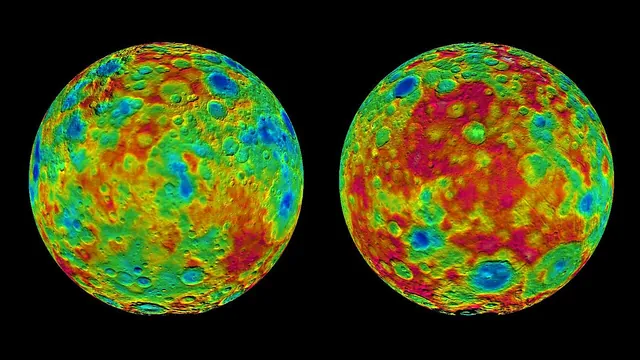
Ceres is the largest body in the asteroid belt, yet its radius is only about one-thirteenth of Earth’s. Dawn measured it at 964.4 × 964.2 × 891.8 km: round at the equator and squashed at the poles. The spacecraft’s gravity and shape measurements show that Ceres is in hydrostatic equilibrium, its figure set by its own gravity and spin rather than by the strength of its rock.1214
With a mass of 9.38 × 10²⁰ kg and a mean density of 2.162 g/cm³, Ceres is much less dense than the rocky planets, and NASA infers from this that about a quarter of its mass is ice. Gravity at the equator is 0.27 m/s², less than 3 per cent of Earth’s. The surface is dark, with a geometric albedo of just 0.090.1101315
Orbit and rotation
Ceres circles the Sun inside the main asteroid belt, between Mars and Jupiter, at an average distance of 2.77 au, about 413 million km. Its path is only mildly elongated, carrying it from 2.55 au at its closest to 2.99 au at its farthest, and is tilted 10.6° to the plane of Earth’s orbit. One circuit takes 1,680 days, or 4.60 years, and sunlight needs about 22 minutes to reach it.12
A day on Ceres lasts just over nine hours. Its axis leans only about 4° from upright, so it has no seasons to speak of, and some crater floors near the poles never see the Sun. The tilt is not fixed, though: calculations show it swinging between about 2° and 20° in a cycle lasting 24,500 years, and at its steepest most of those shadowed regions are lit.121216
- Eccentricity
- 0.07972
Discovery and naming
Giuseppe Piazzi, director of the Palermo Observatory in Sicily, found Ceres on 1 January 1801 while cataloguing stars, and at first reported it as a comet. He followed it for 42 days before it moved too close to the Sun to be seen. The 24-year-old Carl Friedrich Gauss then devised a new way to work out an orbit from Piazzi’s observations, and with his prediction Franz Xaver von Zach found Ceres again on 7 December 1801.21718
Piazzi named his find Ceres Ferdinandea, after the Roman goddess of agriculture, patron deity of Sicily, and after King Ferdinand; only the first name lasted. Ceres was hailed as a planet, but as more bodies turned up in the same region William Herschel proposed calling them asteroids. In 2006 the International Astronomical Union made Ceres a dwarf planet, alongside Pluto and Eris.13171819
What the surface is made of
Dawn’s visible and infrared spectrometer found a dark surface that is much the same everywhere: a mixture of low-albedo material, magnesium-bearing and ammonia-bearing clay minerals (phyllosilicates) and carbonates. The ammonia is a clue to where Ceres came from, because it suggests that material from the cold outer Solar System was built into it.131520
The bright spots are different. In Occator crater they are rich in sodium carbonate, the most concentrated carbonate deposit known beyond Earth on kilometre scales, mixed with ammonium salts. Close-up data from the end of the mission also revealed sodium chloride chemically bound with water at Cerealia Facula. Such salts lose their water within hundreds of years, so the fluid must have reached the surface very recently.1521
Water ice is hard to find on the surface but plentiful just below it. Dawn’s spectrometer picked up water in the small, fresh crater Oxo, and its gamma-ray and neutron detector measured hydrogen at middle and high latitudes consistent with broad expanses of ice in the uppermost soil. Near Ernutet crater the spacecraft also found organic material spread over about 1,000 km².9202223
What hides inside
Dawn’s gravity and shape measurements show that Ceres is partially differentiated: dense rock has settled inwards beneath a lighter, water-rich outer shell, although its layers are not as clearly defined as those of the rocky planets. The telling figure is its normalised moment of inertia, 0.37, which points to a partly layered body rather than a uniform one.114
In NASA’s picture of the interior, the crust is about 40 km thick and made of ice, salts and hydrated minerals. Beneath it lies a layer that may hold a little salty liquid, or brine, reaching down to at least 100 km. Deeper still is a mantle dominated by hydrated rocks such as clays. Dawn could not sense below about 100 km, so whether Ceres has a dense, metal-rich core is unknown.5
The strongest evidence for liquid comes from Occator crater. High-resolution gravity data and thermal modelling imply an extensive brine reservoir about 40 km down and hundreds of kilometres wide. The impact that made Occator opened large fractures that could reach it, letting brine seep up and build the bright deposits. Researchers now describe Ceres as a relict ocean world.721
- Moment of inertia factor
- 0.3714normalised mean moment of inertia
- Crust thickness
- about 40 km5ice, salts and hydrated minerals
- Crust density
- 1,200–1,400 kg/m³24range from different models of isostasy
- Layer that may hold brine
- down to at least 100 km5
- Brine reservoir under Occator
- about 40 km deep21hundreds of kilometres wide
Atmosphere
Ceres has only a very thin atmosphere, and what is known of it is water vapour. In January 2014 astronomers using the European Space Agency’s Herschel space observatory reported the first definite detection: at least 10²⁶ molecules, about 6 kg, escaping every second from localised sources at mid-latitudes. Herschel saw the vapour on four occasions but not on a fifth. It may come from ice turning straight to gas, or from icy volcanism.11925
- First detected by
- Herschel space observatory19announced 22 January 2014
Magnetic field
Scientists do not think Ceres has a magnetosphere, the magnetic bubble that shields planets such as Earth. Dawn did record one brief encounter between Ceres and the solar wind, the stream of charged particles from the Sun: on a single occasion a temporary bow shock formed and accelerated electrons to energies of tens of kilovolts.14
Notable features
Occator crater
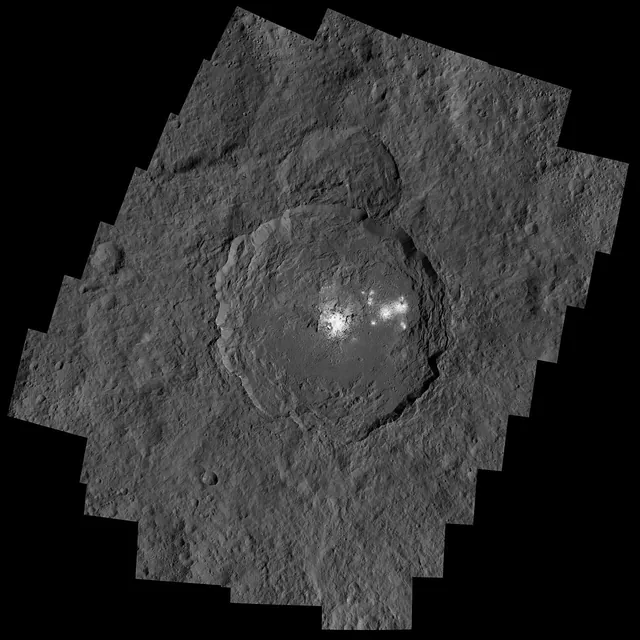
This 92 km crater is home to the most extensive bright areas on Ceres. Cerealia Facula, 14 km across, sits near its centre, with the Vinalia Faculae, 19 km across, to the east. Both are salts, mostly sodium carbonate, left by brine that rose after the impact about 20 million years ago; some are under 2 million years old.6152126
Ahuna Mons
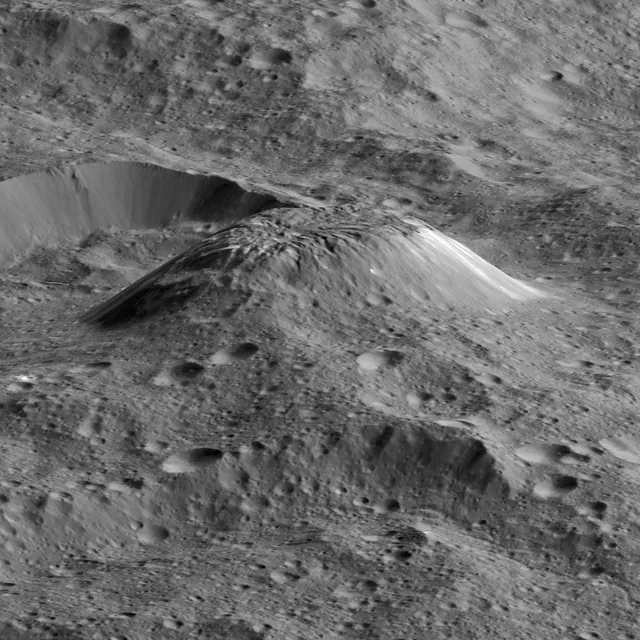
The tallest mountain on Ceres stands alone near the equator, about 20 km across and 4 km high on average, rising to 5 km on its steepest side. Dawn scientists interpret it as a cryovolcanic dome built from salty mud and ice rather than molten rock, and its sharp, lightly cratered slopes suggest it formed within the last billion years.8262728
Kerwan
At 280 km across, Kerwan is the largest crater on Ceres, named after the Hopi spirit of sprouting maize. Its modest size is a puzzle: a world this old should carry far bigger impact scars. Their absence suggests that ice or salt beneath the surface, or past icy volcanism, has smoothed them away.1426
Ernutet
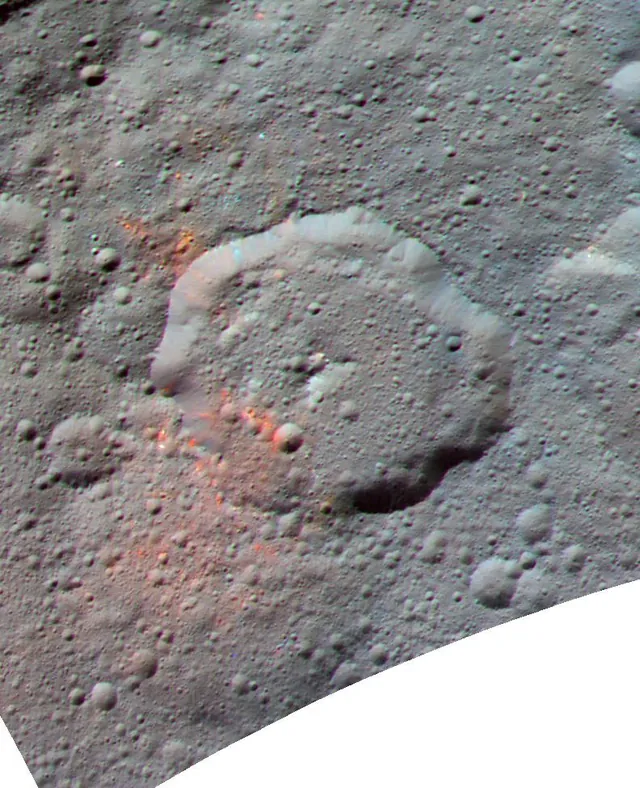
Ernutet is a 53 km crater in the northern hemisphere, named after an Egyptian cobra-headed goddess of the harvest. Around it Dawn made a clear detection of organic material: aliphatic compounds, built from chains of carbon and hydrogen, spread over roughly 1,000 km². Where they came from is still not known.6926
Yalode and Urvara
These two southern craters are the second and third largest on Ceres, 260 km and 170 km across. Yalode is named after a Dahomey goddess worshipped by women at harvest rites, Urvara after an Indian and Iranian deity of plants and fields. That craters this large have kept their shape points to a strong crust.1326
Oxo
Only 10 km wide, Oxo is a geologically fresh crater and the first place where Dawn’s spectrometer saw water at the surface, as ice or as water-bearing minerals. Exposed ice would fade from view within tens of years, so if it is ice it was uncovered or formed recently. Its name honours a god of agriculture in Afro-Brazilian belief.2226
Exploration
Before any spacecraft arrived, the best views came from the Hubble Space Telescope. In 2003 and 2004 Hubble followed Ceres through a full nine-hour rotation, taking 267 images that showed a nearly round body and hinted at a layered interior. Telescopes also picked out diffuse bright regions whose nature was unknown, and Herschel’s detection of water vapour was announced in 2014.1319212930
NASA’s Dawn launched on 27 September 2007, spent 14 months orbiting the asteroid Vesta in 2011 and 2012, and entered orbit around Ceres on 6 March 2015 under ion propulsion. It was the first spacecraft to orbit a dwarf planet and the first to orbit two bodies beyond Earth. It carried two framing cameras, a visible and infrared mapping spectrometer and a gamma-ray and neutron detector.342730
Over the next three years Dawn worked from nine different orbits, at the end dipping to less than 35 km above the surface. It fell silent when its hydrazine ran out, missing contacts on 31 October and 1 November 2018. Because Ceres has organic material and liquid below ground, the craft was left in an orbit that should keep it from crashing for at least 20 years, and very probably 50.213031
- Lowest altitude
- less than 35 km21
Quick answers
Sources
- Ceres: Facts — NASA Science, 2025
- Small-Body Database Lookup: 1 Ceres (A801 AA) — NASA/JPL Solar System Dynamics, 2021
- NASA Spacecraft Becomes First to Orbit a Dwarf Planet — NASA, 2015
- Russell et al., Dawn arrives at Ceres: Exploration of a small, volatile-rich world — Science, 2016
- Ceres’ Internal Structure (Artist’s Concept), PIA22660 — NASA Photojournal, 2018
- Dawn mission: Highlights — NASA Science, 2024
- Raymond et al., Impact-driven mobilization of deep crustal brines on dwarf planet Ceres — Nature Astronomy, 2020
- Ruesch et al., Cryovolcanism on Ceres — Science, 2016
- De Sanctis et al., Localized aliphatic organic material on the surface of Ceres — Science, 2017
- Planetary Physical Parameters — NASA/JPL Solar System Dynamics, 2019
- Asteroid Fact Sheet — NASA Space Science Data Coordinated Archive, 2019
- Ermakov et al., Ceres’s obliquity history and its implications for the permanently shadowed regions — Geophysical Research Letters, 2017
- Dawn mission science: Ceres — NASA Science, 2024
- Park et al., A partially differentiated interior for (1) Ceres deduced from its gravity field and shape — Nature, 2016
- De Sanctis et al., Bright carbonate deposits as evidence of aqueous alteration on (1) Ceres — Nature, 2016
- Ceres’ Shadowed Craters Over Time — NASA Photojournal, 2017
- Ceres: Keeping Well-Guarded Secrets for 215 Years — NASA Jet Propulsion Laboratory, 2016
- The Missing Planet — MacTutor History of Mathematics Archive, University of St Andrews, 2022
- Herschel Telescope Detects Water on Dwarf Planet — NASA, 2014
- De Sanctis et al., Ammoniated phyllosilicates with a likely outer Solar System origin on (1) Ceres — Nature, 2015
- Mystery Solved: Bright Areas on Ceres Come From Salty Water Below — NASA Jet Propulsion Laboratory, 2020
- Combe et al., Detection of local H2O exposed at the surface of Ceres — Science, 2016
- Prettyman et al., Extensive water ice within Ceres’ aqueously altered regolith: Evidence from nuclear spectroscopy — Science, 2017
- Ermakov et al., Constraints on Ceres’ Internal Structure and Evolution From Its Shape and Gravity Measured by the Dawn Spacecraft — Journal of Geophysical Research: Planets, 2017
- Küppers et al., Localized sources of water vapour on the dwarf planet (1) Ceres — Nature, 2014
- Gazetteer of Planetary Nomenclature: Ceres — International Astronomical Union and USGS Astrogeology Science Center
- NASA Discovers “Lonely Mountain” on Ceres Likely a Salty-Mud Cryovolcano — NASA, 2016
- Ahuna Mons — NASA Photojournal, 2018
- Largest Asteroid May Be ‘Mini Planet’ with Water Ice — NASA Science, 2005
- 15 Years Ago: Dawn Begins Voyage to Asteroid Vesta and Dwarf Planet Ceres — NASA History, 2022
- NASA’s Dawn Mission to Asteroid Belt Comes to End — NASA, 2018
Figures checked against these sources in November 2026. Where a quantity is not known, it is left out rather than estimated.

