asteroid
Vesta
Vesta is the second most massive body in the asteroid belt between Mars and Jupiter, holding almost 9 per cent of the mass of all the asteroids. Seen from Earth it is the brightest asteroid of all, and at its best it can just be made out with the unaided eye from a dark site. Heinrich Olbers discovered it from Bremen on 29 March 1807, and Carl Friedrich Gauss named it after the Roman goddess of the hearth.123
NASA’s Dawn spacecraft orbited Vesta from July 2011 to September 2012 and found a battered, rocky world with a basaltic crust. Its south pole is scooped out by the 500 km Rheasilvia basin, whose central peak is among the tallest mountains in the Solar System, and giant troughs ring its equator. Dawn confirmed Vesta as the source of the HED meteorites, but whether it has a sizeable iron core is now debated.14567
Size and physical properties
Vesta is far from a sphere. Dawn measured it at 569 × 554 × 453 km, a lopsided shape because giant impacts removed much of its southern hemisphere, yet NASA notes it is almost spherical enough to be classed as a dwarf planet. Its mean diameter is 522.8 km. Vesta and Pallas are so close in size that sources rank them differently: NASA’s Dawn pages call Vesta the second-largest object in the belt, while Vesta Trek puts it third, after Pallas.1234
With a mass of 2.59 × 10²⁰ kg packed into about 75 million km³, Vesta has a mean density of 3.46 g/cm³, far denser than Ceres at 2.16 g/cm³ and consistent with an overall composition like that of chondritic meteorites. Its surface is bright, reflecting about 42 per cent of the light that falls on it, and it shows one of the largest ranges of brightness of any rocky body in the Solar System.13710
Orbit and rotation
Vesta keeps to the inner part of the main belt, averaging 2.36 au, or about 353 million km, from the Sun. Its orbit is only slightly elongated, ranging from 2.15 au to 2.57 au, and is tilted 7.1° to the plane of Earth’s orbit. One circuit takes 1,325 days, about 3.63 years, so Vesta is nearer the Sun and quicker round it than Ceres or Pallas, which both take about 4.6 years.38
Vesta spins fast, once every 5 hours 20.5 minutes. Years of radio tracking and imaging by Dawn pinned the period down to within a few millionths of a second, and a 2025 analysis of the same data measured the tiny wobbles of its spin axis, its precession and nutation, which reveal how mass is distributed inside the asteroid.37
- Eccentricity
- 0.0903
Discovery and naming
Heinrich Wilhelm Olbers found Vesta from Bremen, Germany, on 29 March 1807. He had already discovered Pallas and believed, wrongly as it turned out, that Ceres and Pallas were fragments of a destroyed planet; Vesta turned up while he was searching for more such pieces. It was the fourth asteroid ever discovered, after Ceres in 1801, Pallas in 1802 and Juno in 1804.138
Olbers handed the honour of naming it to the mathematician Carl Friedrich Gauss, who had computed its orbit, and Gauss chose Vesta, the Roman goddess of the hearth and household. When Dawn’s images called for names on the surface, the International Astronomical Union turned to the vestal virgins, Vesta’s priestesses, for craters and to Roman festivals for the great troughs and plains.111
Vesta’s meteorites and what it is made of
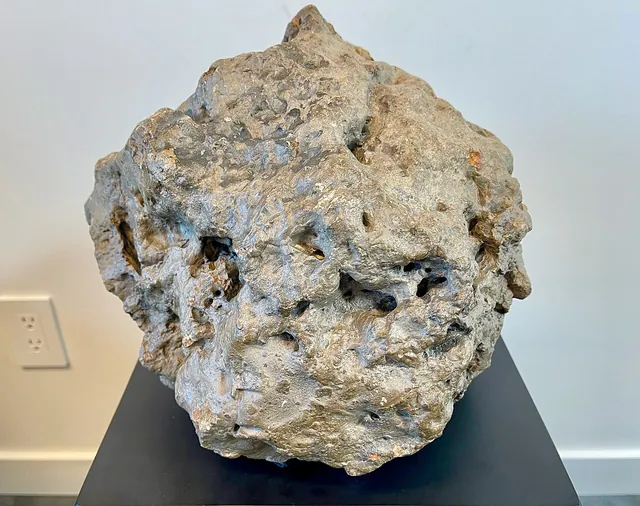
Before Dawn arrived, scientists already suspected that the howardite, eucrite and diogenite meteorites, known together as HEDs, came from Vesta. Dawn confirmed the link by matching the elements and minerals it measured on the surface with laboratory measurements of the meteorites. The debris blasted off by Vesta’s giant impacts still reaches Earth: NASA estimates that about 6 per cent of all meteorites found here came from that ancient collision.46
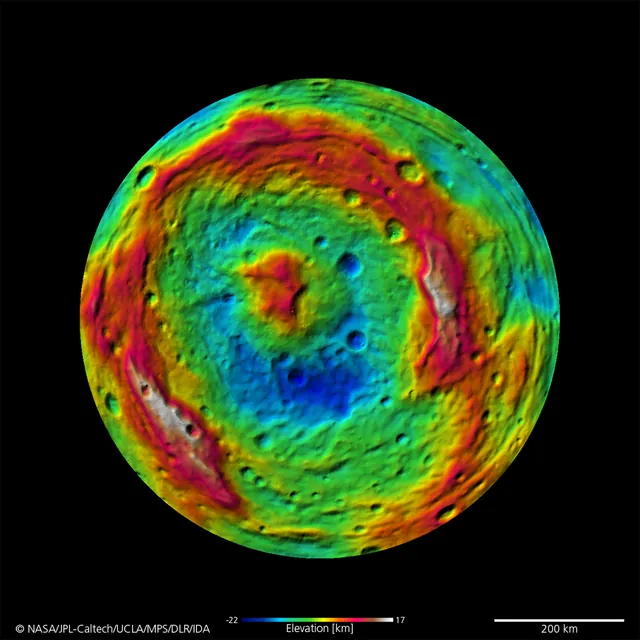
Each type samples a different level. Eucrites are basaltic lavas from the upper crust; diogenites, with larger crystals, formed deeper down as plutonic rocks; and howardites are breccias of both, welded together by impacts. Dawn’s spectrometer saw the same layering on Vesta itself: a eucrite-rich upper crust around the equator and a deeper, diogenite-rich crust exposed inside the Rheasilvia basin.29
Not everything on the surface is native. Dark patches seem to be carbon-rich debris from roughly 300 dark asteroids, 1 to 10 km across, that struck Vesta over the last 3.5 billion years. Pitted ground in some young craters suggests that impact-heated, volatile-rich material degassed, and because Vesta itself is depleted in volatiles, that material probably arrived with the impactors.12412
- Deeper crust
- Diogenite-like rock9exposed in the Rheasilvia basin
What hides inside
Vesta formed within 1 to 2 million years of the birth of the Solar System, early enough for heat from short-lived radioactive elements to melt it. Denser material sank and lighter rock rose, giving it a crust, a mantle and a core, much like Earth. In 2012 the Dawn team reported that Vesta’s mass, volume and gravity field fitted an iron core with an average radius of 107 to 113 km.16
That picture has since been challenged. In 2025 a reanalysis of Dawn’s radio tracking and images measured Vesta’s moment of inertia, a number that shows how strongly mass is concentrated towards the centre, and found it only 6.6 per cent below the value for a uniform body. The best-fitting models have a crust about 47 km thick over a dense mantle and a core of only about 45 km radius, and a coreless Vesta could not be ruled out.7
The authors concluded that Vesta never fully separated into a metal core, rocky mantle and basaltic crust, perhaps because it formed later than thought, or because it gathered itself together from the debris of a larger body shattered in a collision. The HED meteorites, which record extensive early melting, still have to be reconciled with that result.7
Notable features
Rheasilvia
This impact basin covers most of Vesta’s southern hemisphere. Dawn measured it as 500 km wide, 95 per cent of Vesta’s mean diameter, and 19 km deep; the IAU Gazetteer lists 450 km. The impact removed about 1 per cent of Vesta’s mass. Age estimates range from under 1 billion to about 2 billion years.14511
Rheasilvia’s central peak
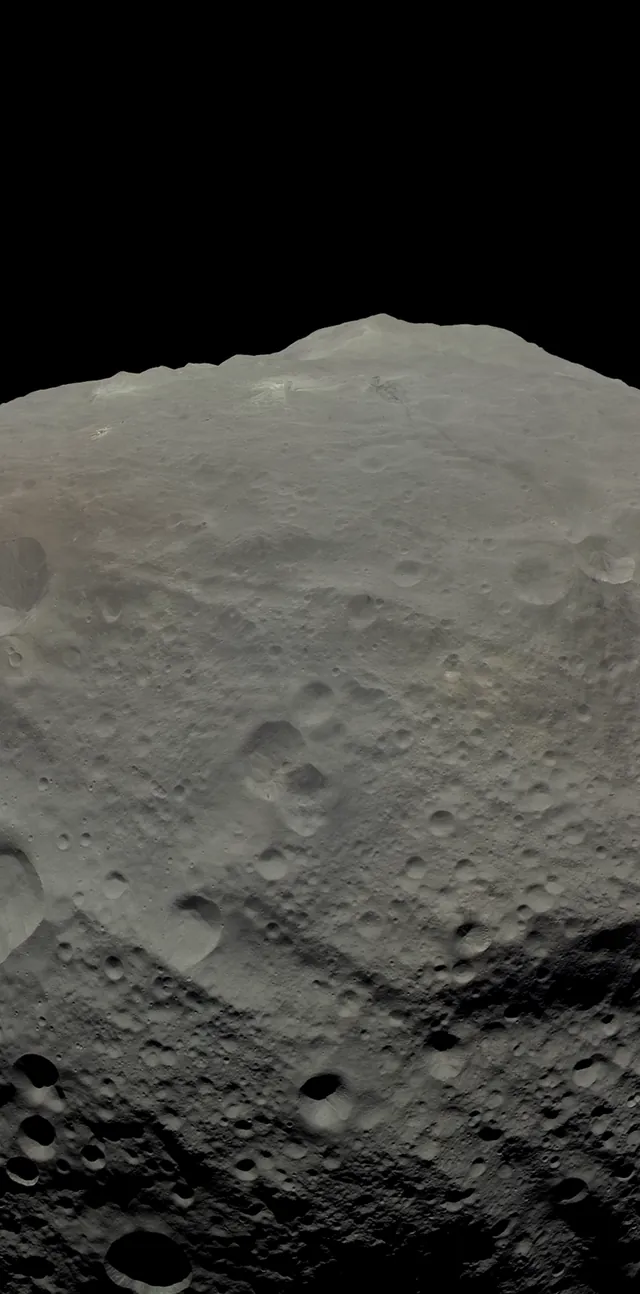
At the heart of Rheasilvia rises one of the tallest mountains in the Solar System. NASA gives its height as 12 to 16 miles, about 19 to 26 km, and its width as over 160 km, rivalling Olympus Mons on Mars; Vesta Trek puts it 23 km above the lowest point of the basin floor.24
Veneneia
An older impact basin about 400 km across, named after one of the first vestal virgins. Rheasilvia obliterated half of it, but part of its rim still shows beyond Rheasilvia’s edge. A second set of great troughs, Saturnalia Fossae, about 345 km long, runs concentric to it in the northern hemisphere.2511
Divalia Fossae
Parallel troughs encircle Vesta’s equator, concentric to Rheasilvia. The largest, Divalia Fossa, is up to 20 km wide and 465 km long, bigger than the Grand Canyon. Their shape shows they are graben, blocks dropped between faults, formed when the giant impacts struck. The IAU renamed the system Divalia Fossae in 2014.121113
The Snowman
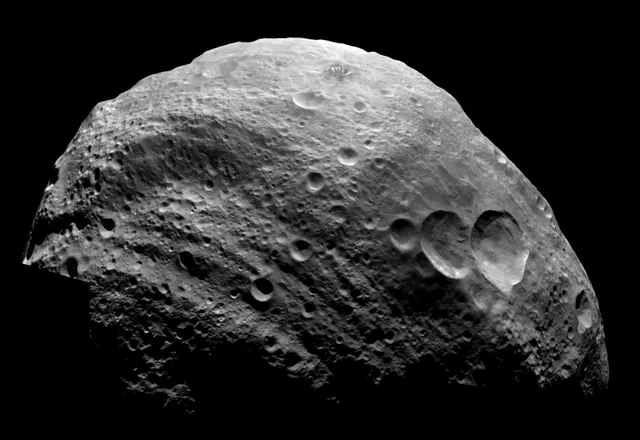
Three craters in the northern hemisphere, Marcia (68 km), Calpurnia (50 km) and Minucia (23 km), line up in a distinctive snowman shape. Their overlapping rims give the order in which they formed: Minucia is the oldest and Marcia the youngest. All three are named after Roman vestal virgins.211
Exploration
Even before any spacecraft arrived, the Hubble Space Telescope showed the combined scar of Vesta’s two giant southern impacts as a great depression, and picked out a peak at its centre. Analyses of the HED meteorites had already pointed to a melted, layered parent body, which made Vesta a prime target for a mission to visit a surviving protoplanet from the earliest days of the Solar System.46
NASA’s Dawn left Earth on 27 September 2007 and, using ion propulsion and a gravity assist from Mars in February 2009, entered orbit around Vesta on 16 July 2011, the first spacecraft to orbit a main-belt object. Over nearly 14 months it worked from six science orbits and returned more than 30,000 images, mapping the whole surface, before leaving on 5 September 2012 for Ceres.114
Dawn carried three science instruments, and tracking its radio signal revealed Vesta’s gravity field. Its results confirmed Vesta as the parent body of the HED meteorites and showed a heavily cratered surface whose rough topography is transitional between planets and asteroids, with features like those of the Moon and the rocky planets as well as of smaller asteroids.41415
Seeing Vesta from Earth
Seen from Earth, Vesta is the brightest of all the asteroids, and at its brightest it can just be seen with the unaided eye from a dark location. Its absolute magnitude, the standard measure of an asteroid’s intrinsic brightness, is 3.25, compared with 4.12 for Pallas and 5.65 for Hygiea. Part of the reason is its bright surface, which reflects about 42 per cent of sunlight.231617
Quick answers
Sources
- 4 Vesta — NASA Science
- Vesta Trek: Quick Facts About Vesta — NASA Solar System Treks
- Small-Body Database Lookup: 4 Vesta (A807 FA) — NASA/JPL Solar System Dynamics, 2021
- Dawn mission science: Vesta — NASA Science
- Schenk et al., The geologically recent giant impact basins at Vesta’s south pole — Science, 2012
- Russell et al., Dawn at Vesta: testing the protoplanetary paradigm — Science, 2012
- Park et al., A small core in Vesta inferred from Dawn’s observations — Nature Astronomy, 2025
- Asteroid Fact Sheet — NASA Space Science Data Coordinated Archive, 2019
- De Sanctis et al., Spectroscopic characterization of mineralogy and its diversity across Vesta — Science, 2012
- Marsset et al., The violent collisional history of aqueously evolved (2) Pallas — Nature Astronomy, 2020
- Gazetteer of Planetary Nomenclature: Vesta — International Astronomical Union and USGS Astrogeology Science Center
- Denevi et al., Pitted terrain on Vesta and implications for the presence of volatiles — Science, 2012
- Buczkowski et al., Large-scale troughs on Vesta: A signature of planetary tectonics — Geophysical Research Letters, 2012
- 15 Years Ago: Dawn Begins Voyage to Asteroid Vesta and Dwarf Planet Ceres — NASA History, 2022
- Jaumann et al., Vesta’s shape and morphology — Science, 2012
- Small-Body Database Lookup: 2 Pallas (A802 FA) — NASA/JPL Solar System Dynamics, 2026
- Small-Body Database Lookup: 10 Hygiea (A849 GA) — NASA/JPL Solar System Dynamics, 2026
Figures checked against these sources in November 2026. Where a quantity is not known, it is left out rather than estimated.

