asteroid
Pallas
Pallas is one of the largest objects in the asteroid belt, about 513 km across, and the second asteroid ever found: Heinrich Olbers spotted it from Bremen on 28 March 1802. Named after the Greek goddess Pallas Athene, it was at first counted as a planet. Its orbit is unusually steep, tilted about 35° to the plane of Earth’s orbit, so Pallas cuts through the belt at a sharp angle.1234
No spacecraft has visited Pallas, the largest main-belt object still unexplored. In 2017 and 2019 astronomers used the SPHERE instrument on the European Southern Observatory’s Very Large Telescope to image it in detail and found a surface pocked with craters, which earned it the nickname “golf ball asteroid”. Its density suggests rock like the water-altered carbonaceous meteorites, and a bright spot may be a salt deposit.245
Size and physical properties
Images from the SPHERE instrument, turned into a 3D model, give Pallas a mean diameter of 513 km and dimensions of 568 × 532 × 448 km. NASA’s older asteroid fact sheet lists a larger 582 × 556 × 500 km. Ceres is much bigger, but Pallas and Vesta are close enough in size that sources rank them differently: ESO and MIT call Pallas the third-largest object in the belt, NASA’s fact sheet the second.12345
Its mass, about 2.04 × 10²⁰ kg, is roughly 7 per cent of the mass of the whole asteroid belt. Combined with the volume of the SPHERE shape model it gives a mean density of 2.89 g/cm³, between icy Ceres at 2.16 g/cm³ and rocky Vesta at 3.46 g/cm³. That settled a long-running puzzle, because earlier density estimates had disagreed with one another.1346
Orbit and rotation
Pallas orbits at an average of 2.77 au, about 414 million km, from the Sun, almost exactly the same distance as Ceres, and takes 1,684 days, or 4.61 years, to go round once. Its orbit, though, is far more stretched, with an eccentricity of 0.23 that carries it between 2.13 au and 3.41 au, and it is tilted by 34.9° to the ecliptic, much more steeply than most asteroids. Pallas turns once every 7.81 hours.135
That tilt shapes its history. Pallas crosses the crowded belt at a steep angle, so its collisions are fast: about 11.5 km/s on average, against about 5.8 km/s for the belt as a whole. MIT researchers estimate that Pallas suffers two to three times more cratering collisions than Ceres or Vesta. The same orbit makes Pallas hard for a spacecraft to reach.245
- Average impact speed
- about 11.5 km/s4belt average about 5.8 km/s
Discovery and naming
Heinrich Wilhelm Olbers found Pallas from Bremen on 28 March 1802, little more than a year after Giuseppe Piazzi discovered Ceres, making it the second asteroid known. The discovery led Olbers to suggest, wrongly, that Ceres and Pallas were fragments of a destroyed planet, and five years later his search for more pieces turned up Vesta.137
Pallas is named after Pallas Athene, the Greek goddess of wisdom. Like many of the asteroids discovered in the 19th century it was at first classified as a planet, and was reclassified as an asteroid only later, as time passed and telescopes improved. NASA’s fact sheet still describes it as the second asteroid discovered.235
A cratered surface
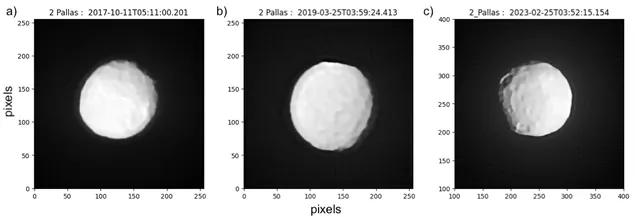
The SPHERE images, taken during 11 series of observations in 2017 and 2019, show Pallas pocked with craters. The team identified 36 craters larger than 30 km across, covering at least 10 per cent of the surface, and called Pallas the most cratered object known in the asteroid belt. The dimpled look led MIT to dub it the “golf ball asteroid”.45
Two large impact basins stand out and may be linked to the impact that made the Pallas family of asteroids. One, about 400 km wide along the equator, was probably made about 1.7 billion years ago by an object 20 to 40 km across; simulations show that the debris it threw out matches the family of fragments that trails Pallas today. In the southern hemisphere a curiously bright spot may be a deposit of salts.245
What it is made of
A density of 2.89 g/cm³ fits a body made of rock similar to CM chondrites, carbonaceous meteorites whose minerals were altered by water, as Pallas’s spectrum near 3 micrometres also suggests. In MIT’s account, Pallas formed from a mixture of water ice and silicates; as the ice inside melted it hydrated the rock and may have left salts that an impact later exposed as the bright spot.45
Pallas reflects about 12 to 17 per cent of the light that falls on it, brighter than dark carbonaceous asteroids such as Hygiea but far darker than Vesta. Researchers note that this relatively high albedo is compatible with salts formed during an early phase of water alteration, although other explanations for the bright spot are possible.1489
- Likely composition
- Like CM carbonaceous chondrites4
Observation and exploration
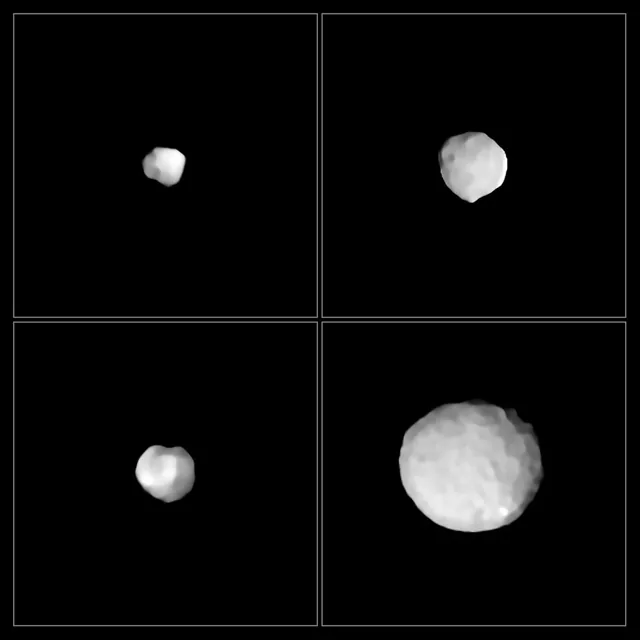
Pallas has never been visited by a spacecraft: it is the largest main-belt object not yet explored, and the only one of the three biggest asteroids without a visit, largely because its steep orbit is hard to reach. Everything known about its surface comes from telescopes. ESO released early SPHERE views of it in December 2017, and the full study of its cratered surface was published on 10 February 2020.2456
Quick answers
- How massive is Pallas?
- Pallas has a mass of 2.04 × 10²⁰ kg (about 7% of the asteroid belt’s mass).136
- How far is Pallas from the Sun?
- Pallas is 2.77 au from the Sun (about 414 million km on average).1
- When was Pallas discovered?
- Pallas was discovered on 28 March 1802, by Heinrich Wilhelm Olbers at Bremen.12
- What is Pallas made of?
- Pallas is made of rock like water-altered carbonaceous (CM) chondrites.4
Sources
- Small-Body Database Lookup: 2 Pallas (A802 FA) — NASA/JPL Solar System Dynamics, 2026
- Golf Ball World (Picture of the Week potw2008a) — European Southern Observatory, 2020
- Asteroid Fact Sheet — NASA Space Science Data Coordinated Archive, 2019
- Marsset et al., The violent collisional history of aqueously evolved (2) Pallas — Nature Astronomy, 2020
- Study reveals details of “golf ball asteroid” — MIT News, 2020
- VLT’s SPHERE spies rocky worlds (Picture of the Week potw1749a) — European Southern Observatory, 2017
- 4 Vesta — NASA Science
- Small-Body Database Lookup: 10 Hygiea (A849 GA) — NASA/JPL Solar System Dynamics, 2026
- Small-Body Database Lookup: 4 Vesta (A807 FA) — NASA/JPL Solar System Dynamics, 2021
Figures checked against these sources in November 2026. Where a quantity is not known, it is left out rather than estimated.

