asteroid
16 Psyche
Psyche is a large, potato-shaped asteroid about 280 km across at its widest, orbiting in the outer main belt roughly three times farther from the Sun than Earth. Discovered by Annibale de Gasparis at Naples on 17 March 1852, it was the 16th asteroid found. It is the largest M-type asteroid in the main belt, and radar echoes suggest that its surface is rich in metal.1234
Psyche was once thought to be the bare iron core of a shattered young planet. Its density, now measured at roughly 3.4 to 4.2 g/cm³, is too low for solid iron, and NASA now describes it as most likely a mixture of rock and metal. NASA’s Psyche spacecraft, launched on 13 October 2023, swung past Mars in May 2026 and is due to begin orbiting the asteroid in August 2029.156789
Size and physical properties
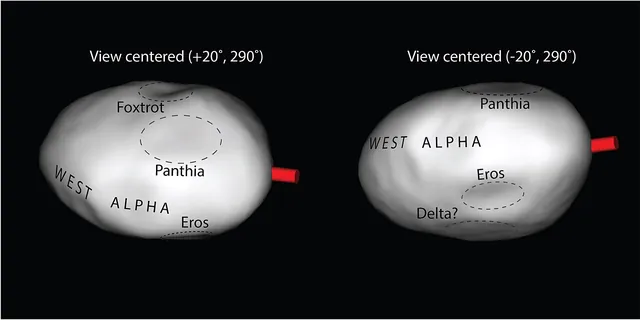
No spacecraft has yet photographed Psyche, so its shape comes from Earth-based radar, telescopes and stellar occultations. The best model, published in 2021, measures 278 × 238 × 171 km, equivalent to a sphere 222 km across. NASA describes it as irregular and potato-like, with a surface area of about 165,800 km². Its gravity is weaker even than the Moon’s.12410
Psyche’s mass is found from the tiny tugs it gives other asteroids that pass near it. Using high-precision Gaia positions, Davide Farnocchia and colleagues measured a GM of 1.601 km³/s² in 2024, equivalent to about 2.40 × 10¹⁹ kg. Combined with the volume, that gives a density of 4.17 g/cm³. Its radar echoes are bright, suggesting the top metre of the surface contains a lot of metal.246
- Volume
- 5.75 million km³6± 0.19 million km³
Orbit and rotation
Psyche orbits in the outer part of the main asteroid belt, between 2.5 and 3.3 au from the Sun, or roughly 378 to 497 million km. One trip around the Sun takes five Earth years. Because Earth and Psyche move at different speeds, the distance between them varies from less than 300 million km to more than 600 million km.1210
Psyche turns once every 4.196 hours, so a Psyche ‘day’ is just over four hours long. According to the 2021 shape model, its spin axis points only about 8° away from the plane of the ecliptic, so the asteroid rolls around the Sun almost on its side.124
Discovery and naming
The Italian astronomer Annibale de Gasparis discovered Psyche from Naples on 17 March 1852. As the 16th asteroid to be found, it is often called 16 Psyche. De Gasparis named it after Psyche, the Greek goddess of the soul, who was born a mortal and married Eros, the god of love; she is often shown with butterfly wings.1210
- Designations
- 16 Psyche2provisional designation A852 FA
Metal world or rubble of metal and rock?
Psyche is one of the few bodies in the main belt that could be an exposed metal core, and for years the scientific consensus was that it is mostly metal: perhaps the core of a planetesimal, an early building block of the planets, left behind by violent hit-and-run collisions. If so, it would offer a unique look at the kind of metal core hidden deep inside Earth.151011
Density measurements complicate the picture. Solid iron meteorites are about 7.8 g/cm³, yet estimates for Psyche cluster near 4: 3.99 g/cm³ from ESO telescope images in 2018, 3.88 g/cm³ from a 2021 mass study and 4.17 g/cm³ in 2024. A 2020 review led by the mission’s principal investigator, Lindy Elkins-Tanton, put it at 3.4 to 4.1 g/cm³, implying 30 to 60 per cent metal by volume, the rest low-iron rock, and no more than about 20 per cent empty space.5671011
Several explanations remain open: a remnant core, a layered rocky world peppered with metal-rich patches erupted by ‘ferrovolcanism’, or a body like mesosiderite stony-iron meteorites or metal-bearing CB chondrites. The mission team says some contradictions in the data may not be resolved until the Psyche spacecraft arrives in orbit.4571011
Surface
Even the sharpest telescope images show Psyche only as a blurred, lumpy disc, but they reveal some large features. ESO’s HARISSA team found a very bright patch, which they named Panthia, and a huge crater almost half the size of the asteroid, which they called Meroe. Shepard’s 2021 map shows four regions with unusually strong radar echoes, all matching optically bright patches, which may be places with extra metal.413
Combined radar and optical data hint at real variations in metal content and colour across the surface, and features vary by about 10 per cent in brightness. No moon has been found: the VLT observations make it almost certain that Psyche has no satellite larger than about 1 km.11113
Exploration
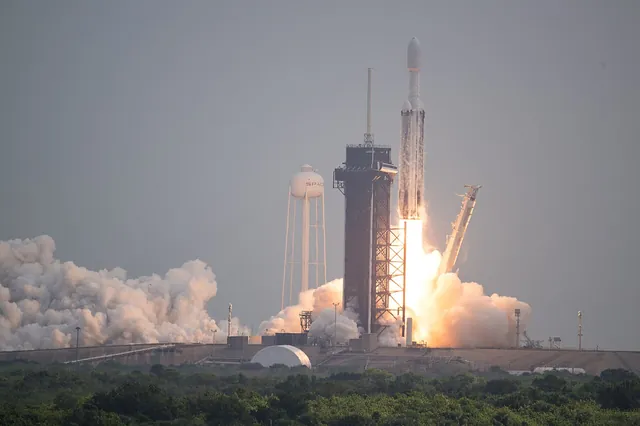
NASA’s Psyche spacecraft is the first mission to a world whose surface holds substantial metal rather than rock or ice. It lifted off on a SpaceX Falcon Heavy from the Kennedy Space Center at 10:19 a.m. EDT on 13 October 2023. About the size of a small van, it carries a multispectral imager, a gamma-ray and neutron spectrometer and magnetometers, and its radio signal will be used to measure Psyche’s gravity.181014
The spacecraft is driven by four solar-powered Hall-effect thrusters, used one at a time, which push out xenon ions with a force of up to 250 millinewtons. On 15 May 2026 it passed 4,609 km above Mars, gaining about 1,600 km/h and a small change of direction. Since 28 September 2026 it has been thrusting almost continuously, on course to start a two-year mapping mission at Psyche in August 2029.91015
Quick answers
- How massive is 16 Psyche?
- 16 Psyche has a mass of 2.40 × 10¹⁹ kg (from its pull on other asteroids).26
- How dense is 16 Psyche?
- 16 Psyche has a mean density of 4.17 g/cm³ (other estimates range from 3.4 to 4.1 g/cm³).2567
- How far is 16 Psyche from the Sun?
- 16 Psyche is 2.93 au from the Sun (about 438 million km on average; 2.5 to 3.3 au).12
Sources
- Asteroid Psyche — NASA Science
- Small-Body Database Lookup: 16 Psyche (A852 FA) — NASA/JPL Solar System Dynamics, 2025
- Asteroid (16) Psyche’s primordial shape: A possible Jacobi ellipsoid (EPSC 2020 abstract) — Europlanet Science Congress, 2020
- Asteroid 16 Psyche: Shape, Features, and Global Map — The Planetary Science Journal, 2021
- Observations, Meteorites, and Models: A Preflight Assessment of the Composition and Formation of (16) Psyche — Journal of Geophysical Research: Planets, 2020
- Mass, Density, and Radius of Asteroid (16) Psyche from High-precision Astrometry — The Astronomical Journal, 2024
- Mass and Density of Asteroid (16) Psyche — The Astrophysical Journal Letters, 2021
- Psyche — NASA Science
- NASA’s Psyche Mission Aces Mars Flyby, Targets Metal-Rich Asteroid — NASA Jet Propulsion Laboratory, 2026
- Psyche: Mission Overview — NASA Science
- (16) Psyche: A mesosiderite-like asteroid? — Astronomy & Astrophysics, 2018
- Meet the 42: ESO images some of the biggest asteroids in our Solar System — ESO, 2021
- Revealing the True Nature of Asteroids — ESO, 2018
- Psyche Science — NASA Science
- Pedal to the Metal: NASA’s Psyche Heads Toward Asteroid Belt — NASA Science (Psyche mission blog), 2026
Figures checked against these sources in November 2026. Where a quantity is not known, it is left out rather than estimated.

