asteroid
2024 YR4
2024 YR4 is a near-Earth asteroid about 60 metres across, roughly the height of a 15-storey building, found by the ATLAS survey telescope at Río Hurtado in Chile on 27 December 2024. For a few weeks in early 2025 it was the most worrying asteroid known: NASA’s estimate of its chance of hitting Earth on 22 December 2032 peaked at 3.1 per cent, the highest NASA had recorded for an object this large.1234
Further observations soon ruled out an impact on Earth, and attention turned to a smaller chance that it could strike the Moon, which rose as high as 4.3 per cent. In February 2026 the James Webb Space Telescope caught the faint asteroid twice more, and on 5 March 2026 NASA announced that a lunar impact was ruled out too: it will pass about 21,200 km from the Moon’s surface.567
Size and physical properties
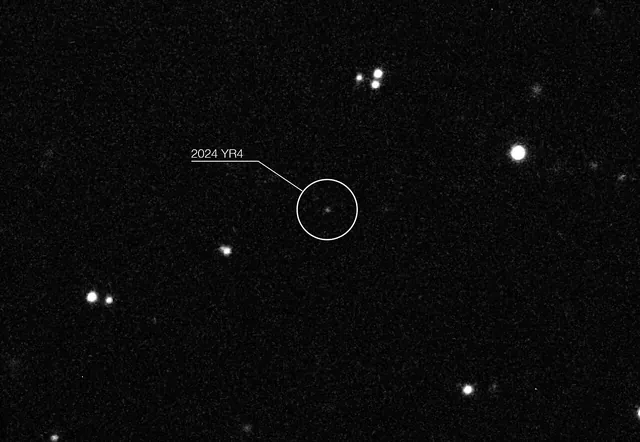
Ground-based telescopes, which see only reflected sunlight, could at first pin the size of 2024 YR4 down only to between 40 and 90 m. In March 2025 the James Webb Space Telescope measured its heat with the MIRI instrument and its reflected light with NIRCam, narrowing the size to 53–67 m, about 60 m. It was the smallest object Webb had ever targeted.12310
The asteroid spins once every 19.46 minutes, placing it among the fast rotators, although spins this quick are common for objects of its size. Its colours and spectrum best match the stony Sq or K classes, with some ambiguity. Webb’s thermal measurements suggest a surface dominated by rocks perhaps fist-sized or larger, with little fine-grained sand.38
A 2026 study combining Webb and ground-based light curves, not yet peer reviewed, models 2024 YR4 as an elongated body with axis ratios of about 1.28 and 1.45, a diameter of 60.8 m and a reflectivity of about 11 per cent. It finds that the surface heats and cools sluggishly, which requires a high thermal inertia.11
Orbit and close approaches
2024 YR4 is an Apollo-type near-Earth asteroid on a long, eccentric orbit that dips to 0.85 au from the Sun, inside Earth’s orbit, and swings out to 4.18 au, far beyond Mars. Each circuit takes almost exactly four years, which brings it close to Earth and the Moon roughly every four years. It passed 829,000 km from Earth on 25 December 2024, two days before it was found.911
Its next close pass, on 22 December 2032, will bring it about 278,000 km from Earth. Webb observations in February 2026 extended the tracked arc by eight months and place it 22,900 ± 800 km from the centre of the Moon on that day, about 21,200 km from the lunar surface. NASA has concluded it poses no significant impact risk to Earth for the next century.679
Discovery and the 2032 impact scare
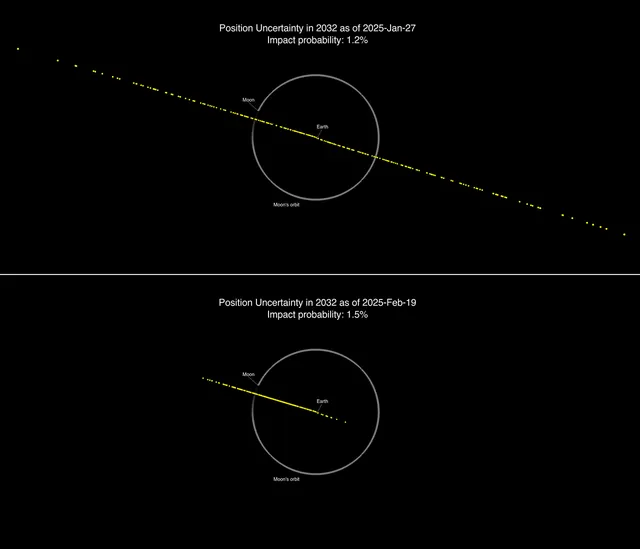
The NASA-funded Asteroid Terrestrial-impact Last Alert System (ATLAS) station at Río Hurtado in Chile discovered 2024 YR4 and reported it to the Minor Planet Center on 27 December 2024. Automated warning systems, such as ESA’s Aegis, quickly found a small chance that it could hit Earth on 22 December 2032, and it rose on NASA’s Sentry risk list on 31 December.1212
By late January 2025 the chance had passed 1 per cent, the threshold for formally notifying other agencies and the United Nations, and the asteroid reached level 3 on the Torino scale. On 18 February NASA’s estimate peaked at 3.1 per cent, the highest it had ever recorded for an object of this size or larger; ESA’s peak, the same day, was 2.8 per cent.12412
Then the odds collapsed, the expected pattern as the cloud of possible orbits shrinks and slides away from Earth. Very Large Telescope observations the next day halved ESA’s figure, and NASA’s fell to 1.5 per cent. By late February NASA put the chance at 0.004 per cent and ESA at 0.001 per cent, and the asteroid dropped to level 0 on the Torino scale.145
Observations and the Moon question
With Earth safe, attention turned to the Moon. NASA put the chance of a lunar impact on 22 December 2032 at 0.8 per cent on 19 February 2025, 1.7 per cent on 24 February and 3.8 per cent in early April, after Webb and ground-based observations. A further Webb observation, made as the asteroid faded from view, raised the estimate to 4.3 per cent.4561013
From spring 2025 the asteroid was out of reach of every telescope except Webb. On 18 and 26 February 2026 a team led by the Johns Hopkins Applied Physics Laboratory used Webb to record it at about magnitude 30.5, the faintest detection of a near-Earth object yet. The new positions shrank the uncertainty of the 2032 lunar encounter more than thirtyfold and ruled out an impact.67
Had 2024 YR4 been heading for Earth, NASA says an airburst would have been a likely outcome; one at the smaller end of its size range over a city could shatter windows and cause minor structural damage. Its rotation, colours and size were measured quickly in case they were needed, and the episode served as a real test of the world’s planetary defence network.258
Quick answers
- How big is 2024 YR4?
- 2024 YR4 has a mean radius of about 30 m (Webb measured a diameter of 53–67 m, about 60 m).23
- How long is a day on 2024 YR4?
- A day on 2024 YR4 lasts 19.46 minutes (one of the fast rotators).8
- How long is a year on 2024 YR4?
- A year on 2024 YR4 lasts 3.99 Earth years (1,458 days).9
- How far is 2024 YR4 from the Sun?
- 2024 YR4 is 2.52 au from the Sun (about 376 million km on average, ranging from 0.85 to 4.18 au).9
- When was 2024 YR4 discovered?
- 2024 YR4 was discovered on 27 December 2024, by the ATLAS survey telescope at Río Hurtado, Chile.12
- What is 2024 YR4 made of?
- 2024 YR4 is made of stony rock (colours and spectrum best fit an Sq- or K-type asteroid).8
Sources
- Asteroid 2024 YR4 no longer poses significant impact risk — European Space Agency, 2025
- Asteroid 2024 YR4: Facts — NASA Science, 2026
- NASA’s Webb Finds Asteroid 2024 YR4 Is Building-Sized — NASA Webb blog, 2025
- Dark Skies Bring New Observations of Asteroid 2024 YR4, Lower Impact Probability — NASA Planetary Defense blog, 2025
- Latest Calculations Conclude Asteroid 2024 YR4 Now Poses No Significant Threat to Earth in 2032 and Beyond — NASA Planetary Defense blog, 2025
- New NASA Asteroid Observations Eliminate Chance of 2032 Lunar Impact — NASA Planetary Defense blog, 2026
- de Wit et al., JWST observations of asteroid 2024 YR4 rule out a 2032 lunar impact and demonstrate a new regime for planetary defense follow-up — Astrophysical Journal Letters, 2026
- Devogèle et al., Rapid-response characterization of near-Earth asteroid 2024 YR4 during a Torino Scale 3 alert — Journal of the Astronautical Sciences, 2026
- Small-Body Database Lookup: 2024 YR4 — NASA/JPL Solar System Dynamics, 2026
- NASA Update on the Size Estimate and Lunar Impact Probability of Asteroid 2024 YR4 — NASA Planetary Defense blog, 2025
- Müller et al., Thermophysical characterization of the potentially hazardous near-Earth object 2024 YR4 (preprint) — arXiv, 2026
- NASA Shares Observations of Recently-Identified Near Earth Asteroid — NASA Planetary Defense blog, 2025
- NASA’s Webb Observations Update Asteroid 2024 YR4’s Lunar Impact Odds — NASA Planetary Defense blog, 2025
Figures checked against these sources in November 2026. Where a quantity is not known, it is left out rather than estimated.

