asteroid
Bennu
Bennu is a small, dark near-Earth asteroid about half a kilometre wide, shaped like a spinning top and built from loosely held rubble. Discovered by the LINEAR survey in 1999, it was the target of NASA’s OSIRIS-REx, the first US mission to bring asteroid material to Earth. In September 2023 its capsule landed in Utah carrying 121.6 g of rock and dust, the largest asteroid sample ever collected in space.12345
Bennu is carbon-rich and made of some of the oldest material in the Solar System. Its grains hold amino acids, all five nucleobases used in DNA and RNA, abundant ammonia and salts left by evaporating brine: ingredients for life, though no sign of life itself. It passes near Earth every six years, and JPL puts its total chance of hitting Earth before 2300 at about 1 in 1,750.126789
Size, shape and structure
Bennu is about 505 m across at its equator and 457 m from pole to pole, a little wider than the Empire State Building is tall. Like several other small asteroids it has a spinning-top shape with a ridge around its equator. That shape probably arose as loose material gathered together again and Bennu went through periods of faster spin in the past.2310
Its low density, 1.19 g/cm³, together with its shape and many large boulders, shows that Bennu is a rubble pile: rock fragments resting together under feeble gravity, with a great deal of empty space between them. Ridges running from pole to pole and long grooves suggest the rubble still has a little internal stiffness.310
The two hemispheres differ. The south has more large boulders and is rounder and smoother; the north has steeper slopes, a less regular shape and more signs of boulders toppling and material flowing downhill. When OSIRIS-REx pressed into the surface, the layer beneath behaved like a granular bed with almost no cohesion and half the density of the asteroid as a whole.1012
Orbit, spin and impact risk
Bennu circles the Sun every 437 days at an average distance of 1.13 au, only slightly farther out than Earth, on an orbit that takes it between 0.90 and 1.36 au and is tilted about 6° to Earth’s. It makes a close approach to Earth every six years, passing within about 299,000 km.24
Bennu spins once every 4.3 hours, upside down relative to Earth: its equator is tilted by about 175°. Its spin is speeding up very slightly, by 3.63 millionths of a degree per day each day, most likely through the YORP effect, in which sunlight absorbed and given off again as heat slowly changes an asteroid’s spin.2411
Tracking of OSIRIS-REx at Bennu sharpened its orbit so much that in 2021 JPL put its total chance of hitting Earth before the year 2300 at about 1 in 1,750, or 0.057 per cent. The single most significant date is 24 September 2182, at about 1 in 2,700, and Bennu will make a close approach to Earth in 2135. JPL’s Sentry monitoring system still lists the same odds.914
Discovery and naming
Bennu was discovered on 11 September 1999 by the Lincoln Near-Earth Asteroid Research (LINEAR) team at Socorro and given the designation 1999 RQ36. Its name was picked in 2013 by nine-year-old Michael Puzio from North Carolina, who won a naming competition for students. Bennu was an ancient Egyptian mythological bird linked with the Sun, creation and rebirth, and with the gods Osiris, Atum and Ra.24
The name suited the mission: according to the official citation, the spacecraft’s Touch-and-Go sampler evokes Bennu’s image as a heron. Features on Bennu continue the theme: its craters, boulders and regions carry the names of birds and bird-like creatures from myths and stories around the world, from the ravens of Norse legend to the harpies of Greece.415
A rugged, restless surface
Before arrival, telescope data suggested a fairly smooth surface of centimetre-sized grains, and the mission planned to sample patches of fine material 50 m wide. Instead OSIRIS-REx found a surface littered with rocks and large boulders, rougher than the spacecraft had been designed for, with only a few apparently safe areas 5 to 20 m across.216
Bennu turned out to be an active asteroid. The team saw more than 300 occasions when rocky particles were thrown off the surface: some escaped into space, some briefly orbited the asteroid, and most fell back. Possible causes include rocks cracking as they heat and cool, small meteoroid impacts and loss of water from minerals.217
With no air to hold warmth, temperatures swing widely; on the sunlit surface they reach about 116 °C. Liquid water cannot exist on or under the surface, and Bennu does not appear to have the conditions needed for life as we know it.2
What Bennu is made of
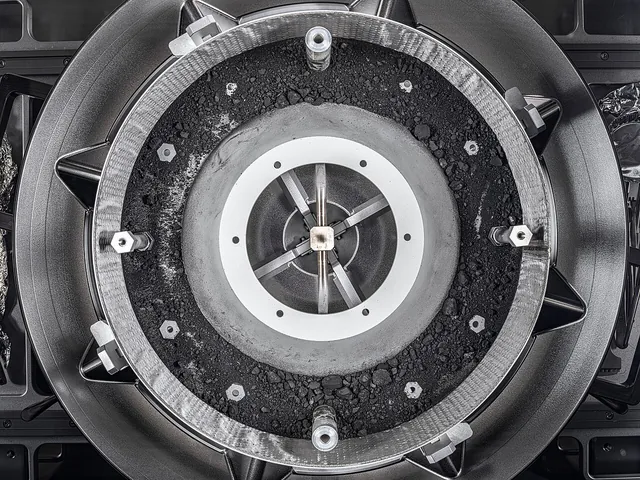
The sample is dominated by clay minerals, especially serpentine, formed when water reacted with rock, along with carbonates, iron oxides and iron sulphides. It is rich in carbon and nitrogen and contains water-soluble phosphates, a surprise because they had not been seen from orbit. The rocks resemble the carbon-rich meteorites that fall to Earth, but without contamination from our planet.2516
In 2025 two studies reported 14 of the 20 amino acids that life uses to build proteins, all five nucleobases found in DNA and RNA, formaldehyde, exceptionally abundant ammonia and about 10,000 nitrogen-bearing compounds. The amino acids come in equal left- and right-handed forms, unlike those made by life on Earth. The ammonia points to ices from the cold outer Solar System.67
The second study found 11 salt minerals, including calcite, halite, sylvite and trona, left behind as salty water evaporated on Bennu’s parent body; trona had never been found in an extraterrestrial sample. These salts break down in Earth’s air, so only a returned sample could reveal them. Similar brines probably exist inside Ceres and Enceladus today.68
Where Bennu came from
Bennu’s rocks formed nearly 4.6 billion years ago on a larger world that was later destroyed by a giant collision. Scientists think a carbon-rich asteroid 100 to 200 km across broke apart, and Bennu gathered from a small part of the rubble, probably in the main asteroid belt between Mars and Jupiter. NASA puts that event between about 0.7 and 2 billion years ago.12
Since then Bennu has drifted into near-Earth space, nudged by the gravity of the giant planets and by the Yarkovsky effect, the tiny thrust a spinning body gets from absorbing sunlight and giving it off again as heat. The salts and clays in the sample show that its parent body once held liquid water, and its ammonia that it formed from or gathered ices from the outer Solar System.278
Named features
Benben Saxum
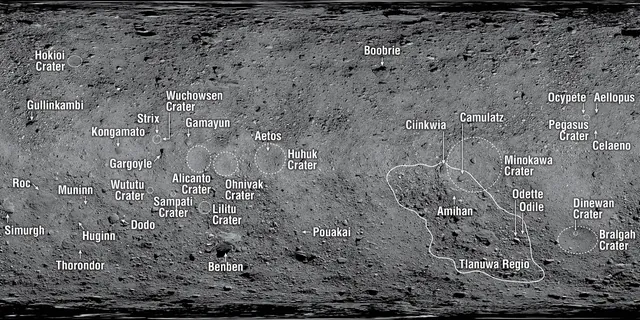
A boulder 52 m across in Bennu’s southern hemisphere, at about 46° south. It is named after the primordial mound of Egyptian myth that rose from the waters of Nu, on which the god Atum settled after flying over the waters as the Bennu bird.15
Roc Saxum
At 96 m across in the Gazetteer of Planetary Nomenclature, Roc Saxum is the largest named boulder on Bennu, lying south of the equator. It takes its name from the enormous bird of prey of Arabic mythology. Boulders like this helped show that Bennu is a pile of rubble rather than one solid rock.315
Minokawa
The largest named crater on Bennu, 181 m wide and sitting almost on the equator. It is named after a massive bird of Bagobo myth from Mindanao in the Philippines, said to live beyond the eastern horizon and to cause eclipses of the Moon.15
Tlanuwa Regio
At 301 m across, this region in the southern hemisphere is the largest named feature on Bennu. Its name comes from the giant birds of Cherokee tradition, from the south-east of the United States, that scattered the Earth with pieces of a serpent, which turned into standing pillars of rock.15
Simurgh Saxum
A boulder about 40 m across, at 25° south, that defines zero degrees longitude on Bennu, the starting point of its map grid. It is named after the benevolent bird of Iranian myth said to possess all knowledge.15
OSIRIS-REx and its sample
OSIRIS-REx launched on 8 September 2016 and began operations at Bennu on 3 December 2018. When it entered orbit, Bennu became the smallest object ever orbited by a spacecraft. After a year of mapping, the team chose a sample site called Nightingale, in a young crater 140 m wide in the northern hemisphere, where freshly exposed material promised a pristine sample.5
On 20 October 2020 the spacecraft briefly touched Nightingale with its sampling head. The surface proved so loosely packed that a person stepping onto it would feel very little resistance, like stepping into a pit of plastic play balls; had OSIRIS-REx not fired its thrusters to back away at once, it would have sunk in. The event blasted out a crater 9 m long and threw rocks and dust into a plume.2513
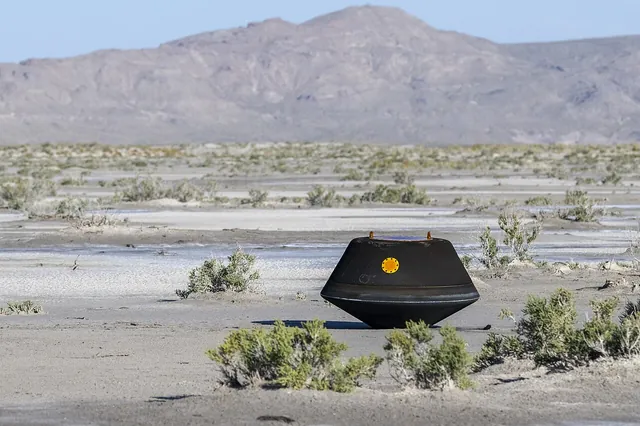
OSIRIS-REx left Bennu on 10 May 2021, and on 24 September 2023 its capsule parachuted into the Utah Test and Training Range. It held 121.6 g of rock and dust, more than twice the mission’s requirement. Grains have gone to laboratories worldwide, including a share for Japan’s JAXA, while the spacecraft, renamed OSIRIS-APEX, is heading for the asteroid Apophis.15
OSIRIS-APEX flew past Earth on 23 September 2025 at 3,438 km. It will study how Apophis changes after the asteroid passes within 32,000 km of Earth’s surface in April 2029, and will dip towards Apophis and fire its engines to kick up loose rocks and dust, revealing the material just below its surface.18
Quick answers
- How massive is Bennu?
- Bennu has a mass of about 7.3 × 10¹⁰ kg (about 73 million tonnes; worked out from its measured gravity (GM = 4.89 m³/s²)).4
- How dense is Bennu?
- Bennu has a mean density of 1.19 g/cm³ (low for rock: Bennu is porous rubble).3410
- How long is a day on Bennu?
- A day on Bennu lasts 4.30 hours (4.296 hours, and slowly speeding up).411
- How far is Bennu from the Sun?
- Bennu is 1.13 au from the Sun (average, about 168 million km; between 0.90 and 1.36 au).24
- What is the temperature on Bennu?
- The temperature on Bennu is up to about 116 °C (on the sunlit surface).2
- When was Bennu discovered?
- Bennu was discovered on 11 September 1999, by the Lincoln Near-Earth Asteroid Research (LINEAR) team at Socorro.4
Sources
- Bennu — NASA Science
- Bennu: Facts — NASA Science
- Shape of (101955) Bennu indicative of a rubble pile with internal stiffness (Barnouin et al.) — Nature Geoscience, 2019
- Small-Body Database: 101955 Bennu (1999 RQ36) — NASA/JPL Solar System Dynamics
- OSIRIS-REx — NASA Science
- NASA’s Asteroid Bennu Sample Reveals Mix of Life’s Ingredients — NASA, 2025
- Abundant ammonia and nitrogen-rich soluble organic matter in samples from asteroid (101955) Bennu (Glavin et al.) — Nature Astronomy, 2025
- An evaporite sequence from ancient brine recorded in Bennu samples (McCoy et al.) — Nature, 2025
- NASA Spacecraft Provides Insight Into Asteroid Bennu’s Future Orbit — NASA Jet Propulsion Laboratory, 2021
- Hemispherical differences in the shape and topography of asteroid (101955) Bennu (Daly et al.) — Science Advances, 2020
- The operational environment and rotational acceleration of asteroid (101955) Bennu from OSIRIS-REx observations (Hergenrother et al.) — Nature Communications, 2019
- Near-zero cohesion and loose packing of Bennu’s near subsurface revealed by spacecraft contact (Walsh et al.) — Science Advances, 2022
- Spacecraft sample collection and subsurface excavation of asteroid (101955) Bennu (Lauretta et al.) — Science, 2022
- Sentry: Earth Impact Monitoring, 101955 Bennu (1999 RQ36) — NASA/JPL Center for Near Earth Object Studies, 2026
- Gazetteer of Planetary Nomenclature: Bennu — IAU Working Group for Planetary System Nomenclature / USGS
- The unexpected surface of asteroid (101955) Bennu (Lauretta et al.) — Nature, 2019
- Episodes of particle ejection from the surface of the active asteroid (101955) Bennu (Lauretta et al.) — Science, 2019
- OSIRIS-APEX — NASA Science
Figures checked against these sources in November 2026. Where a quantity is not known, it is left out rather than estimated.

