asteroid
Ryugu
Ryugu is a dark, carbon-rich near-Earth asteroid about 900 m across, shaped like a spinning top with a prominent ridge around its equator. Discovered by the LINEAR survey in 1999, it was explored by Japan’s Hayabusa2, which arrived in June 2018, sent small rovers and a lander onto its boulder-covered surface, blasted out an artificial crater and touched down twice to collect samples.123456
On 6 December 2020 Hayabusa2’s capsule was recovered in the South Australian desert with 5.4 g of Ryugu, far more than the 0.1 g the mission aimed for. The grains are some of the most pristine material ever studied: they closely match the rare CI meteorites and the chemistry of the Sun itself, and are rich in water-bearing clays, carbonates and organic molecules, including amino acids and uracil.3789101112
Size, shape and structure
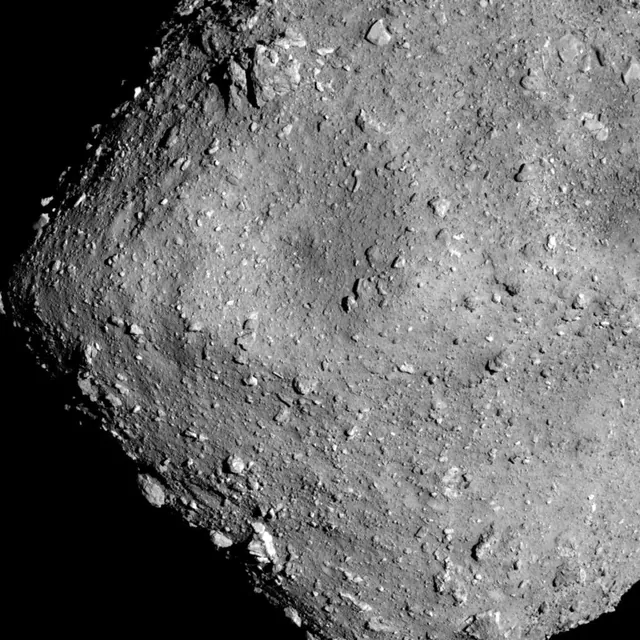
Ryugu is about 1,004 m across and 876 m tall, an oblate spinning top with a prominent circular ridge around its equator. Its mass, measured by Hayabusa2, gives a density of only 1.19 g/cm³, which means that more than half of its interior is empty space. Large boulders across the whole surface show that it is a rubble pile.12
The slopes of Ryugu’s surface suggest that its shape was produced when it once spun about twice as fast as it does today. Together with the uniform make-up of its surface, this led the Hayabusa2 team to conclude that Ryugu was reshaped by centrifugal forces during a period of rapid rotation.1
Orbit and rotation
Ryugu orbits the Sun every 475 days at an average distance of 1.19 au, on a path that ranges from 0.96 au, just inside Earth’s orbit, out to 1.42 au. Its orbit is tilted 5.9° to Earth’s. It turns on its axis once every 7.63 hours.2
Ryugu may not always have kept its distance from the Sun. Hayabusa2 found that its surface is redder at some latitudes, and the craters show that this reddening happened over a short time. The team suggests that Ryugu once made an excursion close to the Sun, where solar heating or space weathering reddened the exposed surface.14
Discovery and naming
Ryugu was discovered on 10 May 1999 by the Lincoln Near-Earth Asteroid Research (LINEAR) team at Socorro and designated 1999 JU3. Its name is that of the undersea palace of the Dragon God in a Japanese legend, in which a fisherman is rewarded with a visit to the palace and brings back a box holding a secret, an apt image for a spacecraft returning a capsule of samples.215
The theme carries on across the surface: Ryugu’s craters, boulders and grooves are named after characters and places in fairy tales from around the world, many of them from the legend of the fisherman Urashima Taro and his journey to the palace.15
Surface
Ryugu is among the darkest known bodies in the Solar System, with an albedo of just 0.045. Boulders are abundant across the entire surface, and impact craters, a ridge around the equator and differences between its eastern and western sides mark its geology. Its colour is fairly uniform over the whole asteroid.213
The MASCOT lander, which reached the surface on 3 October 2018, found it covered with rocks from decimetres to metres across and no deposits of fine dust. Some rocks are bright with smooth faces and sharp edges; others are dark with a crumbly, cauliflower-like surface, and close up show small bright inclusions like those in carbon-rich meteorites.6
From orbit, Hayabusa2’s infrared spectrometer detected a weak absorption at 2.72 micrometres everywhere it looked, showing that minerals containing hydroxyl, chemically bound water, are present all over the surface. The uniformity suggests Ryugu was assembled from fragments of a single parent body that had been altered by water.16
What the samples revealed
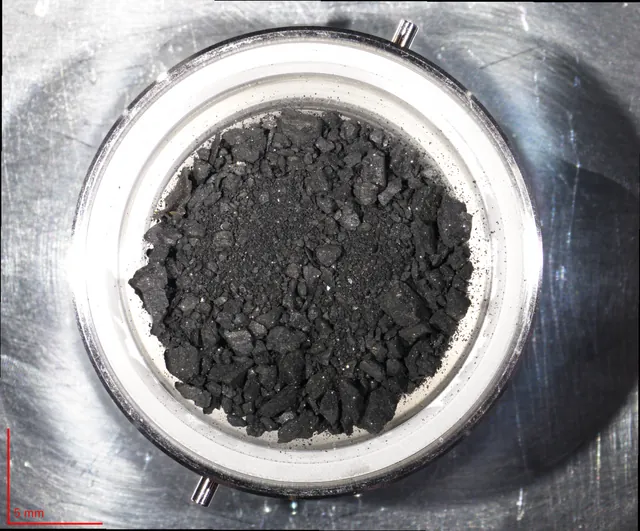
Laboratory studies show that Ryugu is made mostly of minerals formed in water on its parent body, rich in clays and carbonates, and closely resembles the CI or Ivuna-type meteorites. Its chemical make-up matches the Sun’s visible surface more closely than any other natural sample. The minerals formed in fluids at about 37 °C, and the rock was probably never heated above about 100 °C afterwards.910
One crystal contains tiny pockets of water with dissolved carbon dioxide, showing that Ryugu’s parent asteroid formed in the cold outer Solar System, probably about 2 million years after the first solids. The grains also hold amino acids, amines, carboxylic acids and other organic molecules made without life, as well as uracil, one of the four nucleobases in RNA, and niacin, a B vitamin.101112
Named features
Ryujin Dorsum
The ridge that runs right around Ryugu’s equator, 3.2 km long in the Gazetteer of Planetary Nomenclature. It is named after Ryujin, the dragon god who rules the sea in Japanese tales and is master of the undersea Ryugu Palace. The Hayabusa2 team chose a sample collection site on this ridge.115
Otohime Saxum
A boulder 160 m across near Ryugu’s south pole, at about 70° south. It is named after the princess Otohime, who welcomed the fisherman Urashima Taro to the undersea palace and gave him a jewel box whose lid he was told never to open.15
Urashima
At 290 m across, the largest named crater on Ryugu, lying just south of the equator. It is named after Urashima Taro, the fisherman of the Japanese fairy tale who rescued a turtle and rode on its back to the Dragon God’s palace.15
Tokoyo Fossa
A groove 560 m long in Ryugu’s southern hemisphere, the longest named feature after the equatorial ridge. Tokoyo is the eternal, timeless land across or beneath the sea in Japanese mythology, where Princess Otohime lives in the story of Urashima.15
Catafo Saxum
A boulder about 50 m across near the equator that defines zero degrees longitude on Ryugu. It is named after a clever boy in a Cajun fairy tale from the southern United States who marked a trail through the woods with corn meal to find his way home.15
The Hayabusa2 mission
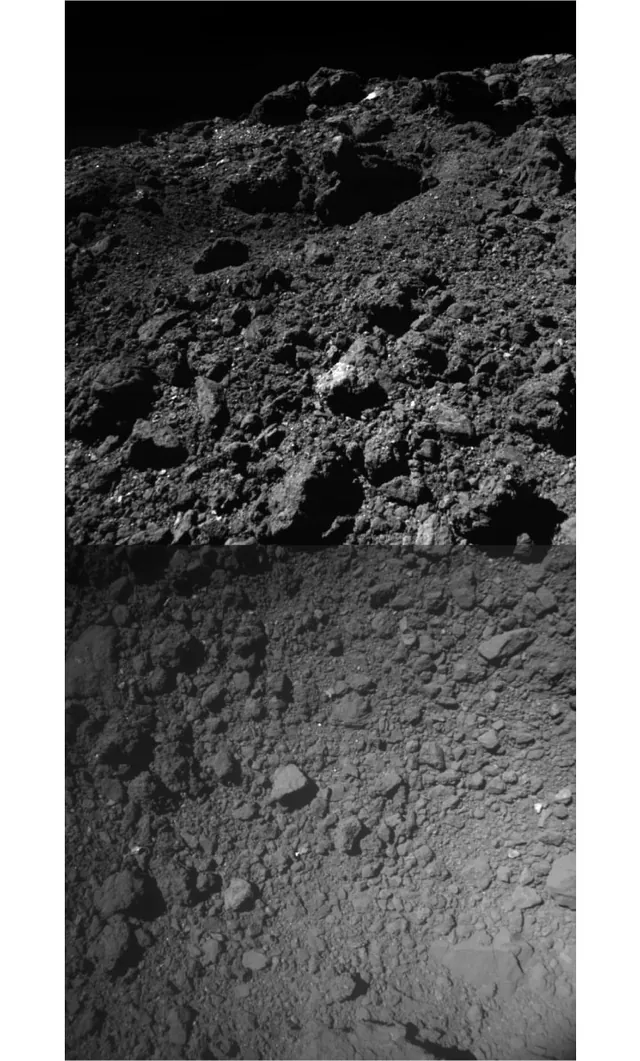
Hayabusa2 launched on 3 December 2014 and reached Ryugu on 27 June 2018, holding station about 20 km away. On 21 September it released the MINERVA-II1 rovers, which landed and hopped across the surface taking pictures, and on 3 October the MASCOT lander touched down and photographed the rocks around it.3456
On 22 February 2019 Japan time Hayabusa2 made its first touchdown, firing a projectile to collect surface material; its thrusters stirred up dark, fine grains. On 5 April it fired the Small Carry-on Impactor, which blasted out the first artificial crater on an asteroid, more than 10 m wide. Crater growth was limited by Ryugu’s weak gravity, not by the strength of its surface.314171819
On 11 July 2019 the spacecraft touched down a second time near the new crater, where ejecta dug from below lay on the surface. It left Ryugu on 13 November 2019, released its capsule on 5 December 2020, and the capsule was recovered at Woomera in South Australia on 6 December. Hayabusa2 continues on an extended mission: on 5 July 2026 it flew 744 m from the centre of the asteroid Torifune, and it is due to reach 1998 KY26 in 2031.37820212223
Quick answers
- How big is Ryugu?
- Ryugu has a mean radius of 448 m (mean diameter 896 m).2
- How massive is Ryugu?
- Ryugu has a mass of about 4.5 × 10¹¹ kg (about 450 million tonnes; worked out from its measured gravity (GM = 30.0 m³/s²)).2
- How dense is Ryugu?
- Ryugu has a mean density of 1.19 g/cm³ (more than half of the interior is empty space).12
- How long is a day on Ryugu?
- A day on Ryugu lasts 7.63 hours.2
- How long is a year on Ryugu?
- A year on Ryugu lasts 1.30 Earth years (475 days).2
- How far is Ryugu from the Sun?
- Ryugu is 1.19 au from the Sun (average, about 178 million km; between 0.96 and 1.42 au).2
- When was Ryugu discovered?
- Ryugu was discovered on 10 May 1999, by the Lincoln Near-Earth Asteroid Research (LINEAR) team at Socorro.2
Sources
- Hayabusa2 arrives at the carbonaceous asteroid 162173 Ryugu: a spinning top-shaped rubble pile (Watanabe et al.) — Science, 2019
- Small-Body Database: 162173 Ryugu (1999 JU3) — NASA/JPL Solar System Dynamics
- Asteroid Explorer Hayabusa2 — JAXA
- Hayabusa2 Rendezvous with Ryugu — JAXA, 2018
- MINERVA-II1 of Hayabusa2 Touches Down Ryugu — JAXA, 2018
- Images from the surface of asteroid Ryugu show rocks similar to carbonaceous chondrite meteorites (Jaumann et al.) — Science, 2019
- The Results of Hayabusa2 Re-entry Capsule Recovery — JAXA, 2020
- Hayabusa2 Curation — ISAS/JAXA Astromaterials Science Research Group
- Samples returned from the asteroid Ryugu are similar to Ivuna-type carbonaceous meteorites (Yokoyama et al.) — Science, 2023
- Formation and evolution of carbonaceous asteroid Ryugu: direct evidence from returned samples (Nakamura et al.) — Science, 2023
- Soluble organic molecules in samples of the carbonaceous asteroid (162173) Ryugu (Naraoka et al.) — Science, 2023
- Uracil in the carbonaceous asteroid (162173) Ryugu (Oba et al.) — Nature Communications, 2023
- The geomorphology, color, and thermal properties of Ryugu: implications for parent-body processes (Sugita et al.) — Science, 2019
- Sample collection from asteroid (162173) Ryugu by Hayabusa2: implications for surface evolution (Morota et al.) — Science, 2020
- Gazetteer of Planetary Nomenclature: Ryugu — IAU Working Group for Planetary System Nomenclature / USGS
- The surface composition of asteroid 162173 Ryugu from Hayabusa2 near-infrared spectroscopy (Kitazato et al.) — Science, 2019
- Hayabusa2 Latest Status, the Successful First Touchdown — JAXA, 2019
- Successful Operation of Asteroid Explorer Hayabusa2’s SCI — JAXA, 2019
- An artificial impact on the asteroid (162173) Ryugu formed a crater in the gravity-dominated regime (Arakawa et al.) — Science, 2020
- Success of the Second Touchdown of Asteroid Explorer Hayabusa2 — JAXA, 2019
- Pebbles and sand on asteroid (162173) Ryugu: in situ observation and particles returned to Earth (Tachibana et al.) — Science, 2022
- Hayabusa2 departs from Ryugu — JAXA, 2019
- Asteroid Explorer Hayabusa2 sets a new record for closest approach during a Solar System body flyby mission — JAXA, 2026
Figures checked against these sources in November 2026. Where a quantity is not known, it is left out rather than estimated.

