interstellar comet
3I/ATLAS
3I/ATLAS is the third object known to have entered the Solar System from interstellar space, and the second comet among them. The NASA-funded ATLAS survey telescope at Río Hurtado in Chile reported it on 1 July 2025. It travels on a strongly hyperbolic path, with an eccentricity of about 6.1, and it swept past the Sun just inside the orbit of Mars in late October 2025.12345
More than a dozen NASA missions, ESA spacecraft from Mars Express to Juice and telescopes worldwide watched it, making it one of the best-observed comets ever. Its coma is unusually rich in carbon dioxide, and its water holds about 30 times more deuterium than in Solar System comets, hinting that it formed in a very cold system perhaps 10–12 billion years ago. NASA says it behaves just as a comet should.12678
Nucleus and coma
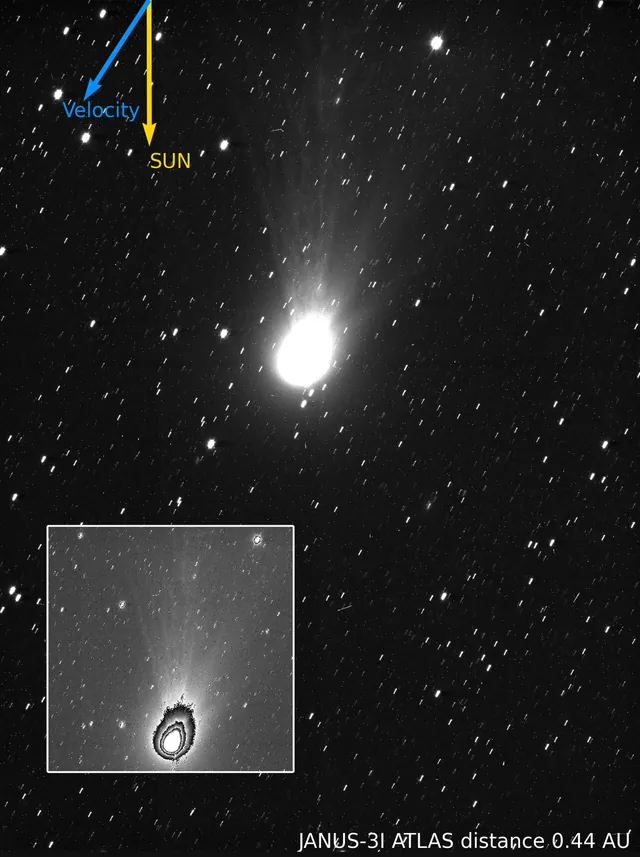
Almost as soon as it was found, telescopes showed that 3I/ATLAS was active, wrapped in a compact coma. Hubble images from 21 July 2025 revealed a teardrop-shaped cocoon of dust flowing from the Sun-warmed side of the nucleus and a weak tail pushed away by sunlight. From them, David Jewitt’s team estimated that the comet was losing roughly 12 to 120 kg of dust every second.4512
The nucleus itself is hidden. From Hubble data up to 20 August 2025, NASA put its diameter between 440 m and 5.6 km. Hubble images taken between December 2025 and January 2026 later allowed a team led by Man-To Hui to separate the nucleus from the coma, giving an effective radius of 1.3 ± 0.2 km, if it is as dark as typical comets.159
Its colour is reddish, with a spectral slope like those of the other interstellar objects and of primitive Solar System bodies such as comets and D-type asteroids. After perihelion it faded faster than it had brightened on the way in, which Hui’s team describes as not unusual for Solar System comets.49
- Nucleus diameter
- 440 m – 5.6 km1NASA range from Hubble data to 20 August 2025
- Effective radius
- 1.3 ± 0.2 km9Hubble, December 2025 – January 2026; assumes albedo 0.04
- Dust loss
- about 12–120 kg/s12July 2025, 3.8 au from the Sun
- Water loss
- about 2,000 kg/s13measured by Juice on 2 November 2025
- Spectral slope
- 17.1 ± 0.2% per 100 nm4reddish
Path through the Solar System
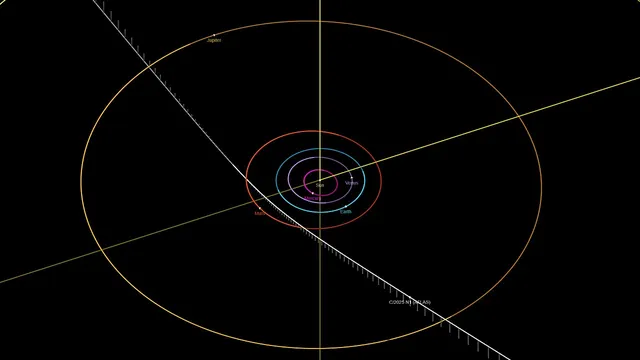
3I/ATLAS approached from the general direction of Sagittarius, towards the centre of the Milky Way. When it was found it was about 670 million km from the Sun, inside Jupiter’s orbit, travelling at about 221,000 km/h. Its orbital inclination of 175° means it moved almost in the plane of the planets, but in the opposite direction to them.134
It reached perihelion on 29 October 2025 at 1.35 au, about 202 million km, just inside the orbit of Mars, moving at about 246,000 km/h. Earth was then on the far side of the Sun, and the comet came no closer to us than 1.8 au, about 270 million km, on 19 December 2025. Earlier, on 3 October, it had passed about 29 million km from Mars.1235
Its eccentricity of about 6.1 makes its path only gently bent, and far from the Sun its speed is about 58 km/s. Outgassing nudged its course, but NASA reports the changes were small and compatible with ordinary comet activity. NASA expected it to pass Jupiter in March 2026 on its way out of the Solar System, which it leaves at the same speed it arrived.1345
Discovery and naming
The ATLAS (Asteroid Terrestrial-impact Last Alert System) telescope at Río Hurtado in Chile, part of NASA’s planetary defence network, reported the object to the Minor Planet Center on 1 July 2025. Its unusual trajectory immediately suggested an interstellar origin, which astronomers worldwide soon confirmed. Searches of older data found it in images from three ATLAS telescopes and the Zwicky Transient Facility back to 14 June 2025, and in NASA TESS images from May.1256
The name follows the International Astronomical Union’s scheme: 3 because it is the third interstellar object, I for interstellar, and ATLAS for the survey that found it. As a comet it also carries the designation C/2025 N1 (ATLAS), in which C marks a non-periodic comet, 2025 the year and N1 the first comet discovered in July.12
- Earliest known images
- May 20256found afterwards in TESS data
What it is made of
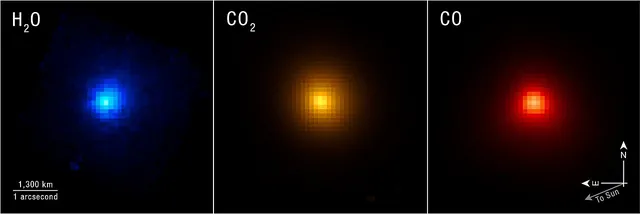
Webb’s first look, in August 2025 at 3.32 au from the Sun, found a coma dominated by carbon dioxide, with water, carbon monoxide, carbonyl sulphide, water ice and dust. Its ratio of carbon dioxide to water, 7.6, is among the highest ever measured in a comet. The team suggested ices exposed to more radiation than Solar System comets, or formation near the carbon dioxide ice line of its parent disc.27
In December 2025, after perihelion, Webb’s mid-infrared instrument detected methane for the first time on an interstellar visitor, apparently released once solar heat reached ices buried below the surface. Webb’s near-infrared spectrograph found water about 30 times richer in deuterium than in Solar System comets and unusually little carbon-13. Together these point to formation below about 30 K, in a metal-poor environment early in the galaxy’s history.81011
Comparing its carbon isotopes with models of how the galaxy’s chemistry changed over time, Martin Cordiner’s team estimates that 3I/ATLAS formed 10 to 12 billion years ago, making it probably older than the Sun. Juice’s instruments measured about 2,000 kg of water vapour a second leaving it on 2 November 2025, on the high side but not exceptional for a comet near the Sun.81113
- Carbon dioxide to water ratio
- 7.6 ± 0.37August 2025, 3.32 au from the Sun
- Deuterium to hydrogen in water
- 0.95 ± 0.06%11more than ten times that of known comets
- Carbon-12 to carbon-13
- 141–191 in CO₂, 123–172 in CO11
- Methane
- detected10Webb, 15–16 and 27 December 2025
- Formation temperature
- below about 30 K11
A campaign across the Solar System
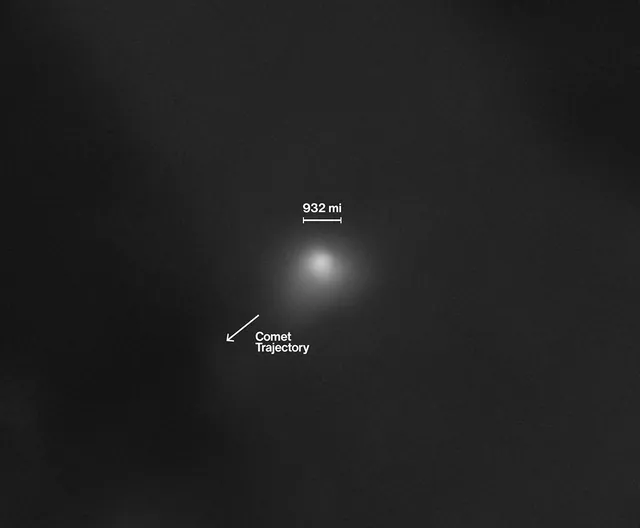
Hubble observed 3I/ATLAS within weeks of discovery and again on 30 November 2025, when it was about 286 million km from Earth. Around its closest approach to Mars in early October 2025, NASA’s Mars Reconnaissance Orbiter imaged its coma with the HiRISE camera from about 30 million km, MAVEN mapped hydrogen around it in ultraviolet light and the Perseverance rover caught it as a faint smudge. ESA’s Mars Express and ExoMars Trace Gas Orbiter observed it too.251415
While the comet was too close to the Sun to see from Earth, spacecraft elsewhere took over. Parker Solar Probe, PUNCH, STEREO, SOHO, Psyche, Lucy and Europa Clipper all recorded it, and ESA’s Juice, about 60 million km away in November 2025, imaged a coma and two tails. TESS, SPHEREx and the X-ray observatories XRISM and XMM-Newton followed; it is the first interstellar comet seen in X-rays.25613
By November 2026 the comet is on its way back into interstellar space, never to return. NASA expected it to pass Jupiter in March 2026, and JPL’s latest orbit, computed on 21 October 2026, includes observations up to 16 October 2026. The data from more than a dozen NASA missions are being kept in public archives, and Juice’s instrument teams planned to publish their results during 2026.35613
Quick answers
- How big is 3I/ATLAS?
- 3I/ATLAS has a mean radius of about 1.3 km (Hubble, December 2025 – January 2026, if as dark as a typical comet; NASA’s earlier range for the diameter was 0.44–5.6 km).19
- How far is 3I/ATLAS from the Sun at perihelion?
- 3I/ATLAS is 1.35 au from the Sun at perihelion (about 202 million km, on 29 October 2025).23
- When was 3I/ATLAS discovered?
- 3I/ATLAS was discovered on 1 July 2025, by the ATLAS survey telescope at Río Hurtado, Chile.12
Sources
- 3I/ATLAS Facts and FAQs — NASA Science, 2026
- Comet 3I/ATLAS – frequently asked questions — ESA, 2026
- Small-Body Database Lookup: 3I/ATLAS (C/2025 N1) — NASA/JPL Solar System Dynamics, 2026
- Discovery and Preliminary Characterization of a Third Interstellar Object: 3I/ATLAS — arXiv (Seligman et al.), 2025
- Comet 3I/ATLAS — NASA Science, 2026
- How Open NASA Data on Comet 3I/ATLAS Will Power Tomorrow’s Discoveries — NASA Science, 2026
- JWST detection of a carbon dioxide dominated gas coma surrounding interstellar object 3I/ATLAS — arXiv (Cordiner et al.), 2025
- NASA’s Webb Finds Clues to Ancient, Distant Origin of Comet 3I/ATLAS — NASA Science, 2026
- Nucleus and Postperihelion Activity of Interstellar Object 3I/ATLAS Observed by Hubble Space Telescope — arXiv (Hui et al.), 2026
- NASA’s Webb Detects Methane on Interstellar Comet 3I/ATLAS — NASA Science, 2026
- Isotopic Evidence for a Cold and Distant Origin of the Interstellar Object 3I/ATLAS — arXiv (Cordiner et al.), 2026
- Hubble Space Telescope Observations of the Interstellar Interloper 3I/ATLAS — arXiv (Jewitt et al.), 2025
- Five things Juice has revealed about Comet 3I/ATLAS — ESA, 2026
- NASA’s Hubble Space Telescope Revisits Interstellar Comet — NASA Science, 2025
- NASA’s Mars Spacecraft Capture Images of Comet 3I/ATLAS — NASA, 2025
Figures checked against these sources in November 2026. Where a quantity is not known, it is left out rather than estimated.

