interstellar comet
Borisov
2I/Borisov was the first comet known to have come from another star system, and only the second interstellar object ever found. Gennady Borisov, an amateur astronomer in Crimea, discovered it with his home-made telescope on 30 August 2019. Unlike the bare-looking ʻOumuamua, it had a fuzzy coma and a tail, and it looked strikingly like an ordinary comet from our own Solar System.1234
Hubble showed that its icy nucleus is less than a kilometre across, hidden inside the coma. Borisov passed closest to the Sun in December 2019, about twice as far out as Earth, on a hyperbolic path with an eccentricity of 3.36. Its gas held far more carbon monoxide than comets usually release so close to the Sun, a clue that it formed somewhere very cold around another star.5678910
Nucleus and coma
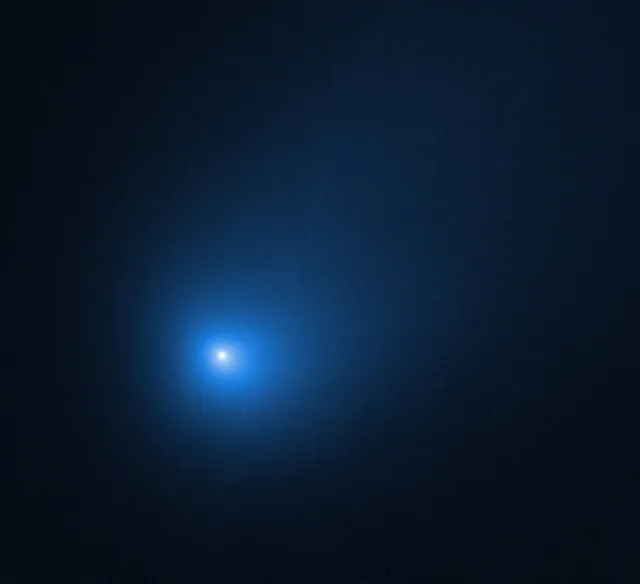
Like any active comet, Borisov hid its nucleus inside a cloud of dust and gas, the coma. Early ground-based estimates put the nucleus at about 1 km in radius. Hubble images from late 2019 set an upper limit of 0.5 km by modelling how the coma’s brightness falls away from the centre, more than 15 times smaller than some earlier estimates, according to the Hubble team’s leader, David Jewitt.156
A lower limit comes from the comet’s motion. Gas jetting from the surface nudged it off a purely gravitational path, and the size of that nudge implies a radius above 0.2 km, assuming a typical comet density of 500 kg/m³. The coma itself was dominated by fairly large dust grains, about 0.1 mm across, thrown off unevenly. NASA describes the nucleus as a loose agglomeration of ice and dust.25
In March 2020, after an outburst was seen as the comet receded 2.8 au from the Sun, Hubble images showed a short-lived second condensation beside the nucleus on 30 March; it was absent on 28 March and gone by 3 April. Jewitt’s team traced it to large boulders breaking up after being thrown off the nucleus. The lost mass was a negligible fraction of the whole, and Borisov survived largely intact.212
- Nucleus radius
- 0.2–0.5 km5Hubble limits, assuming albedo 0.04 and density 500 kg/m³
- Largest possible size
- about 975 m across2NASA’s figure, consistent with the upper limit
- Typical dust grain
- about 0.1 mm5
- Colour index g′−r′
- 0.66 ± 0.011
- Dust thrown off in the 2020 outburst
- about 2 × 10⁷ kg12about one ten-thousandth of the nucleus
- Fragment seen
- 30 March 202012gone by 3 April
Path through the Solar System
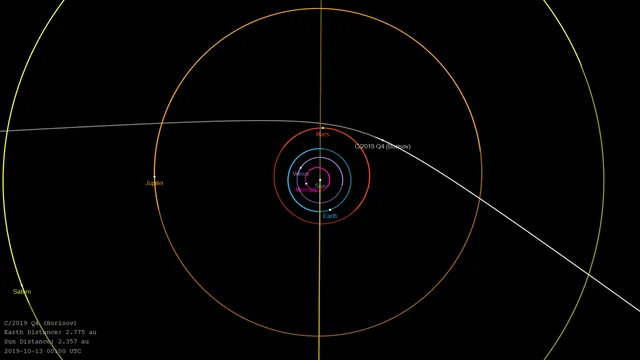
Borisov’s orbit has an eccentricity of 3.36, so its path through the Solar System was only gently curved. It came in at 44° to the plane of Earth’s orbit, reached perihelion on 8 December 2019 at 2.01 au from the Sun, near the inner edge of the asteroid belt, and made its closest approach to Earth in late December 2019, at about 290 million km.68
Far from the Sun its speed is about 32 km/s. In late 2019 Hubble saw it moving at about 175,000 to 177,000 km/h, among the fastest comets ever seen. The Sun’s gravity bent its path slightly but could not capture it, and NASA expected it to pass Jupiter’s distance by mid-2020 on its way back into interstellar space.12678
Discovery and naming
Gennady Borisov, a Crimean amateur astronomer, spotted the comet with his home-made telescope on 30 August 2019, moving in an unusual direction. Within about a week, observations by amateurs and professionals worldwide allowed the Minor Planet Center and NASA’s Center for Near-Earth Object Studies to compute its path and confirm that it had come from interstellar space.137
First catalogued as comet C/2019 Q4 (Borisov), it was then given the interstellar designation 2I/Borisov, the second object in the class begun by ʻOumuamua in 2017. It was the first confirmed interstellar comet: an icy body that grew a coma and tail as the Sun warmed it, where ʻOumuamua looked like a bare rock.2457
- Interstellar origin confirmed
- about a week after discovery7
A carbon monoxide-rich comet
Hubble’s Cosmic Origins Spectrograph examined Borisov four times between 11 December 2019 and 13 January 2020. Combined with water measurements by NASA’s Swift satellite, its data showed the coma holding more carbon monoxide than water vapour, more than three times the proportion measured in any comet in the inner Solar System. The amount did not drop as the comet moved away from the Sun.911
Radio observations with the ALMA array in Chile on 15–16 December 2019 told the same story: carbon monoxide at 35–105 per cent of the water, among the highest levels ever seen in a comet within 2 au of the Sun, while hydrogen cyanide was at ordinary levels. Carbon monoxide freezes only where it is extremely cold, so Borisov probably formed in the outer reaches of its parent star’s planet-forming disc.310
Which star that was is unknown. The Hubble team suggested a carbon-rich disc around a cool red dwarf, the commonest kind of star in the Milky Way, though other kinds of star are possible. Another idea is that Borisov is a carbon monoxide-rich fragment of a small planet.39
- Carbon monoxide relative to water (Hubble and Swift)
- at least 173%11NASA’s release says at least 50% more carbon monoxide than water
- Carbon monoxide relative to water (ALMA)
- 35–105%1015–16 December 2019
- Hydrogen cyanide relative to water
- 0.06–0.16%10typical of Solar System comets
- Carbon monoxide production
- 4.4 × 10²⁶ molecules per second10
Observing Borisov
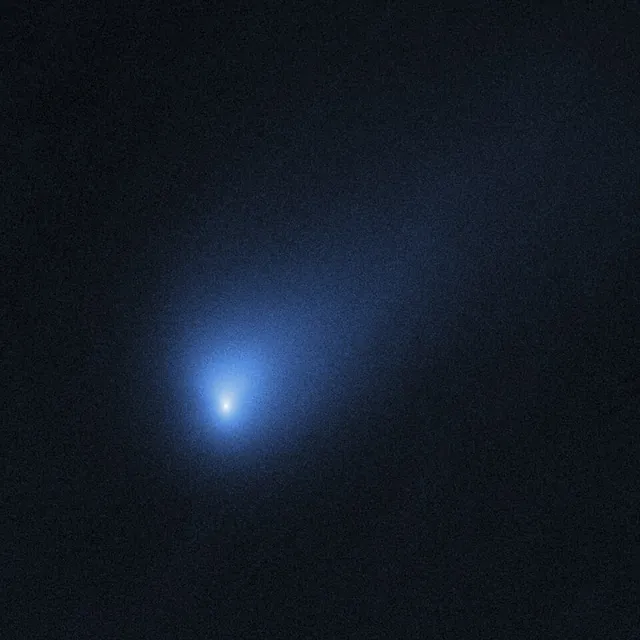
Borisov was found more than three months before perihelion, so it could be studied far more thoroughly than ʻOumuamua. Hubble photographed it on 12 October 2019, about 420 million km from Earth, giving the sharpest view yet of the dust around its nucleus, and again in November and December 2019, once with a distant spiral galaxy in the background.4678
Ground-based telescopes including the William Herschel Telescope, Gemini North and ALMA also studied it. Hubble kept watching into 2020 and caught the outburst and short-lived fragment in March. JPL’s orbit uses observations from 24 February 2019, months before discovery, to 30 September 2020, after which Borisov faded on its way out of the Solar System, never to return.1281012
- Observations used in JPL’s orbit
- 24 February 2019 – 30 September 20208including images found after discovery
Quick answers
- How big is Borisov?
- Borisov has a mean radius of 0.2–0.5 km (nucleus too small to resolve; limits from Hubble images and the comet’s non-gravitational acceleration).56
- How far is Borisov from the Sun at perihelion?
- Borisov is 2.01 au from the Sun at perihelion (about 300 million km, on 8 December 2019).8
Sources
- Initial characterization of interstellar comet 2I/Borisov — Nature Astronomy, 2020
- Comet 2I/Borisov — NASA Science, 2024
- Interstellar Comet Borisov Reveals Its Chemistry and Possible Origins — NASA Science, 2020
- Hubble Observes New Interstellar Visitor (heic1918) — ESA/Hubble, 2019
- The Nucleus of Interstellar Comet 2I/Borisov — Astrophysical Journal Letters, 2020
- Hubble Watches Interstellar Comet Borisov Speed Past the Sun (heic1922) — ESA/Hubble, 2019
- Hubble Observes First Confirmed Interstellar Comet — NASA Science, 2019
- Small-Body Database Lookup: 2I/Borisov (C/2019 Q4) — NASA/JPL Solar System Dynamics, 2024
- Hubble Probes Alien Comet’s Chemical Makeup — NASA Science, 2020
- Unusually high CO abundance of the first active interstellar comet — Nature Astronomy, 2020
- The carbon monoxide-rich interstellar comet 2I/Borisov — Nature Astronomy, 2020
- Outburst and Splitting of Interstellar Comet 2I/Borisov — Astrophysical Journal Letters, 2020
Figures checked against these sources in November 2026. Where a quantity is not known, it is left out rather than estimated.

