interstellar object
ʻOumuamua
ʻOumuamua was the first object ever seen passing through the Solar System from interstellar space. Robert Weryk spotted it on 19 October 2017 in images from the Pan-STARRS1 telescope in Hawaiʻi, more than a month after it had swung closest to the Sun. Its orbit, with an eccentricity of 1.20, is an open hyperbola: it was never bound to the Sun and is now heading back out among the stars.123
Even in the largest telescopes ʻOumuamua was only a point of light: small, reddish and with no trace of dust or gas. Its brightness swung about tenfold as it tumbled, implying an extremely elongated or flattened body a few hundred metres long. It also left slightly faster than gravity alone allows. Outgassing of hydrogen or nitrogen is among the leading natural explanations, but none is settled.456789
Shape and size
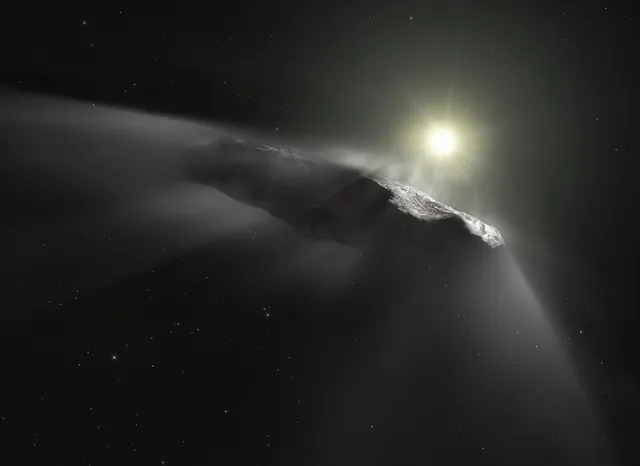
No telescope could resolve ʻOumuamua: it was only ever a point of light, so its shape has to be worked out from the way its brightness changed. Measurements with ESO’s Very Large Telescope and other large telescopes showed it varying by a factor of about ten, more than any known asteroid or comet. Read as a spinning body, that means one of its axes is many times longer than the others.34
The proportions are uncertain. The discovery team suggested a body about ten times as long as it is wide and at least 400 m long; other analyses found ratios nearer 5:1 or 6:1. A light curve cannot easily tell a cigar from a pancake, and one modelling study judged a thin disc more likely than a thin cigar. ʻOumuamua was also tumbling, so no single spin period fits it.451012
Its size depends on how reflective it is, which nobody knows. Assuming it reflects 10 per cent of sunlight, Jewitt and colleagues found an average radius of about 55 m. NASA’s Spitzer Space Telescope could not detect its heat in November 2017, which limits its effective diameter to less than 98–440 m, depending on assumptions. Its colour was reddish, similar to D-type asteroids among Jupiter’s Trojans.1011
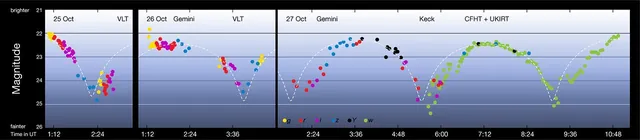
- Brightness variation
- a factor of about 104as it rotated
- Average radius
- about 55 m10assuming a geometric albedo of 0.1
- Effective diameter
- less than 98–440 m11Spitzer non-detection; range covers different thermal models
- Rotation
- 6.9–8.3 hours5range of reported periods; it was tumbling
- Best-fitting shape models
- thin disc (1:6) or thin cigar (1:8)12the disc found more probable
- Colour index B−V
- 0.70 ± 0.0610
Path through the Solar System
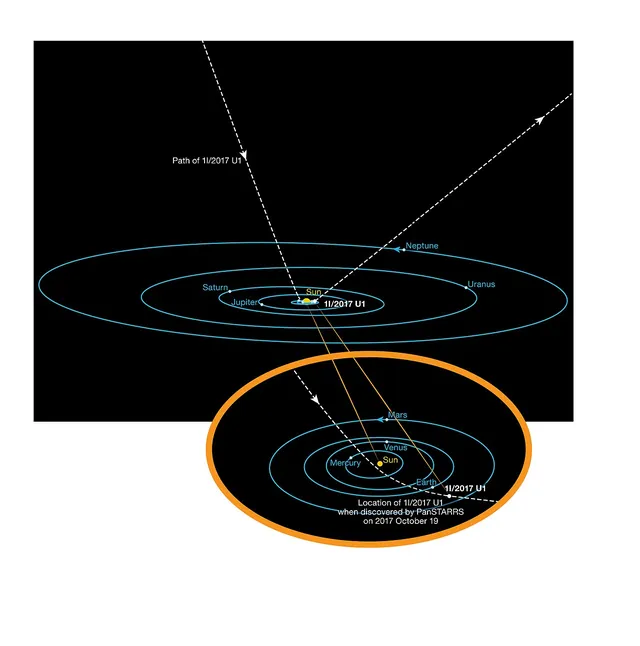
ʻOumuamua approached from far above the plane of the planets, from the direction of the constellation Lyra, so it met no planet on the way in. It crossed the plane just inside Mercury’s orbit on 2 September 2017, rounded the Sun on 9 September at 0.256 au, about 38 million km, and passed Earth on 14 October at about 24 million km, some 60 times the Moon’s distance.12
Its orbit has an eccentricity of 1.20 and a negative semi-major axis, the signature of a hyperbolic path not bound to the Sun. At perihelion it was moving at 87.3 km/s; far from the Sun its speed is about 26.4 km/s. It arrived from roughly the direction of the bright star Vega, though Vega was not in that position when ʻOumuamua passed by, and it is heading towards Pegasus.234
Discovery and naming
Pan-STARRS1, a survey telescope on Haleakalā in Hawaiʻi that searches for near-Earth objects for NASA, recorded the object on 19 October 2017. Robert Weryk of the University of Hawaiʻi’s Institute for Astronomy was the first to identify it and report it to the Minor Planet Center, then found it in the previous night’s images too. Marco Micheli’s follow-up images from ESA’s telescope on Tenerife confirmed that its motion fitted no ordinary orbit.1
Announced on 25 October 2017 as comet C/2017 U1 (PANSTARRS), then relabelled as an asteroid, A/2017 U1, it became the first member of a new class when the International Astronomical Union created the designation 1I, the I standing for interstellar. The discoverers chose the Hawaiian name ʻOumuamua, which NASA translates as “a messenger from afar arriving first”; ESO glosses it as “scout”. The opening character is an ʻokina, a Hawaiian glottal stop.134613
A puzzling push
Deep images from the Very Large Telescope and Gemini South showed no dust around ʻOumuamua, and Spitzer found no carbon monoxide or carbon dioxide. Yet when astronomers led by Marco Micheli combined positions from the Very Large Telescope and other observatories, they found it leaving the Solar System slightly faster than the Sun’s gravity predicts: a small, steady push that weakened with distance from the Sun, as it does for outgassing comets.4611
The team tested and rejected causes such as radiation pressure and the Yarkovsky effect, and favoured gas venting from the surface; which gas remains debated. Jackson and Desch proposed a fragment of nitrogen ice chipped from a Pluto-like world. Bergner and Seligman argued that pure nitrogen, hydrogen or carbon monoxide ice each meet problems, and proposed hydrogen made by cosmic rays inside water ice and released as the Sun warmed it.678
A review by an international team of experts concluded in 2019 that every observation is consistent with a purely natural origin, explained by what is known of comets, asteroids and planet formation. What ʻOumuamua is made of is still unknown: the discovery team read its colour and lack of dust as signs of a rocky body with a radiation-reddened surface, while the outgassing models need ice.4789
Observing ʻOumuamua
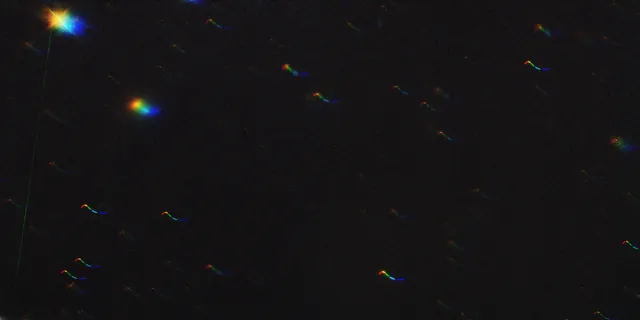
ʻOumuamua was found only after it had passed both the Sun and Earth, so astronomers had weeks rather than months. ESO’s Very Large Telescope and other large telescopes measured its brightness, colour and position, Spitzer stared at it for 30 hours on 21–22 November 2017, and Hubble followed it as it faded. The last observation used in JPL’s orbit dates from 2 January 2018.23411
NASA reported that it crossed the orbit of Mars around 1 November 2017, would pass Jupiter’s orbit in May 2018 and Saturn’s in January 2019, heading out towards Pegasus. Astronomers estimate that a similar object passes through the inner Solar System about once a year, but such bodies are faint and were missed until survey telescopes like Pan-STARRS became powerful enough.34
- Observations used in JPL’s orbit
- 14 October 2017 – 2 January 20182including images taken before the discovery was recognised
Quick answers
- How big is ʻOumuamua?
- ʻOumuamua has a mean radius of about 55 m (if it reflects 10% of sunlight; Spitzer caps the effective diameter at 98–440 m).1011
- How long is a day on ʻOumuamua?
- A day on ʻOumuamua lasts about 7–8 hours (tumbling, so no single period: estimates range from 6.9 to 8.3 hours).45
- How far is ʻOumuamua from the Sun at perihelion?
- ʻOumuamua is 0.256 au from the Sun at perihelion (about 38 million km, on 9 September 2017).12
- When was ʻOumuamua discovered?
- ʻOumuamua was discovered on 19 October 2017, by Robert Weryk, with Pan-STARRS1 on Haleakalā, Hawaiʻi.1
Sources
- Small Asteroid or Comet ‘Visits’ from Beyond the Solar System — NASA, 2017
- Small-Body Database Lookup: ʻOumuamua (A/2017 U1) — NASA/JPL Solar System Dynamics, 2018
- ʻOumuamua — NASA Science, 2025
- ESO Observations Show First Interstellar Asteroid is Like Nothing Seen Before (eso1737) — ESO, 2017
- The tumbling rotational state of 1I/ʻOumuamua — Nature Astronomy, 2018
- ESO’s VLT Sees ʻOumuamua Getting a Boost (eso1820) — ESO, 2018
- 1I/ʻOumuamua as an N₂ ice fragment of an exo-Pluto surface: I. Size and compositional constraints — Journal of Geophysical Research: Planets, 2021
- Acceleration of 1I/ʻOumuamua from radiolytically produced H₂ in H₂O ice — Nature, 2023
- The natural history of ʻOumuamua — Nature Astronomy, 2019
- Interstellar Interloper 1I/2017 U1: Observations from the NOT and WIYN Telescopes — Astrophysical Journal Letters, 2017
- Spitzer Observations of Interstellar Object 1I/ʻOumuamua — Astronomical Journal, 2018
- Modelling the light curve of ʻOumuamua: evidence for torque and disc-like shape — Monthly Notices of the Royal Astronomical Society, 2019
- MPEC 2017-U181: Comet C/2017 U1 (PANSTARRS) — Minor Planet Center, 2017
Figures checked against these sources in November 2026. Where a quantity is not known, it is left out rather than estimated.

