Kuiper Belt object
Arrokoth
Arrokoth is a small, red Kuiper belt object about 36 km long, and the most distant object ever explored up close. NASA’s New Horizons spacecraft flew past it on 1 January 2019 at a distance of about 3,500 km, three and a half years after visiting Pluto. Its images revealed a contact binary: two flattened lobes, Wenu and Weeyo, joined at a narrow neck like a partly squashed snowman.123
Found with the Hubble Space Telescope in 2014, Arrokoth has probably stayed at about the same distance from the Sun, far beyond Neptune, since the Solar System formed. Its lobes merged so gently that neither was crushed, a strong clue that planetesimals, the building blocks of planets, formed by the collapse of clouds of pebbles. Its surface holds methanol ice and red organic material. Its name means sky in the Powhatan/Algonquian language.1456
Shape and size
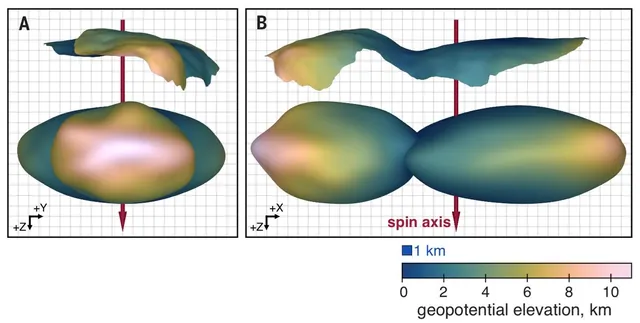
Arrokoth is a contact binary: two flattened lobes joined by a narrow neck. Measured from New Horizons images, it is about 36 km long, 20 km wide and 10 km thick. The larger lobe, Wenu, measures about 20.6 × 19.9 × 9.4 km, and the smaller, Weeyo, 15.4 × 13.8 × 9.8 km, so Wenu holds roughly twice Weeyo’s volume.1237
The far side is less certain, because only the southern half was lit during the flyby. A 2026 model that uses every resolved image finds Arrokoth thicker than first thought, about 34.5 × 19.8 × 13.8 km, with Weeyo almost spherical and Wenu clearly flattened. The mass has never been measured, but for the lobes not to fly apart as it spins, the density must be more than 0.29 g/cm³.27
Assuming a density like that of comet nuclei, about 0.5 g/cm³, gravity at the surface is only about 1 mm/s², roughly a ten-thousandth of Earth’s. New Horizons searched carefully for companions and found no moons larger than about 180 m across, and no rings or dust.12
- Overall size
- 36 × 20 × 10 km2global shape model, 2020
- Overall size, 2026 model
- 34.5 × 19.8 × 13.8 km7preprint; thickness uncertain by up to about 1 km
- Wenu, larger lobe
- 20.6 × 19.9 × 9.4 km2
- Weeyo, smaller lobe
- 15.4 × 13.8 × 9.8 km2
- Volume
- 3,210 ± 650 km³2
- Minimum density
- 0.29 g/cm³2needed to hold the lobes together
- Surface gravity
- about 1 mm/s²2for an assumed density of 0.5 g/cm³
Orbit and rotation
Arrokoth belongs to the cold classical Kuiper belt, objects on nearly circular, barely tilted orbits that the giant planets seem never to have pushed around; cold describes the orbits, not the temperature. It circles the Sun at an average of 44.1 au, between 42.5 and 45.6 au, with an orbit tilted only 2.45° to the plane of Earth’s, taking about 293 years per lap.18
Arrokoth spins once every 15.92 hours on an axis tipped about 98° to its orbit, so, like Pluto, it rotates on its side. When New Horizons arrived, Arrokoth’s south pole pointed almost directly at the Sun, leaving the northern half in winter darkness and largely unseen by the spacecraft.127
Discovery and naming
Arrokoth was found because New Horizons needed somewhere to go after Pluto. No Kuiper belt object the spacecraft could reach was known at launch, so the team searched for ten years with large ground-based telescopes and finally with a dedicated Hubble survey in the summer of 2014. New Horizons team member Marc Buie found it on 26 June 2014, and it was the best target the remaining fuel could reach.19
First designated 2014 MU69 and later numbered 486958, it was nicknamed Ultima Thule before the flyby, after a mythical island of medieval literature. In 2019 it was named Arrokoth, the Powhatan/Algonquian word for sky, with the consent of Powhatan tribal elders; institutions in the Chesapeake Bay region, the Powhatan homeland, played a prominent part in its discovery and exploration.18
Surface and colour
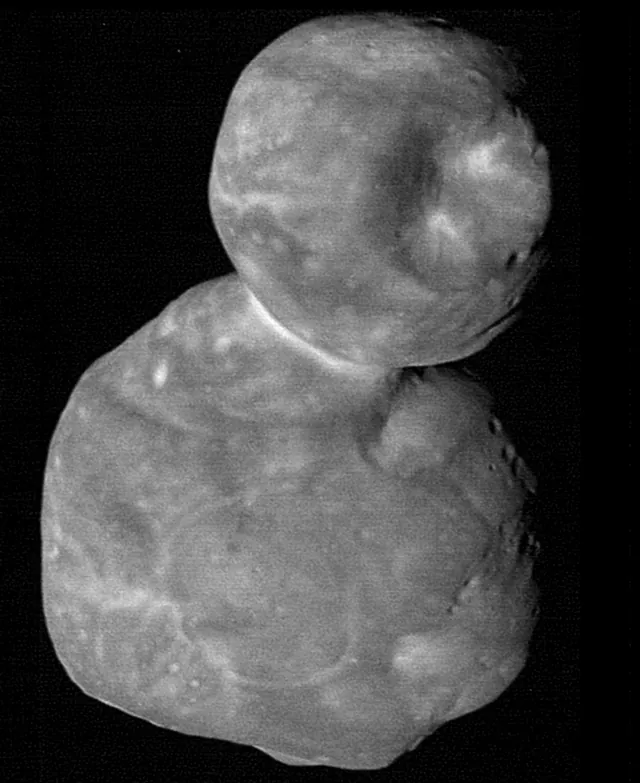
Arrokoth is very red, redder even than Pluto, and the reddest object in the outer Solar System yet visited by a spacecraft. The colour is thought to come from billions of years of ultraviolet light and cosmic rays altering the surface. Colour and spectra vary only slightly across both lobes, suggesting Arrokoth formed from a single uniform or well-mixed supply of solid material.16
The surface is generally dark, with normal reflectance ranging from about 0.18 in the darkest areas to about 0.37 in the brightest, which lie at the neck and in patches inside the crater Sky. Craters are scarce compared with many small bodies: apart from Sky, about 7 km wide, every likely impact crater is 1 km across or smaller, and parts of Wenu have almost none.12
Stereo images show topographic relief of about half a kilometre or less on each lobe. Wenu is covered in rounded mounds, many more than 5 km wide, and a bright, incomplete ring about 7.5 km across, Ka’an Arcus, cuts across its darker hills; small dark pits cluster near the line between day and night.21011
- Colour
- Very red1the reddest outer Solar System object visited so far
- Darkest surface
- reflectance 0.182normal reflectance at 0.6 micrometres
- Brightest surface
- reflectance about 0.372neck and bright patches
- Largest crater
- Sky, 6.8 km3
- Other craters
- 1 km or smaller2
- Topographic relief
- about 0.5 km or less2away from the neck
What it is made of
New Horizons’ infrared spectrometer found methanol ice mixed with organic material, which may have formed when simple molecules were exposed to radiation. It did not detect water ice, which is either missing from the surface or hidden from view. That mixture points to chemistry at the cold outer edge of the young Solar System, where ice rich in carbon monoxide gained hydrogen, or methane frozen onto water-ice grains was processed by radiation.16
Microwave emission from the winter night side gives a mean brightness temperature of 29 ± 5 K, about −244 °C. No atmosphere, gas cloud or interaction with the solar wind was detected; Arrokoth is far too small for its gravity to hold on to an atmosphere.156
How Arrokoth formed
Arrokoth is one of the clearest records of how planetesimals came together. The two lobes have their main axes aligned to within 5° and their equators almost in the same plane, suggesting they once orbited each other as a binary, lost angular momentum and drew together until they touched. Simulations show the final contact must have been very slow, with closing speeds of at most about 4 m/s.24
A faster collision would have wrecked them: in the models, oblique impacts at 5 to 10 m/s distort or slice the lobes, and typical collisions in the cold classical belt today happen at about 300 m/s. The lens-shaped lobes instead suggest that each grew gently from many smaller bodies inside a collapsing cloud of solid particles, such as the dense clumps produced by the streaming instability.4
Wenu itself seems to be built from twelve similar mounds, which may be the original building blocks that came together; why they are so alike in size is a new puzzle for theories of planet formation. Arrokoth has kept its fragile shape since then because the cold classical belt is a calm place, with few disruptive collisions.410
Named features
Wenu Lobus
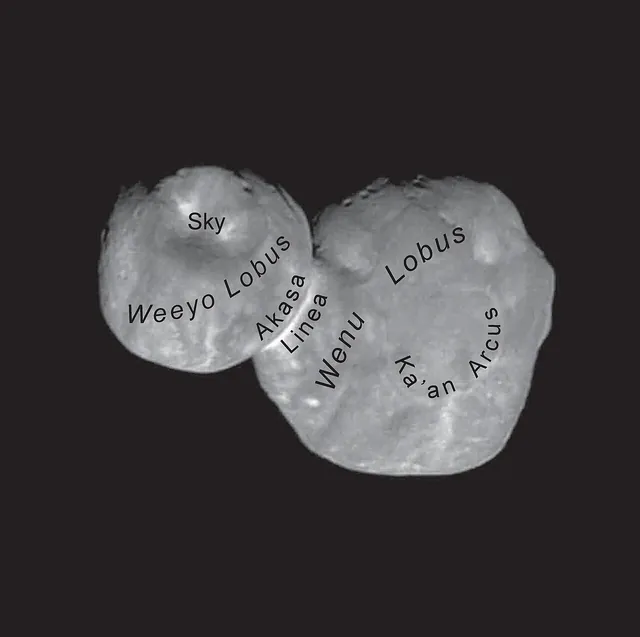
The larger lobe, 21.6 km across in the Gazetteer of Planetary Nomenclature, takes its name from the Mapuche word for sky. It is strongly flattened and appears to be built from a cluster of mounds gathered around a large central one, perhaps the original pieces from which it grew.3710
Weeyo Lobus
The smaller lobe, 15.4 km across, is named from the word for sky in the Pulaar language of western Africa. It is nearly spherical, slightly elongated with its long axis pointing at Wenu, and it touches Wenu along Wenu’s equator. Its face is dominated by the crater Sky.37
Sky
This 6.8 km depression on Weeyo, informally called Maryland before official naming, is very likely an impact crater and by far the largest on Arrokoth. Two patches of bright material lie inside it near the crater floor, fading towards the rim. Its name is the English word for sky.23
Akasa Collum
Named from the Bengali word for sky, this 9 km feature is the bright band around the neck where the two lobes meet, among the brightest terrain on Arrokoth. It was approved as Akasa Linea in September 2021 and renamed Akasa Collum on 17 December 2025.123
Ka’an Arcus
A bright, incomplete ring about 7.5 km across near the centre of Wenu’s face, named from the Yucatec Maya word for sky. Its smooth curve and sharp edges, cutting across darker hills, suggest it is not a seam between original building blocks.310
The New Horizons flyby

New Horizons, launched on 19 January 2006, flew past Pluto in July 2015 and was then retargeted for a flyby of Arrokoth on New Year’s Day 2019. To prepare, teams set up portable telescopes to watch Arrokoth pass in front of stars; on 17 July 2017 five of them recorded an outline about 30 by 20 km that already hinted at a contact binary, and the timings helped steer the spacecraft.121314
At 05:33 UT on 1 January 2019, New Horizons passed 3,538 km from Arrokoth, about 6.6 billion km from Earth. Its sharpest images, taken six and a half minutes before closest approach, show details down to about 33 m per pixel. As it sped away it looked back at a thin crescent, whose outline against the stars showed how thick the unlit side could be.1211
Analysis of the flyby continues: a shape model published as a preprint in 2026 is the first to use every resolved image of Arrokoth. New Horizons remains an active mission, travelling outward through the Kuiper belt; on 1 October 2024 it passed 60 times as far from the Sun as Earth is.713
- New Horizons launched
- 19 January 200612
- Best image resolution
- about 33 m per pixel11
- First outline from an occultation
- 17 July 201714five chords
- Mission status
- Active13
Quick answers
- How big is Arrokoth?
- Arrokoth has a mean radius of 9.2 km (volume-equivalent diameter 18.3 km).2
- How strong is gravity on Arrokoth?
- Gravity at the surface of Arrokoth is about 1 mm/s² (if its density is 0.5 g/cm³; the mass has not been measured).2
- How far is Arrokoth from the Sun?
- Arrokoth is 44.1 au from the Sun (about 6.6 billion km on average).18
- What is the temperature on Arrokoth?
- The temperature on Arrokoth is about 29 K (−244 °C), microwave brightness temperature of the winter night side.6
Sources
- Arrokoth: Facts — NASA Science
- The geology and geophysics of Kuiper Belt object (486958) Arrokoth (Spencer et al.) — Science, 2020
- Gazetteer of Planetary Nomenclature: Arrokoth — IAU Working Group for Planetary System Nomenclature / USGS, 2025
- The solar nebula origin of (486958) Arrokoth, a primordial contact binary in the Kuiper Belt (McKinnon et al.) — Science, 2020
- Initial results from the New Horizons exploration of 2014 MU69, a small Kuiper Belt object (Stern et al.) — Science, 2019
- Color, composition, and thermal environment of Kuiper Belt object (486958) Arrokoth (Grundy et al.) — Science, 2020
- The Shape of (486958) Arrokoth (Porter et al., preprint) — arXiv, 2026
- Small-Body Database Lookup: 486958 Arrokoth (2014 MU69) — NASA/JPL Solar System Dynamics
- The New Horizons Extended Mission Target: Arrokoth Search and Discovery (Buie et al.) — arXiv, 2024
- The Properties and Origin of Kuiper Belt Object Arrokoth’s Large Mounds (Stern et al.) — arXiv, 2023
- New Horizons Spacecraft Returns Its Sharpest Views of Ultima Thule — NASA, 2019
- Arrokoth (2014 MU69) — NASA Science
- New Horizons — NASA Science
- Size and shape constraints of (486958) Arrokoth from stellar occultations (Buie et al.) — The Astronomical Journal, 2020
Figures checked against these sources in November 2026. Where a quantity is not known, it is left out rather than estimated.

