asteroid
Itokawa
Itokawa is a small, peanut-shaped near-Earth asteroid only 535 m long, and the first asteroid from which samples were brought back to Earth. Japan’s Hayabusa spacecraft studied it closely from September to early December 2005 and touched down twice on a smooth patch of gravel. The science team likened its shape to a sea otter, with a smaller head and a larger body, and showed it to be a loose rubble pile.1234
Hayabusa’s mission was beset by failures: lost reaction wheels, a fuel leak, a sampling projectile that may never have fired and a rover that missed the surface. Even so, its capsule landed in Australia on 13 June 2010, and about 1,500 tiny rock grains from Itokawa were found inside. They proved that the most common meteorites on Earth, the ordinary chondrites, come from stony S-type asteroids like Itokawa.25678
Size, shape and structure
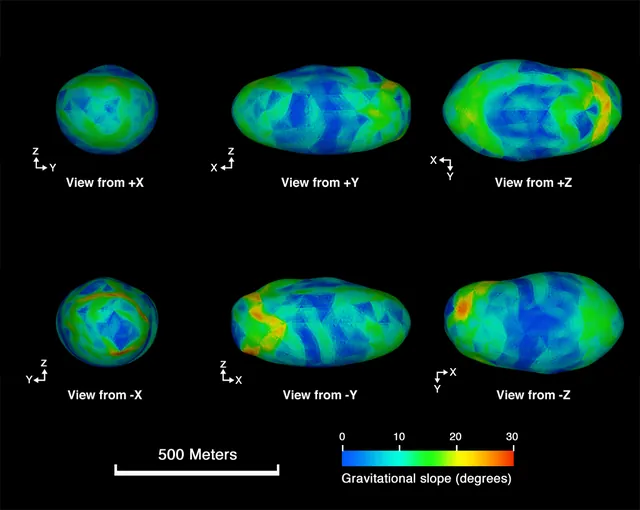
Itokawa measures 535 × 294 × 209 m and has a mass of about 35 million tonnes. Hayabusa’s team described it as a sea otter: a smaller head joined to a larger body. Its low density, about 1.9 g/cm³, means that roughly 40 per cent of its volume is empty space, much like a heap of angular sand.1211
Its low density, high porosity, boulder-covered surface and shape made Itokawa the first small asteroid shown to be a rubble pile rather than one solid rock. Very large boulders and pillars suggest that a bigger parent asteroid was shattered early on and the fragments gathered together again. The head and body may once have been two rubble piles that bumped gently together and stuck.1211
Itokawa is not uniform inside. Careful timing of its spin from 2001 to 2013 with ESO’s New Technology Telescope and other telescopes could only be explained if its two parts have different densities, from 1.75 to 2.85 g/cm³. It was the first evidence that an asteroid can have a highly varied internal structure.13
Orbit and rotation
Itokawa orbits the Sun every 556 days at an average distance of 1.32 au. Its fairly elongated orbit carries it from 0.95 au, just inside Earth’s orbit, out to 1.70 au, and is tilted only 1.6° to Earth’s. It spins once every 12.13 hours.10
Sunlight is slowly speeding up that spin. Heat radiated unevenly from its irregular surface, the YORP effect, gives Itokawa a tiny, constant twist, shortening its rotation period by about 0.045 seconds each year. The size of that change, measured over 12 years of observations, is what revealed the different densities of its head and body.13
Discovery and naming
Itokawa was discovered on 26 September 1998 by the Lincoln Near-Earth Asteroid Research (LINEAR) team at Socorro, New Mexico, and designated 1998 SF36. It is named after Hideo Itokawa (1912–1999), regarded as the father of Japanese rocketry, who began Japan’s first launch tests of the small Pencil rockets in 1955.210
Under his leadership Japanese rockets reached space by 1960 and put the country’s first satellite into orbit in 1970. Itokawa was chosen as Hayabusa’s target partly because it belongs to the S type, one of the most common kinds of rocky asteroid near Earth, so studying it would set a benchmark for many others.2410
- Provisional designation
- 1998 SF3610
Surface
Before arrival the team expected a cratered surface covered in fine dust like the Moon’s. Instead Hayabusa found a mix of rough, boulder-strewn ground and smooth seas of gravel, unlike any asteroid explored before. Craters are few and indistinct, probably because any impact strong enough to dig one shakes the rubble loose so that it fills the hole.2459
The smooth areas, the Muses Sea and Sagamihara, lie in gravitational lows, the lowest ground on Itokawa, which suggests that loose material migrates downhill when Itokawa is jolted by impacts. Close-up images of the first touchdown site in the Muses Sea showed a field of size-sorted grains from millimetres to centimetres across. The largest boulder is about 50 m wide, too big to have come from Itokawa’s largest crater.123
What the grains revealed
The returned dust is identical in its minerals to LL chondrites, a group of ordinary chondrite meteorites that were heated in their parent body. That directly showed what telescopes had long suggested: ordinary chondrites, the most common meteorites found on Earth, come from S-type asteroids, the most common type in the inner main belt.28
Many grains cooled slowly after being heated to about 800 °C deep inside a rocky body that must have been more than 20 km across, far larger than Itokawa today. They then suffered impact shock, so Itokawa seems to be made of reassembled pieces from the interior of a once larger asteroid that was shattered by a collision.2814
Gases from the solar wind trapped in the grains show they were exposed at the surface for only 100 to 1,000 years. Itokawa is steadily losing its surface to space, at a rate of several tens of centimetres or more every million years. Tiny iron-rich particles on the grains are direct evidence of space weathering.14
Named features
MUSES-C Regio
The smooth, gravel-covered region 300 m across, known as the Muses Sea, where Hayabusa touched down twice in November 2005. It takes its name from MUSES-C, the spacecraft’s name before launch. Its grains were sorted by size, from millimetres to centimetres.3415
Sagamihara Regio
A smooth region 230 m across near Itokawa’s north pole, the second of its two large smooth areas. Like the Muses Sea it lies in a gravitational low. It is named after the city in Japan that is home to JAXA’s Institute of Space and Astronautical Science.115
LINEAR Regio
A region 120 m across in Itokawa’s southern hemisphere, named after the Lincoln Near-Earth Asteroid Research programme that discovered the asteroid in 1998. Like most names on Itokawa, it honours a place or organisation connected with the Hayabusa mission and the study of asteroids.215
Miyabaru
At 90 m across, the largest named crater on Itokawa. It is named after a radar site at the Uchinoura Space Center in Japan, from which Hayabusa was launched. Craters on Itokawa are few and generally have indistinct outlines.915
Arcoona Regio
A region 160 m across in the northern hemisphere, named after a place near Woomera in Australia, close to where Hayabusa’s sample capsule came down and was recovered in June 2010.615
The Hayabusa mission
Hayabusa, Japanese for falcon, was launched on an M-V rocket on 9 May 2003 to test the technologies for bringing back samples: ion engines, autonomous navigation, a sampler and a re-entry capsule. After an Earth swing-by in May 2004 it reached Itokawa on 12 September 2005 and mapped it from altitudes of 20 km down to 3 km. Two of its three reaction wheels had already failed.251416
During a rehearsal descent the small MINERVA rover was released at about 200 m, not the 70 m the team believed, while the spacecraft was climbing, so it could not reach the surface. Hayabusa then touched down on the Muses Sea on 19 and 25 November 2005, but its sampling projectile may not have fired, and a fuel leak afterwards emptied almost all of its chemical propellant.235
Using its ion engines, xenon gas and sunlight pressure to control its attitude, the team nursed Hayabusa home three years late. The capsule separated on 13 June 2010 and landed at Woomera, Australia. Inside, about 1,500 rocky grains, mostly smaller than 10 micrometres, were identified as coming from Itokawa; later curation found particles up to about 300 micrometres, most about 50.56712
Quick answers
- How big is Itokawa?
- Itokawa has a mean radius of 165 m (the radius of a sphere of the same volume).10
- How massive is Itokawa?
- Itokawa has a mass of 3.51 × 10¹⁰ kg (about 35 million tonnes; another Hayabusa estimate gives 3.58 × 10¹⁰ kg).111
- How dense is Itokawa?
- Itokawa has a mean density of 1.9 g/cm³ (roughly 40 per cent of its volume is empty space).111
- How long is a day on Itokawa?
- A day on Itokawa lasts 12.13 hours.10
- How long is a year on Itokawa?
- A year on Itokawa lasts 1.52 Earth years (556 days).10
- How far is Itokawa from the Sun?
- Itokawa is 1.32 au from the Sun (average, about 197 million km; between 0.95 and 1.70 au).10
Sources
- The rubble-pile asteroid Itokawa as observed by Hayabusa (Fujiwara et al.) — Science, 2006
- 25143 Itokawa — NASA Science
- Touchdown of the Hayabusa spacecraft at the Muses Sea on Itokawa (Yano et al.) — Science, 2006
- A sea otter-shaped rubble pile in space — AAAS (EurekAlert!), 2006
- The Age of Solar System Exploration: interview with Junichiro Kawaguchi — JAXA
- Asteroid Explorer HAYABUSA (MUSES-C) Reentry — JAXA, 2010
- Identification of origin of particles brought back by Hayabusa — JAXA, 2010
- Itokawa dust particles: a direct link between S-type asteroids and ordinary chondrites (Nakamura et al.) — Science, 2011
- Detailed images of asteroid 25143 Itokawa from Hayabusa (Saito et al.) — Science, 2006
- Small-Body Database: 25143 Itokawa (1998 SF36) — NASA/JPL Solar System Dynamics
- Mass and local topography measurements of Itokawa by Hayabusa (Abe et al.) — Science, 2006
- Hayabusa Curation — ISAS/JAXA Astromaterials Science Research Group
- The Anatomy of an Asteroid — ESO, 2014
- Hayabusa and Itokawa — ISAS/JAXA Astromaterials Science Research Group
- Gazetteer of Planetary Nomenclature: Itokawa — IAU Working Group for Planetary System Nomenclature / USGS
- HAYABUSA — ISAS/JAXA
Figures checked against these sources in November 2026. Where a quantity is not known, it is left out rather than estimated.

