asteroid
Eros
Eros is a very elongated asteroid about 34 km long whose orbit crosses that of Mars and comes close to Earth’s. Found on 13 August 1898 by Gustav Witt in Berlin, and on the same night by Auguste Charlois in Nice, it was the first near-Earth asteroid ever discovered. Named after the Greek god of love, it later helped astronomers measure the scale of the Solar System.1234
NASA’s NEAR Shoemaker spacecraft went into orbit around Eros on Valentine’s Day 2000, the first time any spacecraft had orbited an asteroid. A year later, on 12 February 2001, it touched down gently on the surface, making the first landing on an asteroid. Its pictures revealed an old, cratered rock strewn with boulders, with strange flat ‘ponds’ of fine dust collected in hollows.1567
Size and physical properties
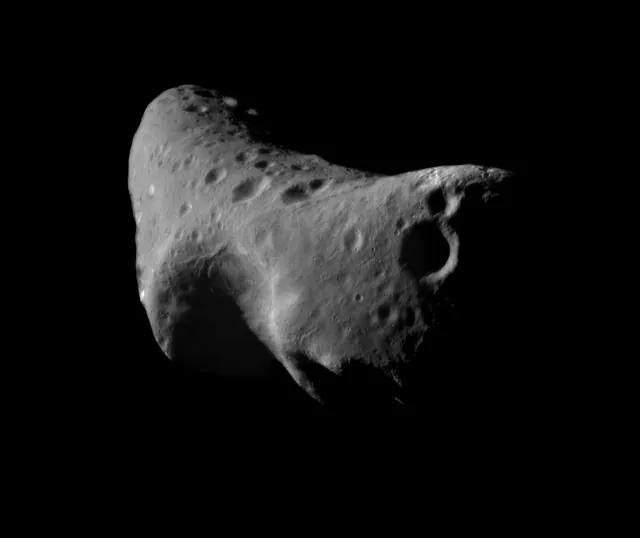
Eros is one of the most elongated asteroids known: NEAR measured it at 34.4 × 11.2 × 11.2 km, roughly three times longer than it is wide. Its volume of about 2,503 km³ equals that of a sphere 16.84 km across. Tracking the spacecraft’s radio signal gave its mass, 6.687 × 10¹⁵ kg, which works out at a mean density of 2.67 g/cm³, about the same as Earth’s crust.1238
Gravity on such a small, lopsided body is feeble and uneven. The speed needed to escape from its surface ranges from only 3.1 m/s to 17.2 m/s depending on where you stand, so a brisk throw could send a stone away for good. The surface reflects about a quarter of the sunlight that falls on it.28
Orbit and rotation
Eros circles the Sun every 643 days on a moderately stretched orbit that carries it from 1.13 au, just outside Earth’s orbit, to 1.78 au. It belongs to the Amor group of near-Earth asteroids, which cross the orbit of Mars but do not quite reach Earth’s. Its close passes still bring it near: in 1975 it came within about 22 million km of Earth and was watched by observers worldwide.12
Eros spins once every 5.27 hours. Tracking of the NEAR spacecraft and images of surface landmarks pinned down the direction of its spin axis and showed that its rotation is steady, with no measurable wobble of the pole, at least over the short term.28
Discovery and naming
Gustav Witt, director of the Urania Observatory in Berlin, found Eros on 13 August 1898 by accident, as a short trail on a two-hour photographic exposure of another asteroid, Eunike. Auguste Charlois independently spotted it the same night at Nice. Within two weeks Adolf Berberich had worked out that its orbit came well inside that of Mars, making it the first near-Earth asteroid known.12
Breaking with the custom of giving asteroids female names, it was called Eros, after the Greek god of love. Because it comes so close, astronomers used it before the age of radar to work out the mass of the Earth–Moon system and the length of the astronomical unit. A ridge on Eros is named after Arthur Hinks, the English astronomer who first used it to measure the solar parallax.14
Surface and composition
Most of Eros is saturated with craters smaller than 1 km, a sign that its surface is old. Grooves and ridges run across it, some probably following planes of weakness left by collisions. Blocks of rock tens of metres across are abundant but patchy: mapping suggests most of the large ones were thrown out by a single young impact crater about 7.6 km wide.31011
The whole asteroid is blanketed in loose debris. In some places this has settled into strikingly flat ‘ponds’ that look smooth even at 1.2 cm per pixel, probably fine dust sorted out of the upper regolith; nothing quite like them had been seen before. Spectra and X-ray measurements show a primitive, chondritic make-up close to ordinary chondrite meteorites, with no sign that Eros ever melted and separated into layers.379
What hides inside
NEAR’s gravity measurements suggest that the density inside Eros is uniform, with no dense core. Compared with ordinary chondrite meteorites, its density of 2.67 g/cm³ implies that between about 10 and 30 per cent of its volume is empty space, in cracks and pores. Low aluminium levels measured at the surface also argue that Eros was never melted and differentiated. NEAR Shoemaker’s magnetometer found no magnetic field at Eros either.3589
Notable features
Himeros
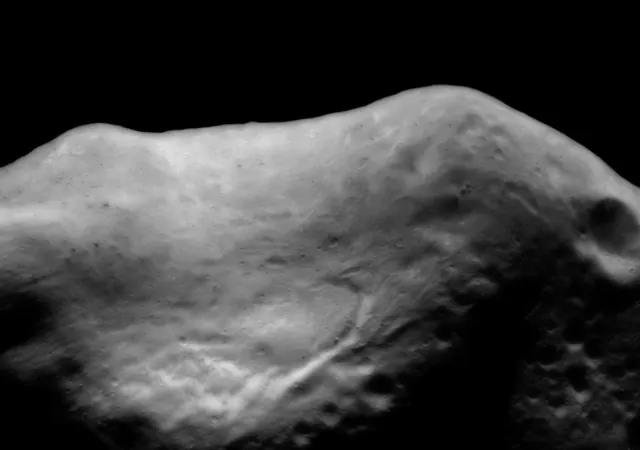
A saddle-shaped depression about 10 km across, named after the attendant of Eros who personified the longing of love. Early NEAR images showed it as a degraded, crater-like hollow. NEAR Shoemaker touched down just south of it on 12 February 2001.345
Psyche
A crater 4.8 km across centred at 31.6° N, the largest named crater on Eros after Himeros in the IAU’s Gazetteer of Planetary Nomenclature. It is named after Psyche, the beloved of Eros, who personifies the human soul in Greek mythology.4
Shoemaker Regio
The roughest part of Eros, densely scattered with boulders up to 100 m across, slumps, slides and blanketing fine material. Thomas and colleagues traced most of the asteroid’s large ejecta blocks to a relatively young 7.6 km crater here.710
Hinks Dorsum
A ridge on Eros centred at about 42° N in the northern hemisphere. It is named after the English astronomer Arthur Robert Hinks (1873–1945), who first used observations of Eros to measure the solar parallax, and so the distance from Earth to the Sun.4
Witt Regio and Charlois Regio
Two broad regions of Eros named after its discoverers: Carl Gustav Witt (1866–1946), the German astronomer who found it first, and Auguste Charlois (1864–1910), the French astronomer who discovered it independently.4
Exploration
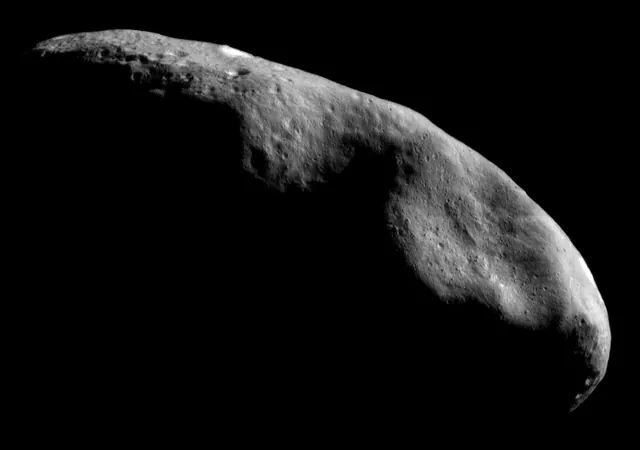
NEAR, the Near Earth Asteroid Rendezvous, was the first mission of NASA’s low-cost Discovery programme. Launched on 17 February 1996, it flew past the asteroid Mathilde in June 1997. A failed engine burn in December 1998 forced a quick flyby of Eros instead of a rendezvous, so the spacecraft finally entered orbit on 14 February 2000, about a year late. It was renamed NEAR Shoemaker in March 2000, in honour of geologist Eugene Shoemaker.5
After a year of mapping, controllers steered the spacecraft down to the surface. It touched down at about 6.4 km/h on 12 February 2001, taking its closest picture from 129 m with a resolution of about 1 cm. Although never designed to land, it survived and sent gamma-ray data from the surface for about two weeks. In all it returned some 160,000 images.156
Quick answers
- How big is Eros?
- Eros has a mean radius of 8.42 km (radius of a sphere with the same volume, 2,503 km³).28
- How massive is Eros?
- Eros has a mass of 6.687 × 10¹⁵ kg.8
- How long is a day on Eros?
- A day on Eros lasts 5.27 hours.2
- How long is a year on Eros?
- A year on Eros lasts 1.76 Earth years (643 days).2
- How far is Eros from the Sun?
- Eros is 1.46 au from the Sun (about 218 million km on average; 1.13 to 1.78 au).2
Sources
- Eros — NASA Science
- Small-Body Database Lookup: 433 Eros (A898 PA) — NASA/JPL Solar System Dynamics, 2021
- NEAR at Eros: imaging and spectral results — Science, 2000
- Gazetteer of Planetary Nomenclature: Eros — IAU/USGS
- NEAR Shoemaker — NASA Science
- The landing of the NEAR-Shoemaker spacecraft on asteroid 433 Eros — Nature, 2001
- The nature of ponded deposits on Eros — Nature, 2001
- Radio science results during the NEAR-Shoemaker spacecraft rendezvous with Eros — Science, 2000
- The elemental composition of asteroid 433 Eros: results of the NEAR-Shoemaker X-ray spectrometer — Science, 2000
- Shoemaker crater as the source of most ejecta blocks on the asteroid 433 Eros — Nature, 2001
- PIA02467: NEAR’s First Whole-Eros Mosaic from Orbit — NASA/JPL Photojournal, 2000
Figures checked against these sources in November 2026. Where a quantity is not known, it is left out rather than estimated.

