asteroid
Hygiea
Hygiea is the fourth-largest object in the asteroid belt, after Ceres, Vesta and Pallas, and one of the darkest: its surface reflects only about 7 per cent of the light that falls on it. Annibale de Gasparis discovered it from Naples on 12 April 1849, and it is named after Hygieia, the Greek goddess of health. It orbits in the outer part of the belt, on average 3.15 au from the Sun.1234
In 2017 and 2018 astronomers imaged Hygiea with the European Southern Observatory’s Very Large Telescope and found it nearly spherical, almost as round as Ceres and lacking the giant crater they had expected. That makes it a candidate dwarf planet, possibly the smallest known, but the International Astronomical Union has not reclassified it. Its round shape probably dates from a shattering collision more than 2 billion years ago.1356
Size, shape and the dwarf-planet question
SPHERE images give Hygiea a volume-equivalent radius of 217 km, a diameter of just over 430 km. The team’s best estimate of its mass, 8.32 × 10¹⁹ kg, yields a mean density of 1.94 g/cm³, the same as Ceres’s within the uncertainties. Older measurements differ: observations by the IRAS infrared satellite gave a diameter of 407 km, the value still listed in NASA’s Small-Body Database.1235
As a main-belt object, Hygiea already meets three conditions for a dwarf planet: it orbits the Sun, is not a moon and has not cleared its orbit. The fourth is a nearly round shape set by its own gravity. The team measured its sphericity at 0.9975, against 0.9988 for Ceres, and suggested it could be reclassified, but the International Astronomical Union still recognises only five dwarf planets: Ceres, Pluto, Haumea, Makemake and Eris.136
Orbit and rotation
Hygiea is the most distant of the four largest asteroids, orbiting the Sun at an average of 3.15 au, about 471 million km; Ceres, Vesta and Pallas all average less than 2.8 au. Its moderately elongated orbit carries it between 2.81 and 3.49 au, it is tilted only 3.8° to the ecliptic, and a full circuit takes 2,043 days, or 5.59 years.27
Since 1991 several groups had reported a rotation period of 27.6 hours. While watching Hygiea’s brightness with the TRAPPIST telescopes to prepare the SPHERE observations, the team found the light curve suspiciously symmetrical and realised that half that period fitted far better. Hygiea is now known to turn once in about 13.8 hours.235
Discovery and naming
Annibale de Gasparis found Hygiea from Naples on 12 April 1849. It is named after Hygieia, the Greek goddess of health, who is always shown holding a snake drinking from a cup. When the SPHERE team identified two craters on it, they borrowed her symbols and named them Serpens and Calix, Latin for snake and cup, both still emblems of medicine and pharmacy.24
Surface and the missing basin
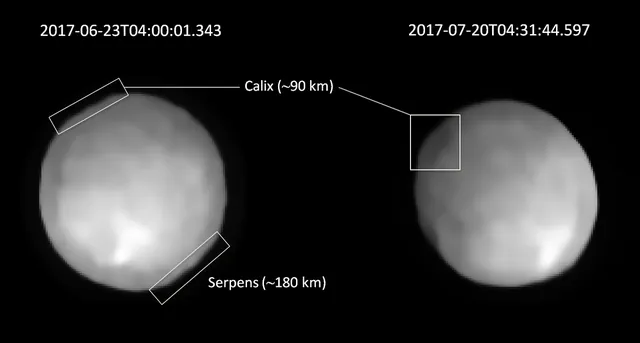
Although they saw about 95 per cent of the surface, the SPHERE team found only two unambiguous craters, 180 km and 97 km across. That was a surprise. Hygiea is the largest member of a family of close to 7,000 asteroids that all came from one parent body, and the impact that made the family was expected to have left a huge basin like Vesta’s Rheasilvia.135
Simulations offer an answer. A collision with a projectile 75 to 150 km across, most likely head-on, completely shattered the parent body. The pieces fell back together under their own gravity, briefly behaving like a fluid, and settled into a nearly round shape that erased every earlier feature, while other debris became the Hygiea family. ESO dates the collision to about 2 billion years ago.135
- Members of the Hygiea family
- close to 7,0001
What it is made of
Hygiea is a dark, carbonaceous C-type asteroid, and it is the only known asteroid whose surface composition appears similar to that of Ceres. The two also share similar densities and albedos, Hygiea reflecting about 7 per cent of light and Ceres about 9 per cent. The researchers argue that both contain a high proportion of water and so must have formed beyond the snow line.235
- Closest compositional match
- Dwarf planet Ceres5
Observations
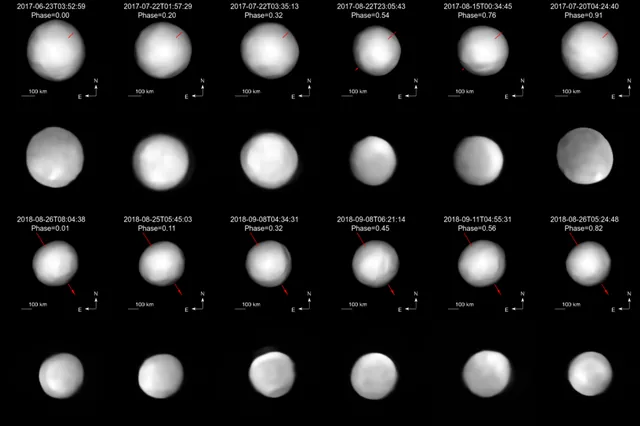
Although its large apparent size makes it an easy telescope target, Hygiea was the least studied of the four asteroids larger than 400 km, and its shape and spin were poorly known. In 2017 and 2018 an ESO large programme imaged it on 12 occasions with the ZIMPOL camera of SPHERE on the Very Large Telescope, reaching a resolution of about 20 milliarcseconds.35
The results, published in Nature Astronomy on 28 October 2019, gave the first reliable size and shape, halved the accepted rotation period and revealed the missing basin. ESO announced them under the headline that Hygiea could be the smallest dwarf planet yet in the Solar System.15
Quick answers
- How massive is Hygiea?
- Hygiea has a mass of 8.32 × 10¹⁹ kg (±0.80 × 10¹⁹ kg).3
- How long is a year on Hygiea?
- A year on Hygiea lasts 5.59 Earth years (2,043 days).2
- How far is Hygiea from the Sun?
- Hygiea is 3.15 au from the Sun (about 471 million km on average).2
- When was Hygiea discovered?
- Hygiea was discovered on 12 April 1849, by Annibale de Gasparis at Naples.2
Sources
- ESO Telescope Reveals What Could be the Smallest Dwarf Planet yet in the Solar System — European Southern Observatory, 2019
- Small-Body Database Lookup: 10 Hygiea (A849 GA) — NASA/JPL Solar System Dynamics, 2026
- Vernazza et al., A basin-free spherical shape as outcome of a giant impact on asteroid Hygiea (author manuscript) — European Southern Observatory, 2019
- Vernazza et al., Hygiea: supplementary material — European Southern Observatory, 2019
- Vernazza et al., A basin-free spherical shape as an outcome of a giant impact on asteroid Hygiea — Nature Astronomy, 2019
- Dwarf Planets — NASA Science
- Asteroid Fact Sheet — NASA Space Science Data Coordinated Archive, 2019
Figures checked against these sources in November 2026. Where a quantity is not known, it is left out rather than estimated.

