dwarf planet
Haumea
Haumea is a dwarf planet in the Kuiper Belt beyond Neptune, and one of the strangest bodies in the Solar System. It spins once every 3.9 hours, one of the fastest rotations of any large object known, and the spin has stretched it into an elongated ellipsoid about 2,300 km long but only about 1,000 km from pole to pole. It is named after the Hawaiian goddess of childbirth and fertility.1234
Haumea has two small moons, Hiʻiaka and Namaka, and in 2017 it became the first known Kuiper Belt object found to have a ring. A glaze of crystalline water ice covers a largely rocky body, and a family of icy fragments follows similar orbits, apparently debris from an ancient collision. Teams in California and Spain both claimed its discovery; the International Astronomical Union names no discoverer.134567
Size and shape
Haumea is shaped like an elongated, flattened ellipsoid. A stellar occultation on 21 January 2017, recorded by 12 telescopes at 10 observatories, combined with its rotational light curve, gave semi-axes of about 1,161, 852 and 513 km. That makes it some 2,322 km from end to end along its longest axis but only about 1,026 km from pole to pole. Its volume equals that of a sphere 1,595 km across.3
The mass, 4.006 × 10²¹ kg, comes from the orbits of its moons measured with Hubble and Keck. Early estimates assumed Haumea had the shape of a spinning fluid and implied a density of 2,600–3,340 kg/m³. The 2017 occultation showed that Haumea is larger than thought, cutting the density to at most 1,885 kg/m³ and the albedo to 0.51, and revealed a shape inconsistent with a uniform body in equilibrium.238
- Dimensions
- about 2,322 × 1,704 × 1,026 km3semi-axes 1,161 ± 30, 852 ± 4 and 513 ± 16 km
- Volume-equivalent diameter
- 1,595 km3±11 km
- Mass
- 4.006 × 10²¹ kg8±0.040 × 10²¹ kg
- Mean density
- 1,885 kg/m³3upper limit, ±80 kg/m³
- Geometric albedo
- 0.513±0.02
- Brightness swing as it spins
- 0.28 magnitudes2peak to peak, reported in 2006
Orbit and rotation
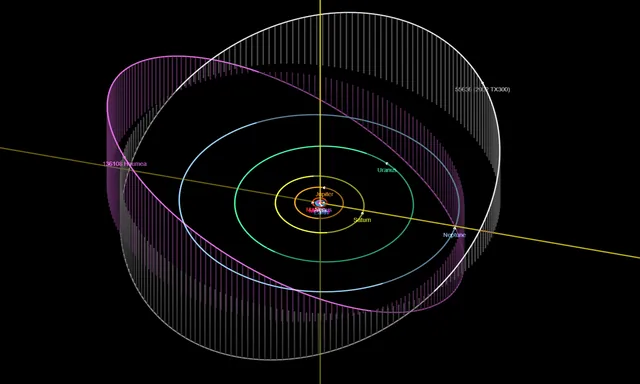
Haumea orbits in the Kuiper Belt at an average of 43.1 au, about 6.44 billion km from the Sun, on a path tilted 28° to the plane of the planets and moderately elongated, with an eccentricity of 0.19. Its distance ranges from 34.7 au at perihelion to 51.4 au at aphelion, and a year lasts about 283 Earth years. In November 2026 it was 49.7 au away, heading slowly towards perihelion around 2133.910
A day on Haumea lasts 3.9154 hours, measured from a double-peaked light curve as its elongated shape turns. When it was reported in 2006, this was the fastest rotation reliably determined for any Solar System body larger than 100 km. Brown’s team notes that Haumea’s orbit lies near a 7:12 resonance with Neptune, a pattern that slowly destabilises orbits over long periods of time.269
A disputed discovery
Who discovered Haumea is disputed. Mike Brown’s team at Caltech found it in images from around Christmas 2004 and tracked it for months, planning to announce it in September 2005; conference abstracts released in July referred to it by the code name K40506A. Meanwhile a team led by José Luis Ortiz at the Instituto de Astrofísica de Andalucía reported in late July 2005 that it had found the object in images taken at Sierra Nevada Observatory in 2003.9111213
Brown at first congratulated the Spanish team. He then found web-server logs showing that computers at their institute had viewed online observing records of his team’s telescope pointings the day before their report, and asked the International Astronomical Union to investigate. The records could have helped find the object, or simply confirmed that both groups had found the same one. Ortiz, for his part, criticised Brown’s team for keeping discoveries secret while they studied them.111214
The IAU had no procedure for settling such a dispute. It now lists the discovery as made at Sierra Nevada Observatory on 7 March 2003 without naming a discoverer, but on 17 September 2008 it adopted names proposed by Brown’s team, taken from Hawaiian mythology to honour the place where the moons were found: Haumea, goddess of childbirth and fertility, and her daughters Hiʻiaka and Namaka.146914
- Announced
- 29 July 200513Minor Planet Electronic Circular 2005-O36
Surface
When it was found, Haumea was the third-brightest Kuiper Belt object known, and spectra from the Gemini North and Keck telescopes show why: its surface is rich in crystalline water ice. That form of ice is less favoured than disordered, amorphous ice at such low temperatures, so its presence suggests the surface may be renewed. The best models mix two-thirds to four-fifths pure crystalline ice with a material such as hydrogen cyanide or clay.25
In visible light the surface is neutral in colour, and pure-ice models match Haumea’s brightness well enough that it is unlikely to be covered by much dark material such as carbon black. The 2017 occultation lowered the geometric albedo to 0.51, still bright, from earlier estimates of more than 0.6. NASA notes that little else is known about the surface.1235
What hides inside
NASA describes Haumea as rock with a coating of ice. Brown’s team reached that picture from the spin: a dense body stretches less than a light one, and Haumea’s shape implied almost solid rock under a thin film of ice, the outer ice probably stripped away by a giant impact. The lower density from the 2017 occultation makes Haumea less puzzling, in line with other large objects beyond Neptune, although its interior may not be uniform.136
Atmosphere and magnetic field
No atmosphere was detected during the 2017 occultation: any global nitrogen atmosphere must have a surface pressure below 15 nanobars, and any methane atmosphere below 50 nanobars. NASA notes that very little is known about Haumea’s atmosphere, and scientists do not think it has a magnetosphere, the magnetic bubble that surrounds planets such as Earth.13
Ring, moons and family
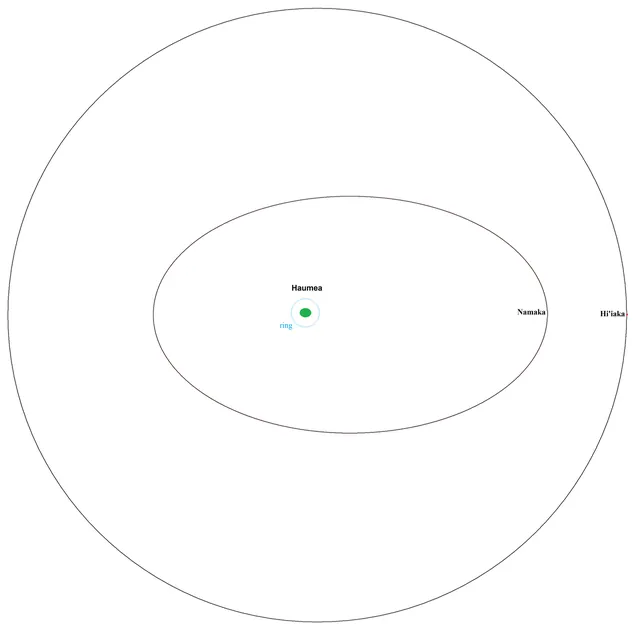
Haumea’s ring and moons lie close to its equatorial plane. The moons’ orbits were worked out from Hubble and Keck images; the two pull on each other, so no simple orbit describes Namaka’s motion for long. Their nearly coplanar orbits and ice-like density strengthen the idea that Haumea suffered a giant collision billions of years ago and that the moons formed from the debris.38
The ring
Found during the 21 January 2017 occultation, the ring has a radius of about 2,287 km, a width of about 70 km and an opacity of 0.5. It lies in Haumea’s equatorial plane, inside the limit within which material cannot gather into a moon, and close to a 3:1 resonance: each particle orbits once while Haumea spins three times.3
Hiʻiaka
The outer, larger moon was found on 26 January 2005 with the Keck Observatory’s adaptive optics. It orbits about 49,880 km from Haumea every 49.5 days, has a mass of 1.79 × 10¹⁹ kg and shows unusually deep water-ice bands. It is named after the patron goddess of the island of Hawaiʻi and of hula dancers.48915
Namaka
The inner, fainter moon was found on 7 November 2005, also at Keck. It orbits about 25,657 km from Haumea in roughly 18.3 days, on a markedly elongated path tilted about 13° to Hiʻiaka’s orbit, and its mass is only marginally measured. It is named after a water spirit in Hawaiian mythology, a daughter of Haumea.489
The Haumea family
In 2007 Brown’s team reported a family of Kuiper Belt objects whose orbits and almost pure water-ice surfaces closely match Haumea’s. They appear to be fragments of its icy mantle, blasted off in the collision that left it spinning so fast, and were the first collisional family found beyond Neptune.67
Exploration
No spacecraft has visited Haumea: the only one to explore the Kuiper Belt, New Horizons, flew past Pluto and Arrokoth. Everything known about Haumea comes from telescopes: photometry for its spin, Keck and Hubble for its moons and mass, Gemini and Keck spectra for its ice, and twelve telescopes at ten observatories for the 2017 occultation that revealed its ring and true size.235816
The moons have offered more than a mass. Their orbits predicted that, from 2009, Namaka and Haumea would pass in front of each other as seen from Earth for several years, and Brown’s team set out to use these mutual eclipses and occultations to study the system in unprecedented detail. Hubble imaged Haumea and both moons again with its Wide Field Camera 3 on 30 June 2015.168
Quick answers
- How big is Haumea?
- Haumea has a mean radius of about 798 km (half the volume-equivalent diameter of 1,595 km).3
- How massive is Haumea?
- Haumea has a mass of 4.006 × 10²¹ kg.8
- How dense is Haumea?
- Haumea has a mean density of about 1.885 g/cm³ (an upper limit).3
- How long is a year on Haumea?
- A year on Haumea lasts about 283 Earth years (103,208 days).9
- How far is Haumea from the Sun?
- Haumea is 43.1 au on average from the Sun (about 6.44 billion km; 34.7 to 51.4 au).9
Sources
- Haumea Facts — NASA Science, 2026
- Rabinowitz et al., Photometric observations constraining the size, shape, and albedo of 2003 EL61, a rapidly rotating, Pluto-sized object in the Kuiper Belt — Astrophysical Journal, 2006
- Ortiz et al., The size, shape, density and ring of the dwarf planet Haumea from a stellar occultation — Nature, 2017
- Planet and Satellite Names and Discoverers — International Astronomical Union and USGS Astrogeology Science Center (Gazetteer of Planetary Nomenclature)
- Trujillo et al., The surface of 2003 EL61 in the near-infrared — Astrophysical Journal, 2007
- Haumea: the strangest known object in the Kuiper belt — Mike Brown, California Institute of Technology
- Brown et al., A collisional family of icy objects in the Kuiper belt — Nature, 2007
- Ragozzine and Brown, Orbits and masses of the satellites of the dwarf planet Haumea (2003 EL61) — Astronomical Journal, 2009
- Small-Body Database Lookup: 136108 Haumea (2003 EL61) — NASA/JPL Solar System Dynamics, 2026
- Horizons System: ephemeris of 136108 Haumea for 1–2 November 2026 — NASA/JPL Solar System Dynamics, 2026
- 10th Planet Controversy — Universe Today (from AstronomiaOnline), 2005
- The electronic trail of the discovery of 2003 EL61 — Mike Brown, California Institute of Technology, 2005
- MPEC 2005-O36: 2003 EL61 — Minor Planet Center, 2005
- Overbye, Gauntlet down on fight over new ‘planet’ — The New York Times, as reprinted in The Indian Express (University of Granada press archive), 2005
- Barkume, Brown and Schaller, Water ice on the satellite of Kuiper Belt object 2003 EL61 — Astrophysical Journal Letters, 2006
- Kuiper Belt — NASA Science
Figures checked against these sources in November 2026. Where a quantity is not known, it is left out rather than estimated.

