dwarf planet
Makemake
Makemake is a dwarf planet in the Kuiper belt, the cold region of icy bodies beyond Neptune. About 1,430 km across, roughly two-thirds the size of Pluto, it is the second-brightest object in the Kuiper belt as seen from Earth, after Pluto itself. It was found in March 2005 at Palomar Observatory by Mike Brown, Chad Trujillo and David Rabinowitz, and in July 2008 the International Astronomical Union named it and classed it as a dwarf planet.123
Makemake takes about 308 years to circle the Sun and is now close to the far end of its orbit, almost 53 times Earth’s distance from the Sun. Its bright, reddish surface is coated in frozen methane laced with ethane and other hydrocarbons. In 2016 the Hubble Space Telescope revealed a small, dark moon, and in 2025 astronomers using the James Webb Space Telescope reported methane gas above the surface, a sign that this distant world is not entirely inert.123456
Size and physical properties
Makemake is one of the largest bodies beyond Neptune. On 23 April 2011 it passed in front of a star, and observers who timed the star’s disappearance measured projected axes of about 1,430 and 1,502 km. A later reanalysis of the same timings, assuming the dwarf planet is seen nearly pole-on, found it almost perfectly round, with an equatorial diameter of 1,434 km.711
Its surface reflects roughly four-fifths of the light that falls on it, making it about as bright as fresh snow. The mass is still uncertain, because the moon’s orbit is not yet well measured. A 2025 study of archival Hubble images gives a preliminary system mass of about 2.7 × 10²¹ kg and a density near 1.8 g/cm³, but it has not been peer reviewed. An earlier density derived from the occultation was later shown to be unconstrained.57811
- Equatorial diameter
- 1,434 ± 14 km7from the 2011 occultation, assuming a nearly pole-on view
- Projected axes
- 1,430 × 1,502 km11original fit to the 2011 occultation
- System mass
- about 2.7 × 10²¹ kg8preliminary: (2.69 ± 0.20) × 10²¹ kg, from a 2025 preprint
- Mean density
- about 1.8 g/cm³8preliminary: 1.76 ± 0.17 g/cm³
- Absolute magnitude
- −0.253
Orbit and rotation
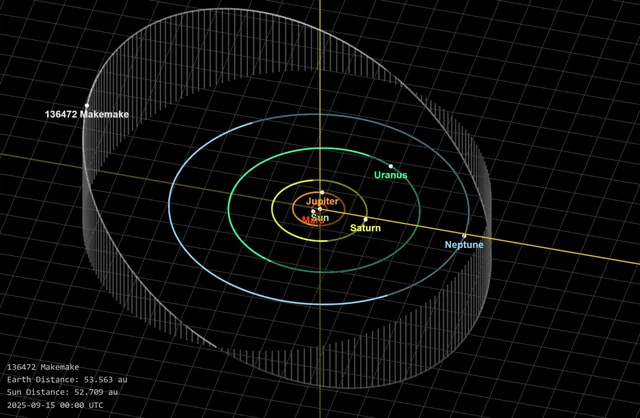
Makemake follows a moderately elongated orbit, tilted 29° to the plane of Earth’s orbit, that carries it between 38.3 au from the Sun at its closest and 52.8 au at its farthest. One circuit takes about 308 years. It last passed its closest point in 1881 and is now near the far end of its path: on 13 November 2026 it was 52.7 au from the Sun, in the constellation Coma Berenices.34
Its day is close to Earth’s. Monitoring between 2006 and 2017 found a rotation period of 22.83 hours, longer than earlier estimates, and only a tiny change in brightness as it turns. That suggests either an almost spherical shape or that we see Makemake nearly pole-on. NASA quotes a day of about 22 and a half hours.19
Discovery and naming
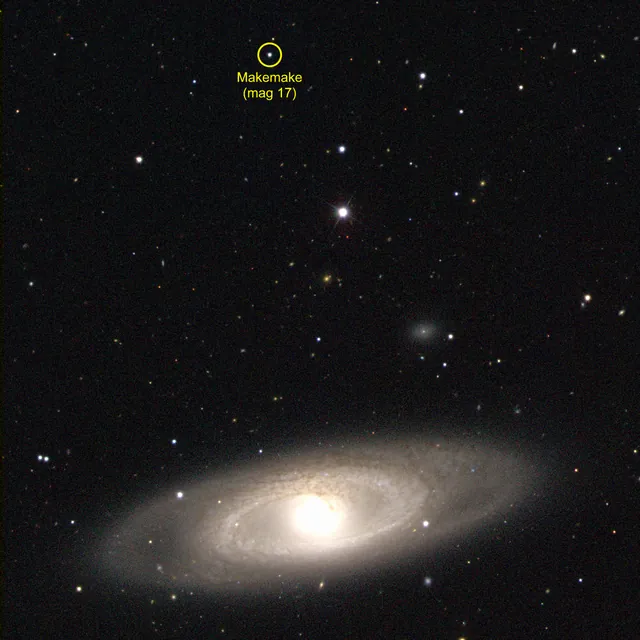
Mike Brown, Chad Trujillo and David Rabinowitz discovered Makemake at Palomar Observatory in California on 31 March 2005. Because it turned up a few days after Easter, the team nicknamed it Easterbunny; its provisional designation was 2005 FY9, later replaced by the minor-planet number 136472. Its discovery, together with that of Eris, prompted the International Astronomical Union to rethink what counts as a planet and to create the class of dwarf planets.123
On 19 July 2008 the union’s naming committees called it Makemake and classed it as the fourth dwarf planet and the third plutoid. Brown chose the name from Rapa Nui, or Easter Island: Makemake is the creator of humanity and god of fertility there, the chief god of the bird-man cult, worshipped in the form of sea birds.23
What is known of the surface
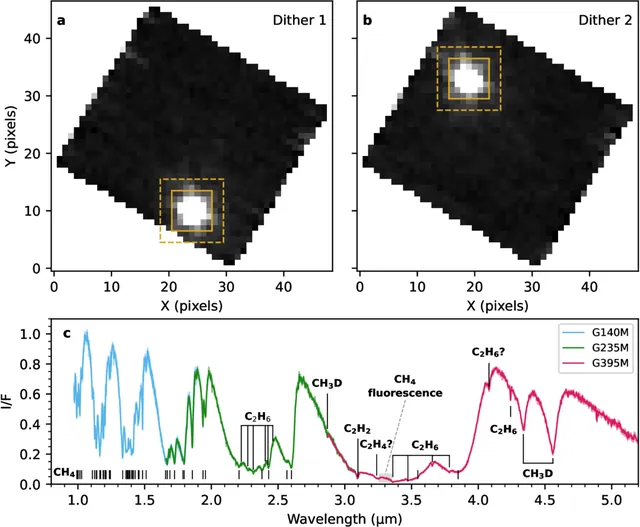
No telescope can show detail on Makemake, but its light reveals what covers it. The surface looks reddish-brown and is dominated by frozen methane, with ethane also detected; NASA notes that methane ice pellets as large as a centimetre may lie on it. Small shifts in the methane absorption bands, measured with the 6.5 m MMT telescope in 2006 and 2007, suggest another ice is mixed in, most likely nitrogen, as on Pluto and Triton.1212
Spectra from the James Webb Space Telescope show a chemically complex surface: methane and its deuterium-bearing form CH₃D, possibly methanol, and grains of acetylene and ethane, with ethylene also considered. These hydrocarbons form when radiation breaks methane apart, so the process is either ongoing or recent. The ratio of deuterium to hydrogen in the methane ice is about 4 × 10⁻⁴.6
Atmosphere and gas
When Makemake hid a star in April 2011, the star vanished and reappeared abruptly, which showed that it has no global atmosphere like Pluto’s: the surface pressure must be below 4–12 nanobar, although a local atmosphere could not be ruled out. NASA notes that a very thin atmosphere, most likely of nitrogen, may develop near perihelion.111
In 2025 a team led by Silvia Protopapa reported the first detection of gas at Makemake: methane glowing as it re-emits absorbed sunlight, seen in Webb spectra. That makes Makemake only the second trans-Neptunian object, after Pluto, with confirmed gas. It may come from a tenuous atmosphere with a surface pressure of about 10 picobars and a temperature near 40 K, or from plume-like outbursts; the data cannot yet tell which.613
Makemake’s moon
Makemake has one known moon, provisionally designated S/2015 (136472) 1 and nicknamed MK2. Hubble’s Wide Field Camera 3 caught it on 27 April 2015, 7.8 magnitudes, or more than 1,300 times, fainter than Makemake, and the find was announced in April 2016. Earlier searches had missed it, probably because its orbit is seen almost edge-on, hiding the moon in Makemake’s glare for much of the time.510
MK2 seems to be charcoal-black, although Makemake is as bright as fresh snow, and its dark surface may account for the warm material earlier attributed to patches on Makemake. NASA estimates it at about 160 km across, seen roughly 21,000 km from the dwarf planet. A preliminary orbit from Hubble images taken between 2015 and 2019 gives a period of about 18 days, but awaits peer review.15810
Quick answers
- How long is a day on Makemake?
- A day on Makemake lasts 22.83 hours (rotation period from photometry taken between 2006 and 2017).39
- How long is a year on Makemake?
- A year on Makemake lasts 307.6 Earth years (112,365 days; NASA rounds it to about 305 years).13
- How far is Makemake from the Sun?
- Makemake is 45.6 au on average from the Sun (about 6.8 billion km; it ranges from 38.3 to 52.8 au).13
Sources
- Makemake — NASA Science
- Fourth dwarf planet named Makemake (press release iau0806) — International Astronomical Union, 2008
- Small-Body Database Lookup: 136472 Makemake (2005 FY9) — NASA/JPL Solar System Dynamics, 2026
- Horizons System: ephemeris of 136472 Makemake for 13 November 2026 — NASA/JPL Solar System Dynamics, 2026
- Hubble Discovers Moon Orbiting the Dwarf Planet Makemake — NASA Science, 2016
- Protopapa et al., JWST Detection of Hydrocarbon Ices and Methane Gas on Makemake — Astrophysical Journal Letters, 2025
- Brown, On the size, shape, and density of dwarf planet Makemake — Astrophysical Journal Letters, 2013
- Bamberger, A preliminary orbit for the satellite of dwarf planet (136472) Makemake (preprint, not peer reviewed) — arXiv, 2025
- Hromakina et al., Long-term photometric monitoring of the dwarf planet (136472) Makemake — Astronomy & Astrophysics, 2019
- Parker et al., Discovery of a Makemakean Moon — Astrophysical Journal Letters, 2016
- Ortiz et al., Albedo and atmospheric constraints of dwarf planet Makemake from a stellar occultation — Nature, 2012
- Tegler et al., Evidence of N2-ice on the surface of the icy dwarf planet 136472 (2005 FY9) — Icarus, 2008
- SwRI-led team discovers methane gas on Makemake — Southwest Research Institute, 2025
Figures checked against these sources in November 2026. Where a quantity is not known, it is left out rather than estimated.

