comet
67P/Churyumov–Gerasimenko
Comet 67P/Churyumov–Gerasimenko is a small Jupiter-family comet whose two-lobed nucleus, about 4 km long, has often been likened to a rubber duck. Found in 1969 on a photographic plate, it loops around the Sun every six and a half years, from just beyond the orbit of Jupiter to between the orbits of Earth and Mars. In 2014 it became the first comet to be orbited and landed on by spacecraft.12345
ESA’s Rosetta mission escorted the comet for more than two years, while its lander, Philae, bounced across the surface and came to rest in shadow. Together they revealed a dark, dusty and extremely porous body, with about four times more dust than ice by mass, that breathes out water, carbon monoxide, carbon dioxide and even molecular oxygen. Rosetta also found the amino acid glycine, and its measurements of heavy water have reshaped the debate over where Earth’s oceans came from.6789101112
Shape and size
The nucleus is made of two lobes joined by a narrow neck. Along its principal axes it measures 4.34 × 2.60 × 2.12 km. The larger lobe is about 4.10 × 3.52 × 1.63 km and the smaller about 2.50 × 2.14 × 1.64 km; they hold 66 and 27 per cent of the volume, with the neck making up the other 7 per cent. The total volume is about 18.8 km³.315
Rosetta’s radio science experiment weighed the comet by tracking how its gravity nudged the spacecraft during flybys 10–100 km from the nucleus. The result, 9.982 × 10¹² kg, gives a bulk density of 533 kg/m³, about half that of water. Gravity at the surface is several hundred thousand times weaker than on Earth, so Philae was designed to touch down at no more than walking pace.814
Early figures released months after arrival, when only about 70 per cent of the surface had been imaged, gave a larger volume of 21.4 km³ and a lower density of 470 kg/m³. Both were refined once images taken up to perihelion in 2015 had mapped the entire nucleus.313
Orbit and rotation
67P is a Jupiter-family comet. Its elliptical orbit, with an eccentricity of 0.64 and a tilt of 7° to the ecliptic, carries it from 1.24 au from the Sun, between the orbits of Earth and Mars, out to 5.68 au, just beyond Jupiter. One circuit takes about 6.4 years. Rosetta followed it through perihelion on 13 August 2015, when it passed 186 million km from the Sun.21314
Its path has not always been like this. Until the mid-19th century the comet came no closer to the Sun than about 4.0 au, too far to grow a coma and be seen from Earth. A close encounter with Jupiter in 1840 moved its perihelion in to about 3.0 au, and another in 1959 brought it to about 1.3 au. Like most Jupiter-family comets, it probably came from the Kuiper belt.1
When Rosetta arrived, the nucleus turned once every 12.4041 hours about its principal axis. As the comet neared the Sun, the gas escaping from its surface pushed on it like small thrusters: the period first lengthened slightly, to 12.4304 hours in May 2015, then shortened to 12.305 hours just before perihelion. The spin axis also wobbles a little, over 11.5 days.31516
Discovery and naming
Klim Churyumov and Svetlana Gerasimenko, astronomers from Kiev, found the comet in 1969 at the Alma-Ata Observatory. Gerasimenko had photographed another comet, 32P/Comas Solà, on 11 September; while examining that plate, Churyumov spotted the image of a new one. The discovery is dated 22 October 1969.1214
Its name follows the convention for periodic comets. The P marks a short-period comet, one that takes less than 200 years to orbit the Sun, and 67 means it was the 67th periodic comet catalogued; Halley’s Comet, the first, is 1P. The rest of the name honours its two discoverers. Telescopes on Earth observed it at almost every return after 1969.114
It was not Rosetta’s first target. The mission was originally planned to meet comet 46P/Wirtanen, but 67P was chosen because it could be reached with the same version of the Ariane 5 rocket. With a nucleus about four kilometres across, it is larger than Wirtanen and much more active near the Sun.14
- Discovery plate taken
- 11 September 19691by Svetlana Gerasimenko
Surface and landscape
Rosetta found a world of boulders, towering cliffs, pits and smooth plains. Scientists divided the surface into 26 regions with distinct boundaries, named after ancient Egyptian deities to match the mission’s Egyptian theme: goddesses for regions on the small lobe, or ‘head’, gods for the large lobe, or ‘body’, and the Nile gods Hapi and Sobek for the two regions on the neck.171819
The terrains fall into five broad types: dust-covered ground; brittle material with pits and circular structures; large depressions; smooth terrains; and exposed, more consolidated, rock-like surfaces. Much of the northern hemisphere is blanketed in dust, perhaps several metres thick in places, that falls back after being lifted by escaping gas. The gas also sculpts dune-like ripples and ‘wind-tails’ behind boulders.1318
The surface is dark, rich in carbon compounds and, at scales of tens of metres, largely free of ice. Bright spots are the exception: in one study, eight of 13 bright spots showed water ice in their spectra. Cliff faces are cut by fractures linked to rapid heating and cooling, and some steep walls show 3 m textures nicknamed ‘goosebumps’.1320
Coma, jets and outbursts
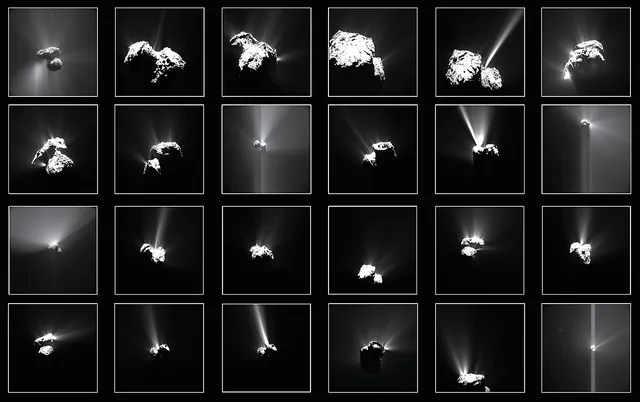
As the comet warms, ice turns straight into gas that streams away, dragging dust with it, to form the coma. Water is usually the main gas, with carbon monoxide and carbon dioxide close behind, along with many nitrogen-, sulphur- and carbon-bearing molecules. Measured water output rose from 0.3 litres per second in June 2014 to 1.2 litres per second by late August, much of it from the neck.913
Much of the activity came from jets, seen rising from the smooth neck and from pits. In the three months around perihelion, Rosetta’s cameras caught 34 brief but powerful outbursts, about one every 2.4 rotations, many where steep cliffs and scarps mark region boundaries. Some may be triggered by the sudden morning warming, others by heat reaching buried ice, and some by collapsing cliffs.131522
Estimates of how much dust leaves compared with gas vary: early Rosetta measurements suggested about four times as much dust as gas by mass, while NASA describes about twice as much. As the coma grew, Rosetta watched it interact with the solar wind, building an ionosphere and a magnetosphere around the comet, though the nucleus itself proved to have no magnetic field.11323
What it is made of
Rosetta’s gravity and shape measurements suggest the nucleus holds about four times more dust than ice by mass, or twice as much by volume. Its ROSINA mass spectrometer sampled the gases directly and made the first detections at a comet of molecular nitrogen and of molecular oxygen, O₂, which averaged 3.80 per cent of the water. Because the oxygen tracks the water so closely, it was probably locked into the ice when the comet formed.18924
In 2016 the ROSINA team reported the first unambiguous detection of glycine at a comet. The simplest amino acid, it was found together with methylamine and ethylamine, possible precursors, and alongside phosphorus, a key element of DNA and cell membranes. Glycine appeared mainly when dust was abundant, suggesting it is released from icy coatings on dust grains as they warm in the coma.1025
Water’s deuterium-to-hydrogen ratio is a clue to its origin. In 2014 ROSINA measured (5.3 ± 0.7) × 10⁻⁴, about three times the value in Earth’s oceans, which the team said added weight to models favouring asteroids over comets as the main source of Earth’s water. A 2024 reanalysis of more than 4,000 measurements found that dust raises the local value; away from it the ratio is 1.2–1.6 times terrestrial, reopening the question.111226
- Dust-to-ice ratio
- about 4 : 18by mass; about 2 : 1 by volume
- D/H in water, 2014
- (5.3 ± 0.7) × 10⁻⁴26about three times the terrestrial value
- D/H in water, 2024 reanalysis
- (2.59 ± 0.36) × 10⁻⁴12measured where the gas is well mixed, away from dust
- Molecular oxygen
- 3.80 ± 0.85 per cent24relative to water; locally 1–10 per cent
Inside the nucleus
The precise gravity field shows that the interior is uniform on a global scale, without large voids. Instead, the high porosity of about 70–75 per cent seems to be a property of the material itself, a loosely packed mix of dust and ice. Whether the pores are tiny or larger gaps between clumps is still unknown.3813
How the comet got its shape was a key question. Layers of strata up to 650 m thick wrap each lobe separately, like the layers of an onion, and lie closer to perpendicular to each lobe’s own gravity than to that of the whole nucleus. This indicates the two lobes formed independently and later merged in a gentle, low-speed collision early in the Solar System’s history.627
Taken together, Rosetta’s results suggest that the comet was born in a very cold region of the young Solar System more than 4.5 billion years ago, and that comets are ancient leftovers of planet formation rather than fragments of later collisions between larger bodies.6
Named regions and sites
Hapi
The smooth region on the neck between the two lobes, named after a Nile god. Much of the comet’s early activity came from the neck, where jets were seen consistently. Between December 2014 and March 2015 a depression 140 m wide and 0.5 m deep grew here, probably driven by carbon dioxide ice close to the surface.13151728
Imhotep
A region of smooth terrain on the large lobe. Between May and July 2015 Rosetta watched roundish features spread across its plains at roughly 20–30 cm an hour, the first major surface changes seen on the comet. Their bluish edges hint at freshly exposed ice, though sublimation alone cannot explain how they grew.171829
Seth
A region on the large lobe made of brittle material scarred by pits and circular structures. Studies of the pits on 67P show that some are active and probably formed when the surface collapsed into a cavity below, like a sinkhole, and that the top few hundred metres of the nucleus are far from uniform.171830
Ma’at
A dust-covered region on the small lobe, or ‘head’, named after a goddess, with active pits. Rosetta ended its mission here on 30 September 2016, coming to rest just inside an ancient pit at a spot named Sais, after the town where the Rosetta Stone was originally kept.6171823
Agilkia
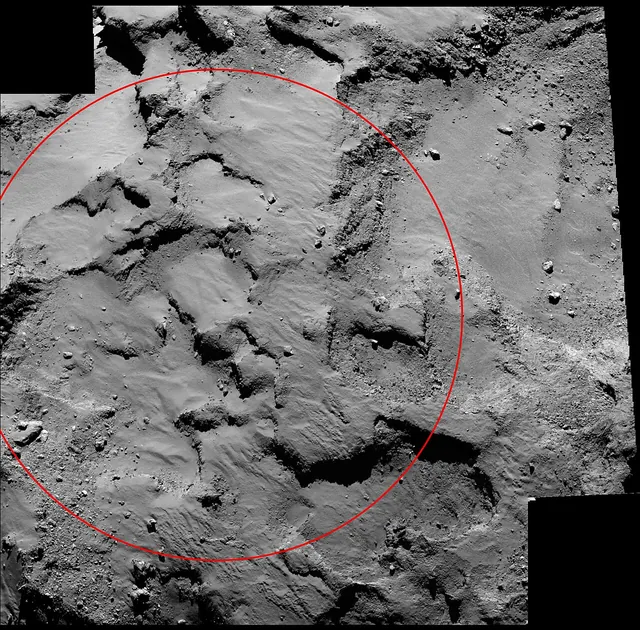
Philae’s first touchdown site, on the head, chosen six weeks after Rosetta arrived and first known as Site J. It was named after Agilkia Island on the Nile, where the temples of Philae island were moved when Aswan dams flooded it. The name won a public contest that drew more than 8,000 entries.419
Abydos
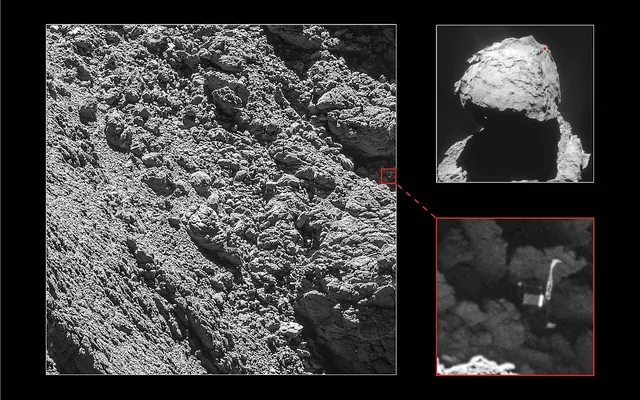
Philae’s final resting place, on the small lobe, reached about two hours after it bounced from Agilkia. Wedged into a dark crack, the lander was found only on 2 September 2016, when Rosetta’s OSIRIS camera photographed its 1 m body and two of its three legs from 2.7 km.7
Rosetta and Philae
ESA’s Rosetta was launched on 2 March 2004. To reach the comet it flew past Earth three times and Mars once, visited the asteroids Šteins and Lutetia, and spent 31 months in hibernation before waking on 20 January 2014. After ten manoeuvres to match the comet’s speed, it arrived on 6 August 2014, 405 million km from Earth, the first spacecraft ever to rendezvous with a comet.5619
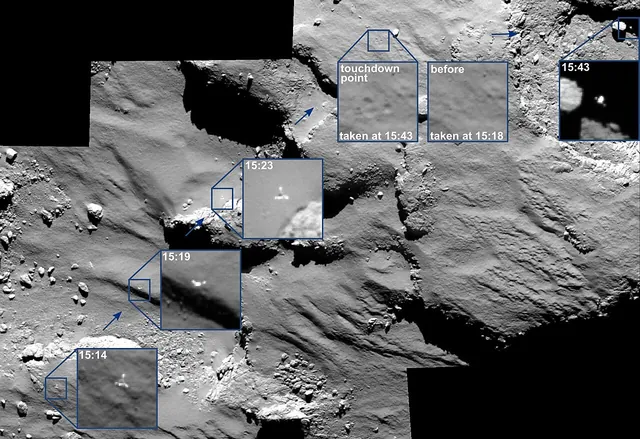
On 12 November 2014 Rosetta released Philae 22.5 km from the comet’s centre. After a seven-hour descent, confirmation of touchdown reached Earth at 16:03 GMT. But Philae bounced from Agilkia and flew for two more hours before settling in shadow at Abydos. Its main battery ran out after about three days; the lander woke briefly in June and July 2015, then fell silent.719
Rosetta followed the comet through perihelion and back out, operating beside it for 786 days. With power fading as both headed beyond Jupiter’s orbit, ESA ended the mission by guiding the orbiter down onto the comet on 30 September 2016; its signal vanished at 11:19 GMT. Analysis of its data continues.623
Quick answers
- How massive is 67P/Churyumov–Gerasimenko?
- 67P/Churyumov–Gerasimenko has a mass of 9.982 × 10¹² kg (about 10 billion tonnes, weighed by Rosetta’s radio tracking).813
- How dense is 67P/Churyumov–Gerasimenko?
- 67P/Churyumov–Gerasimenko has a mean density of 0.533 g/cm³ (about half that of water; 70–75 per cent of the nucleus is empty space).38
- How long is a day on 67P/Churyumov–Gerasimenko?
- A day on 67P/Churyumov–Gerasimenko lasts 12.4 hours (12.4041 h on arrival in 2014; 12.305 h just before perihelion in 2015).3
- How long does 67P/Churyumov–Gerasimenko take to complete one orbit?
- 67P/Churyumov–Gerasimenko completes one orbit in 6.43 years (2,350 days; often rounded to 6.5 years).25
- How far is 67P/Churyumov–Gerasimenko from the Sun?
- 67P/Churyumov–Gerasimenko is 1.24–5.68 au from the Sun (about 186 million km at its closest, about 850 million km at its farthest).214
- What is the temperature on 67P/Churyumov–Gerasimenko?
- The temperature on 67P/Churyumov–Gerasimenko is about −70 °C (average measured by Rosetta’s VIRTIS instrument on approach in 2014).5
Sources
- 67P/Churyumov-Gerasimenko — NASA Science
- Small-Body Database Lookup: 67P/Churyumov-Gerasimenko — NASA/JPL Solar System Dynamics
- The global shape, density and rotation of Comet 67P/Churyumov-Gerasimenko from preperihelion Rosetta/OSIRIS observations (Jorda et al.) — Icarus, 2016
- Farewell ‘J’, hello Agilkia — ESA, 2014
- Rosetta arrives at comet destination — ESA, 2014
- Mission complete: Rosetta’s journey ends in daring descent to comet — ESA, 2016
- Philae found! — ESA, 2016
- A homogeneous nucleus for comet 67P/Churyumov-Gerasimenko from its gravity field (Pätzold et al.) — Nature, 2016
- First detection of molecular oxygen at a comet — ESA, 2015
- Rosetta’s comet contains ingredients for life — ESA, 2016
- Rosetta fuels debate on origin of Earth’s oceans — ESA, 2014
- A nearly terrestrial D/H for comet 67P/Churyumov-Gerasimenko (Mandt et al.) — Science Advances, 2024
- Getting to know Rosetta’s comet — ESA, 2015
- Rosetta: frequently asked questions — ESA
- On the nucleus structure and activity of comet 67P/Churyumov-Gerasimenko (Sierks et al.) — Science, 2015
- Comet 67P/Churyumov-Gerasimenko rotation changes derived from sublimation induced torques (Kramer et al.) — Astronomy & Astrophysics, 2019
- Comet regions — ESA Science & Technology, 2017
- Comet regional maps — ESA, 2015
- Touchdown! Rosetta’s Philae probe lands on comet — ESA, 2014
- Detection of exposed H2O ice on the nucleus of comet 67P/Churyumov-Gerasimenko (Barucci et al.) — Astronomy & Astrophysics, 2016
- Comet southern hemisphere — ESA, 2015
- Summer fireworks on comet 67P (Vincent et al.) — Monthly Notices of the Royal Astronomical Society, 2016
- Rosetta’s last words: science descending to a comet — ESA, 2016
- Abundant molecular oxygen in the coma of comet 67P/Churyumov-Gerasimenko (Bieler et al.) — Nature, 2015
- Prebiotic chemicals – amino acid and phosphorus – in the coma of comet 67P/Churyumov-Gerasimenko (Altwegg et al.) — Science Advances, 2016
- 67P/Churyumov-Gerasimenko, a Jupiter family comet with a high D/H ratio (Altwegg et al.) — Science, 2015
- Two independent and primitive envelopes of the bilobate nucleus of comet 67P (Massironi et al.) — Nature, 2015
- CO2-driven surface changes in the Hapi region on Comet 67P/Churyumov-Gerasimenko (Davidsson et al.) — Monthly Notices of the Royal Astronomical Society, 2022
- Temporal morphological changes in the Imhotep region of comet 67P/Churyumov-Gerasimenko (Groussin et al.) — Astronomy & Astrophysics, 2015
- Large heterogeneities in comet 67P as revealed by active pits from sinkhole collapse (Vincent et al.) — Nature, 2015
Figures checked against these sources in November 2026. Where a quantity is not known, it is left out rather than estimated.

