comet
Encke
Encke (2P/Encke) is a small, dark comet with a nucleus about 4.8 km across. It loops around the Sun every 3.3 years, one of the shortest periods of any known comet, swinging from inside the orbit of Mercury out to 4.1 au. It was the second comet whose return was successfully predicted, and it is the parent of the Taurid meteors, known for bright fireballs in October and November.12345
Pierre Méchain first saw the comet in 1786, and Caroline Herschel and Jean-Louis Pons found it again on later returns, but no one knew these were the same object until Johann Franz Encke worked out its orbit in 1819. The comet bears his name. On 20 April 2007 NASA’s STEREO-A spacecraft watched a blast of material from the Sun tear its tail away; the tail soon grew back.1456
The nucleus
Encke’s nucleus is small and very dark. JPL lists an effective diameter of 4.8 km, about a third of the size of the object thought to have ended the age of the dinosaurs, and a geometric albedo of 0.046, so its surface reflects less than 5 per cent of the sunlight falling on it. JPL also lists a rotation period of about 11.08 hours.12
A short, fast orbit
Encke follows a compact, highly elongated orbit with an eccentricity of 0.847. At perihelion it comes within 0.34 au (about 51 million km) of the Sun, inside the orbit of Mercury, and at aphelion it reaches 4.1 au. One lap takes about 3.3 years, or 1,210 days. Because its aphelion is fairly close to the Sun, its orbit has changed only slowly over the centuries.245
NASA describes Encke as the comet with the shortest orbital period known. JPL’s Small-Body Database now lists one numbered periodic comet with a slightly shorter period, 311P/PANSTARRS at 3.24 years, so Encke is better described as having one of the shortest periods of any comet.13
In the 19th century Encke’s returns came a little early, by about 2.5 hours each time. Encke blamed a resisting medium in space. The accepted explanation, put forward by Fred Whipple in 1950 and anticipated by Friedrich Bessel, is a rocket-like push from gas streaming off the comet itself. These non-gravitational effects on Encke’s motion are now nearly zero.4
Discovery and name
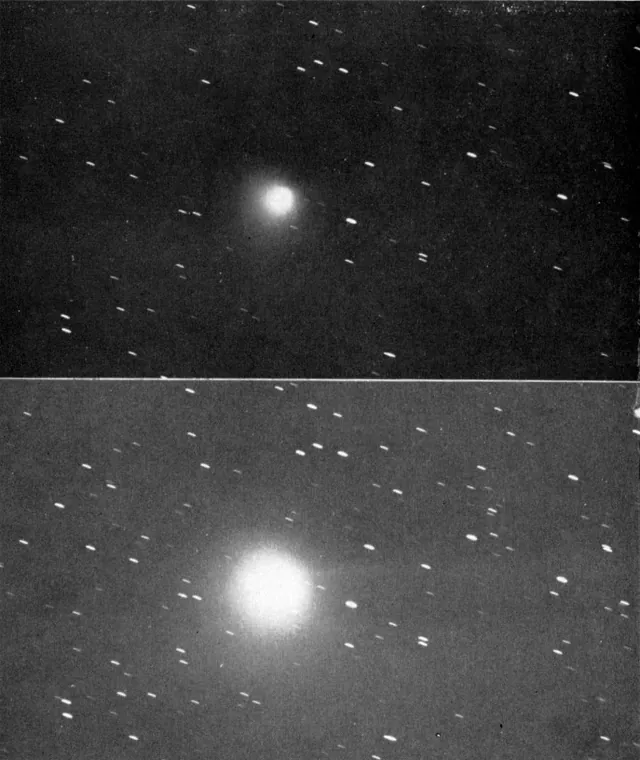
Pierre Méchain discovered the comet at Paris on 17 January 1786, but it was observed on only two nights, too few to work out an orbit. Caroline Herschel found it again at Slough, England, on 7 November 1795, her sixth comet, and Jean-Louis Pons found comets at Marseille in 1805 and on 26 November 1818. The astronomer Olbers suspected that the comets of 1786, 1795 and 1818 were one object.24
In 1819 Johann Franz Encke, a student of Gauss, confirmed this by calculating the comet’s motion under the pull of all the known planets except Uranus. He predicted its next perihelion for 24 May 1822: only the second successful prediction of a comet’s return. Encke himself always called it Pons’s comet, but it is named after him because he calculated its orbit.14
Meteors, activity and tail
Taurid meteors
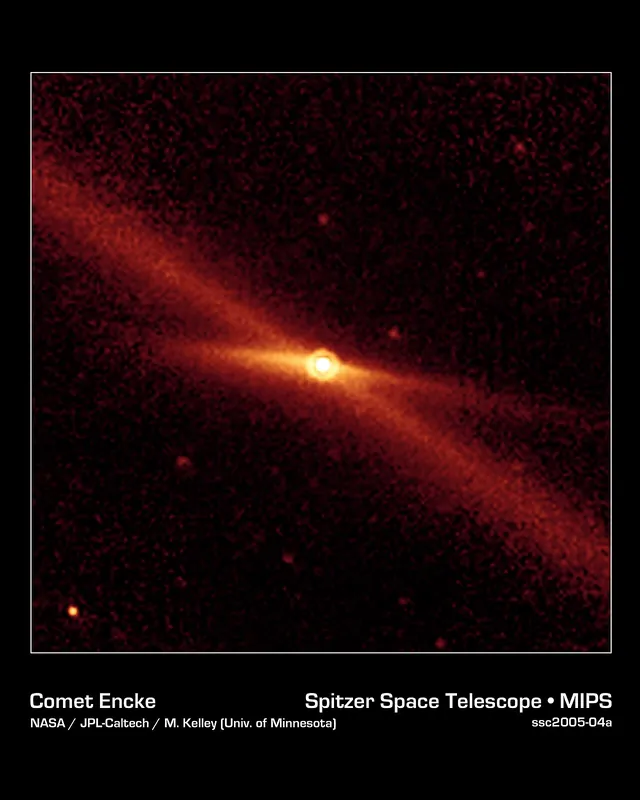
Encke is the parent comet of the Taurid meteors. The showers last about two months, peaking around 18 October and 5 November for the Southern Taurids and 12 November for the Northern Taurids. The meteors strike at about 104,600 km/h and are known for fireballs, which often appear around Halloween.17
Lopsided activity
Encke is much brighter before perihelion than after: Kresák noted in 1965 an excess of two to three magnitudes about three to four weeks before perihelion. Whipple and Sekanina suggested in 1979 that most of its gas comes from one hemisphere, whose pole points away from the Sun about three weeks after perihelion.4
Tail torn away, 2007
On 20 April 2007, with Encke 0.34 au from the Sun, a coronal mass ejection hit the comet and carried its plasma tail away, as recorded by the Heliospheric Imager on NASA’s STEREO-A. Interacting magnetic fields, rather than the pressure of the blast, probably tore the tail off, and a new one grew.56
Exploration
NASA’s Comet Nucleus Tour (CONTOUR) was to fly about 100–160 km from Encke on 12 November 2003 at 28.2 km/s, then visit comets Schwassmann–Wachmann 3 and d’Arrest. Launched on 3 July 2002, it fell silent when it fired its rocket motor to leave Earth orbit on 15 August 2002. An investigation board concluded it most likely broke up from plume heating during the burn.8
Spacecraft have watched Encke from afar. In 2013 it passed the Sun at the same time as the much-photographed comet ISON, and was imaged both by the STEREO solar observatory and by MESSENGER, which was orbiting Mercury and photographed the comet on 17 November 2013, during its closest approach to that planet.1
Quick answers
- How long is a day on Encke?
- A day on Encke lasts about 11.1 hours (rotation period of 11.083 hours listed by JPL).2
- How long does Encke take to complete one orbit?
- Encke completes one orbit in 3.30 years (about 1,210 days).12
- How far is Encke from the Sun?
- Encke is 0.34–4.1 au from the Sun (about 51–610 million km).2
Sources
- 2P/Encke — NASA Science
- Small-Body Database: 2P/Encke (orbit, physical parameters, discovery) — JPL Solar System Dynamics
- Small-Body Database Query: comets with orbital periods under 3.31 years — JPL Solar System Dynamics
- Comet Encke: an historical perspective (D. K. Yeomans, CONTOUR document set) — NASA Planetary Data System, Small Bodies Node
- Astronomy Picture of the Day, 3 October 2007: Comet Encke’s Tail Ripped Off — NASA, 2007
- Study of the April 20, 2007 CME-Comet Interaction Event with an MHD Model (Jia et al.) — arXiv, 2009
- Major Meteor Showers — American Meteor Society
- CONTOUR — NASA NSSDC
Figures checked against these sources in November 2026. Where a quantity is not known, it is left out rather than estimated.

