comet
Halley
Halley’s Comet, 1P/Halley, is the most famous comet of all and the first known to come back on a regular schedule. It swings around the Sun about every 76 years on a backward, steeply tilted orbit that reaches beyond Neptune. It last passed closest to the Sun on 9 February 1986 and, according to JPL’s orbit, will next do so on 28 July 2061.123
In 1705 Edmond Halley realised that the comets seen in 1531, 1607 and 1682 were one object and predicted its return in 1758; it was duly found on 25 December that year. In 1986 an international fleet of spacecraft met it, and Europe’s Giotto photographed its nucleus: a dark, potato-shaped body about 15 km long, spraying jets of gas and dust. Debris it sheds causes the Eta Aquariid and Orionid meteor showers.124567
The nucleus
Halley’s solid heart is an irregular, potato-shaped body. Giotto’s camera measured it at about 14.9 × 8.2 km, and the Vega images gave about 14 × 7.5 × 7.5 km; NASA rounds this to roughly 15 by 8 km. Its effective diameter is about 11 km. The Vega cameras timed its spin at about 53 hours, roughly 2.2 days.125
Its mass has never been weighed directly, but a 1988 study of the Vega and Giotto results estimated an average density of about 0.6 g/cm³, with a large uncertainty, from about 0.2 to 1.5 g/cm³. That is less than solid ice and fits ‘snowball’ models of a loosely packed nucleus, although the authors noted that a more compact ice structure could also match.8
Dark surface and jets
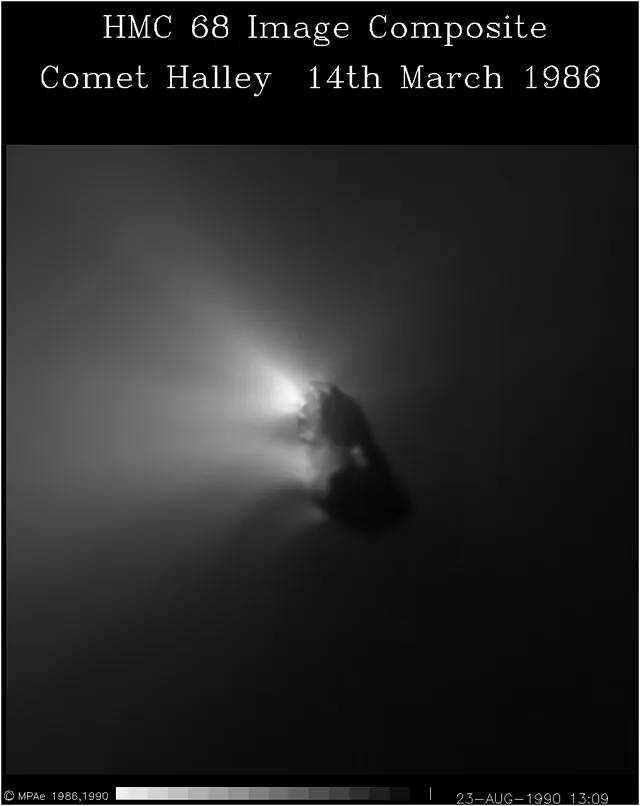
Halley is one of the darkest objects in the Solar System: its surface reflects only about 3 per cent of the sunlight that falls on it. Giotto’s images showed that only small parts of the surface were active. Most of it is covered by a crust of non-volatile material, and jets of gas and dust burst from the side facing the Sun.1410
Giotto’s instruments measured the size, composition and speed of dust particles streaming from the nucleus, and found the first evidence of organic material in a comet. The material Halley loses on each pass is a mixture of ice and rocky dust, which spreads out along its orbit and later reaches Earth as meteors.467
With each pass around the Sun a comet the size of Halley loses an estimated 1 to 3 m of material from its surface. NASA notes that an average periodic comet survives about 1,000 orbits; Halley has been on its present orbit for at least 16,000 years, yet shows no obvious signs of ageing in its recorded appearances.1
Orbit
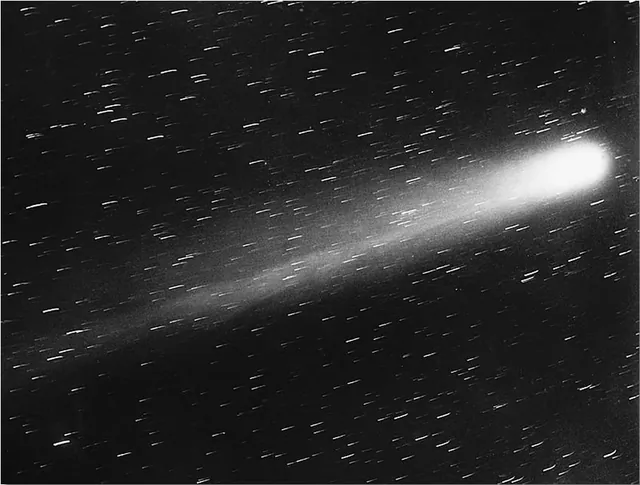
Halley travels around the Sun backwards, opposite to the direction of the planets, on an orbit tilted 18° to Earth’s, which is written as an inclination of 162°. The orbit is very elongated: at perihelion in 1986 the comet came within 0.587 au of the Sun, inside the orbit of Venus, and at aphelion in 1948 it was 35.25 au away, beyond Neptune.129
Its period averages about 76 years but changes from one return to the next as the planets tug on it. Measured between perihelia it has been as short as 74.42 years (1835–1910) and as long as 79.25 years (451–530). In 1986 it was moving at 54.55 km/s at perihelion, while at aphelion in 1948 it crawled along at just 0.91 km/s.1
Its closest recorded approach to Earth came on 10 April 837, at 0.033 au, when it shone at about magnitude −3.5. In 1910 it passed 0.15 au from Earth on 20 May. In 1986 it came no closer than 0.42 au, on its way out from the Sun, and was only slightly brighter than the Pole Star, its light spread over a much larger area.111
Halley’s prediction
Until Edmond Halley (1656–1742), comets were thought to pass through the Solar System only once. In 1705 he used Isaac Newton’s laws of gravity and motion to compute the orbits of several comets, noticed that the bright comets of 1531, 1607 and 1682 followed almost the same path, and proposed that they were one comet returning. He predicted that it would be back in 1758.1
Halley did not live to see it. The comet was first spotted on its predicted return on 25 December 1758 by Johann Georg Palitzsch, and became the first known periodic comet, named in Halley’s honour. The ‘P’ in its designation, 1P/Halley, marks a periodic comet, one that takes less than 200 years to orbit the Sun.12
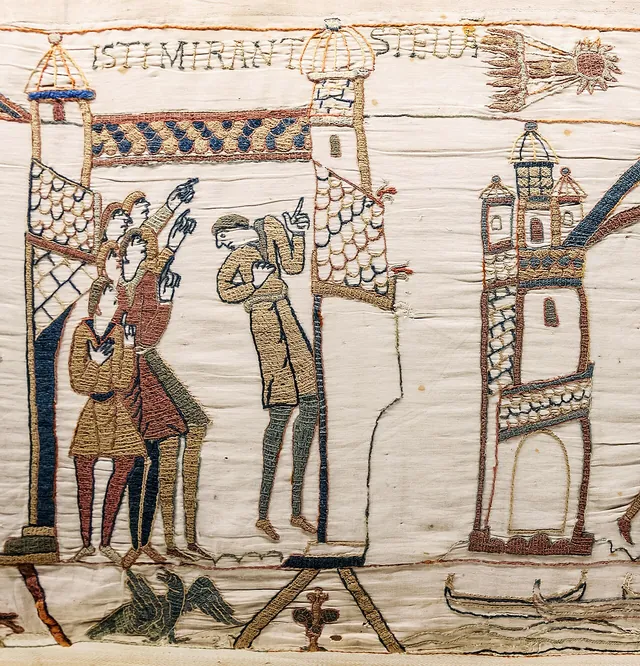
Astronomers have since linked the comet to observations going back more than 2,000 years. Orbit calculations carried back to 1404 BC reproduce ancient Chinese records over nearly two millennia, and JPL’s list of great comets includes its returns from 87 BC onwards. The 1066 appearance is shown on the Bayeux Tapestry, which tells the story of the Battle of Hastings.11112
Halley’s meteor showers
Each time Halley rounds the Sun its nucleus sheds ice and rocky dust, which spreads out along its orbit. Earth runs through this stream of debris twice a year, producing two meteor showers: the Eta Aquariids, which peak in early May, and the Orionids, which peak in mid-October. NASA calls both of them weak showers.167
Both are known for their speed. Eta Aquariid meteors hit the atmosphere at about 65.4 km/s and Orionids at about 66 km/s, fast enough to leave glowing trains that can linger for seconds to minutes. Under dark skies observers typically see about 10 Eta Aquariids an hour, and about 50 at the peak, and 10 to 20 Orionids an hour.67
The Halley Armada
When Halley returned in 1986 it was met by an international fleet that Japan’s space agency calls the Halley Armada. It included the Soviet Vega 1 and Vega 2, sent on after a successful Venus mission, Japan’s Suisei and Sakigake, Europe’s Giotto and the international ISEE-3/ICE spacecraft, while NASA’s Pioneer 7 and Pioneer 12 also gathered data.1413
The Vegas acted as pathfinders. Between 4 and 11 March 1986 their television cameras returned about 1,500 images, the best from 8,000–9,000 km, showing a dark, rotating nucleus. Suisei passed 151,000 km from the comet on 8 March, timing its rotation in ultraviolet light and tracking its output of water, while Sakigake measured the solar wind and magnetic field nearby.451314
Guided by the Vega results, Giotto flew in on 14 March 1986 at 68 km/s relative to the nucleus. Seconds before closest approach a dust grain of about a gram set it spinning and contact was briefly lost, but it passed within 596 km and kept returning data. Its camera took the first close-up images of a comet nucleus, revealing its size, shape and dark surface.4
Quick answers
- How dense is Halley?
- Halley has a mean density of about 0.6 g/cm³ (very uncertain: between about 0.2 and 1.5 g/cm³).8
- How long is a day on Halley?
- A day on Halley lasts about 2.2 days (53 ± 3 hours from the Vega images).15
- How long does Halley take to complete one orbit?
- Halley completes one orbit in about 76 years (75.9 years in JPL’s orbit; it has ranged from 74.4 to 79.3 years).129
- How far is Halley from the Sun?
- Halley is 0.59–35.3 au from the Sun (from 87.8 million km at perihelion to about 5.3 billion km at aphelion).12
Sources
- 1P/Halley — NASA Science
- Small-Body Database: 1P/Halley — JPL Solar System Dynamics, 2025
- Horizons System: osculating elements of 1P/Halley (solution JPL#75) — JPL Solar System Dynamics, 2025
- Giotto overview — ESA
- Television observations of comet Halley from Vega spacecraft — Nature, 1986
- Eta Aquariids — NASA Science
- Orionids — NASA Science
- Is the nucleus of comet Halley a low density body? — Nature, 1988
- Comet Fact Sheet — NASA NSSDC
- First Halley Multicolour Camera imaging results from Giotto — Nature, 1986
- Great Comets in History — JPL Solar System Dynamics, 2007
- The long-term motion of comet Halley — Monthly Notices of the Royal Astronomical Society, 1981
- SUISEI — JAXA Institute of Space and Astronautical Science
- SAKIGAKE — JAXA Institute of Space and Astronautical Science
Figures checked against these sources in November 2026. Where a quantity is not known, it is left out rather than estimated.

